Simon Russell Beale

The Choral

09/11/25

Cineworld, Ediburgh

The year is 1916 and in the fictional Yorkshire town of Ramsden, the local choral society is drawing up plans for its next production – but the depredations of war have taken their inevitable toll. Most of the village’s males are either away fighting or already dead. Yet, ironically, with so many of them buried on the Western Front, the most under-employed person on the society’s committee is Mr Trickett (Alun Armstrong), the local undertaker.

The choral’s leader, Alderman Bernard Duxbury (Roger Allam), is painfully aware that his own voice is at best, average but, as the man who provides most of the funds for these productions – and who badly needs distraction after the death of his own son in the trenches – he presses ahead with his plans for the next show, in which he fully expects to sing the lead. 

With the former musical director recently enlisted, Duxbury is keen to acquire the services of Dr Henry Guthrie (Ralph Fiennes) as his replacement, but here too lie problems. Guthrie makes no secret of the fact that he lived and worked for several years in (whisper it) Germany! There are many locals who feel this taints him irrevocably – and why does he spend so much time in the library checking out news articles about the German navy? But other members of the committee, Mr Fyton (Mark Addy) and Mr Horner (Robert Emms), have to grudgingly admit that the man is a real talent.

But once they have him on board, what piece of music can the society possibly perform? Nearly every title they come up with has been written by a German! Eventually, Guthrie alights upon The Dream of Gerontius by Edward Elgar, a suitably British composer. Duxbury gives the title role his best endeavour, but it’s clear that something’s not working…

This original screenplay by Alan Bennett, directed by Nicholas Hytner, could so easily be one of those traditional feel-good features, with the plucky inhabitants of Ramsden coming together to create a masterpiece and performing it to a packed auditorium of spellbound locals – and, while this isn’t so very far from what’s actually delivered here, the telling steers clear of schmaltz and offers something more gritty, nuanced and realistic. 

Guthrie enlists many of his performers from the local hospital where soldiers, recovering from their injuries, are happy to have something else to concentrate on. And for the role of Gerontius, how about young soldier, Clyde (Jacob Dudman)? He has returned to his hometown minus his right arm, only to find that the girl he loves, Bella (Emily Fairn), has fallen for another boy in his absence. If ever there was someone with a real understanding of loss, here he is – and luckily, he has a decent voice.

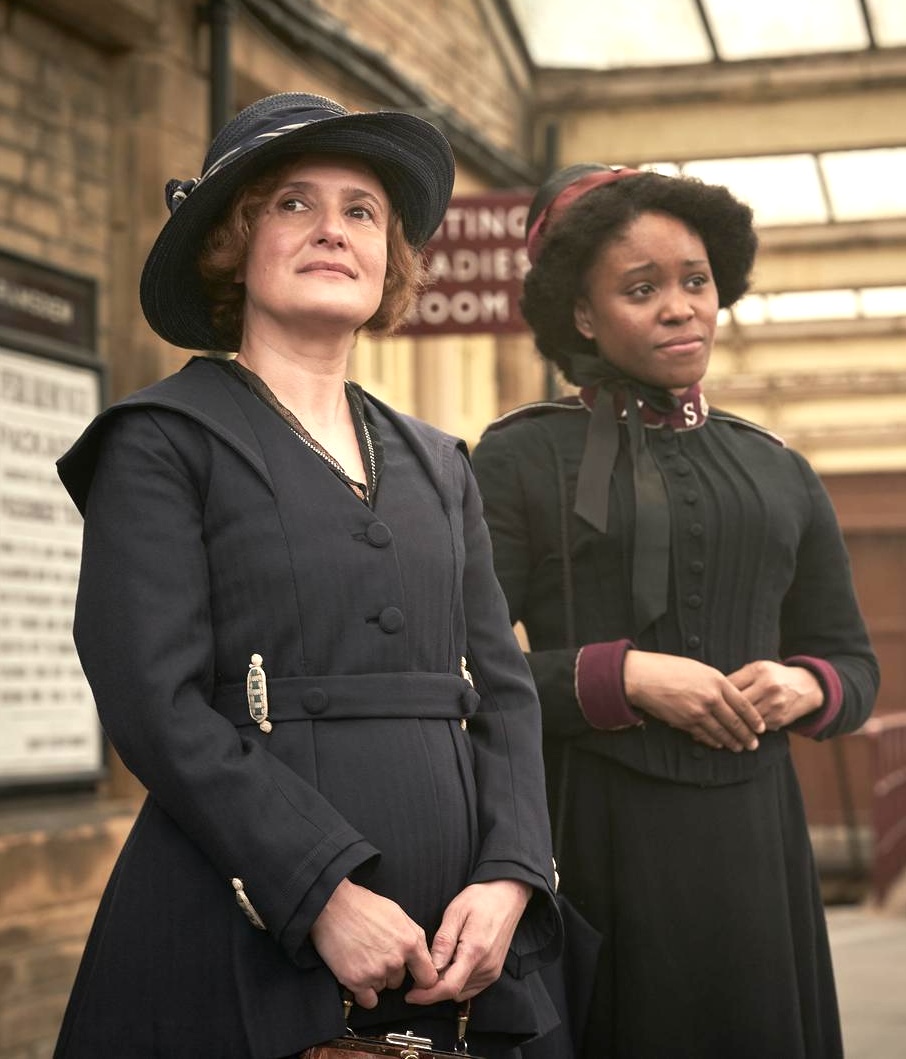
The production gradually starts to come together. When Salvation Army worker, Mary (Amara Okereke), innocently invites Sir Edward Elgar (Simon Russell Beale) along to see a rehearsal, nobody expects that he’ll actually turn up… or that he will turn out to be such a self-aggrandising bellend, maybe the one man who can stop the show in its tracks. There’s a genuine sense of jeopardy as realisation dawns.

But the element of The Choral that I find the most affecting is the depiction of the youths of the town, who use the whole enterprise as a means to meet members of the opposite sex, to have some fun and enjoy a laugh, all the time painfully aware that the clock is ticking, and that their 18th birthdays are fast approaching… along with their call-up papers.

The Choral is an engaging and melancholic piece that serves as a reminder of the awful injustice of war, and the healing power of communal art in times of tribulation.

4 stars

Philip Caveney

The Death of Stalin

23/10/17

If there was a prize for ‘Most Unlikely Subject for a Comedy’, the death of Russian premier Joseph Stalin would probably figure on the list of prime contenders. I mean, how amusing can that actually be? But Armando Iannucci clearly isn’t interested in such preconceptions. Against all the odds, he’s fashioned a funny and subversive entertainment from this unpromising source, based on the graphic novel by Fabien Nury.

It’s March, 1953, and Russia is cowering under the brutal regime of ‘Uncle Joe’ Stalin. People can be rounded up and shot for the most spurious of reasons – perhaps they’re intellectuals. Perhaps they belong to the wrong organisation. Perhaps their faces just don’t quite fit. The atmosphere of paranoia is amply portrayed in the film’s opening sequence, where radio director Comrade Andryev (Paddy Considine), is forced to restage a live performance by a symphony orchestra, simply because Stalin has phoned up and asked for a recording of it – and unfortunately no such recording has actually been made. ‘Don’t worry,’ Andryev assures his bemused audience as he ushers them frantically back to their seats. ‘You won’t be killed. I promise.’

Armando Iannucci’s comedy of terrors is a brave and wonderfully assured undertaking, finding comic mileage in the absurdity of day-to-day existence under the jackboot of a tyrant – and from the unexpected possibilities that are unleashed when that tyranny finally comes to an end. When Stalin unexpectedly drops dead from a heart attack, the various members of his government begin the complex task of jockeying for position in the new order and the results are a joy to behold.

The film has been criticised in some quarters for its lack of authenticity, but to be fair, there’s no real attempt to make it feel authentic. Characters talk in a mix of accents from regional British to (in the case of Steve Buscemi’s Nikita Krushchev) broad American, and the script misses no opportunity to go for a well-timed belly laugh.  

The cast is stellar – I particularly like Simon Russell Beale as head of the secret police, Lavrentiy Beria, a smiling assassin who hides his vile nature under a mask of cheerful bonhomie. Jeffrey Tambour is also excellent as Georgy Malenkov, Stalin’s second in command, who suddenly finds himself simultaneously having to lead the country in its collective grief and incapable of coming to a rational decision about anything. Rupert Friend has a lot of fun with the role of Vassily, Stalin’s loose-canon, vodka-swilling son. But the film’s undoubted comic highlight is Jason Isaacs as straight talking ‘Marshall of the Soviet Union’, Georgy Zhukov, the hilarity aided no end by the fact that he talks with a pronounced Yorkshire accent. I’ve no idea why that’s so funny, it just is.

Okay, so this isn’t quite the comic masterpiece that some have dubbed it. The film suffers somewhat from the age-old problem of having nobody in particular to root for, since they all appear to be lying, double-dealing creeps – unless of course, you count Olga Kurylenko’s Maria Yudina, a concert pianist who seems to be the only person in the film brave enough to speak her mind about Stalin’s cruelty; but hers is a cameo role, acted out on the sidelines. The only other character we remotely care about is Stalin’s hapless daughter, Svetlana (Andrea Riseborough), who can only watch the carnage that unfolds in the wake of her father’s death and hope against hope that she’ll somehow make it out of there alive.

Weighing in at a relatively sprightly 106 minutes, The Death of Stalin is a clever and accomplished movie, well worth investigating. This is Iannucci playing to his strengths as a political satirist and mostly coming up with the goods. Interesting though, that despite a script peppered with crackling dialogue, the film’s funniest scene is an entirely visual one. Go figure.

4.2 stars

Philip Caveney