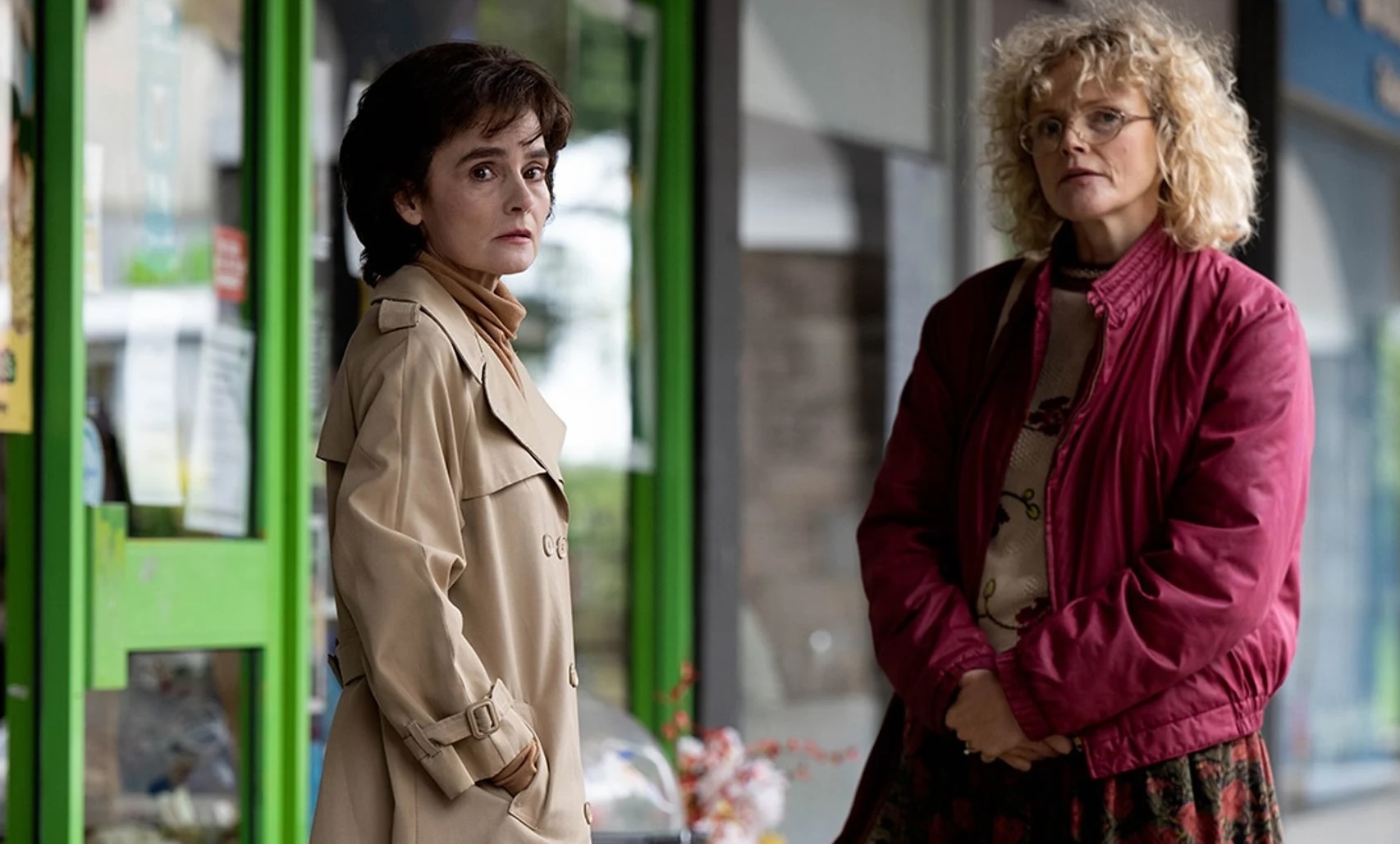
Shirley Henderson

I Swear

10/10/25

Cineworld, Edinburgh

I Swear follows a tried and tested feel-good formula. You know the one: a vulnerable protagonist struggles to live with a misunderstood condition until their saviour arrives in the shape of a kind and unassuming friend, allowing them to flourish. So far, so seen-it-all-before. But writer-director Kirk Jones gives the format a kick in the baws with this tale of grit and humour in the face of great adversity.

The film is elevated by two things: an extraordinary true-life story and a stellar cast. The central character is John Davidson, an MBE-decorated Scottish activist, who lives with Tourette syndrome and campaigns to raise public awareness. Played here by Scott Ellis Watson (as a teenager) and Robert Aramayo (as an adult), he lights up the screen, his frustration and sadness leavened by his innate sweetness – and the undeniable funniness of his inappropriate comments and sweary outbursts. “I’m a paedophile,” he says at a caretaking job interview, when informed that the role includes setting up a hall for youth groups to use. The same prospective employer asks him about his tea-making skills. “I’m good,” John assures him, “I use spunk for milk.”

Despite the jocularity, Jones’ screenplay never mocks John, never laughs at him or belittles what he has to deal with every day. Instead, it’s an honest account of a young man floundering in a hostile world, rescued from despair by finding acceptance. John’s protector is his pal’s mum, Dottie (Maxine Peake), a mental health nurse with a terminal cancer diagnosis, who takes John in. While his own mum, Heather (Shirley Henderson), is uptight and puritanical, embarrassed by his language, making him sit apart from the family to eat because of his tendency to spit, Dottie ignores his tics and profanity, welcoming him at her kitchen table, telling him not to apologise for things he can’t help. She encourages him to see a future for himself: one where he can hold down a job and live independently.

Another positive influence in John’s life is his janitor boss, Tommy (Peter Mullan), who champions his young assistant, serving as both mentor and father figure. It’s Tommy who tells John he needs to raise awareness of his syndrome: “The problem isn’t Tourette’s; it’s people not knowing about Tourette’s.” It’s Tommy who stands up for John in court, when the judge seems ready to penalise him for contempt, unable to accept that his shouting is involuntary.

At the end of the movie, we see the real-life John, a familiar figure to those of us old enough to remember the 1989 BBC documentary, John’s Not Mad, which featured the sixteen-year-old Davidson. I’m a little confused as to why this influential TV programme is never mentioned in the film, as it must have made him something of a local celebrity and changed the way he was perceived. Still, he’s been spreading the word ever since, organising conventions, giving presentations to school kids and police officers, making sure that everyone knows about Tourette syndrome. We’ve no excuse for condemning those living with it to the years of misery John himself endured.

Engaging, enraging and hilarious, I Swear is something of a triumph.

As John himself might say, “Fuck off to the cinema and watch it, ya wankers.”

4.3 stars

Susan Singfield

The Trouble with Jessica

06/04/24

Cameo Cinema, Edinburgh

The Trouble With Jessica is at the Cameo tonight, and so are director Matt Winn and lead actor Shirley Henderson, here for a Q&A. The place is bustling. Indeed, the only seats we can find are in the very front row, but that’s okay. We settle down in the comfy velvet chairs and stretch our legs out, making the most of the space.

TTWJ is essentially a comedy of manners, drawing on elements of farce. It goes to some dark places – including suicide, depression and rape – but always (trust me) with humour, eliciting belly laughs from tonight’s audience. Winn treads that precarious line well.

Sarah (Henderson) and Tom (Alan Tudyk) have invited their best friends over for what Sarah dramatically announces will be the last dinner party they’ll host in this house. Tom’s latest architectural project has flopped, and they need to sell their beloved home to save themselves from going under. But Beth (Olivia Williams) and Richard (Rufus Sewell) have brought along an extra guest, a mutual ‘friend’ called Jessica (Indira Varma), whose recent memoir has become a bestseller. Sarah is not pleased. She’s no fan of Jessica’s and, as soon as the titular character begins to speak, it’s easy to see why. She’s awful.

And then she kills herself in Sarah and Tom’s garden.

Sarah is furious. The house sale might be jeopardised! Her kids might have to go to state schools! They might have to live in a rubbish part of London! There’s nothing for it. They’ll have to move the body, pretend the suicide occurred elsewhere…

Through all the deliciously heightened nonsense that follows, the only thing I find hard to believe is that Sarah and Beth would keep up their friendship with Jessica. She doesn’t seem to have any redeeming features. She’s slept with two of Beth’s boyfriends and flirts incessantly with Tom. She’s rude and demanding and I don’t know anyone who’d put up with her.

That aside, I enjoy this film.

There is a charming cameo from Anne Reid as a nosey neighbour, and a wonderfully sinister series of scenes with Sylvester Groth as the potential house buyer. Jonathan Livingstone and David Schaal are very funny as PCs Terry and Paul, working-class foils to all the hoity-toity hogwash (although PC Paul recognises a decent clafoutis when he sees one).

It’s a stylish movie. The camera often lingers on the loveliness of the house, like an estate agent’s puff piece, reminding us of what’s at stake. Yes, Sarah and Tom are very privileged and it’s easy to mock their first world problems – but no one wants to lose what they have accrued; no one wants to fail, to have to step backwards. Of course they’d probably be fine if it all went tits up – but it’s no surprise they don’t want to put that theory to the test. It’s more relatable than its milieu might make it sound.

I like the title cards that act as introductions to the various ‘chapters’, each beginning The Trouble With… Tension mounts as the quartet struggle to come to terms with what they’re doing, as well as to manage the practicalities. Henderson in particular is riveting, her brittle capriciousness a delight to watch.

The Q&A is interesting too; it’s good to find out a little more about the process – especially Winn’s composition of the score – and it’s always a thrill to be in the same room as the people you’ve just been watching on the screen.

Once home, I find myself googling clafoutis recipes. Guess what we’re having for pudding tonight?

4 stars

Susan Singfield

Greed

22/02/20

Steve Coogan’s regular collaborations with director Michael Winterbottom always yield interesting results. There’s the iconic 24 Hour Party People, the various iterations of The Trip, the splendidly labyrinthine A Cock and Bull Story – but none of these can quite prepare a viewer for the caustic evisceration of venture capitalism that is Greed. The film isn’t subtle in its approach; on the contrary, it goes in with all guns blazing and neatly obliterates its chosen targets.

Coogan plays Sir Richard ‘Greedy’ McCreadie, a man who has positioned himself as a major player in the fashion industry, mostly by virtue of being meaner and crueller than the competition. As he approaches his sixtieth birthday, he finds his image smeared by bad publicity, so he decides to throw a Gladiator-themed birthday bash on the Greek island of Mykonos. He invites his ex-wife – and titular head of his company – Samantha (Isla Fisher), his new partner (Shanina Shaik), his aged mother (Shirley Henderson), his son, Finn (Asa Butterfield), and a whole host of VIPs. The event will be staged as a gladitorial extravaganza, which naturally involves building a Roman ampitheatre and will even feature a lion called Clarence. What could go wrong?

Through the ensuing confusion wanders the hapless Nick (David Mitchell, pretty much playing himself). He’s Sir Richard’s chosen biographer, clearly struggling to put together a sympathetic portrait of an odious subject – though he does find some solace in his brief exchanges with personal assistant, Cathy (Pearl Mackie), who has her own reasons for hating her boss. McCreadie is a man who complains that the local beach is occupied by ‘unsightly’ Syrian refugees, a man who – instead of paying them to make themselves scarce (which would be bad enough) – tricks them into working as his waiters, complete with Roman slave costumes. With his slicked back grey hair and outlandishly capped teeth, McCreadie is quite clearly styled on Sir Philip Green, right down to the appropriation of his workers’ pension funds, the profits from which go straight into the purchase of yet another luxury yacht. If anybody on the planet had an ounce of sympathy left for Green, this film will neatly extinguish it.

Winterbottom (who also wrote the screenplay) makes no bones about his utter contempt for his subject. Though he examines McCreadie’s formative years, when he was card-sharping his way through boarding school, there’s never any attempt to create sympathy for the character. He is, quite simply, the product of privilege – an arrogant, hateful man addicted to the aquisition of more and more wealth, for no better reason than the fact that he has a natural ability for it. Though Coogan often has some amusing lines, its easier to laugh at McCreadie than with him.

Greed has been widely criticised for a scattershot approach to its central subject, but it’s fueled by an almost incandescent sense of anger, a disgust that creatures like McCready are allowed to exist and prosper in a world that ought to have the sense to depose them The closing credits offer a horrifying list of statistics about the world’s wealth, but they are hardly necessary. The film has already instilled a feeling of utter shame.

4.7 stars

Philip Caveney


Stan & Ollie

18/12/18

I’m no Laurel and Hardy aficionado, but of course I know who they were and the nature of their work; I haven’t spent my life under a stone! And I’m a fan of clowning, generally, and a sucker for a biopic. So, off I go to the local multiplex, to catch a preview screening of this much-talked-about movie.

It’s a gentle film, lovingly created, with two stellar performances at its heart. John C Reilly (Hardy) and Steve Coogan (Laurel) are note-perfect in their roles, embodying their real-life counterparts with obvious relish.

This is a bittersweet chronicle, detailing the latter years of the duo’s partnership. Their glory days behind them, they leave Hollywood to embark on a tour of Britain, hopeful that this will entice an eminent producer to get behind their latest movie idea: a comic retelling of Robin Hood. But audience figures are low, even in small, regional theatres, and the pair are left to face the fact that their careers are largely history.

It’s beautifully played, and the pathos is at times unbearable, but I can’t help feeling it’s all a little… subdued. I’d like everything dialled up a notch, and more focus on the emotional consequences of what happens to the pair. The script (by Jeff Pope) is terribly restrained; I’d prefer it if the leash were loosened just a tad.

Still, this is eminently watchable, with some cracking moments to relish. The interplay between the comics’ wives is particularly enjoyable: Lucille Hardy (Shirley Henderson) and Ida Kitaeva Laurel (Nina Arianda) were evidently as chalk and cheese as their husbands, and their reluctant friendship is a highlight of the film.

A good movie, then, but not a brilliant one, despite those fine impersonations of two comedy legends.

3.8 stars

Susan Singfield