Sharon Small

Nye: National Theatre Live

27/04/24

Cameo Cinema, Edinburgh

National Theatre Live has chosen a propitious subject for its hundredth project. 

Nye, written by Tim Price and directed by Rufus Norris, is the story of Aneurin ‘Nye’ Bevan, the Labour MP who conceived and delivered the National Health Service. I’m somewhat embarrassed to admit that beyond that one incredible achievement, I have no other knowledge of the man’s life, so this feels like the perfect time to find out more about him.

When we first encounter Nye (Michael Sheen), he’s a patient in one of the National Health hospitals he built. Accompanied by his ever-protective wife, Jennie (Sharon Small), and his best friend, Archie (Roger Evans), Nye has just undergone a routine operation for a stomach ulcer but it turns out there’s something much more serious causing the awful pains in his gut. Zonked out on drugs and hallucinating, his hospital bed takes on a magic carpet-like ability to whisk him back down the years to revisit key scenes in his life.

Vicki Mortimer’s ingenious set design is mostly achieved using curtains. They sweep from side to side, they descend from on high and sometimes they even rise magisterially from the floor, to alternatively create new spaces and reveal hidden depths within the Olivier’s expansive stage. Though Sheen remains dressed in his striped pyjamas throughout, there’s never any doubt as to where (and when) a particular memory is located. 

We see Nye in childhood, afflicted by a stutter and brutalised by a sadistic teacher, but uniting his classmates in a show of defiance. We see him and Archie as older children, discovering the wonders of a library where… unbelievably…books can be borrowed and read – for free! And we see an older Nye, a fledgling politician now, arguing with his sister, Arianwen (Kezrena James), over the care of their father, David (Rhodri Meiler), a former miner succumbing to a slow and horrible death from black lung.

Later, Nye crosses swords with a bombastic Winston Churchill (Tony Jayawardena), who is violently opposed to handing out free health care to the oiks. Then, under a new Labour government, he accepts an offer from Clement Attlee (Stephanie Jacob, silently gliding around the stage behind a desk like a Doctor Who villain) to become Minister for Health – and Housing.

If certain elements of Nye’s life have been simplified for dramatic purposes (his huge collection of siblings is whittled down to a single sister, for instance), it matters little. The central premise of this story is so huge that it can’t be overburdened with detail.

Sheen is terrific in the central role, giving Nye an understated and strangely vulnerable charm. Small is also marvellous as the firebrand, Jennie Lee – so good in fact that she should perhaps be given a little more to do, but that’s only a niggle. A sprightly rendition of Get Happy with Sheen singing and dancing his way around a busy hospital ward conveys Nye’s playful, engaging nature.

I love Jon Driscoll’s projection design, which utilises cinematic techniques. A key scene, depicting the death toll on the UK population after the end of the war, features hordes of monochromatic figures shambling helplessly towards the camera, only to morph into actual actors, appearing as if by magic, pleading for our help. Another sequence has Nye being scrutinised by the medical profession, scores of masked faces staring blankly at him across an abyss of prejudice. Who is this upstart who wants to change everything?

The play’s climax is almost unbearably poignant and I’m left sitting in the semi-darkness, tears in my eyes, marvelling at the sheer scale of one man’s glorious ambition. It seems particularly significant that. as I write this, a Tory government (which has spent so much time and effort trying to dismantle Aneurin Bevan’s wonderful achievement) looks set to be finally given its marching orders. Please let that happen!

Nye will doubtless be given other screenings soon, so keep an eye out for more opportunities if you missed it this time around. This is National Theatre Live at its most creative and enjoyable.

4.7 stars

Philip Caveney
Good: NT Live

28/04/23

Cameo Cinema, Edinburgh

We miss the first screening of Good due to health issues and are resigned to our fate, but happily The Cameo Cinema offers this encore screening just as we’re scratching our heads and wondering what we should see tonight.

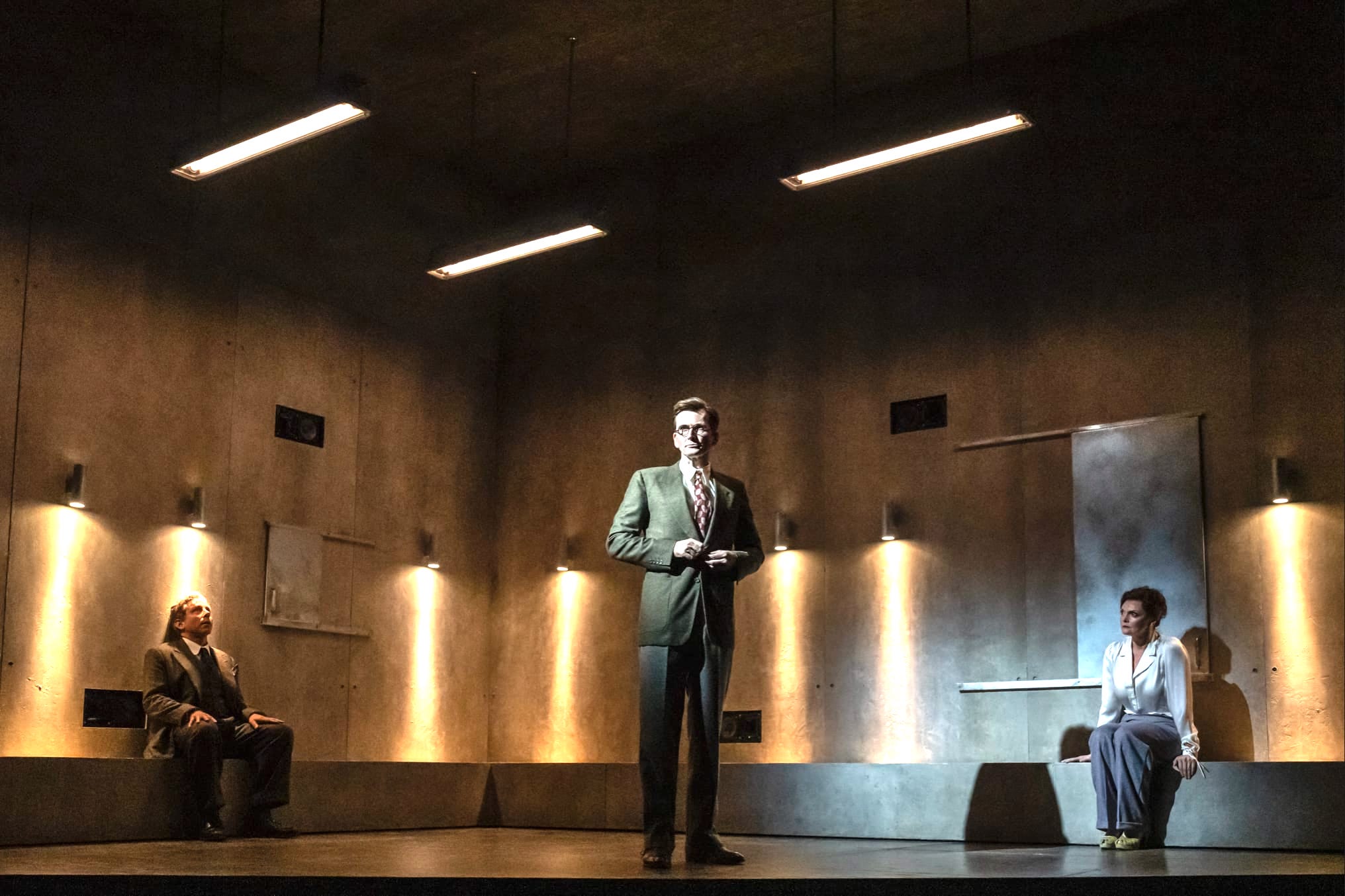
Written by the comparatively little known C P Taylor (who tragically died soon after Good had its London premiere in 1981) this excoriating piece of theatre feels weirdly askew from the opening scene. Why has set designer, Vicki Mortimer opted to use so little of the Harold Pinter Theatre’s stage, confining the action to a narrow, wedge shaped, performance space, which only really opens up at the play’s startling conclusion?

Well, it’s this confined quality which emphasises the chilling claustrophobia of the piece, the story of a man consumed by his own hubris and his willingness to repeatedly spin his own heinous crimes as the actions of a ‘good’ person.

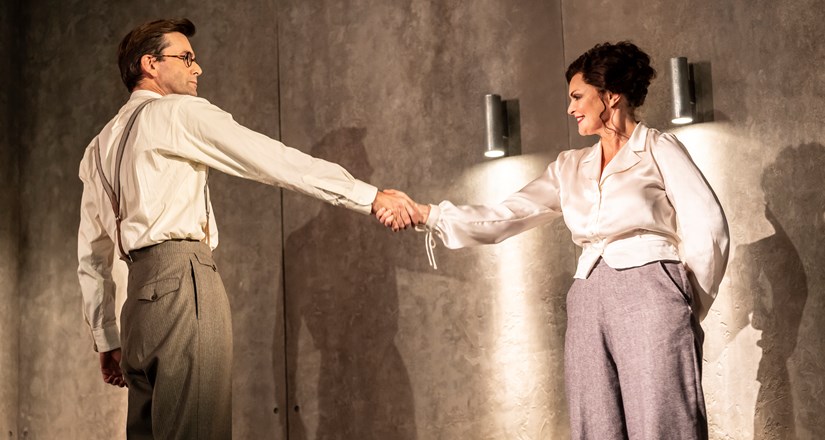
The man in question is Halder (David Tennant), a German literary professor whose published works catch the eyes of important people in the rising Nazi party, and who is invited to join their swelling ranks. But there’s an obvious problem with this suggestion: Halder’s best friend, psychiatrist Maurice (Elliot Levey), is Jewish and doesn’t see why he should be expected to hide the fact. Meanwhile, Halder is struggling to maintain a marriage to his hapless wife, Helen (Sharon Small), whilst looking after his mother, who is stricken by dementia – and he’s also starting an affair with one of his students, Anne. How is he going to square all these issues to his own satisfaction whilst proudly taking his place in the ranks of the SS? And at what point will he decide that he’s being asked to go too far?

Tennant, making his long awaited return to the West End, is incredibly assured in the complex role of Halder, switching from slyly funny to chillingly mercenary with aplomb. At one point, he even sings and dances with absolute authority, personifying the charmer with a steely inner self. Levy too is excellent, both as Maurice and in the other roles he inhabit, but for me it’s Small who really commands the stage, flicking effortlessly between her three female characters – and the persona of an alpha male SS commandant – simply by changing her voice and her posture. It’s a superbly nuanced performance that ensures I’m always fully aware of who she is embodying at any given moment.

Essentially a three-hander (although the play does feature other performers in its final stages), Good is an ambitious and original piece of theatre that makes me wonder what Taylor might have achieved if only he’d lived longer.

4 stars

Philip Caveney

Still Alice

25/09/18

King’s Theatre, Edinburgh

Still Alice started life as a novel, self-published by Harvard neuroscientist Lisa Genova in 2007. It tells the story of Dr Alice Howland, a – wait for it – Harvard neuroscientist with young onset dementia, charting the impact of this terrible disease on both Alice and her family. Its success led first to commercial publication, and then – such was its appeal – to adaptations for both stage and screen. The movie version (which we reviewed in 2015: https://bouquetsbrickbatsreviews.com/2015/03/17/still-alice/) secured Julianne Moore an Oscar, and it’s clear that the eponymous Alice requires a strong performer.

In fact, this touring production by the Leeds Playhouse utilises two strong performers in the central role. This is playwright Christine Mary Dunford’s masterstroke: Alice’s inner self (Herself) is played by Eva Pope, while her physical manifestation belongs to Sharon Small. The two start off almost identical, dressed in the same clothes, mirroring each other’s moves. Herself does not have much to say, because Alice can articulate her thoughts. As her condition worsens, however, Herself becomes louder and more vocal, speaking up when Alice can not. They become separate entities with bigger spaces between them, but Herself is never less than nurturing and protective. It’s an effective device, performed in an understated and unfussy way that makes it really powerful.

Of course, Alice is not the only one affected by her diagnosis and deterioration: the play focuses too on her family’s struggle to deal with this new version of their wife and mom. She’s no longer a fit and healthy high-achiever, a Harvard professor with an enviable career. Her son, Thomas (Mark Armstrong), who’s about to become a father, is especially troubled: he wants his mother back. He’s confused and angry; refuses to accept reality. Her daughter, Lydia (Ruth Ollman), seems to be coping better. She hasn’t always seen eye to eye with Alice (she’s chosen acting over academia, and Alice thinks this is a mistake), but she’s able to support her mother through her illness with an open mind and gentle acceptance.

But it’s Alice’s husband, John (Martin Marquez), who bears the brunt of the responsibility, and he does his best to care for his wife, while – sensibly – ensuring he looks after himself too. He’s a research scientist, and he doesn’t let his home life impinge on his career. Why should he? Alice has always been a careerist too; she wouldn’t want him to abandon his passions. This tension is beautifully realised, with sensitive direction from David Grindley, and a subtle, convincing performance by Marquez.

The set, designed by Jonathan Fensom, manages to be both naturalistic and metaphorical: we start with a cluttered stage, filled with the detailed trappings of a family home – a fitted kitchen, a three-piece suite – but, slowly, scene by scene, this paraphernalia is stripped away, until we’re left with an empty space, all we – and Alice – can see reduced to the present moment: two chairs, a handsome man with a checked shirt. What’s startling is that this is not an unhappy place; Alice has found peace and acceptance of a sort.

It’s a heart-breaking and thought-provoking piece, with much to recommend it. If I’ve a quibble, it’s the moment when Alice delivers a speech at an international conference. I want this to be more of a battle cry, or at least to illuminate something new; it doesn’t tell us anything we haven’t already learned by this point in the play. It’s a climactic scene,  pregnant with possibility, and I don’t feel it achieves all that it could.

Still, that doesn’t prevent this from being an important piece of theatre, and well worth going to see. It’s at the King’s until the 29th September, and will be at the Theatre Royal in Glasgow from the 13th to 17th November.

4.3 stars

Susan Singfield