
Seth Rogan

Dumb Money

23/09/23

Cineworld, Edinburgh

How soon is too soon? The real life tale of the GameStop share crisis happened during lockdown, when most of us were more concerned about where we were going to get toilet paper from than in following the details of a story about share dealings, and – while it might have been a big deal across the water – it didn’t warrant much more than a passing mention in the British press.

Pitched as a sort of David and Goliath story, Dumb Money relates the tale of Keith Gill (the ever likeable Paul Dano), a small time, blue-collar share dealer, who advertises himself as ‘Roaring Kitty’ and who has a predilection for wearing T-shirts with pictures of cute cats on them. Gill has a regular spot on Reddit, where he recommends likely investments to a group of followers. He has recently decided that struggling bricks and mortar computer outlet GameStop is worth saving – so much so, he’s willing to gamble his life savings on it and to encourage his viewers to take a punt.

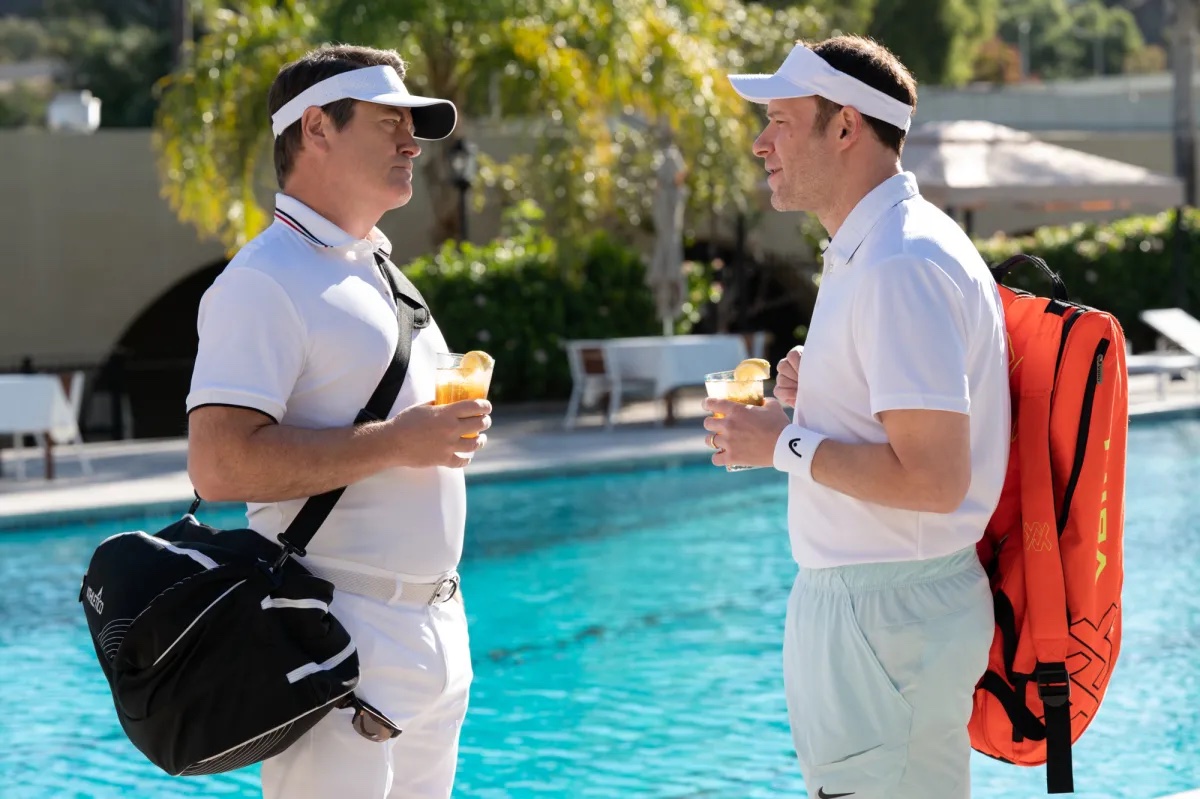
These include hospital worker, Jenny (America Ferrara), and actual GameStop employee Markus (Anthony Ramos). But as the company’s share price begins to rise, a lot of others decide they want to get in on the action and throw in everything they can spare. What was at first a steady rise suddenly goes up like a rocket. But several hedge fund companies – including Melvin Capital, led by Gabe Plotkin (Seth Rogan) – have already invested millions into GameStop, in the confident belief that they will trigger a ‘short squeeze’ scenario. They fully expect the company to go bust and their hedge funds to make millions from its demise. Now, thanks to Gill, they stand to lose everything.

Director Craig Gillespie, who previously gave us the brilliant I, Tonya, does his best to make all this work, but to somebody like me, who has no knowledge (or indeed interest) in the subject of stocks and shares, it’s sometimes hard to understand exactly what’s going on here, or more importantly, why I should care. Perhaps Dumb Money ties in to the American infatuation with the idea of making something from nothing, of taking on the big players and equating money with success.

Every character that appears onscreen is accompanied by a credit informing viewers of their net worth, and the loveable maverick quality that Gill exhibits feels somewhat overstated when we learn that, as a result of all these shenanigans, he himself is now a millionaire.

Though it’s fitfully amusing and occasionally generates some genuine laughs, Dumb Money never really settles into its stride. When the big players rig the game so that small investors can no longer participate, we’re probably supposed to be angry at the fact that there’s no such thing as a level playing field – but the whole story takes place in a world that seems light years away from our experience.

Consequently, it’s hard to feel involved. And therein lies the problem. Those with an interest in such matters may have a much better time with Dumb Money than I do.

2.8 stars

Philip Caveney

Teenage Mutant Ninja Turtles: Mutant Mayhem

02/08/23

Cineworld, Edinburgh

Those sewer-dwelling, pizza-devouring ‘heroes in a hard-shell’ return to the big screen, courtesy of Seth Rogen and his team and it’s clear from the outset that the key word here is Teenage. The word Ninja has also been reinstated – those in the UK with long memories may recall that, for a while, Hero was used as a replacement. How times change. This film only has a PG certificate but it doesn’t hold back on the violence – and clearly the message isn’t getting through. The afternoon screening I attend features quite a few parents trying to handle confused-looking children, who clearly aren’t sure what to make of what’s happening up on the big screen.

TMNT:MM begins with a pre-credit sequence explaining the origin stories of Leonardo (Nicholas Cantu), Donatello (Micah Abbey), Michelangelo (Shamon Brown Jr) and Raphael (Brady Noon). They begin life as part of a disrupted science experiment, and are accidentally flushed down the drain into the sewers. (We’ve all been there.) Down in those malodorous depths they are adopted by friendly rat, Master Splinter (Jackie Chan), who is also affected by the chemicals they’ve absorbed and, like them, grows to be bigger than he should be. After a disastrous attempt to introduce his ‘family’ to human society, Splinter decides that people aren’t quite ready to embrace something so different so he keeps the foursome hidden below ground – but he does give them intensive martial arts training.

Now they are teenagers and itching to be out in the real world, where they can chase after girls and watch Ferris Bueller’s Day Off (it’s pretty clear what decade we’re in). When they see teenager April (Ayo Edebiri) being robbed of her scooter, they cannot stop themselves from helping her out, swinging into action and despatching a whole gang of tough customers with ease. But this starts a complex chain of events that will eventually lead to them taking on mutant master villain, Superfly (Ice Cube), who has dedicated himself to the task of eradicating human life from the face of the planet.

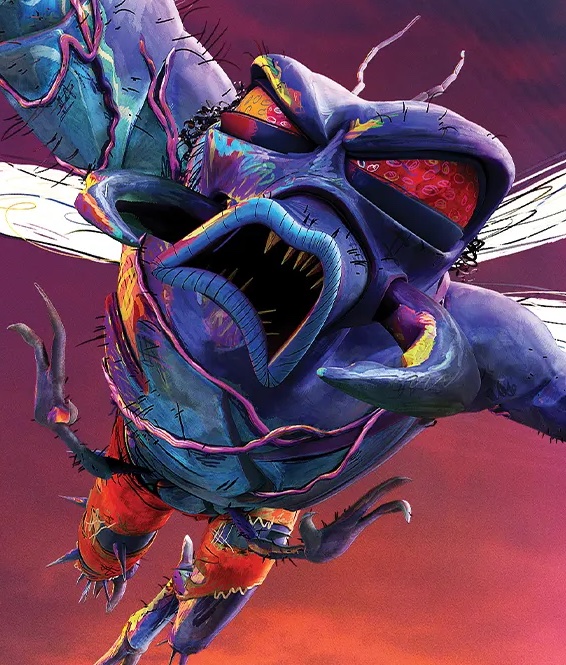
The first thing to say here is that the animation style is ravishing, borrowing some of its look from the Spider-Man animations, perhaps, but adding its own expressionistic dazzle into the process. Occasionally, the four heroes have the solidity of stop-frame animation characters; at other times, they are more fluid, more experimental – and there’s even a delightful childhood experience rendered as crayons on paper. Co-directors Jeff Rowe (of The Mitchells Versus the Machines) and Kyler Spears attempt to keep everything coherent and mostly succeed.

The script, written by Rogan and Evan Goldberg (in collaboration with several others), is obsessed with the horrors of puberty and never misses the opportunity to go for cheap belly laughs. (Want to see somebody puking uncontrollably? It’s here.) This occasionally feels like a bunch of older guys desperately trying to reconnect with their own teenage years and, inevitably, not all of the quips hit their targets as solidly as they might. It’s also true that some of the action sequences – particularly an extended set piece towards the film’s conclusion – are a little muddled at times. Who’s hitting who? With what? And… why?

Reservations aside, I have a lot of fun with this, despite the fact that I’m not a former Turtles fan and barely gave them a glance back in the 80s. It has some interesting points to make about inclusivity but it doesn’t hammer me over the head with them. However, those looking to entertain little ‘uns in the school break should be warned: unless you want to explain a giant rat snogging an enormous cockroach, this may not be the film you’re looking for. Just saying.

Oh yes, stay in your seats for the post-credit bit, which seems to suggest a follow-up is in the works.

3.7 stars

Philip Caveney

The Fabelmans

28/01/23

Cineworld, Edinburgh

In the wake of the pandemic, several film directors seem to be have been inspired to take a closer look at at their own roots. Already this year we’ve had Sam Mendes’s Empire of Light, Alejandro G Innarutu’s Bardo and James Gray’s Armageddon Time – though good luck tracking down any cinema or streaming service showing the latter.

Now comes the turn of Steven Spielberg, arguably one of our greatest living directors, who is clearly looking to settle some old ghosts with The Fabelmans. The film is preceded by a short clip featuring an avuncular-looking Spielberg, humbly thanking the audience for coming to the cinema to see his latest offering. What we are about to watch, he tells us, is his most personal film ever.

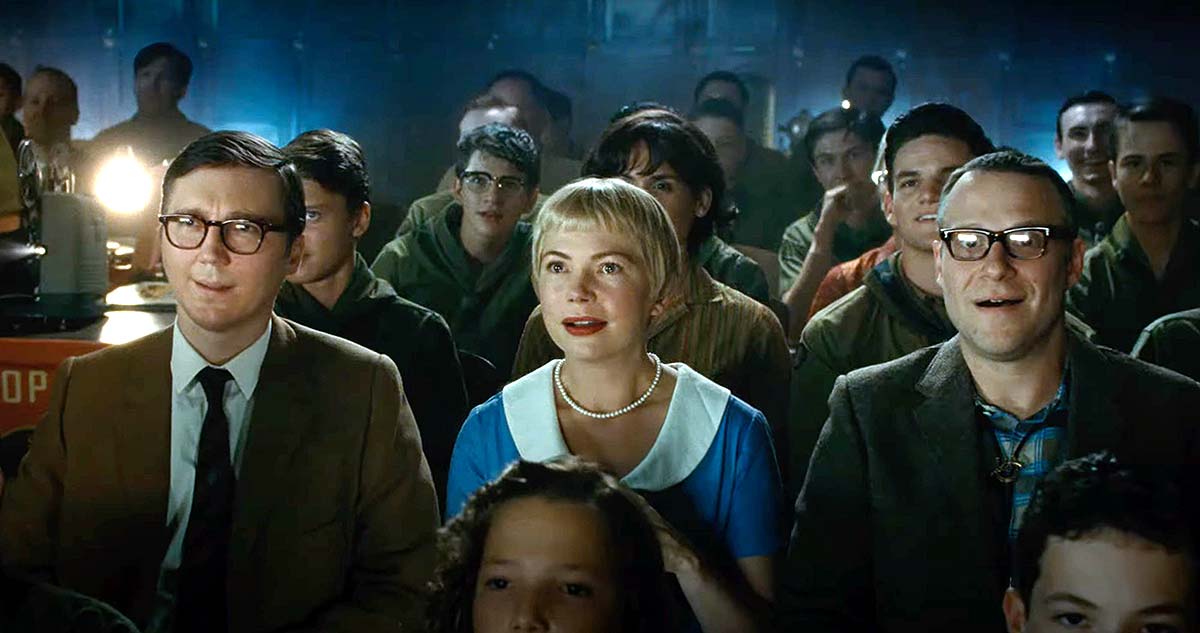
It begins in 1952, when the young Sam Fabelman (Mateo Zoreyan) goes to his very first picture show along with his parents, Burt (Paul Dano), a computer programmer, and Mitzi (Michelle Williams), a talented pianist. Sam is initially apprehensive about the upcoming experience – he’s heard terrible things! – but is transfixed by Cecil B DeMille’s The Greatest Show on Earth, particularly an extended sequence that depicts an epic train crash. That Christmas, Sam is given a lovely toy train set and he cannot stop himself from attempting to recreate what he saw in the movie and, inevitably, capturing it on film.

Time rolls on, and a teenage Sam (Gabrielle LaBelle) is living in Arizona, where Burt has gone for work. He’s still obsessively making amateur movies, aided by his willing schoolmates (including the famous World War 2 on a budget epic Escape to Nowhere) and thinks nothing of the fact that Burt’s friend, ‘Uncle’ Bennie (Seth Rogan), is a constant presence in the family’s life. It’s only when he is editing a film about a recent family camping trip that the camera reveals something he has previously had no inkling of…

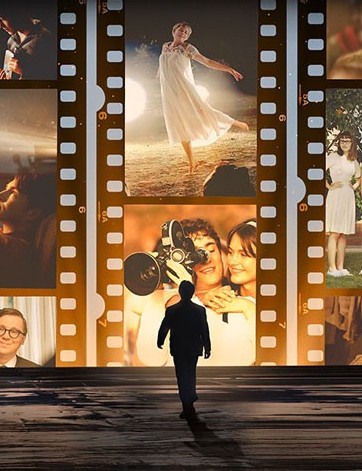
The Fabelmans is essentially a family drama, but one that encompasses some weighty topics: mental health issues, the prevalence of anti-semitism and the expectations that parents can sometimes place on their children. Above all hovers the love of cinema, the almost magical ability it has to transform a viewer’s world, to allow them to escape from reality into a variety of uncharted realms. This is a warm and affectionate study of the director’s beginnings and, if it occasionally ventures perilously close to schmaltz, Spielberg is deft enough to repeatedly it snatch back from the abyss. The world he creates here is utterly believable.

There’s plenty to enjoy. I love the brief appearance by Judd Hirsch as all-round force of nature, Uncle Boris – a former silent movie actor, who recognises the nascent director lurking inside Sam and calls him to do something about it. There’s a beautifully nuanced performance from the ever-impressive Williams as a woman who has sacrificed her own creative ambitions to the demands of her family and is suffering because of it, and there’s a delicious, foul-mouthed cameo from (of all people) David Lynch. Throw in Janusz Kaminski’s gorgeous cinematography and legendary composer John Williams’ music, and you’ve got something a little bit special.

And while The Fabelmans is not quite the five-star masterpiece that so many critics have declared it to be, it’s nonetheless a fascinating look at the filmmaker’s roots and one that never loses momentum throughout its duration.

So don’t wait for streaming. See it where it belongs, and Steven will thank you in person.

4.6 stars

Philip Caveney

The Lion King

19/07/19

Much to the dismay – and often outright incredulity – of every millennial I know, I’ve never seen the original Lion King. I mean, I’ve seen the original original (Hamlet), but not the much-loved 1994 animation. Quelle horreur! So it seems tonight’s the night to – sort of – put that right, by reclining in my brand new leather Cineworld seat and checking out Jon Favreau’s new CGI adaptation.

It looks… ravishing. It’s stunningly impressive. The animals are so perfectly rendered I find myself thinking of it as ‘live action’, then have to remind myself that these are computer-generated images, not real wildlife at all. It’s truly awesome; I’m sure that even ardent fans of the cartoon would enjoy this iteration.

Because – apparently, according to Philip – it’s faithful to the original. It feels like a  lovingly recreated version of an old favourite, using new technology to enhance the look.

For those even further out of the loop than me, this is the story of Simba (JD McCrary/Donald Glover), a lion ordained for greatness. When his father, King Mufasa (James Earl Jones), is killed by his evil uncle Scar (Chiwetel Ejiofor), Simba has to leave the plains he is destined to rule. He buries his sadness and shame, and forges a carefree life for himself in another region, where he befriends comedy warthog/meerkat duo, Pumbaa (Seth Rogan) and Timon (Billy Eichner). Meanwhile, Scar and the scary hyenas are destroying Simba’s homeland. Eventually, fate comes calling for the young lion, when his childhood friend, Nala (Beyoncé), seeks him out, demanding his return.

Of course, the story is an old one, so there are few surprises in the script. No matter – it’s beautifully told. Sure, it’s a bit schmaltzy at times (that’s Disney for you), but it doesn’t shy away from the difficult stuff either, and is really rather dark at times. The hyenas (particularly Shenzi, voiced by Florence Kasumba) are genuinely terrifying, and the battles violent and visceral. I do have a few issues with the central premise (I’m not so keen on the idea that some are ‘born to rule’), but – honestly –  my main take-home from this is a sense of marvel at the technical accomplishments.

It’s very definitely worth seeing.

4.1 stars

Susan Singfield


Long Shot

12/05/19

Long Shot takes place in an alternative version of America, where Charlize Theron could conceivably be Secretary of State and where she just might be having a covert affair with Seth Rogan’s amiable slacker of a journalist. Think, if you will, of a US version of a Richard Curtis film. It might have a perfectly preposterous story line but, if you turn a blind eye to that, it’s nonetheless pretty entertaining.

Theron is S of S Charlotte Field, looking towards turning her current situation into a bid to become America’s first female POTUS, having received an endorsement from  incumbent President Chambers (Bob Odenkirk), who has decided he wants to get out of politics and become a film star. At an upmarket party, Charlotte reconnects with Gonzo journalist, Fred Flarsky (Rogan), for whom she used to babysit back in the day, and with whom she clearly has unfinished business. Flarsky is newly unemployed after the paper he works for has been bought out by the odious capitalist, Parker Wembley (Andy Serkis), and it just so happens that Charlotte is looking for a speechwriter to help her launch her bid for the presidency.

With Flarsky on board, Charlotte sets off on a world tour in an attempt to sell herself as the next president of America but, inevitably, romantic sparks soon begin to fly between the odd couple. Problem is, Flarsky’s image may not be a suitable fit for somebody looking to be taking seriously as a politician…

As I said, Long Shot might not have the most convincing plot you’ve ever encountered, but it’s smart, clever, and – for most of its duration – very funny. Theron and Rogan manage to generate some convincing chemistry together, and somewhere in here there’s the age-old message about being true to yourself and never compromising on your beliefs.

So – fun while it’s happening, but probably not destined to linger in the memory for very long. And as for that title, I have no idea what it refers to.

3.9 stars

Philip Caveney

The Disaster Artist

08/12/17

Let me begin with a question: is it ever possible to make a silk purse out of a sow’s ear? In this analogy, the sow’s ear is Tommy Wiseau’s movie, The Room (https://bouquetsbrickbatsreviews.com/2017/12/04/the-room/), a film of such toe-curling ineptitude that it actually hurts to watch it – and a film, moreover, that – since its initial release in 2003 – has somehow recruited a sizable coterie of avid fans, who gather at regular midnight screenings around the world to celebrate its general naffness. The potential silk purse is The Disaster Artist, the film about the making of The Room, in which James Franco plays Wiseau and, in a hubristic gesture that Wiseau would undoubtedly approve of, also directs.

Franco’s film opens in San Francisco in the 90s, where we meet young wannabe actor, Greg Sestero (Dave Franco), who is struggling to make some kind of impact on the local theatre scene. At a workshop, he encounters Wiseau, a mysterious long-haired individual who, when invited to improvise in front of the other students, unleashes a ‘performance’ of such unabashed fury, that the more inhibited Sestero immediately wants to know more about him. The two men become buddies and, when Wiseau casually suggests that they should go to Los Angeles and ‘get into the movies,’ Sestero happily goes along – Wiseau already has an apartment there and he’s perfectly happy to share it. It soon becomes apparent, however, that there are a lot of unanswered questions concerning Mr Wiseau. Where does his seemingly bottomless pit of money come from? Why does a man who claims to be a native of New Orleans have what sounds like a middle European accent? And why is he so willing to go to any lengths to impress Sestero? Will there be a price to pay?

When, after months of fruitless auditions have resulted in exactly zero film or TV roles, Wiseau announces that there is only one option left: he will write a movie script for the two of them to star in – and then he will direct it. Which is pretty much what happens. Wiseau’s complete ignorance of the film-making process means that he ends up spending over six million dollars on his little vanity project and, since he seems reluctant to heed any advice from professionals, the result of all his labours is an incoherent mess but, undeterred, he sets about arranging a premiere…

It would be very easy to make a cruel comedy out of this but, though the film is often laugh-out-loud funny, Franco’s evident affection for Wiseau shines through in every frame. As the director has said in interviews, it takes as much commitment and ingenuity to make a bad film as it does to make a good one and it will be a hard-hearted individual indeed who won’t feel for Wiseau when his beloved project is greeted by hoots of derision from all who see it. Franco’s impersonation of Wiseau is uncannily accurate, as are most of the other performances here. Sharp-eyed viewers will spot some big names in cameo roles: Sharon Stone, Bob Odenkirk, Seth Rogan, Josh Hutcherson, J.J. Abrams. Oh yes, and there’s Bryan Cranston actually playing himself. Most telling of all is the extended sequence at the end of the film, where scenes from The Room are played alongside their equivalent from The Disaster Artist. They are virtually identical.

So, the million dollar question. Do you need to have seen the original movie in order to enjoy this homage? Well, it may not be an essential requirement, but it certainly helps me to fully appreciate the care and attention that has gone into this project. Mind you, with the new interest in The Room that the film seems certain to generate, I wouldn’t be at all surprised if a general re-release is waiting in the wings, which I’ve no doubt will be a bonus for Mr Wiseau.

So, returning to my original question, in this case yes. The sow’s ear has become a silk purse – and this is definitely one of the most intriguing films of the year.

4.2 stars

Philip Caveney

Sausage Party

ne96mtkr882uce_1_a

08/09/16

In the colourful cartoon world created by Seth Rogen, Jonah Hill (and, it should be said,  a whole bunch of other writers), the edible inhabitants of Shopwell’s supermarket have created a convenient myth for themselves – that when they are ‘chosen’ by shoppers, they embark on a journey to The Great Beyond, a paradise where they will be forever happy with their perfect partners. Frank (Seth Rogen) is one member of a pack of frankfurter sausages who longs to be lustily united with Brenda (Kristen Wiig) a shapely hot dog bun. (You’ll already have gathered that the minds behind this concoction are not reaching for anything too intellectual.) When a jar of honey-mustard is returned by a shopper (because he wasn’t quite honey and he wasn’t quite mustard), he terrorises the other inhabitants of the store  with nightmarish tales of what he has witnessed – food being horribly tortured and mutilated before being devoured by humans – which sets Frank off on a convoluted quest to discover the truth about the Great Beyond.

Okay, so Sausage Party is an allegory about religion and the lies that people are prepared to swallow in order to make their existence tolerable – and, to be fair, there are a few clever scenes dotted throughout this film that hint at just how good it might have been if a little more thought had gone into it; but, unfortunately, such scenes are brutally nixed by the barrage of appalling racial, sexual and gender stereotypes to which the plot continually returns. It’s a case of one step forward, two steps back. No sooner have you enjoyed, for instance, the quite clever parody of Saving Private Ryan, than the script is offering some clumsy interplay between a Jewish bagel and a Middle Eastern lavash (that’s Armenian unleavened flatbread, in case you were wondering) that seems purely designed to offend religious sensibilities with its supposedly funny, lascivious er… climax.

Look, this was never going to be a masterpiece – it’s clearly something that’s been put together based on the ramblings of a couple of stoners (‘Hey man, imagine if this food we’re about to eat could talk!’) and, all things considered, it’s surprising that the end result is as watchable as it is. Those who enjoy their humour rude and obvious will doubtless laugh along with this – but its ambitions rarely take it any higher than a snake’s belly – and what can you honestly expect of a film that features a villain that is… quite literally, a douchebag?

And be warned. The central premise of this movie could easily encourage an eating disorder. This is a public service announcement. You have been warned.

3 stars

Philip Caveney

Steve Jobs

16/11/15

Steve Jobs is a strange sort of movie. Danny Boyle’s valiant attempt to capture the wayward genius of Apple’s head honcho is a film that really could only have been made after the man’s death. If he’d still been alive he’d have sued the makers for every penny they had. Not because it’s inaccurate, you understand, simply because that’s the kind of man he was.

Set mostly at the launch of three Apple products – the original Macintosh, the ill-fated Next cube and finally, the iMac, the set up is more like that of a theatrical production – and for all Boyle’s claims that this is a ‘standing-up’ movie rather than a ‘sitting-down’ one, it still comes across as predominantly talky. The script, by Aaron Sorkin, is a cut above most movie dialogue you’ll encounter, which certainly helps, but this frankly isn’t in the same league as The Social Network, with which the film will inevitably be compared.

Jobs (Michael Fassbender), quickly demonstrates the kind of behaviour that had him classed as a major pain in the backside by pretty much everyone who had the misfortune to work with him. He’s obsessed with tiny details, unwilling to take anyone else’s views into consideration and equally unwilling to take responsibility for his daughter, Lisa, who he claims might not actually be his child. His long-suffering assistant, Joanna Hoffman (Kate Winslet) is lumbered with the unenviable task of keeping him on track and we see clashes with bearded workhorse Steve Wozniak (Seth Rogan) and conversations with the closest thing that Jobs had to a father-figure, John Sculley (Jeff Daniels) – unless of course you include his actual biological father, a restaurant owner who used to boast that Jobs ate in his establishment, without ever finding out he was actually waiting on his own son.

Boyle’s films are usually adrenalin-fuelled, razzle-dazzle affairs, so this slow burning, stage bound production will inevitably prove a disappointment to many. Certainly, early indications are that the movie is not exactly putting bums on seats – but it wins through in the end by virtue of Sorkin’s edgy script and a soaring conclusion, where everything finally falls into place.

4 stars

Philip Caveney