24/10/23
Traverse Theatre, Edinburgh
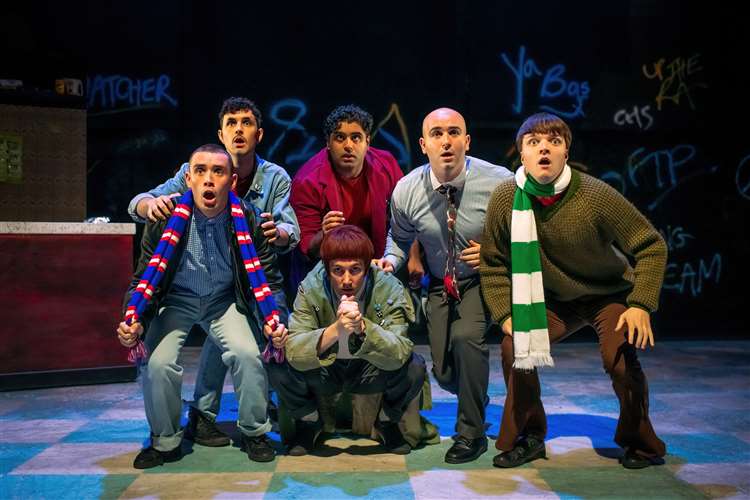
It’s Garry (Martin Docherty)’s 50th birthday and he’s not in the mood for a celebration. Instead, he prefers to think back to his teenage years and the wee amateur football team he put together with his best friends in Renfrew. He warns us in advance, this isn’t going to be an easy ride…
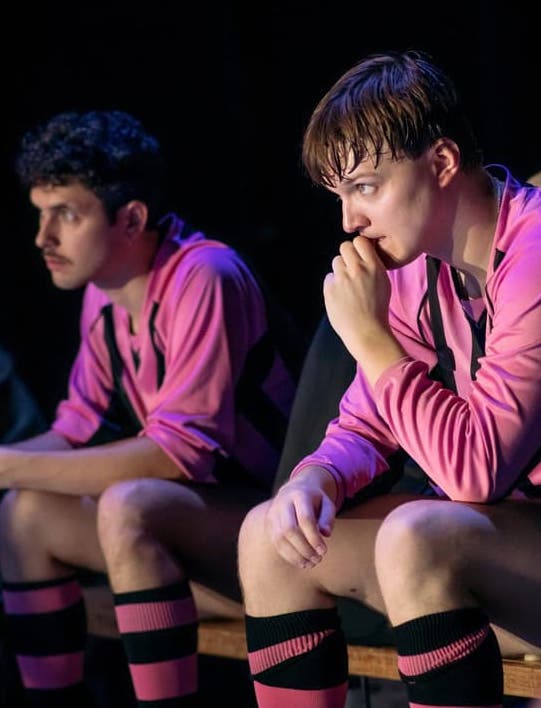
He assembles his crew. For starters, there’s Mick (Jatinder Singh Randhawa), once a promising member of a junior football team, now plying his trade as a hairdresser. There’s Tubs (Dylan Wood), who is gay – and in a 1980s small town, that’s seriously difficult – and there’s Paul (Sean Connor), struggling to cope with an abusive, alcoholic father. Noodles (Santino Smith) appears to be the most successful of the crew, with a decent job and the money to pay for some fancy football shirts (but should they be that shade of maroon?). Sooty (Kyle Gardiner) is a dedicated mod with a fishtail parka and no higher ambition than to ‘do a Quadrophenia’ and ride his scooter to Brighton, while Mince (Bailey Newsome) has an uncanny propensity for saying the wrong thing at the wrong time… every time.
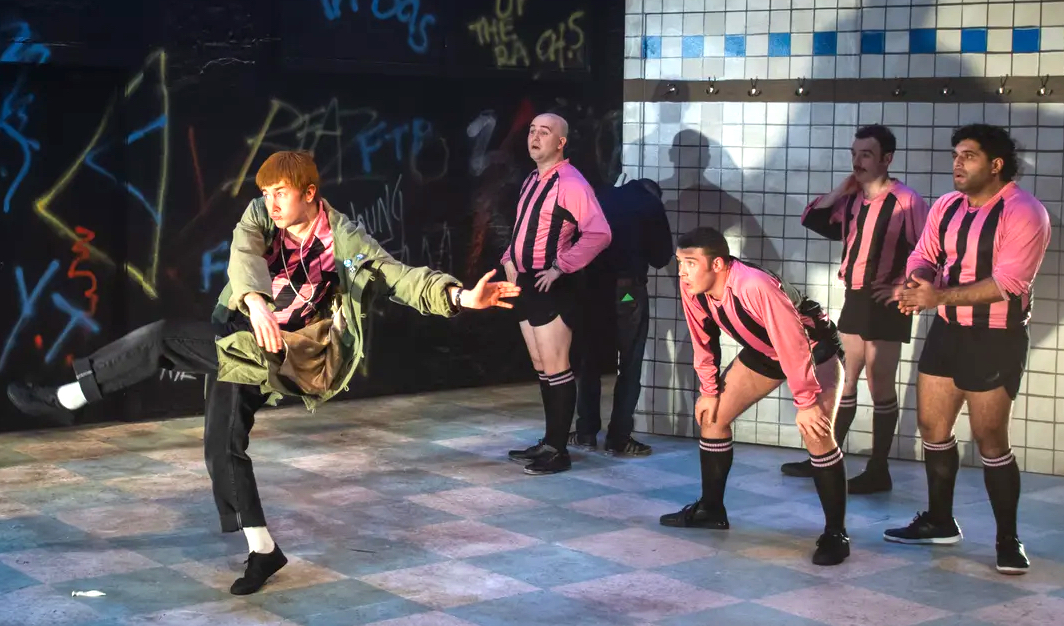
But from their very first training session, the teammates work well together. The go from strength to strength, finding pleasure in the simple joys of kicking a ball around a pitch. They are blissfully unaware that darker times are inexorably closing in on them.
Moorcroft, written and directed by Elidh Loan, is a fabulous slice of theatre, one that moves effortlessly through a whole series of emotions. It swerves from raucous hilarity to visceral anger to heartrending tragedy with all the sure-footed precision of a well-drilled team. There are superb performances from the entire cast – particularly from Newsome as the slow-witted but oddly adorable Mince – and I especially enjoy the physical sequences as the team leap, twirl and kick their way through a series of energetic routines backed by a selection of 80s bangers. Loan knows exactly when to switch the mood. One minute I’m laughing out loud, the next my eyes are filling with tears.
It would be so easy to dismiss this as ‘a play about football’ but it’s much more than that. Moorcroft is a meditation on masculinity, its strengths, its weaknesses. It’s a reflection on the everyday deprivation of working-class life, and it’s a lament about the awful injustice of fate. Compelling and propulsive throughout, it never once relaxes its powerful grip.
It shoots, it scores. It’s a winner.
5 stars
Philip Caveney


 Bouquets & Brickbats