
Sam Mendes

The Motive and the Cue

21/03/24

Cineworld, Edinburgh: National Theatre Live

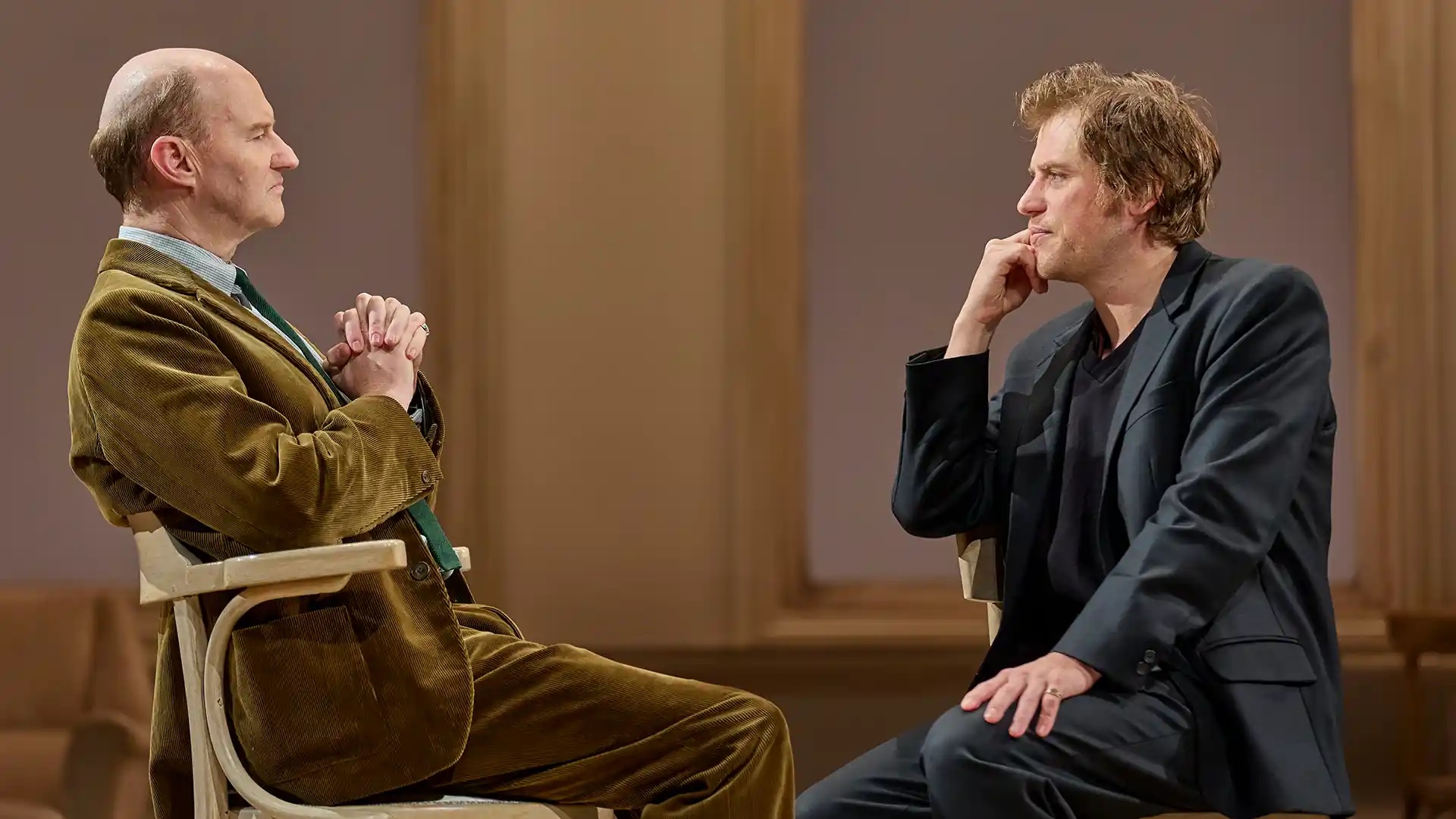
It’s 1964 and Welsh superstar Richard Burton (Johnny Flynn) has decided to turn down some lucrative film offers in order to perform Hamlet on Broadway. (We’ve all been there.) He’s decided that the director should be John Gielgud (Mark Gatiss). Now in his sixties and considered something of a has-been, he famously played the Danish prince to great acclaim as a young actor.

To complicate matters, Burton has recently married Elizabeth Taylor (Tuppence Middleton) – for the first time – and she reluctantly accompanies him, but finds herself banished from the rehearsal space and sequestered in a swish hotel room with an endless supply of alcohol, while her husband grapples with his role.

Jack Thorne’s fascinating play, beautifully directed by Sam Mendes, never shows us the finished production but lingers instead on successive rehearsals as director and star bicker and feud their way to a fresh vision of Shakespeare’s most-performed play. There’s a large ensemble cast at work – some eighteen of them – but most of the other actors are relegated to supporting roles, though both Allan Corduner as Hume Cronyn and Luke Norris as William Redfield manage to make an impression. Meanwhile, Gatiss and Flynn joust entertainingly with each other to sometimes hilarious effect, Gatiss perfectly embodying Gielgud’s sly and snarky manner, while Flynn turns up the bombast as the hubristic Burton, his working-class-lad-made-good bluster deliciously rendered.

Middleton too does well with her character, capturing Taylor’s earthiness and her uncanny ability to cross all boundaries, particularly in the scene where she acts as a kind of intermediary when Gielgud and Burton (inevitably) end up at each other’s throats. I love the scene where Gielgud reflects on the tragedy of achieving stardom at twenty-three, to which Taylor points out that she was just twelve when National Velvet became a runaway hit.

The production is also blessed with an extraordinary set by Ed Devlin, where scene changes are revealed using an ingenious expanding letterbox arrangement. I have no idea how this is achieved, but the effect is remarkable, the transformations so slickly done it feels almost like a series of magic tricks.

This is a play that will delight anyone who loves theatre and the way it works, a glimpse at the nuts and bolts that lie behind the glittering façade. It’s fascinating to see the players experiment with the source material as they gradually inch their way to what will eventually become one of the most successful theatre productions in history.

4.6 stars

Philip Caveney

The Fabelmans

28/01/23

Cineworld, Edinburgh

In the wake of the pandemic, several film directors seem to be have been inspired to take a closer look at at their own roots. Already this year we’ve had Sam Mendes’s Empire of Light, Alejandro G Innarutu’s Bardo and James Gray’s Armageddon Time – though good luck tracking down any cinema or streaming service showing the latter.

Now comes the turn of Steven Spielberg, arguably one of our greatest living directors, who is clearly looking to settle some old ghosts with The Fabelmans. The film is preceded by a short clip featuring an avuncular-looking Spielberg, humbly thanking the audience for coming to the cinema to see his latest offering. What we are about to watch, he tells us, is his most personal film ever.

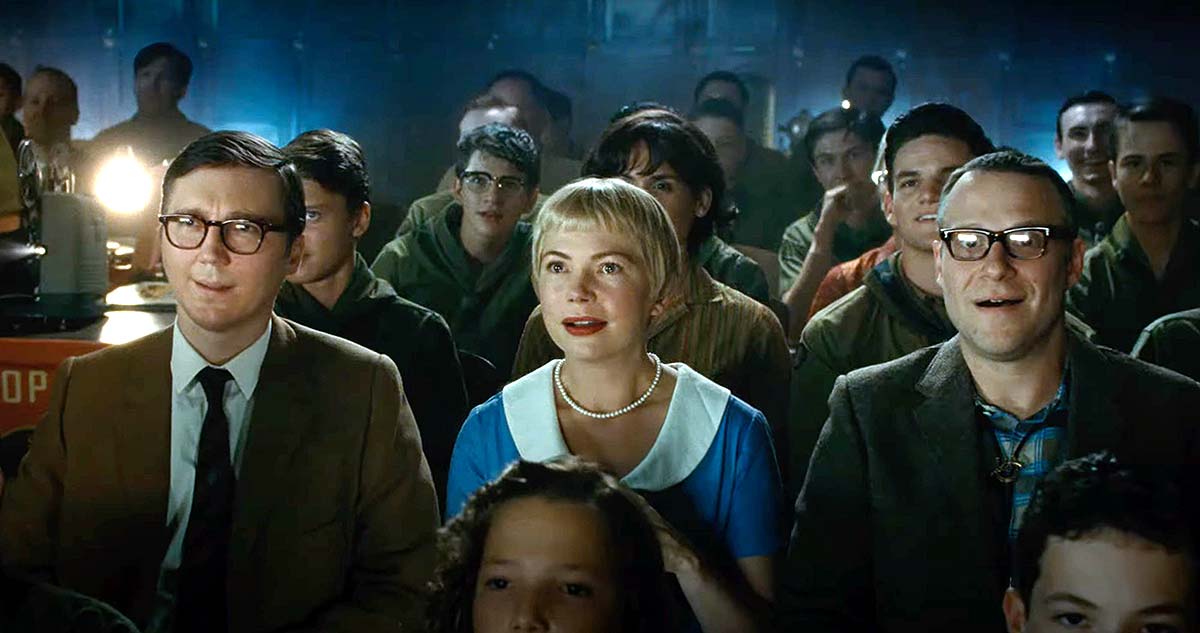
It begins in 1952, when the young Sam Fabelman (Mateo Zoreyan) goes to his very first picture show along with his parents, Burt (Paul Dano), a computer programmer, and Mitzi (Michelle Williams), a talented pianist. Sam is initially apprehensive about the upcoming experience – he’s heard terrible things! – but is transfixed by Cecil B DeMille’s The Greatest Show on Earth, particularly an extended sequence that depicts an epic train crash. That Christmas, Sam is given a lovely toy train set and he cannot stop himself from attempting to recreate what he saw in the movie and, inevitably, capturing it on film.

Time rolls on, and a teenage Sam (Gabrielle LaBelle) is living in Arizona, where Burt has gone for work. He’s still obsessively making amateur movies, aided by his willing schoolmates (including the famous World War 2 on a budget epic Escape to Nowhere) and thinks nothing of the fact that Burt’s friend, ‘Uncle’ Bennie (Seth Rogan), is a constant presence in the family’s life. It’s only when he is editing a film about a recent family camping trip that the camera reveals something he has previously had no inkling of…

The Fabelmans is essentially a family drama, but one that encompasses some weighty topics: mental health issues, the prevalence of anti-semitism and the expectations that parents can sometimes place on their children. Above all hovers the love of cinema, the almost magical ability it has to transform a viewer’s world, to allow them to escape from reality into a variety of uncharted realms. This is a warm and affectionate study of the director’s beginnings and, if it occasionally ventures perilously close to schmaltz, Spielberg is deft enough to repeatedly it snatch back from the abyss. The world he creates here is utterly believable.

There’s plenty to enjoy. I love the brief appearance by Judd Hirsch as all-round force of nature, Uncle Boris – a former silent movie actor, who recognises the nascent director lurking inside Sam and calls him to do something about it. There’s a beautifully nuanced performance from the ever-impressive Williams as a woman who has sacrificed her own creative ambitions to the demands of her family and is suffering because of it, and there’s a delicious, foul-mouthed cameo from (of all people) David Lynch. Throw in Janusz Kaminski’s gorgeous cinematography and legendary composer John Williams’ music, and you’ve got something a little bit special.

And while The Fabelmans is not quite the five-star masterpiece that so many critics have declared it to be, it’s nonetheless a fascinating look at the filmmaker’s roots and one that never loses momentum throughout its duration.

So don’t wait for streaming. See it where it belongs, and Steven will thank you in person.

4.6 stars

Philip Caveney

Empire of Light

03/01/23

Cineworld, Edinburgh

Sam Mendes’ Empire of Light is essentially a passionate love letter to the cinema, the kind of film that could have created with me – or somebody very like me – in mind

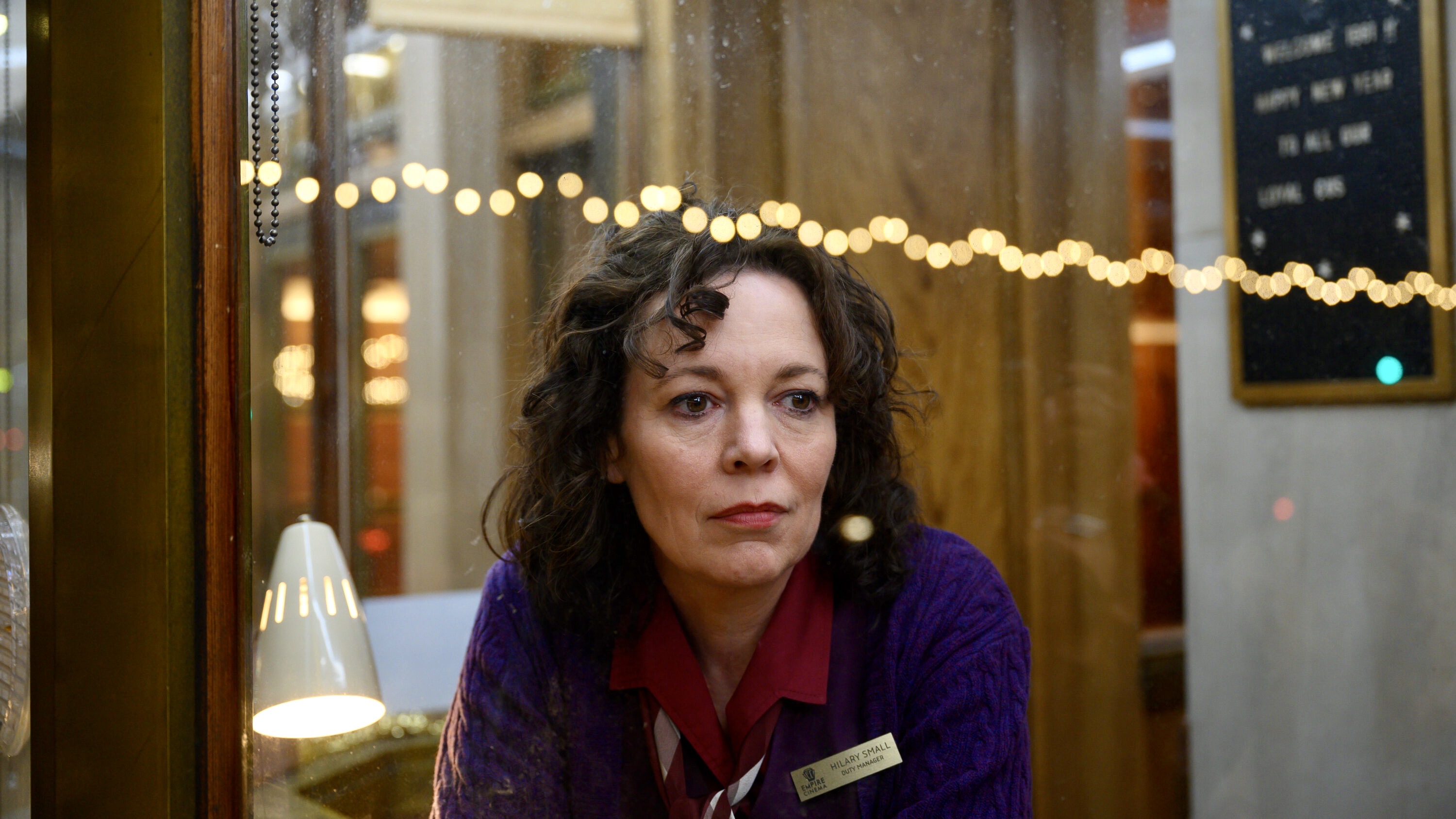
It’s 1981 and, somewhere on the south coast of England, the Empire cinema, a magnificent but now somewhat dilapidated Art Deco picture house, proudly announces its current offerings: The Blues Brothers and All That Jazz. Filmed on location in Margate, the atmosphere of the era is convincingly evoked, right down to the last detail. Here is the age of Thatcherism, a time when fascism, in the form of skin head culture, was in the ascendent. But, within the sheltering walls of the Empire, deputy manager Hilary (Olivia Colman) and her team of social misfits seem inured to change, even though two of their four screens are now permanently closed.

Hilary is occasionally expected to find time to pop up to the office of sleazy manager, Mr Ellis (Colin Firth) – for a joyless sexual fumble on his desk. Ellis is married and it’s supposed to be a secret but – of course – the others are well aware of what’s going on. A change is signalled by the arrival of new employee, Stephen (Micheal Ward), a handsome young Black man with a liking for Two Tone music. When Hilary shows Stephen around the derelict, pigeon-infested ballroom on the top floor, something clicks between them…

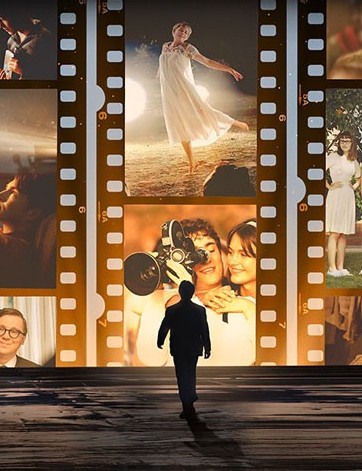
At a time when streaming is increasingly becoming the norm, it seems doubly poignant when projectionist Norman (Toby Jones) explains how moving pictures employ a simple trick to deceive the viewer’s eyes into thinking they are watching something more than a long series of still photographs. We occasionally see him in his booth, the walls plastered with images of movie stars from across the eras, meticulously directing images from his 35 mm reels onto a giant screen. The moment is mesmerising and it’s a timely reminder that cinema itself is in danger of suffering the fate of the dinosaurs.

Beautifully shot by Roger Deakins and written by Mendes, Empire of Light is compelling, and at times overpoweringly poignant. I almost get tired of praising Olivia Colman, but – from Tyrannosaur onwards – she has offered up a series of extraordinary screen performances and Hilary may be her best character yet. She’s complex and unpredictable, vacillating from joyful enthusiasm to vengeful anger. You believe in her implicitly and, furthermore, I’ve rarely seen mental illness presented with such skill, such gentle acceptance. Much of this is due to Mendes’ nuanced script, and the fact that the director’s own mother struggled with her mental health may have instructed his writing. Stephen too is a compelling character, somehow managing to operate through the hateful levels of racism he experiences on a daily basis, keeping his gaze firmly fixed on a brighter future.

This charming and affecting movie has me entranced from its opening shot to its final frame and I suspect that anybody with a genuine love of film is going to have a similar experience. Go and see it – in the cinema, please!

5 stars

Philip Caveney

1917

10/01/20

Blame Orson Welles. 

In his 1958 film, Touch of Evil, he decided to kick proceedings off with a twelve minute continuous tracking shot and, in doing so, opened future filmmakers up to the idea of what might be done with the concept once technology had made it easier to accomplish such marvels. 

In 2016, Sebastian Schipper finally took the idea to its logical conclusion with his low-budget thriller, Victoria, a nail biting two hours and 18 minutes filmed in one continuous take. Surely, there was nowhere else left to go?

Clearly, nobody told Sam Mendes. 1917, based on stories told to him by his grandfather, a World War 1 veteran, isn’t quite a single take movie – it really couldn’t be, not on the scale envisaged for this epic drama – but it is composed of several lengthy tracking shots, cunningly spliced together to make it look like a seamless sequence. There’s only one (intentionally) obvious cut in its entire run, which – given the story’s circumstances – seems entirely justified. 

There’s no time wasted on needless exposition. We are quickly introduced to the two protagonists who will lead us through the story. They are Blake (Dean-Charles Chapman) and Schofield (George MacKay), two young soldiers, who – within minutes of the film opening – have been charged with a monumental task: to travel miles across enemy-occupied territory to call off a planned attack by another division, set to occur the following morning. Aerial surveillance has exposed the endeavour as a carefully laid trap, the Germans forces giving the appearance that they are in retreat when, in fact, they are primed to exact a punishing slaughter. To add extra jeopardy to the situation, Blake’s older brother is serving with the battalion that is about to go over the top. If the message doesn’t get through in time, sixteen hundred men will be needlessly massacred…

And, in terms of plot, that’s all you need to know. With the clock ticking, the two men set off along the crowded trenches until they reach the final outpost and are obliged to walk across no-man’s land, weighed down by the awful knowledge that every moment of delay brings disaster a step closer.

Roger Deakins’ cinematography is a thing of wonder. I soon forget the gimmick (because a gimmick; it most certainly is) and find myself caught up in the almost unbearable suspense of the situation. 

This is a war movie that feels horribly immersive. The distance between the screen and my seat seems non-existent and I am in those trenches along with the protagonists, wading through mud and across rat-ravaged corpses. I am dodging bullets and bursts of shrapnel; I am shivering with cold and running frantically past blazing buildings, stranded amidst the architecture of a world gone mad. Yes, this is undoubtedly a technological marvel but, more importantly, it is a riveting, pummelling experience that drives home the horror and futility of war. Lest I make it all sound unbearable, let me add that there are a couple of instances of unexpected beauty in this film, scenes where elements of nature and the resilience of humanity shine like jewels amidst the smoke and devastation.

A whole host of top-flight actors put in cameos as commanding officers, but it’s the two young leads who carry this film and it’s easy to see why it has already earned itself a well deserved ‘best picture’ award at the Golden Globes. 

For all the razzmatazz of its structure, it’s inevitably story that comes first and this delivers at every level, resulting in the first truly unmissable film of 2020.

5 stars

Philip Caveney