Roger Michell

The Duke

09/03/22

Cineworld, Edinburgh

The latest entry in the ‘truth is stranger than fiction’ genre is The Duke – the final feature from versatile director, the late Roger Michell. This is the story of the improbably named Kempton Bunton (Jim Broadbent), an irascible campaigner for pensioners’ rights, women’s suffrage and, in his spare time, a would-be playwright. Quite why his script The Adventures of Susan Christ never found an audience is anybody’s guess.

It’s the early 1960s and ,while England’s capital is celebrating a new-found sense of freedom, life on the gloomy streets of Newcastle is a somewhat bleaker prospect, as Bunton stumbles from job-to-job, constantly losing them because of his propensity to stand up against any signs of injustice he encounters. His long-suffering wife, Dorothy (Helen Mirren), slogs her guts out as a home help to her more affluent neighbour, Mrs Gowling (Anna Maxwell Martin), in order to make ends meet. She is mortified when her husband is obliged to spend a short spell in prison for non-payment of his TV licence (free TV for OAPs being his current pet project).

Meanwhile the couple’s younger son, Jackie (Fionn Whitehead), dreams of building and selling luxury boats, while his brother, Kenny (Jack Bundeira), has his own run-ins with the police to contend with.

And then a valuable painting of The Duke of Wellington by Goya is ‘borrowed’ from the National Gallery – and when it winds up hidden in the back of the Bunton’s wardrobe, it’s only a matter of time before the merde hits the fan.

The Duke is an irresistibly enjoyable piece that manages to evade the cosy complacency of so many films aimed at more mature audiences. Michell’s direction cleverly juxtaposes glossy widescreen shots of London with the grubby, timeworn realities of 60s Newcastle and the humdrum rigours of everyday working-class life are convincingly captured. The Buntons feel like real characters rather than archetypes. A past sadness that Kempton and Dorothy share is skilfully revealed in Richard Bean and Clive Coleman’s canny script – and there’s also a twist to the tale that genuinely takes me by surprise.

But this is surely Broadbent’s film. He’s terrific in the central role, making us genuinely care about a character who was, by all accounts, a bit of a wastrel. The penultimate scene where Bunton stands up in court to discuss the art theft with his barrister, Jeremy Hutchinson (Matthew Goode), had me laughing out loud and is probably worth the price of admission all by itself. Meanwhile, Mirren handles her role as the family matriarch with her usual aplomb and even manages to knit aggressively.

I’m hoping that some enterprising theatre will finally decide to stage one of Bunton’s lost plays – I’d love to see whether Susan Christ achieves her ambitions – but until that happens, The Duke is sure to send you on your way with a smile on your face.

4 stars

Philip Caveney
Nothing Like a Dame

dame1

03/05/18

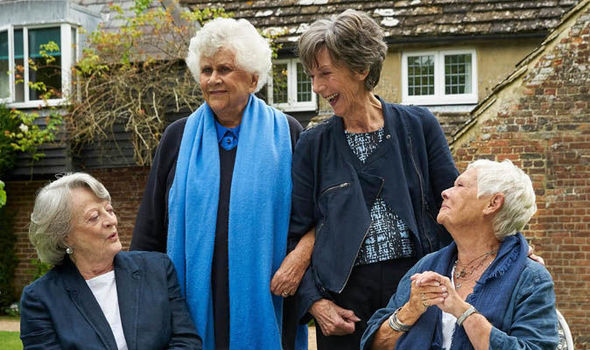
Take four national treasures. Decant them into a country house and allow to ferment for a couple of days. Throw in four glasses of champagne, then sit back and watch what happens. This is pretty much the recipe for Roger Michell’s charming documentary, Nothing Like a Dame, and, given how unpromising it sounds, it’s amazing how entertaining the results are.

The dames in question are, of course, Judi Dench, Eileen Atkins, Maggie Smith and Joan Plowright, old friends of long standing, and this is a regular get-together they’ve kept going over the years, meeting up at the country home that Dame Joan shared with her husband, Sir Laurence Olivier.

What the film offers us is a series of anecdotes – many of them laugh-out-loud-funny – and a chance to look back at four astonishing careers, with vintage clips of their first forays into theatre and film. Totally unscripted and extremely relaxed, it’s the cinematic equivalent of a warm hug, fully engaging while it’s happening but not particularly memorable when the credits have rolled. Dame Maggie arguably gets the majority of the best lines, sporting a sarcastic streak that makes the most throwaway remark an absolute killer, while Dame Judi spends much of the film helpless with laughter as she and her friends discuss some of the experiences they shared in those early days. What this is, more than anything else, is a film about ageing and the effects of it. Seeing footage of them, so young, so vital, so filled with enthusiasm for their chosen careers is simultaneously enervating and also vaguely melancholic.

There isn’t much to talk about here in terms of a review, but lovers of theatre and admirers of these four women in particular will find plenty to enjoy. Roger Michell, as he openly admits in the little feature that accompanies the main film, doesn’t so much direct as simply point the camera and allow it to run. This certainly won’t be for everyone, but lovers of theatre – and of the work of the four dames – are in for a treat.

4 stars

Philip Caveney


My Cousin Rachel

10/06/17

I’ll admit to a soft spot for Daphne du Maurier, despite the melodrama and the bodice-ripping. Okay, so her books are essentially pot-boilers, all over-hyped emotion and bald sensationalism. However, I read them first as a teenager, and just couldn’t put them down. They’re exciting, engaging stories, whatever literary merit they lack. But, though I devoured all those my local library stocked, My Cousin Rachel didn’t grace their shelves. So I approach this film in the unusual position of a fan who doesn’t really know the source material.

It’s typical du Maurier though; this doesn’t challenge my expectations. And director Roger Michell embraces her style, filling in the expository details with remarkable economy, and focusing on the growing fears of Philip Ashley (Sam Clafin), as the eponymous Rachel (Rachel Weisz), his uncle’s widow, beguiles him with her charms.

It’s the ambiguity that makes this film: is Rachel a femme fatale, a ruthless gold-digger who wants to destroy Philip? Or is she, instead, held to account for her beauty, made to carry the blame for men’s desires, accused of destroying them if she does not reciprocate?  This duality is what creates the tension here, and it’s meticulously rendered throughout. I tend towards the latter theory, but it’s really not clear cut.

A fascinating movie then: slow-paced but exhilarating; schlocky but sophisticated. The Cornish locations are beautifully evoked, Rachel Weisz is glorious in the lead role (of course she is), and the supporting cast is decent too. Well worth a watch – and now I’m off to buy the book. It’s about time I read it, after all.

4 stars

Susan Singfield