Robin Wright

Here

08/01/25

Cineworld, Edinburgh

If a film deserves accolades for originality then Here definitely earns them. I’ve never seen anything quite like it. That said, it does feel very much like an experiment, with director Robert Zemeckis continuing the fascination with movie technology he’s been relentlessly pursuing since 2004’s The Polar Express. Not everything in the film quite comes off – but the parts that do are extraordinary.

Take the opening sequence for instance, where a fixed camera offers a changing view of a particular point on the compass and, through a series of portals, we are offered glimpses of the ever-changing landscape from the world’s inception and onwards across the unfolding centuries. The gimmick of the film – and there’s no better word to describe it – is that the camera never moves its position. Eventually, we see the woodland where it stands being cleared and, later, a house is constructed around it until it is enclosed in a room. Through the window there’s a view of a much grander house, which once belonged to the illegitimate son of Thomas Jefferson, but here, in the more modest home across the street, a series of middle-class families move in and play out scenes from their lives. The aforementioned portals are used to zip the viewer back and forth in time, allowing us to catch glimpses set in different eras.

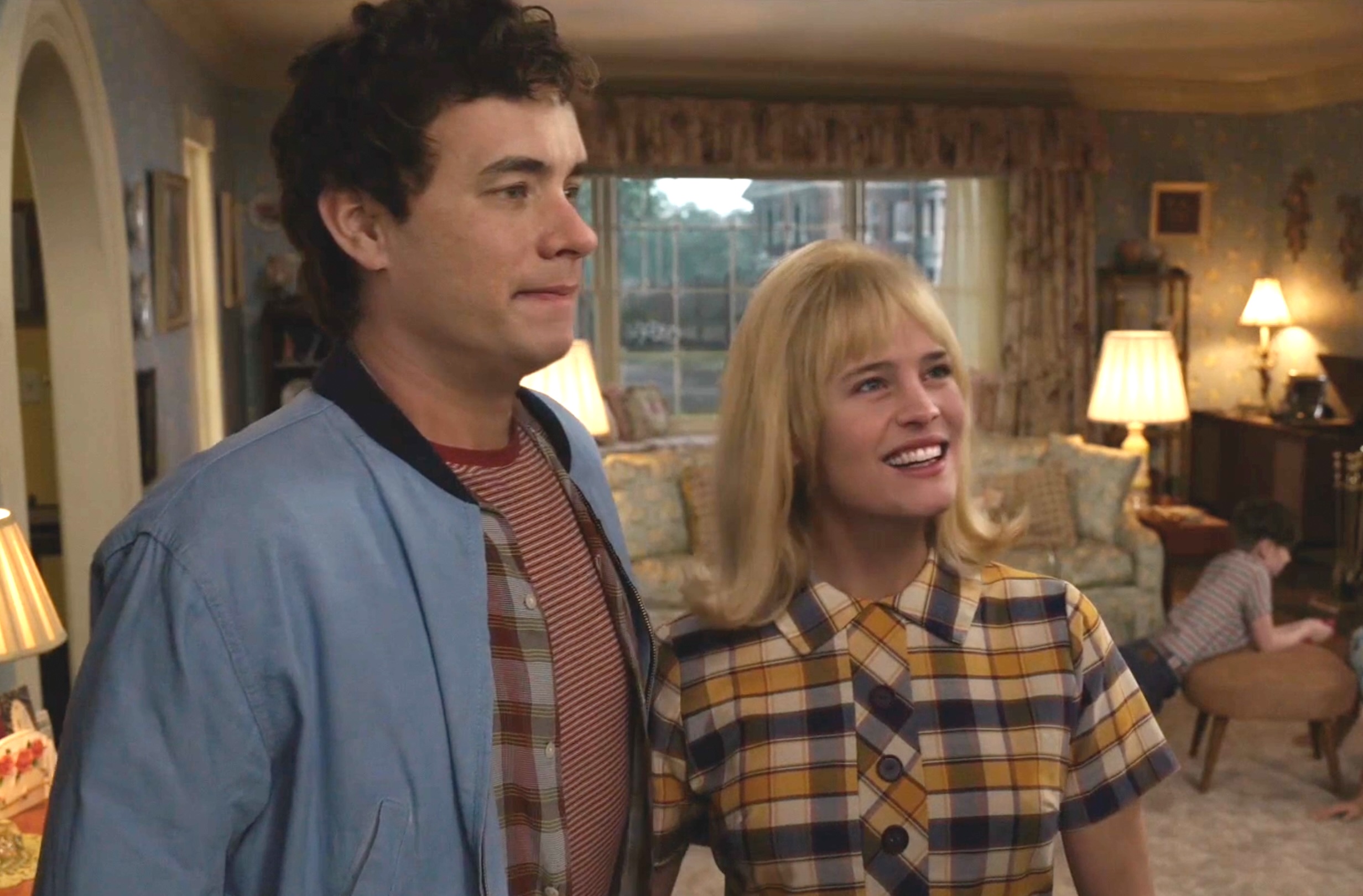
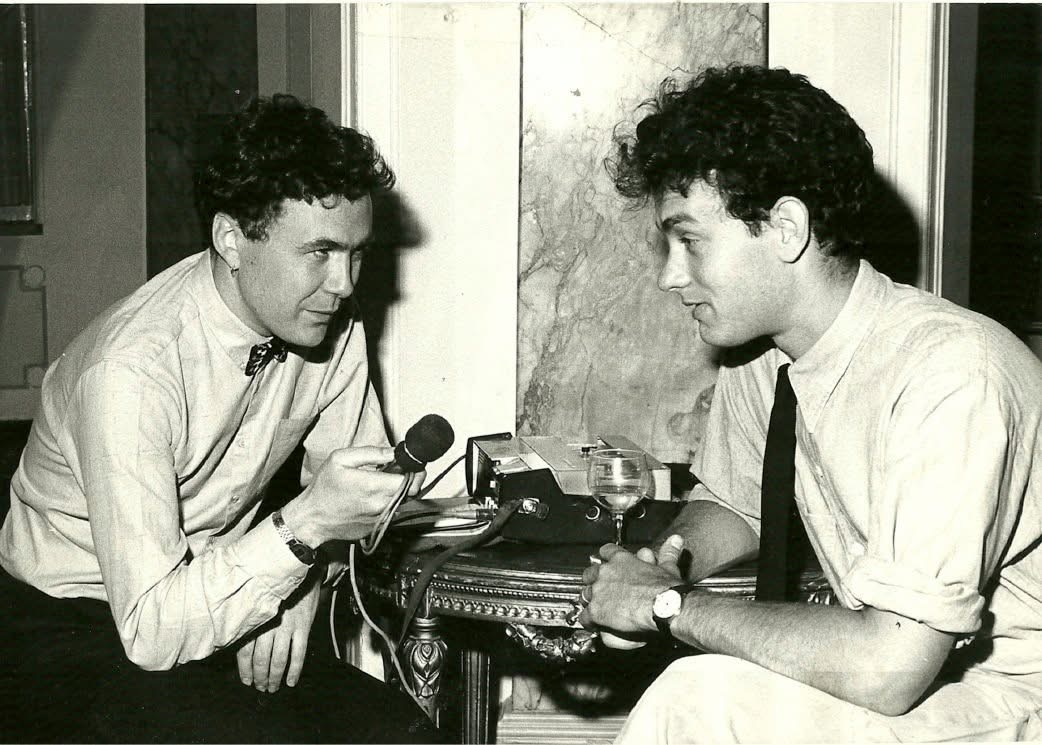
Al (Paul Bettany), who has recently returned from the Second World War, and his wife, Rose (Kelly Reilly), move into the house and start a family. One of their children is Richard, a frenetic, hyperactive sort, played by four different kids before transforming into Tom Hanks. The growing-up process encompasses cowboy hats, drum kits and eventually an obsession with the idea of becoming an artist. (Substitute the word ‘writer’ and I’m pretty much looking at my own youth.) With the use of sophisticated de-aging software, Hanks is exactly how I remember him in 1984 when, as a reporter for Piccadilly Radio, Manchester, I interviewed him for the film Splash. I make no apology for including that image here, because to my mind, this is the quality that Here (adapted by Eric Roth from a graphic novel by Richard McGuire) handles with considerable skill: the ability to transcend the limitations of time.

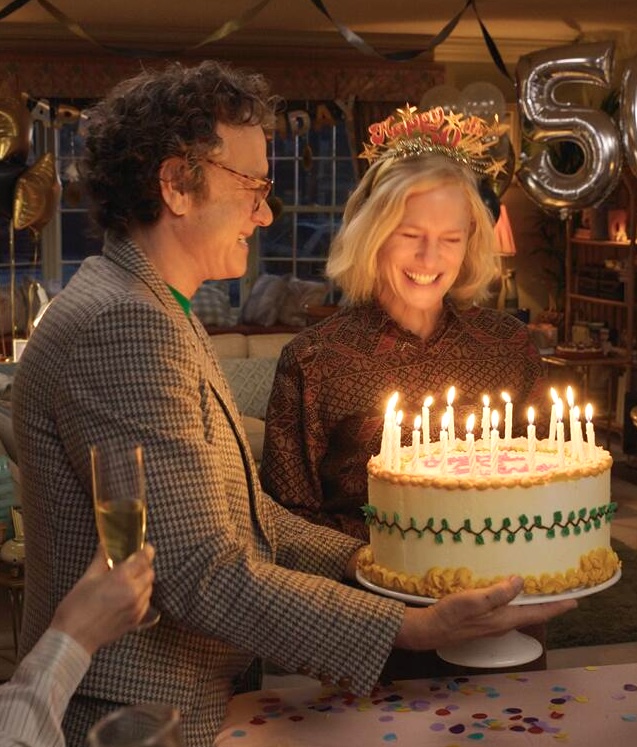
Richard introduces his parents to Margaret (Robin Wright) and, soon enough, she’s pregnant and Richard is beginning his own journey into adulthood, with all its joys, disappointments and trials. This central thread works well, but some of the other strands are less convincing. A narrative about a romance between a Native American brave and a young woman from his tribe feels too picture-book cute to be convincing – and I’d like to learn more about the Black family that moves in after Richard and Margaret have left the house. A scene where Devon Harris (Nicholas Pinnock) instructs his son Justin (Cache Vanderpuye) about what to do if his car is ever stopped by the police, hints at bigger themes that might have been more challenging than the invention of the La-Z-Boy armchair.

Here won’t be for everyone. The many strands that make up the narrative are occasionally somewhat confusing and that insistence on keeping the point of view so stubbornly fixed occasionally necessitates some unlikely seating arrangements in order to ensure that everybody remains in shot.

Still, I admire Zemeckis’s determination to keep pushing the boundaries of cinema and I think it’s fair to say that the man who gave us Back to the Future, Forrest Gump and Cast Away has earned the right to spend his time playing in the sand box. Here isn’t up there with his best work but it’s nonetheless an intriguing and highly original concept.

3.8 stars

Philip Caveney

Blade Runner 2049


05/10/17

The original Blade Runner (1982) is widely regarded as a classic of the sci fi genre. People forget that on its release, it didn’t receive much acclaim. The critics were distinctly sniffy about it and, for that matter, it didn’t exactly pack out the multiplexes. But, over the intervening years, its stature has grown, especially as original director Ridley Scott couldn’t seem to stop tinkering with it. This must surely be the only film where the Director’s Cut is actually shorter than the theatrical release?

When the news broke that there would be a sequel – and furthermore, that Scott would only be producing, rather than directing, expectations plummeted. But the appointment of Denis Villeneauve to the director’s seat definitely helped to bolster confidence; (his Arrival was one of the most acclaimed films of last year) and besides, Scott’s recent return to another of his franchises, with Alien Covenant, hadn’t exactly been the massive success everybody had predicted. Maybe it was the right thing to go forward with a new hand on the helm. Then the advance reviews for Blade Runner 2049 broke and it was, apparently, a masterpiece, a jaw-dropping work of staggering genius. The truth of course, is that it isn’t quite that, but it is an assured and credible sequel to the original film, which is pretty much all we could have hoped for.

It’s thirty years since the events of Blade Runner and a new generation of replicants – ones that are supposedly incapable of insurrection, are now taking on the work that humans disdain, including hunting down and ‘retiring’ the last remaining Nexus 6 models, who are still insisting on going about their business. ‘K’ (Ryan Gosling) is one of the new breed of ‘skin job’, working as a Blade Runner for the LAPD, under the direction of Lieutenant Joshi (Robin Wright). While hunting down renegade replicant Sapper Morten (Dave Bautista), K makes an unexpected discovery. Buried in a box beneath one of the world’s last surviving trees, are the remains of a woman. The pathology department soon establishes that she died in childbirth. The problem is, a serial number hidden in her bones identifies her as a replicant. And replicants are supposedly incapable of procreation. This is news that threatens to have world-changing repercussions and one, when you think about it, that is the basis for most religions.

If Villeneauve’s brief was to mirror the look and feel of the original movie, then this has to be regarded as a success. The squalid grandeur of the cityscapes are breathtakingly realised, the recreation of a smog laden, overcrowded dystopian Los Angeles is perfectly achieved – even Hans Zimmer’s eerie score manages to echo the feel of the Vangelis original while still somehow managing to be its own beast. The references to the first story are all cleverly integrated. Nothing ever feels tacked on.

But this is more than just an accomplished rehash. I particularly liked the concept of Joi (Ama de Armas), K’s virtual reality companion, which gives you an idea of where the likes of Siri and Alexa are eventually going to wind up. A VR creation capable of feeling love for its owner? This element is the film’s strongest card, (and a scene where Joi ‘borrows’ the body of another woman in order to make love to K is a standout); but there are plenty of other thought-provoking ideas in here, much more than the usual cartoonish ones we’ve become used to in this genre. They will have you discussing their implications long after the credits have rolled.

What exactly does it mean to be human? How important are memories to our evolution and to what degree can we trust them? And perhaps, most baffling of all… why does Harrison Ford never seem to get any older?

Okay, so the film isn’t quite perfect. Jared Leto’s Niander Wallace  – the man who has inherited and improved upon the Tyrell Corporation’s achievements – is a bit wearisome, to tell you the truth, given to intoning his lines like an Old Testament prophet; and while I appreciate that there must be fight scenes in a film like this, the climactic punch up between K and a supercharged female adversary seems to go on for just about forever. But the ending is cool. I really didn’t see that coming…

Inevitably, arguments will rage about this one. Some people are going to hate it. Some are going to insist that it’s way better than the original. But for me that will always be a solid gold five star picture, while this one? Close, but no cigar. Maybe just a slim panetella.

4.6 stars

Philip Caveney


Wonder Woman

05/06/17

The character of Wonder Woman first appeared, in comic form, in 1942. In 1976, portrayed by Linda Carter, she was the star of a TV series, which ran for a perfectly respectable three seasons. The inevitable question is, why has it taken so long for her to star in a big screen adaptation of her story? (I’m going to discount the brief appearance she made in last year’s Batman vs Superman.) Is it simply that the superhero genre has always been associated with ‘films for the lads?’ Did the powers-that-be actually believe that a woman wasn’t capable of carrying an entire movie? The last time it was tried was in 2004, with Catwoman – which, it has to be admitted, wasn’t exactly a success.

Whatever the reason, the wait has been worthwhile – because unlike most of DC’s other recent output, this film benefits from a great big shot of fun. The plot may occasionally raise your eyebrows but it’s hard to deny just how enjoyable a ride this is – at least until the final twenty minutes or so.

We first encounter our eponymous heroine in the modern day, as she receives a communication from Wayne Enterprises. This is DC trying to open out their shared universe, taking their lead, no doubt, from Marvel’s more confident approach. Then we are quickly whisked back in time to the mysterious island of Themiscyra, where the Amazons dwell. Young Diana is the only child on an island inhabited entirely by women – and before you ask the obvious question, she was fashioned from clay by her mother, Hippolyta (Connie Nielsen), with a little help from Zeus.  Hippolyta wants to protect her daughter from the evils of the outside world, and tries to steer her away from anything too physical, but Diana’s auntie, (Robin Wright) secretly coaches Diana in the ways of warfare so she will be able to fulfil her destiny and, pretty soon, she has grown up to be former physical training instructor Gal Gadot, a woman of such stunning physical beauty and strength, she might have descended from thoroughbred race horses.

Then one fateful day, a plane crashes on the island and Diana rescues the pilot, who turns out to be doe-eyed hunk, Steve Trevor (Chris Pine). Steve is a spy and, it turns out,  one who is carrying a very important notebook – something that he believes will help to end the First World War – for out in the real world it is 1916, and evil German officer, Ludendorff (Danny Huston, who, if not exactly chewing the scenery, is definitely giving it a pretty thorough nibble) is working alongside disfigured scientist, Dr Maru (Elena Anaya) to create a deadly nerve gas, one that Ludendorff thinks will turn the tide of the war and make his country victorious.

Pretty soon, Diana and Steve are on their way to London, with a tall order to fulfil – to end the war, once and for all. Okay, so this isn’t going to win any prizes for being the most convincing story ever written (indeed there are plot holes here you could comfortably drive an Amazon chariot through) but there’s real chemistry between Gadot and Pine and it does feel refreshingly empowering to see a woman handling the kind of kick-ass moves usually commandeered by the boys in spandex. There’s nicely judged comedy relief from Lucy Davis as Steve’s secretary, Etta, and some genuinely funny scenes where Diana’s gung ho attitude crashes headlong into the patriarchal conventions of the age. Despite what the naysayers are muttering, neither Diana nor Steve call the shots in this enterprise. They work together as a team.

My only beef with the film are those final twenty minutes, when inevitably, the limitations of the genre kick in and we’re plunged headlong into yet another over-pixilated punch up. As Diana and her nemesis, Ares, start picking up tanks and throwing them at each other, it simply serves to emphasise the point that what’s so good about this film is the way in which a superhero interacts with real people. But that quibble aside, there’s much to enjoy here and the news that director Patty Jenkins has already scored a record opening weekend for a female director is simply the icing on an already tasty cinematic confection.

If, like me, you’re a little tired of seeing moody blokes in capes thumping seven bells out of each other, this may be just the film for you.

4.2 stars

Philip Caveney