Robbie Morris

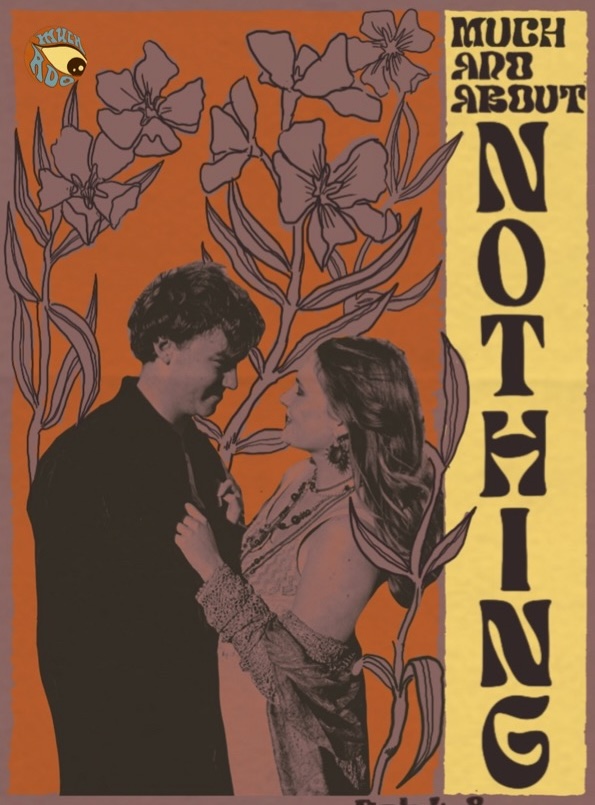
Much Ado About Nothing

06/02/25

Pleasance Theatre, Edinburgh

Let’s face it, judged by plot alone, Much Ado About Nothing is a bit, well… silly. Like most of Shakespeare’s comedies, the humour relies on disguise, misunderstandings and a fickle approach to romance. As an audience, we really have to suspend our disbelief. Would sworn enemies such as Benedick and Beatrice (Benedict Harrison and Verity Mann) really have an immediate change of heart thanks to some very unsubtly orchestrated eavesdropping? Both of them? It seems unlikely. Would a respected celebrant (Dylan Kaeuper) really suggest that a jilted bride should fake her death, or her father embrace the idea – agreeing that “death is the fairest cover for her shame”? Hmm. And would the groom – a mere twenty-four hours later – agree to marry his dead fiancé’s looky-likey cousin without ever setting eyes on her? I mean, that’s a no, right? Meanwhile, we’re also supposed to accept that no one in Leonato (Faolán Ingram)’s household suspects the decidedly dodgy – almost moustache-twirling – Don John (Cameron Broadly) of being a villain, despite the many outward clues. But still. It is what it is, and there’s a lot of fun to be had along the way.

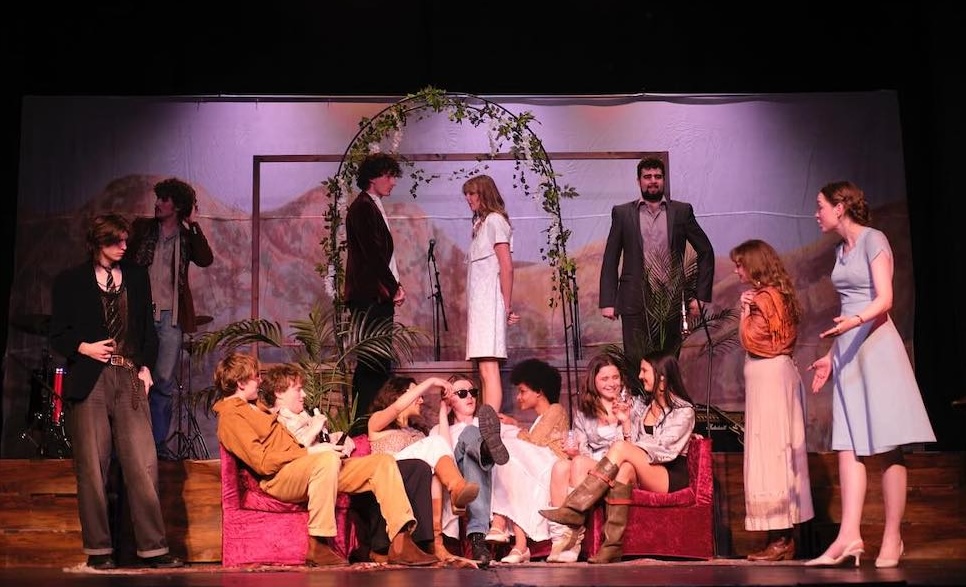
EUSC’s production of this sprawling play is sprightly and engaging. The directors (Madeleine Brown, Marina Funcasta and Anna Simurda) have chosen to emphasise the humour, eliciting larger-than-life performances from their actors rather than aiming for anything subtle – and I think this is a wise move. The action has been moved from Italy to California, from the 16th century to the 1970s but, while the period is clearly-evoked, I’m less certain about the place. There’s certainly a laid-back Summer of Love vibe, but most of the music is British (Bowie, Bolan, The Sweet, The Police) and the majority of characters speak with English accents, so it all feels a bit more Camden Town than Haight-Ashbury.

Leonato’s estate is Party Central as he and his wife, Antonia (Maria Wollgast), play host to the local socialites. What better way to make a match for their beloved daughter, Hero (Francesca Carter)? The dope is plentiful, the drinks are flowing – and love is in the air. Claudio (Rider Hartley) fancies his chances with Hero, and she’s rather keen on him as well. But “the course of true love never did run smooth” (yes, I know – wrong play), and what could go wrong with Don Pedro (Eric Parker)’s complicated plan to woo the girl on his friend’s behalf? Throw in some meddling servants, a fabulously drunken henchman (Fraser Murray), a local constable (Robbie Morris) and a veritable army of liggers – and the scene is set for some merry mayhem.

It’s a great idea to have a live band on stage, although I can’t help feeling they’re under-utilised. Still, the young cast are clearly having a ball, dressed up to the nines in flares and sequins (floppy hats off to costume designers Paloma Leigh-Stevenson, Alex Dunlop and Bea Fitz), their delivery as bold and brash as the script demands. Not everyone has a lot to do, but they all make the most of what there is, and there are some lovely moments of background detail, such as Margaret (Mia Dé)’s horrified realisation that her tryst with Borachio is being used to frame Hero. Harrison (Benedick) and Carter (Hero) are the standouts for me, but all of the actors and musicians perform with gusto, and I am thoroughly entertained.

There are just two more chances to catch this groovy rendition of Much Ado, so why not head on down to the Pleasance and hang loose with the hippies? Be sure to wear some flowers in your hair…

3.4 stars

Susan Singfield
1984

11/10/24

Bedlam Theatre, Edinburgh

George Orwell’s dystopian masterpiece has loomed large over 2024 for us. In April, we listened to Audible’s star-studded ‘immersive’ audio adaptation, where Andrew Garfield, Cynthia Erivo, Tom Hardy and Andrew Scott brought Oceania memorably to life. Immediately afterwards, we both read Sandra Newman’s Julia, a reworking of the novel from the lead female’s point of view. And today we’re here at Bedlam Theatre, ready to see EUTC’s interpretation of the cautionary tale.

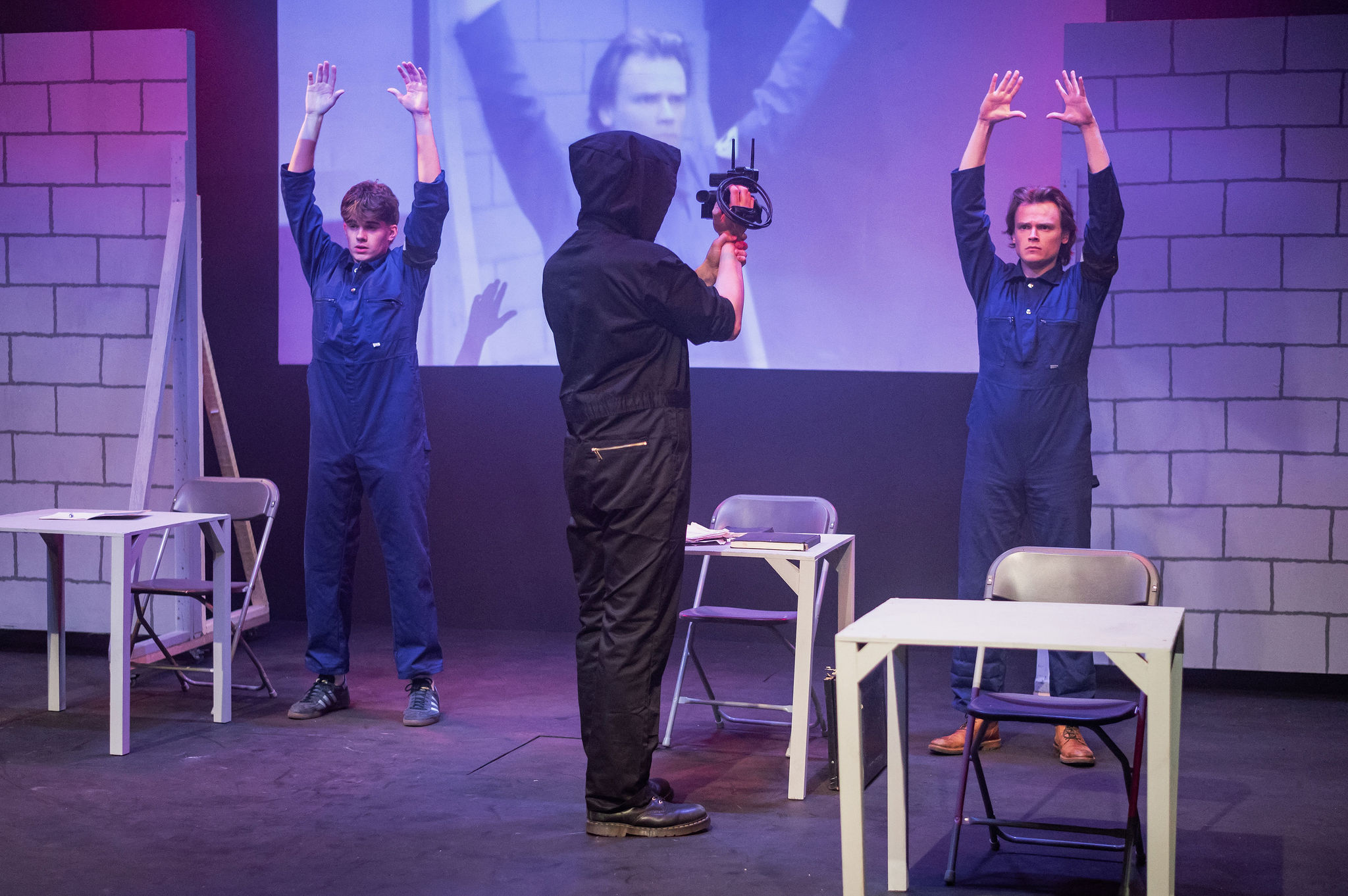
The use of screens projecting both pre-records (Lewis Eggeling) and live video (Tom Beazley) is inspired: there can’t be many stories more suited to a multi-media approach. The scene is set as soon as we enter the theatre: Big Brother (Thaddeus Buttrey) is watching us, a close-shot of his eyes filling the back drop. Instead of ushers, there are guards (Molly Gilbert, Rose Sarafilovic, Dylan Kaeuper and Fergus White), forbidding in their black uniforms, scarfs covering their lower faces. “All hand-held telescreens must be switched off,” one intones; “Silence!” bellows another. Predictably, we all comply.

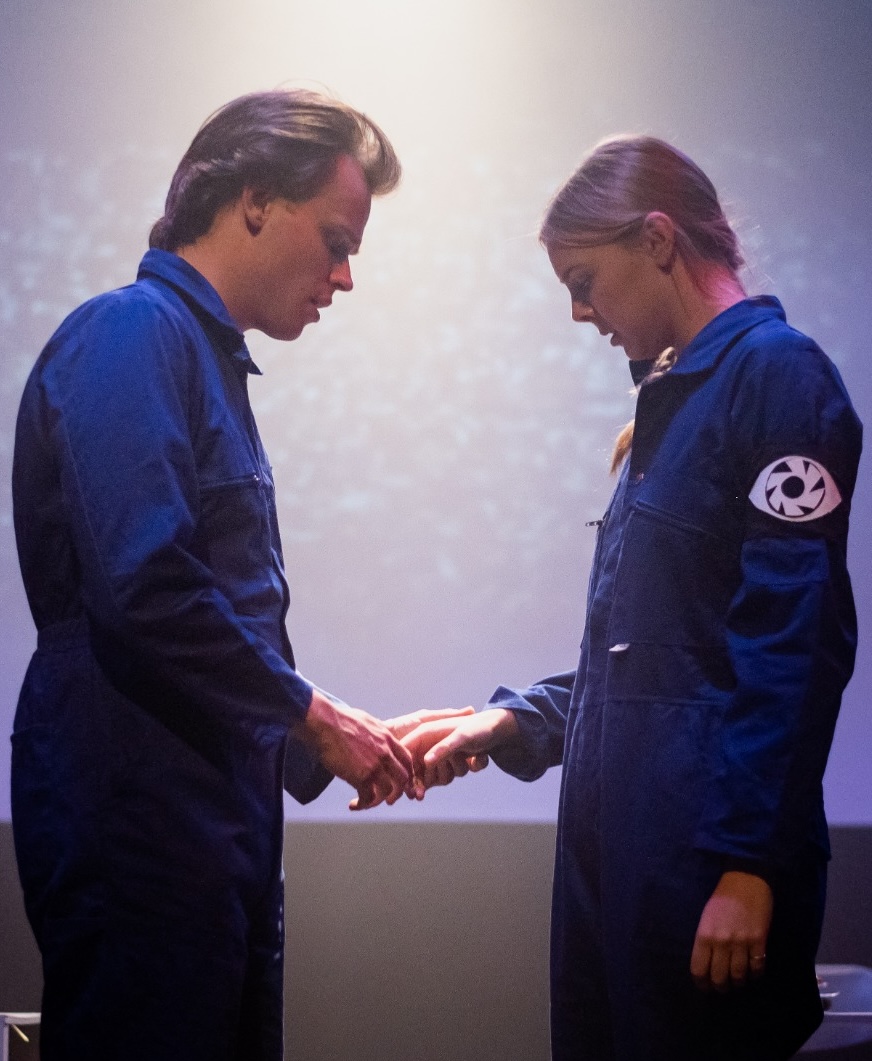
This adaptation (by Robert Owens, Wilton E Hall Jr, and William A Miles Jr) generally works well, plunging us immediately into the middle of the story. What used to be Britain is now part of Oceania, a sprawling dictatorship led by Big Brother, its impoverished citizens ruled with an iron rod by the unforgiving Party. By falling in love, Ministry of Truth workers Winston (Harry Foyle) and Julia (Francesca Carter) have broken the law and, having crossed that line, find themselves increasingly unable to swallow the propaganda they are fed. But what chance do they stand against the all-seeing apparatus of the State?

Director Hunter King does a great job of establishing a sense of threat, as well as highlighting the fragile humanity that endures, despite Big Brother’s best efforts to quash it. “They can make us say things,” as Julia acknowledges, “But they can’t make us think them.” As the central duo, Foyle and Carter both deliver flawless performances: Winston and Julia are convincingly reckless, persuading themselves that they are less vulnerable than they really are, caught up in the excitement of their affair. The story is so well known that there is a dramatic irony not present in the original plot, and King exploits this effectively, so that we find ourselves grieving for the couple even as their relationship blooms.

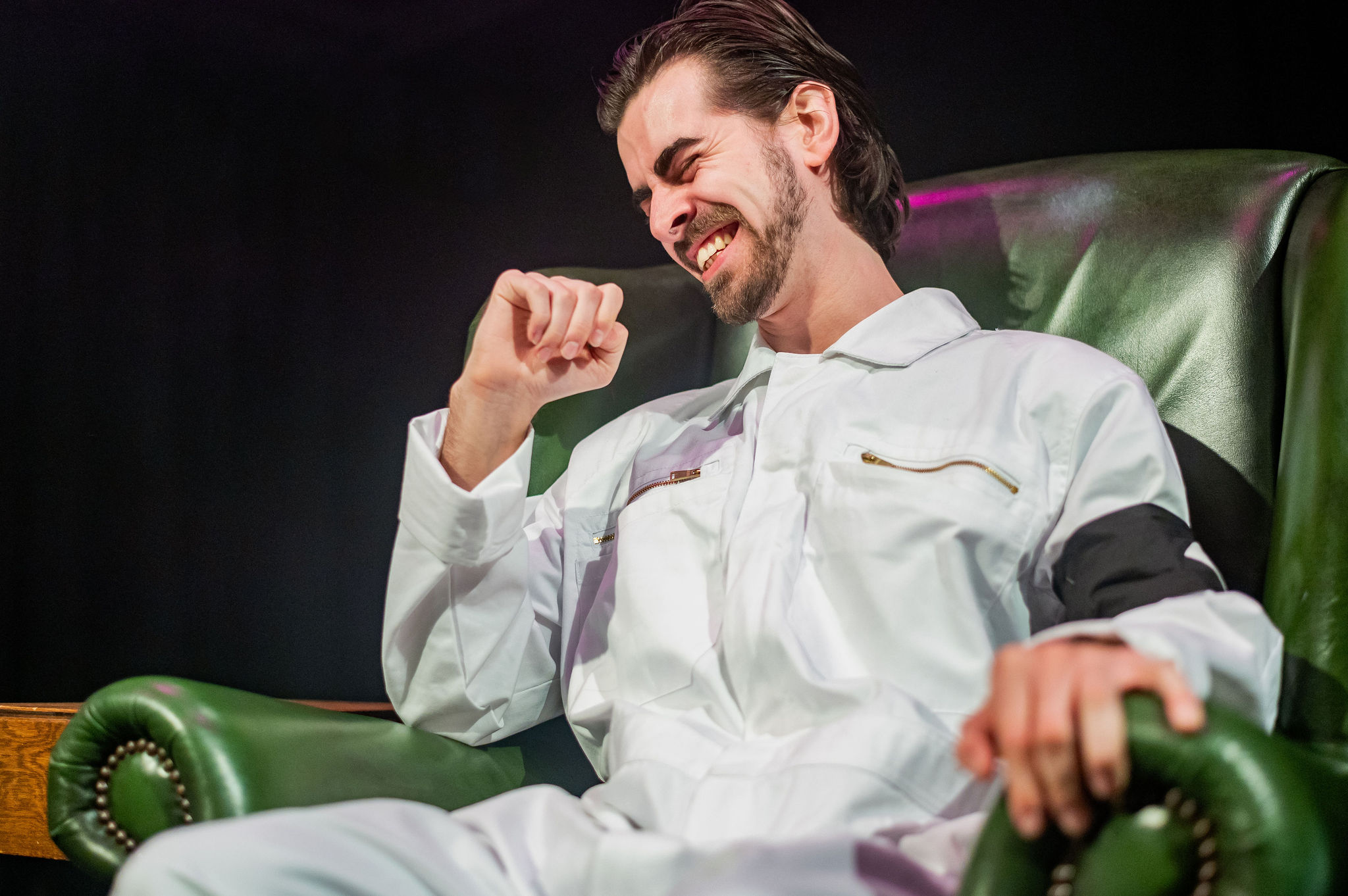
Robbie Morris is clearly having a whale of a time as smarmy backstabber, O’Brien, member of the Inner Party and chief snarer of the unwary. He plays the role as a kind of archetypal villain, complete with maniacal laugh, which makes for an interesting counterpoint, highlighting the freedom that comes with privilege: this is not a man who has ever felt the need to hide or even mute his feelings, unlike even the most loyal Party members. The only other character who seems uncowed is the landlady (Raphaella Hawkins), who owns the apartment Winston and Julia rent for their illicit lovemaking. As a Prole, she has a certain kind of liberty, born of being so poor and lowly that she’s considered unworthy of attention. It’s a dubious advantage.

As we’ve come to expect from Edinburgh University’s student shows, this is an impressive piece of theatre. I especially enjoy the fight sequences, directed by Rebecca Mahar, which are horribly credible and more brutal than I’m used to seeing on stage, ramping up the horror of this too-close-for-comfort imagined world. If I have a criticism, it’s more about the script than this production – there are a lot of actors without much to do, and I think more could be made of the ensemble. I’m also not sure why Winston and Julia get married – that’s not in the book and it doesn’t seem like there’s any dramatic purpose for the change.

That aside, EUTC’s 1984 is remarkable from start to finish, with even the final bows making a statement. It’s double-plus good.

4.4 stars

Susan Singfield