Morna Young

Sunset Song

30/05/24

Lyceum Theatre, Edinburgh

Lewis Grassic Gibbon’s Sunset Song is widely regarded as one of the most important Scottish novels of the 20th century. There are many who first encountered it as a set text in school and have carried it in their hearts ever since. Playwright Morna Young was evidently one such teenager and this is her adaptation of the tale in collaboration with Dundee Rep. I’ll confess that I’ve never got around to reading the book myself. Set in the 1900s, it’s a dour and sometimes bleak story based around the misadventures of the Guthrie family, farmers who live and work in (the fictional) Kinraddie in the wilds of Aberdeenshire.

When we first meet Chris Guthrie (Danielle Jam), she’s young and ambitious, a keen reader and already planning to seek a career as a teacher. In this, she has the grudging support of her father, John (Ali Craig), though he’s a hard taskmaster, never slow to hand out physical punishment to Chris and her siblings whenever they step over what he perceives as ‘the line.’ 

Chris’s much-loved mother, Jean (Rori Hawthorn), mentally broken by the recent birth of twins, takes matters into her own hands, killing herself and her new babies. Two younger children decide to flee  the family home to start a new life in Aberdeen and it isn’t long before Chris’s older brother, Will (Naomi Stirrat) follows their example and heads off to seek his own fortune in Argentina. This leaves Chris to run the farm with her father and, after he suffers a debilitating stroke, to fend off his sexual advances. When tragedy strikes yet again, Chris finally has an opportunity to start over but (maddeningly) she decides to stay where she is and marry local boy Ewan (Murray Fraser). But by now, the world is heading into a massive global conflict and it’s hardly a spoiler to say that more heartbreak is looming on the horizon…

While it does of course feature more than its fair share of harrowing occurrences, it’s to this production’s credit that it manages to convey difficult themes without ever feeling too prurient. Young’s adaptation remains true to the novel’s Doric dialogue, though occasionally I feel I’m told things that I would rather see – and the decision to have no costume changes when actors embody several different characters does mean that I’m occasionally confused as to who is who.

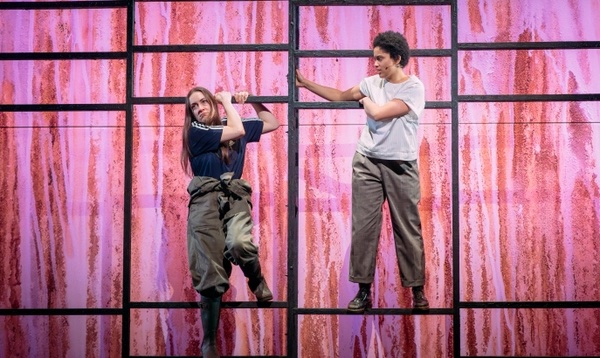
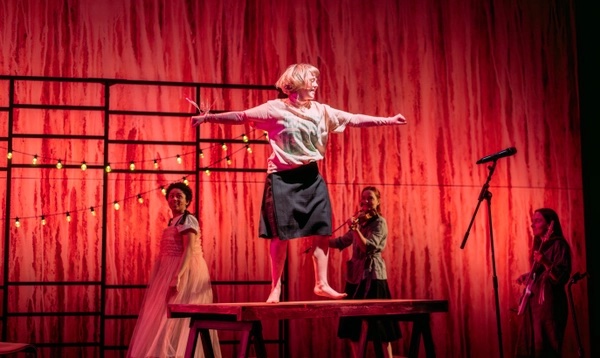
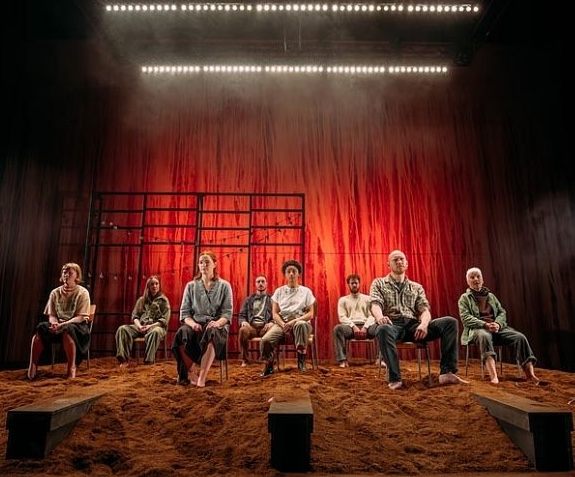
Emma Bailey’s simple but effective set design is based around a large rectangular section of soil, across which the characters walk barefoot, fight, make love and celebrate. The story’s central theme couldn’t be more evident. To the Guthries, the earth is all-important. It provides sustenance, a wage and a reason to go on living. And of course, it is also the place to which they will eventually return. As if to accentuate this, the backdrop is a closeup of a field of wheat.

On either side of the soil, musical instruments are arranged and the cast occasionally break off to deliver Finn Anderson’s evocative songs, singing in plaintive harmonies, pounding propulsive drums, strumming electric guitars and at one point even launching headlong into a spirited wedding ceilidh. These elements offer a welcome respite from the unrelenting bleakness of the story.

Finn de Hertog’s direction is assured and I particularly enjoy Emma Jones’ lighting design, which manages to convey that simple slab of soil in so many different ways. I like too that many of the props the actors require are clawed up out of the ground like a strange crop.

But much as I’d like to, I can’t really warm to the story, which at times feels uncomfortably like a series of disasters unleashed upon one luckless family.

3.6 stars

Philip Caveney
The Snow Queen

25/11/23

Lyceum Theatre, Edinburgh

Hans Christian Andersen’s The Snow Queen has never been my favourite fairytale. Although there are plenty of gloriously memorable images – and the book I had as a child was beautifully illustrated – I’ve always found the plot unwieldy. Happily, in this very Scottish adaptation, Morna Young does an excellent job of clearing the dead wood, jettisoning some of the unnecessary complications and illuminating the story’s season-appropriate warm heart.

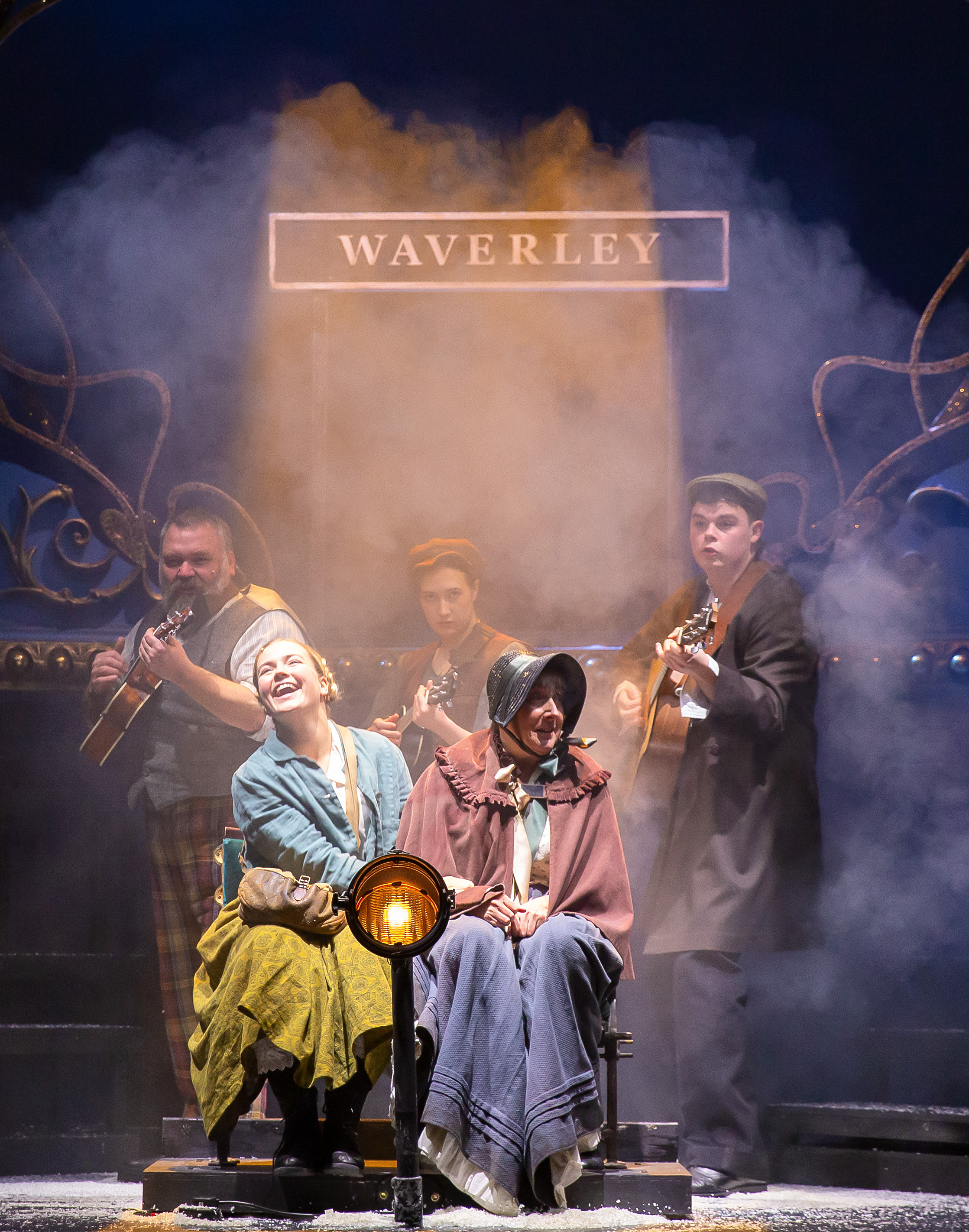
We start off in Victorian Edinburgh, where we were for last year’s An Edinburgh Christmas Carol. But we don’t stay there long: The Snow Queen is about a quest, so of course there’s an epic journey to be made. Best friends Gerda (Rosie Graham) and Kei (Sebastian Lim-Seet) are orphans, living with their respective grandparents. Every evening, they climb up onto the roof of their tenement to tend to their pot plants and plan for the future. Kei dreams of going to university, while Gerda wants to see the world.

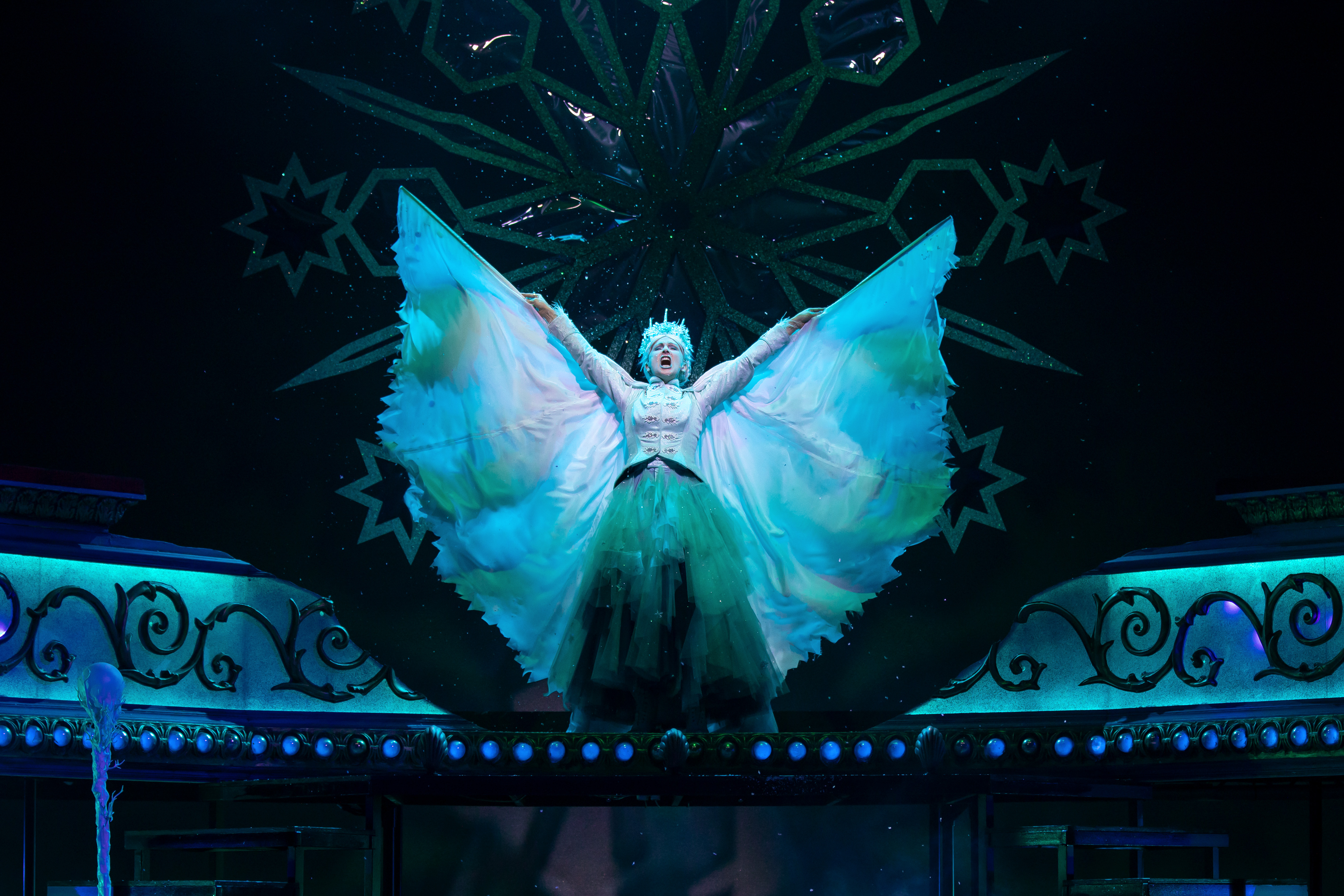
Meanwhile, in another realm, some trolls have broken a magic mirror and its shards have caused havoc, turning Beira, the Scottish Queen of Winter, into the evil Cailleach Bheur (Claire Dargo), determined to reign forever, and never relinquish her power to Bride, the Queen of Spring. Bride (Naomi Stirrat) isn’t strong enough to overpower the Snow Queen, but she does manage to slow her down – by planting five seeds of spring inside five human beings. So far, the Snow Queen has tracked down four… and now she thinks she knows where the fifth one lies. Kei doesn’t stand a chance. Corrupted by the magic mirror, he turns against Gerda and follows the Cailleach Bheur to her icy lair. But the Snow Queen has reckoned without Gerda, and underestimated the power of true friendship…

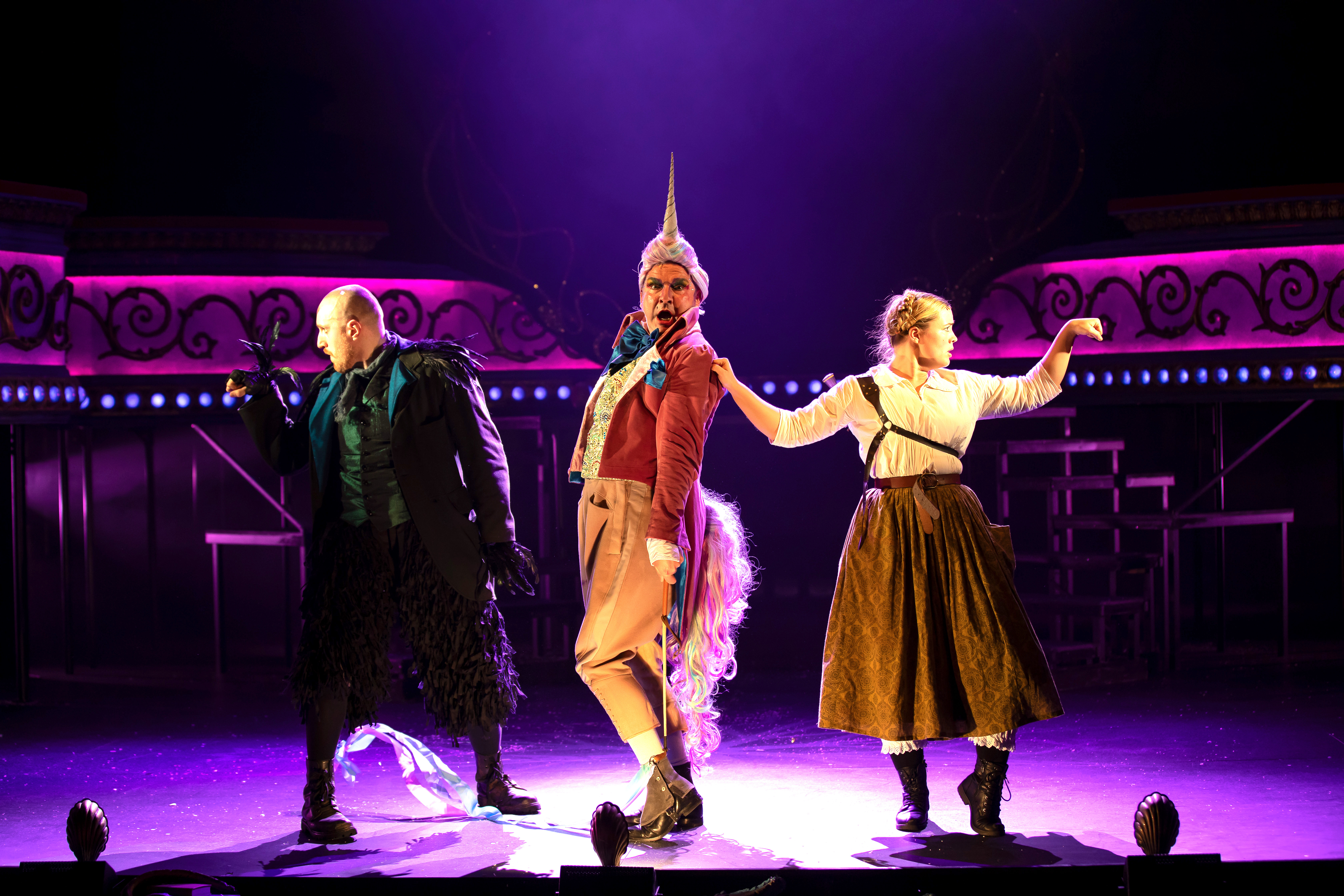
With a lively score by Finn Anderson and some very memorable songs – including Quines Gotta Fight and the innuendo-rich A Horse with a Horn – this production is as bold and vivacious as everything we’ve seen Cora Bissett direct. Graham and Lim-Seet convince as sweet and wholesome children, while Dargo’s white witch is suitably scary. Samuel Pashby – who plays Corbie, the Snow Queen’s corvid assistant – is an excellent clown, his gymnastic capers always engaging. But it’s Hamish the Unicorn (Richard Conlon) who steals the show, which does unbalance things a little – but, honestly, it doesn’t matter a jot. After all, this is a piece of festive family fun, and it’s hardly surprising that a rainbow-farting magical beast should be the mane (sorry) attraction.

I’m a little bit in love with Emily James’ set, which mirrors (and thus closes) the Lyceum’s dress circle, reflecting the theatre back at us. It’s huge and imposing and difficult for the actors to negotiate – and therein lies its beauty. The image is as in-your-face as it gets, too direct to count as subtext, and I admire its audacity. It’s impossible to ignore. James’ costumes are wonderfully opulent too: I’m drawn to the bright colours of the flowers in the fairy garden, and to the Cailleach Bheur’s shimmering pastels.

The Snow Queen straddles the line between theatre and panto, Hamish’s broad humour contrasting with the more serious underlying themes. For the most part, I think this works, although some of the jokes don’t land as well as they might, eliciting titters rather than belly laughs. Perhaps it would be an idea to have Hamish and Corbie engage more directly with the audience, signalling the tonal change. Nonetheless, the enthusiasm with which the final rendition of A Horse with a Horn is sung suggests that even the youngest attendees are fully on board.

A sparkling delight.

4 stars

Susan Singfield

The Stamping Ground

24/05/23

Festival Theatre, Edinburgh

As jukebox musicals go, The Stamping Ground – inspired by the back catalogue of the near legendary (and now, sadly defunct) Gaelic rock band, Runrig – is more coherent than most. Writer Morna Young has skilfully repurposed twenty of the band’s songs into the story of a community of contemporary villagers struggling to save their way of life.

Euan (Ali Watt) is the author of a series of bodice-ripping novels set in the Scottish Highlands, but his career has stalled. After his teenage daughter, Fiona (Caitlin Forbes), is beaten up by a gang of bullies, he and his wife, Annie (Jenny Hulse), decide to relocate from their home in London to Glenbeag, (‘Little Valley” in Gaelic), the remote village where they were raised, and where his widowed mother, Mary (Annie Grace), still lives. But Euan is horrified to discover that Mary is now close friends with Summer (Naomi Stirrat), the daughter of the man who, years ago was responsible for Euan’s father’s death.

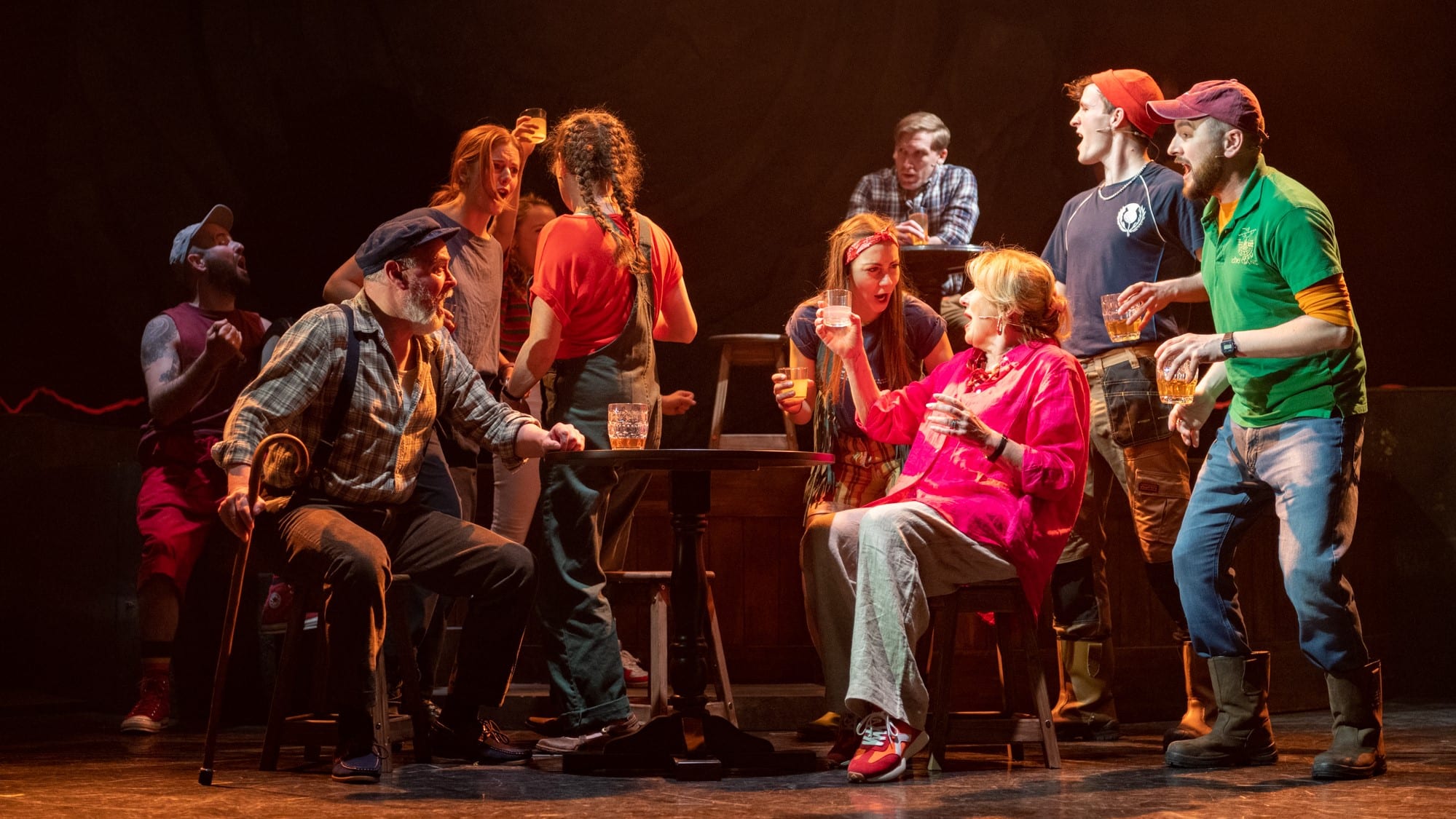
The family have arrived at a turbulent time for the village. The local inhabitants, who have already lost their cafe and post office, are now reeling from the news that their beloved pub may be the next thing to go, repurposed into holiday flats for visiting tourists. They all put their heads together to think of ways to raise money and it’s Annie who comes up with the idea of hosting a harvest festival. But when bad weather intervenes, its clear that a solution to the problem is not going to be easily found…

The Stamping Ground is, quite simply, a love letter to Scotland, a paean to the concept of people’s relationship to the land in which they live. It’s bold and vivacious, filled with likeable characters and fuelled by a mixture of plaintive melodies and rousing reels powered along by Stuart Semple’s propulsive drumming, John Mckenzie’s guitar and John Kielty’s keyboards. Members of the talented cast regularly grab other instruments to augment the songs as the story unfolds. While events occasionally come perilously close to sentimentality, I’d be lying if I denied filling up during Summer’s emotive ballad about leaving her friends – and, likewise, if I denied laughing out loud at some of the villager’s mischievous banter.

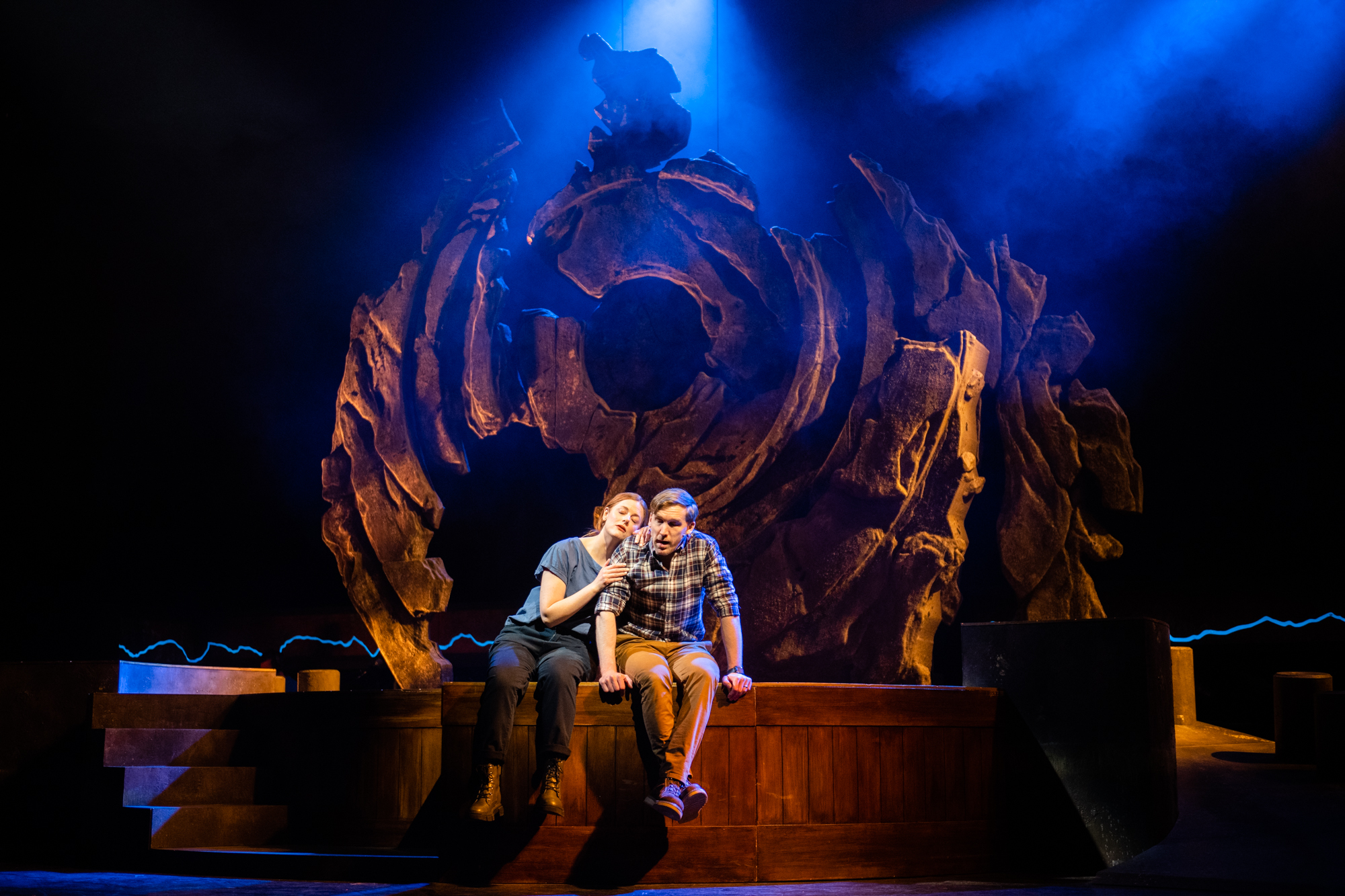
There’s a lot more here to enjoy. Kenneth McLoud’s fabulous set design, centred around the broken remains of an ancient standing stone, is a particular delight, while Jade Adams choreography and Luke Kernaghan’s direction keeps the whole enterprise bubbling to its stirring conclusion. By the end of the night the audience is on its feet clapping joyfully along to a rousing rendition of Loch Lomond.

The Stamping Ground is Scottish to its roots and never shies away from proudly saying so.

4 stars

Philip Caveney

Babs

14/03/23

Traverse Theatre, Edinburgh

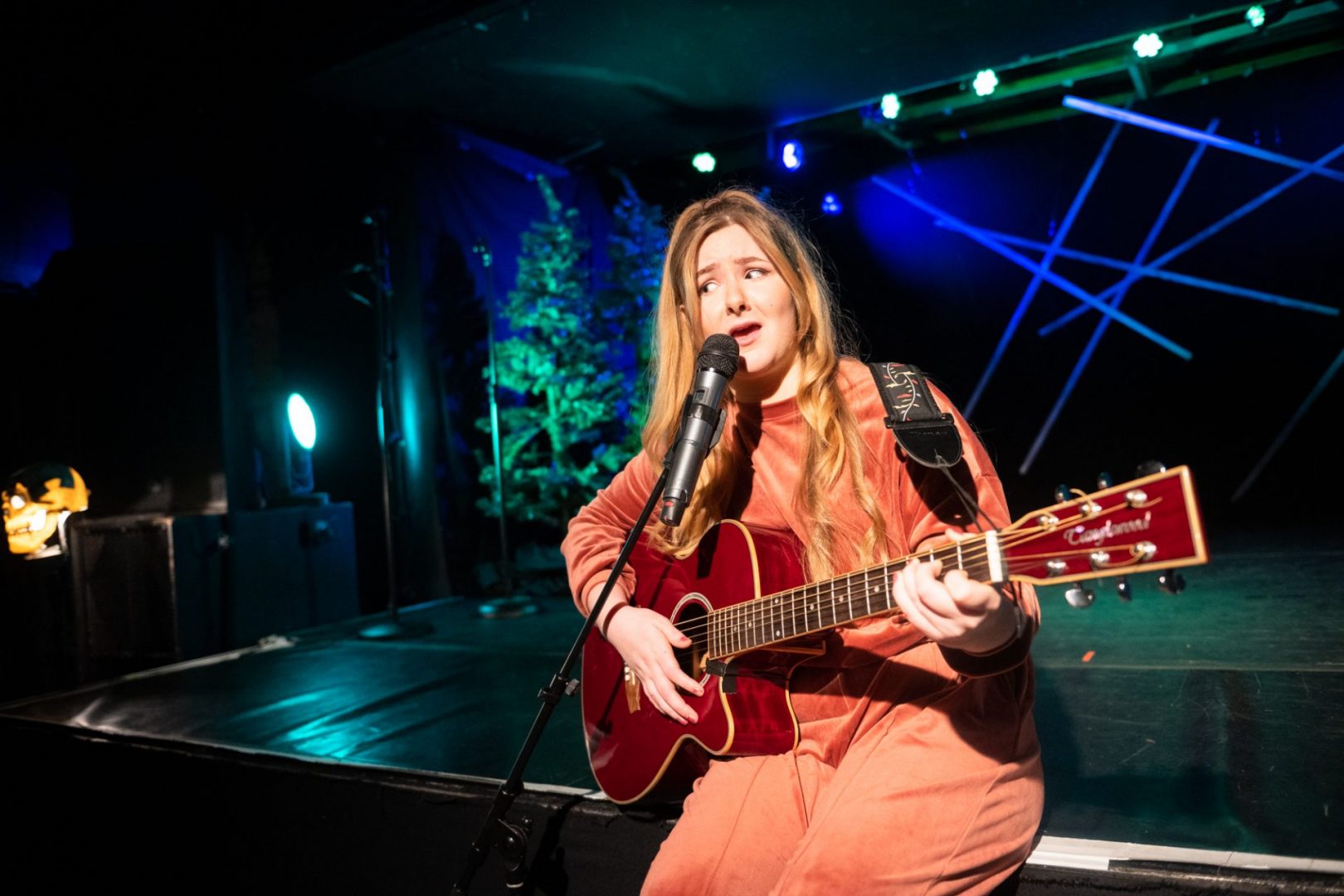
This week’s A Play, A Pie and A Pint is the pithily titled Babs by Morna Young. We’ve enjoyed Young’s work before – Lost at Sea and Aye, Elvis are both excellent examples of Scottish theatre – so we arrive at the Traverse this Tuesday lunch time with high expectations. The set, by Gemma Patchett and Jonny Scott, doesn’t give much away: there are a few fir trees, some pipes, a couple of skulls and a ukelele – an eclectic mix, promising something unusual.

We’re not disappointed.

Bethany Tennick plays Lisa, a troubled young quine from Aberdeen, who lives for her annual holiday with her best pal, Shelley. Apart from that, all Lisa has is her guitar, her tunes and a truckload of attitude. So when Shelley decides she’d rather go away with her new boyfriend, Gareth, Lisa is raging. How dare Shelley ditch her? Desperate and drunk, she signs up for a solo retreat, which turns out to be life-changing, because ‘Babs’, the mysterious host, is none other than Baba Yaga – she of the iron teeth and chicken-legged house… Why has she invited Lisa here?

Young’s decision to write the piece in Doric dialect gives it an urgent authenticity, underscoring Lisa’s need to be true to herself, even as she searches for a new identity. She is a bold, in-your-face character, and Tennick imbues her with such spark and vim that it’s impossible not to warm to her, even when she’s being completely unreasonable. The songs (composed by Tennick) add an extra dimension, showing us that Lisa has the potential to be more than ‘a sheep’, even if she can’t yet see it herself. The plaintive ode to her mother is especially emotive.

Despite its dark themes, Babs is essentially a comedy, and I spend much of the fifty-minute running time laughing at Lisa’s disproportionate outrage, or at her renditions of the other characters who populate the tale. Director Beth Morton keeps the pace snappy, and every joke lands well with the audience.

I’m fair-tricket to say this is another winner from 2023’s first PPP season.

4.2 stars

Susan Singfield

Lost At Sea

20/05/19

King’s Theatre, Edinburgh

Morna Young’s seafaring play is a searing, tempestuous examination of fishing communities in the Northeast of Scotland. From the heydays of the 1980s, when the money was rolling in, to the more elitist issues of the early 2000s, when only a select few were still living it large, we are shown the strengths and divisions within these close-knit neighbourhoods and the cruel toll the sea exacts on them.

Journalist Shona (Sophia McLean) returns to the fishing village she left when she was just a child. She is looking for answers: her father, Jock (Ali Craig), died, lost at sea, and she needs to find out more, to know what happened on that fateful day. But the locals close ranks on her: they’ve lost too many; suffered too much; accepted the Faustian exchange that keeps them all in work.

Young’s own father was lost at sea, and this piece blends fiction with that reality. There are verbatim voices – telling of the fishermen’s arduous days at sea and their families’ agonising waits on land – interwoven with constructed dialogue; the authentic details of a fishing life and a fictional account of one woman’s family. It’s a powerful mixture.

There are politics here too: the cameradie and team spirit of the 1980s gives way to a far more cynical individualism and – by 2012 – the community is bitterly divided. Shona’s Uncle Kevin (Andy Clark) has taken advantage of the UK’s strange decision to enable its fishermen to sell their EU quotas to the highest bidder, often to foreign investors. (No other EU country allowed this – for obvious reasons.) In Kevin’s case, it means he’s safe, no longer endangering his life at sea, just staying home and waiting for the money to pour in. But, as Skipper (Tam Dean Burn) reminds him, this means that those around him are risking their lives for an ever diminishing slice of the pie. What price community?

This could be a heavy, sombre tale, but Ian Brown’s nimble direction ensures that it is fleet of foot, as restless as the sea itself. The ensemble work is precise and light, the movement (by Jim Manganello) evoking rolling waves, and turbulent emotions. The spare set (designed by Karen Tennent) lends the piece a stark brutality, with restless projections of a dark and ominous sea.

If we don’t quite get the cathartic thrill of a dramatic climax, we do at least get a thought-provoking piece of theatre, straddling introspection and social commentary. It’s not exactly an easy watch, but it’s certainly most worthwhile.

4 stars

Susan Singfield


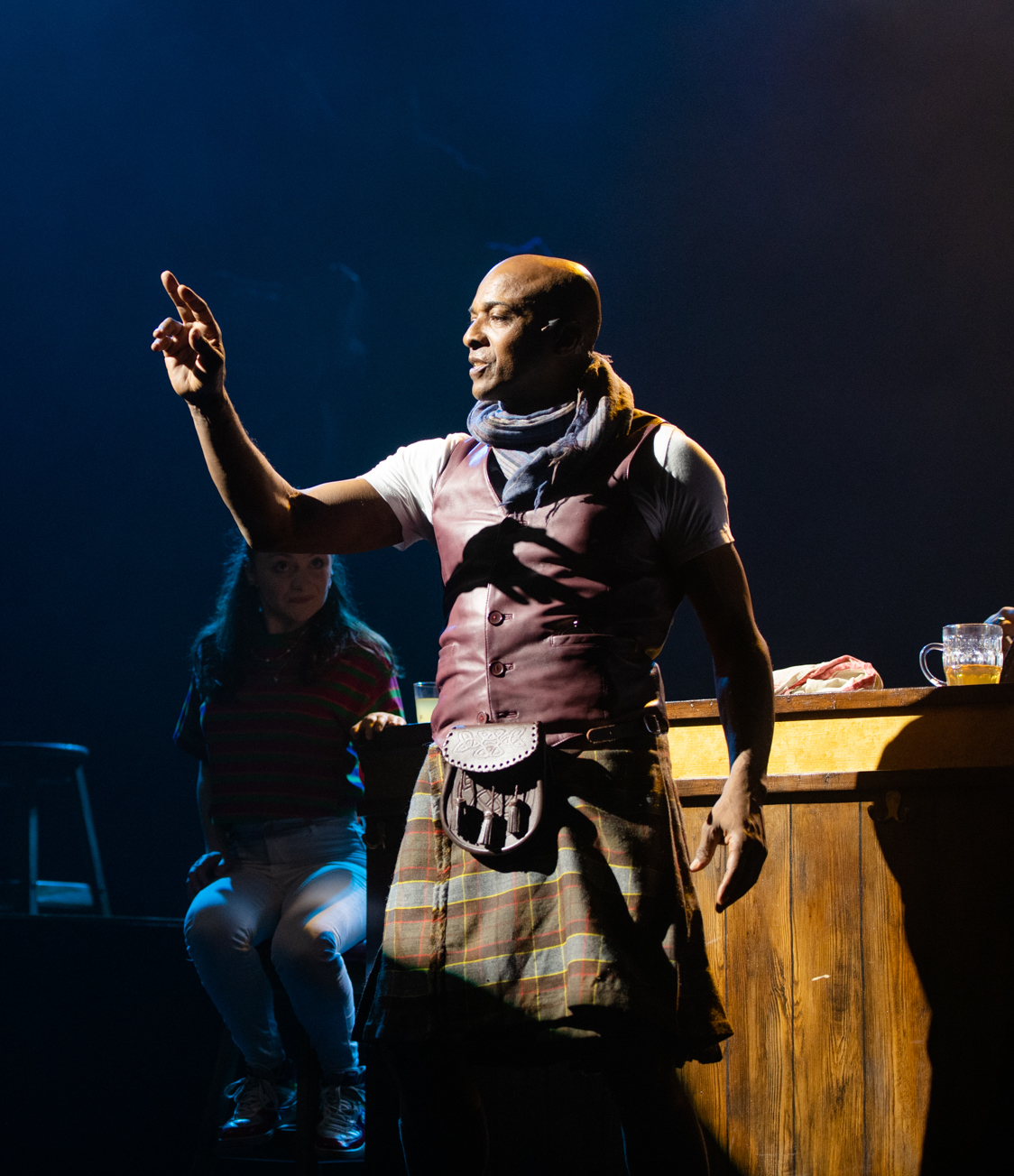
Aye, Elvis

10/08/18

Gilded Balloon, Rose Theatre, Edinburgh

Joyce Falconer stars as Joanie in Morna Young’s engaging play. Joanie’s world is dreary and dull: she bickers daily with her housebound mum, and dreams of something more exciting than her supermarket checkout job. Singing karaoke at the local pub leads to an obsession with Elvis, and she sets herself up as a tribute act, drawn into the cameraderie of online chat groups dedicated to the King. Encouraged by Fat Bob, the pub landlord, she sets out on an ambitious project that is sure to change her life.

Aye, Elvis is a big hit with tonight’s (largely Scottish) audience, who are vocally appreciative throughout, joining in with the big numbers, clapping and laughing and generally enjoying what they see. It’s not hard to see why: this is entertaining, feelgood stuff: silly and poignant and hilarious throughout. Falconer clearly has a strong fan-base here; she has a twinkle in her eye, and seems to be relishing her time on this small stage. Karen Ramsey makes the most of some deliciously acerbic lines as Joanie’s crabby mum, and David McGowan’s Fat Bob is a charming, calming presence.

Dazzlingly costumed and played for laughs, this is a lot of fun, and definitely worth making a trip to see. It even gets a standing ovation from the crowd – the first we’ve seen at this year’s Fringe.

4 stars

Susan Singfield