Michael Fassbender

Black Bag

15/03/25

Cineworld, Edinburgh

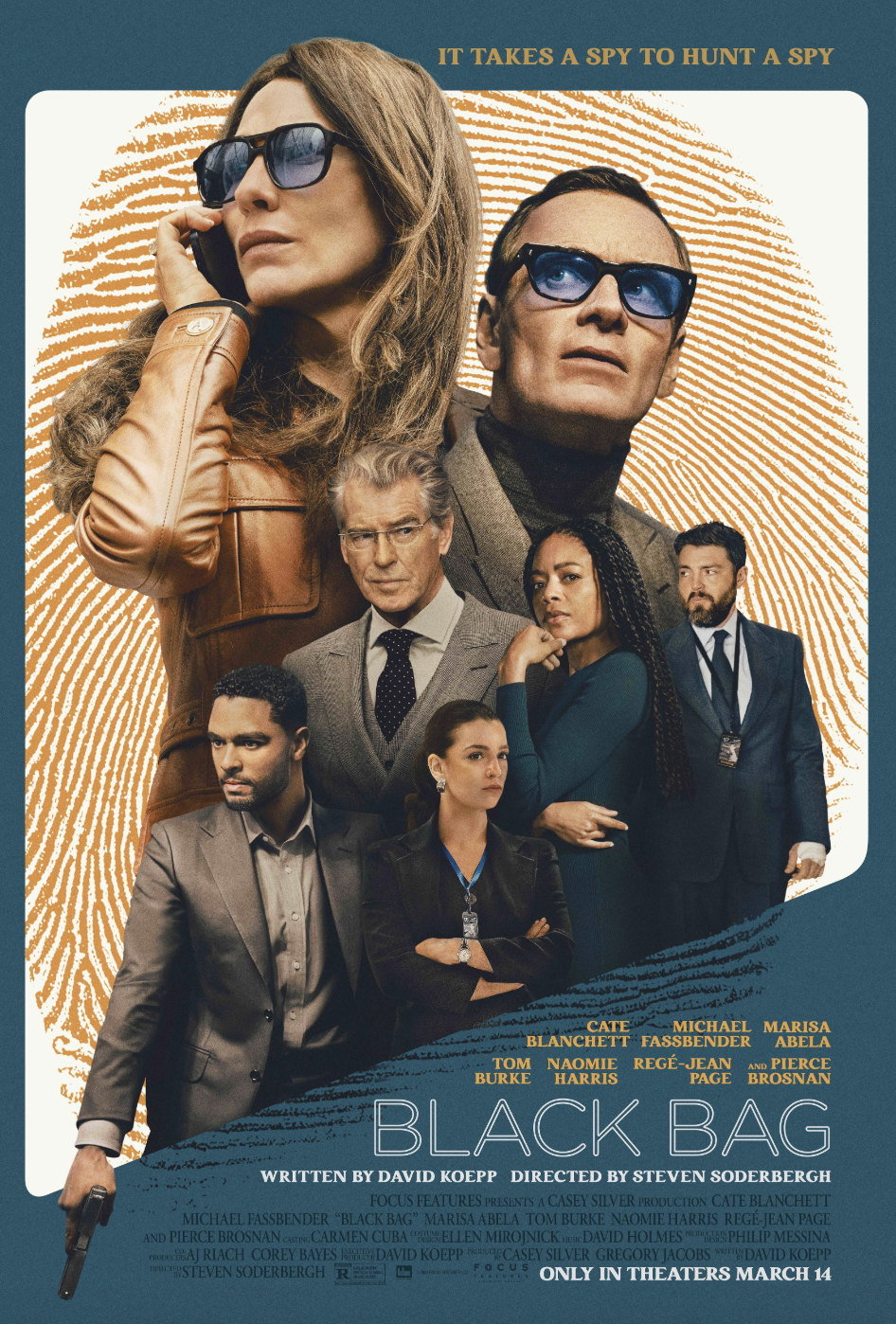
Meanwhile, back in the most unconvincing retirement since Frank Sinatra announced his ‘final’ tour, Steven Soderbergh has a new film. (We reviewed his previous effort, Presence, in January.) So he’s more productive than most of his peers and, if it sometimes feels as though he’s simply ticking some boxes here – “Ooh, I haven’t done a proper spy movie before!” – Black Bag is yet another notch on his belt, even if it seems like his latest opus is a little too understated for comfort.

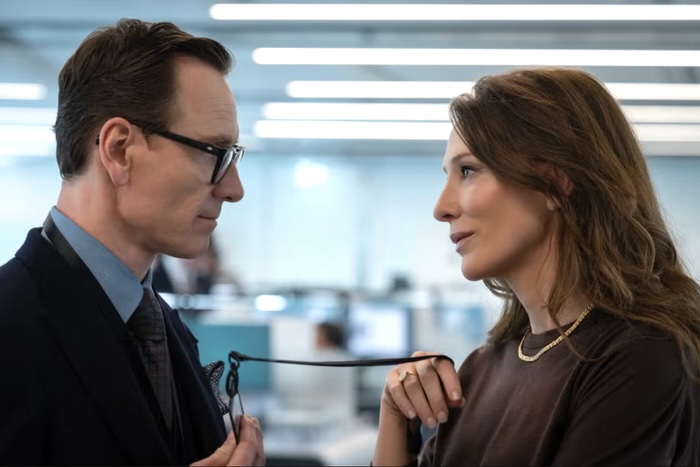
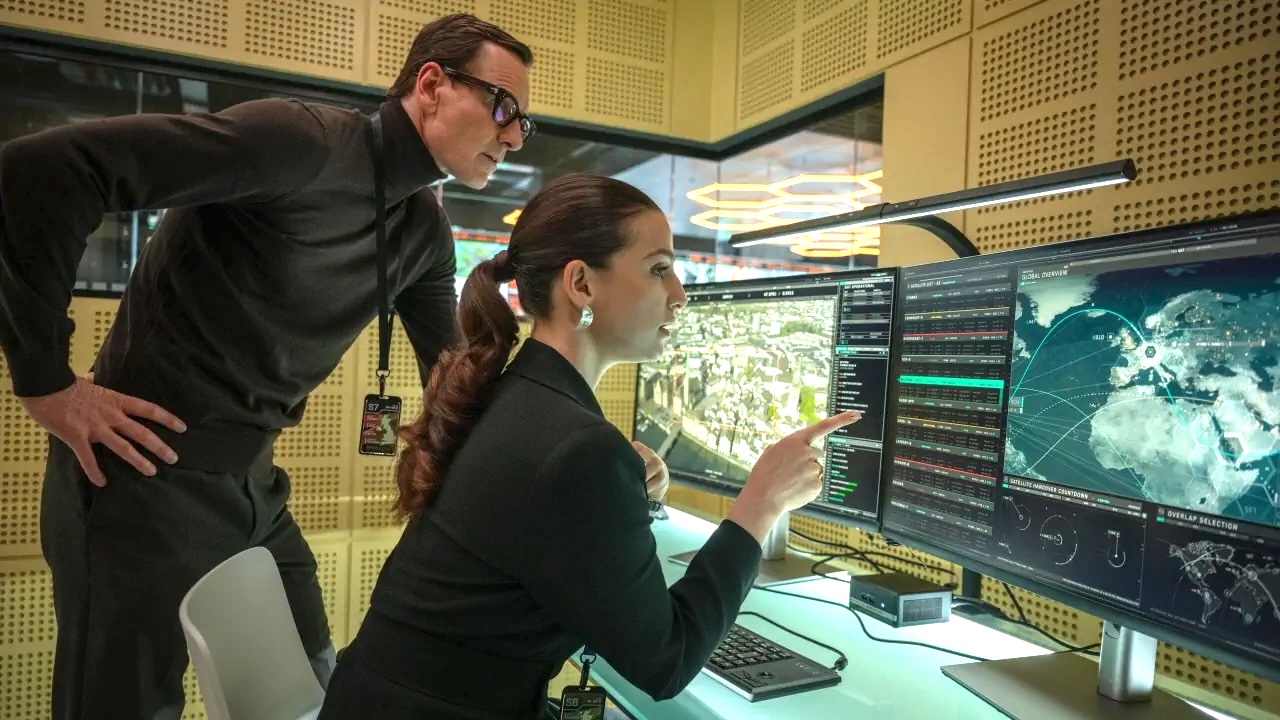
British intelligence officer George Woodhouse (Michael Fassbender) is contacted by his superior, ‘Meachum’ (Gustaf Skarsgaard), to investigate the leak of a top-secret software programme called ‘Severus.’ (It might just as readily have been named ‘McGuffin.) All we really know about Severus is that, if it falls into the wrong hands, thousands of people could die, though exactly how is a matter of conjecture. Meachum warns George that amongst the suspects is Woodhouse’s wife and fellow-operative, Kathryn (Cate Blanchett), who – George has to reluctantly admit to himself – has been behaving rather suspiciously of late. But he trusts her implicitly… doesn’t he? Meachum gives George a week to find out who is responsible but, shortly afterwards, Meachum succumbs to an unlikely heart attack and dies.

George is a meticulous operative and he promptly invites the four other suspects – all of them fellow spies – to a dinner party at his house, where he spikes a bowl of curry with a truth serum (after first warning Kathryn not to eat any). But who is the most likely candidate for this betrayal? Could it be satellite imagery expert, Clarissa (Marisa Abela)? Her current boyfriend, Freddie (Tom Burke), who is himself having an affair with… somebody? What about the agency psychiatrist, Zoe (Naomi Harris), who is privy to all their secrets? Or her current squeeze, James (Regé Jean Page), a man who is perhaps a little too cool and handsome to be entirely trustworthy?

To add a little extra spice, the agency’s overall boss, Arthur Steiglitz (Pierce Brosnan), would also appear to have some skin in the game…

Black Bag is, I suppose, a slice of cold-war claustrophobia. The title refers to the two-word excuse given by operatives when they don’t want their recent escapades to be investigated too closely. Soderburgh keeps everything bubbling along as David Koepp’s script switches slickly back and forth between the various machinations, and there are some cyber-tech scenes where suspects are investigated by hidden cameras… but there’s a problem here: it’s that I’m simply not invested enough in the characters to care what happens to them. The most interesting scene is the one where the four suspects undergo lie-detector tests and Soderbergh has fun cutting back and forth between their respective POVs, but that’s not really enough to keep me hooked through the entire hour-and-a-half run time.

And the closing scene’s final ‘twist’ doesn’t feel like enough justification for the whole enterprise. So, decent-ish, I guess, but certainly not up there with the director’s finest work.

So, let’s see what he has up his sleeve. It occurs to me that he’s never really done a cannibal holocaust movie. Who knows? It could just happen.

3.2 stars

Philip Caveney

Kneecap

04/01/25

Amazon Prime

Kneecap, a semi-fictionalised origin story for the titular Irish hip hop band, only had a short theatrical release, despite winning big at Sundance and being shortlisted for two Oscars. We missed it on the big screen, so we are pleased to discover that it has dropped, with barely a splash, onto Amazon Prime.

Liam (Liam Ó Hanneadh) and Naoise (Naoise Ó Cairealláin) are two disaffected teenagers, living in the Gaeltacht (or Irish-speaking) Quarter of West Belfast. At a drug-fuelled party, Liam is picked up by the police and brought into an interrogation room but, true to his father Arlo’s teaching, he refuses to speak any language but his native tongue. Arlo (Michael Fassbender) is a former republican paramilitary, who has been missing-presumed-dead for a decade.

A call for an interpreter is put out and mild-mannered music teacher JJ O’ Dochartaigh reluctantly does the honours but, since the cops can only speak English, JJ and Liam are able run rings around them and report back only a fraction of what they actually say. JJ ends up in possession of Liam’s notebook, which he discovers is full of potential lyrics. By lucky coincidence, JJ just happens to be the proud owner of a ramshackle recording studio in his garage.

He suggests that Liam and Noise might like to lay down some tracks – and, almost before they know it, the three of them are performing in a local working man’s club, stoned to the gizzards on Ketamine with JJ wearing a balaclava in case anybody recognises him. But when a barmaid films a clip of their performance and puts it onto social media, it isn’t long before their foul-mouthed, blatantly political act is reaching the ears of a younger audience…

Kneecap (named after the IRA’s favourite punishment) is a ton of fun, quirky, acerbic and fearlessly provocative, but it does have a more serious subtext about the cultural importance of a country’s native tongue and how it needs to be celebrated and protected. Debut writer/director Richard Peppiatt has created a genuinely funny script, brimming with snarky one-liners, and I love the many comic-book captions and images that pepper the visual storytelling. The three band members do a pretty good job of portraying themselves, while Simone Kirby puts in a great performance as Liam’s agoraphobic mum, Dolores, and Josie Walker is deliciously menacing as local police chief Detective Ellis, enraged when she discovers that her Protestant niece, Georgia (Jessica Reynolds), is having a fling with Naoise – a Catholic!

The songs are mostly an outpouring of curses and boasts, propelled by urgent 4/4 rhythms. I don’t speak Irish, so I’m very grateful for the subtitles (the script is a 50/50 mix of Irish and English), but it’s clear from the concert sequences that Kneecap have already established a fervent following on their home turf and this film is sure to bring their music to a wider audience.

Interested? Head straight to Amazon where the party can be joined at the touch of a button.

4.2 stars

Philip Caveney

Chicken

18/04/24

Traverse Theatre, Edinburgh

It’s certainly a memorable entrance as Eva O’Connor struts and pecks her fretful way onto the stage of The Traverse, clad in an ingenious suit (designed by Bryony Rumble) that transforms her into the creature of the title. That said, she is no ordinary chicken. O’Connor plays Don Murphy, a proud Kerry cockerel and a ‘true son of Ireland.’ Hatched on a beach and full of ambition, he begins the long and eventful journey to stardom with dogged determination, working his way from appearing as Jesus in a local nativity play to the dizzy heights of Hollywood. I mean, come on, how many chickens do you know that have actually won a mother-clucking Oscar?

Chicken, co-written by O’Connor with Hildegard Ryan, is certainly like nothing I’ve ever seen before and O’Connor’s performance is a study in utter commitment as she circles the stage, staring intently into the audience, flapping her wings and flinging out chicken-related puns with absolute conviction. Don, it turns out, is also an inveterate name-dropper. He’s worked with all the biggest Irish film stars – Michael Fassbender, Colin O’Farrell, Brendan Gleeson – and he’s had some strange encounters along the way.

But things become more unsettled when he crosses paths with a daring avian performance artist who reminds him that not all chickens are as lucky as he – and that many of them are destined for the dinner plates of humanity.

For all O’Connor’s undoubted skills as a performer, Chicken is ultimately a little too one-note for comfort. Though exquisitely told and punctuated by a couple of spirited, strobe-lit dance sequences (courtesy of Marianne Nightingale), it doesn’t really have anywhere else to go. By the time Don tells us of his return to his roots in Derry – to star in a Martin McDonagh movie, no less – I’m starting to wish the piece would progress in some more fundamental way, other than pointing out the ultimate limitations of Don’s poultry form. But then, quite without warning it reaches its conclusion.

All respect to O’Connor who gives this 100%, but ultimately I am left wanting more. Happily, that doesn’t extend to calling in at Nando’s on the way home.

3 stars

Philip Caveney

The Killer

13/11/23

Netflix

The arrival of a new film by David Fincher is always of interest, but apart from limited screenings at a few independent cinemas, The Killer has quietly dropped onto Netflix without much trumpeting. Based on Alexis Nolent’s graphic novel of the same name, this sees Michael Fassbender as the titular assassin, who, when we first encounter him, is stalking his latest target, whilst simultaneously providing a running commentary. This comes across as a self-help manual for would-be professional murderers and would perhaps be more impressive if the projected hit didn’t go spectacularly awry.

But it does and, shortly afterwards, a revenge attack is carried out on our psychopathic hero’s nearest and dearest, whereupon (cliché alert!) he is obliged to travel around the world ensuring that those who were hired to clean up after his errors are brought to book in the severest manner possible.

Fincher is an accomplished director and the long opening sequence is beautifully handled, the tension and suspense steadily mounting as the seconds tick by. Likewise, an extended fight sequence in an apartment somewhere in Florida is brutally and viscerally captured in bone-crunching detail. The assassin’s preoccupation with listening to The Smiths as he works provides a wonderfully quirky detail and Erik Messerschmidt’s sleek cinematography is a delight.

But there’s an inherent problem here and it’s one of empathy. It’s hard for a viewer to care about a sociopath and even harder to sympathise with him when he’s given the kind of rough treatment he generally doles out to his victims. We never really learn anything about them – or him for that matter – and the only other person we meet in any detail, The Expert (Tilda Swinton), isn’t on screen long enough to make her presence felt.

Ultimately, this is an exercise in style that needs more content to back it up. Yes, the various components are masterfully assembled, and yes, it’s an example of skilfully-constructed images, but I’m left chasing shadows for the best part of two hours and, no matter how artfully that’s depicted, it’s really not enough to make this a satisfying piece of cinema.

3.4 stars

Philip Caveney

The Snowman


25/10/17

Apart from the occasional exception, the name ‘Michael Fassbender’ attached to a film used to stand for a guarantee of some kind of quality (although, since Assassin’s Creed, he doesn’t seem to have put a foot right). Director Tomas Alfredsen did a fabulous job with Let the Right One In, and his Tinker Tailor Soldier Spy adaptation received a lot of acclaim (even if it did leave me feeling indifferent). Still, put the two men together on an adaptation of one of Jo Nesbo’s hugely successful scandi-noir thrillers and for good measure, bring in Soren Sveistrup (of The Killing) to co-write the screenplay, and you’ve got at least a chance of a winner, right?

Well, no, I’m afraid not. It’s hard to understand quite how The Snowman can have gone so spectacularly wrong, but wrong it undoubtedly goes, a two hour opus that actually feels more like four, so turgid is the storytelling. It doesn’t help that wonderful character actors like Toby Jones and Adrian Dunbar are reduced to standing around spouting bits of clunky exposition whilst looking vaguely embarrassed, or that the plot is so ridiculously convoluted it beggars belief. Most damning of all in a procedural is that the eventual unveiling of a killer seems designed to surprise absolutely no-one, since it’s evident from about half an hour in who that killer is going to be – simply because we are presented with no other possible suspects.

Harry Hole (Fassbender) is a washed-up detective, reduced to drinking himself insensible in children’s playgrounds, after a messy break-up from his partner, Rakel (Charlotte Gainsbourg), whom he still carries a torch for, and his teenage stepson, Oleg (Michael Yates). When new recruit Katrine Bratt (Rebecca Ferguson) joins Harry’s team, the two of them work together to investigate a series of seemingly random killings, which are always marked by the presence of a snowman at the murder scene. This being Norway in the depths of winter, there are presumably an awful lot of snowmen about – and, when a character surmises that it’s probably falling snow that sets the killer off, it’s hard not to smile. The film occasionally flashes back to the events of nine years earlier in which another alcoholic detective, Rafto (Val Kilmer), stumbles around investigating a similar case – but the film is so clumsily edited, we’re not always sure what is past and what is present. Kilmer, by the way, is positively unreal. I get the impression that his efforts have been edited down to the bare minimum.

What else can I tell you? What might have generated suspense on the printed page doesn’t really work on film. The smiling snowmen featured throughout the story are no doubt intended to come across as sinister, but here they just cause unintended sniggers – and how is that Harry, a hopeless chain-smoking alcoholic, still manages to sport a six-pack that would make Charles Atlas suitably envious?

I hate to be so negative, so let me just say that those snowbound Norwegian landscapes do look ravishing – but frankly, that’s really not enough to recommend this farrago of a film. I doubt that it will please fans of the book and I’m sure it will leave most cinema-goers as baffled as I am.

1.5 stars

Philip Caveney


Alien: Covenant

13/05/17

Prometheus was one of the biggest cinematic disappointments of recent years. After several underwhelming Alien sequels, fans of the series were eagerly anticipating Ridley Scott’s return to the world that he originated in 1979, but what we actually got was some distance away from that premise – perhaps a few steps too far. So Covenant is very much Scott’s attempts to make amends for that misstep and to some degree, he’s been successful in his ambitions – even if too much of the film riffs on earlier ideas. Oddly, this one feels closer to James Cameron’s brilliant second instalment, Aliens – which Scott still feels was arranged ‘behind his back.’

This film is set ten years after Prometheus and the colony ship Covenant is making its way towards a new planet where the passengers hope to start a whole new world. While the crew are deep in hyper sleep, the day-to-day running of the ship is left to ‘synthetic’ Walter (Michael Fassbender). But an unexpected incident means that the crew are woken seven years too early and, even worse there are a couple of fatalities – including the Captain, the husband of Daniels (Katherine Waterston). The new captain, Oram (Billy Crudup) isn’t exactly relishing the idea of getting back into those unreliable pods, so when the crew happen upon an inexplicable signal issuing from what appears to be a nearby habitable planet, he feels it’s worth going in to investigate…

Sound familiar? Well, yes, very. Pretty soon an advance party are making a landing on the planet and realising that it really isn’t a safe place to try and make a new home – and Walter meets an earlier model of himself, David, who has been surviving alone on the planet since the events of Prometheus. But can the advance party make it back to their spaceship alive?

Ridley Scott’s films are nearly always good to look at and he manages to crank up enough tension to keep you on the edge of your seat through much of this. The planet locations are beautifully set up, Waterstone steps gamely into Ellen Ripley’s boots and there are enough chest-bursters, face-huggers and Xenomorphs to keep the fans happy. There’s also an interesting trope set up between caring, artful David and his cooler, less compassionate successor, Walter. I’m delighted to see that the project has finally gone back to the designs of creature-creator H.R. Giger for its look. But there remains the conviction that we’re simply revisiting territory that has already been well and truly trodden flat. The news that Scott is planning to expand the Alien universe with another three films does not exactly fill me with excitement. He’s done what he should have done last time out. Surely now, he should let this idea rest and move on with his many other projects. After all, at 79, who knows how many more he will achieve?

For my money, Alien: Covenant would make a decent swan song for the franchise. Leave it, Ridley. Step away from the franchise. There’s nothing new to see here.

4 stars

Philip Caveney

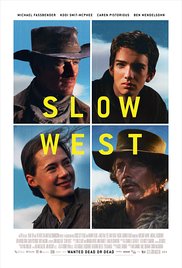
Slow West

MV5BNTYxNDA5ODk5NF5BMl5BanBnXkFtZTgwNzMwMzIwNTE@._V1_UX182_CR0,0,182,268_AL_

05/01/16

I’ve been trying to see this for quite a while. I missed its brief appearance in cinemas, failed to pick up the DVD and then, by chance, noticed it when I was scrolling around Netflix looking for something to watch. I was initially delighted for the opportunity to catch up, but, inevitably, I suppose, was left feeling a little disappointed, because reviews I’d read on its release had led me to expect something amazing; but John Maclean’s film didn’t thrill me as I’d been promised.

Slow West, as you might expect, is set in America but is actually filmed in New Zealand and though the widescreen vistas are undoubtedly handsome, they didn’t really convince as genuine locations. Jay Cavendish (Kodi Smit-McPhee) is a vulnerable sixteen year old Scottish lad, on a mission to find his former ‘sweetheart’, Rose Ross (Caren Pistorius), who has  fled to America with her papa, after he accidentally killed Jay’s wealthy father in a brawl. Jay is rescued from an encounter with bad guys and befriended by the more experienced Silas Selleck (Michael Fassbender) who offers to chaperone him to his eventual destination – but Jay is unaware that Selleck is actually a bounty hunter, after the reward that’s been offered for the Scottish runaways. As it turns out, Selleck is only one of a whole crew of bounty hunters all intent on claiming the hundred dollars ‘dead or alive.’ But who will get there first?

As I said, it’s all handsomely mounted but there’s no real sense of urgency  in the film and despite the fat that a high body count mounts up throughout  proceedings, (something that Maclean focuses on only in the film’s closing moments) you don’t really feel the impact of those killings. Throw in occasional jokey appearances by some rather unconvincing Native Americans and an ending that ought to be devastating, but somehow isn’t, and I can’t help feeling that this film has been somewhat overpraised. It’s not awful, you understand, just a bit… meh.

3.5 stars

Philip Caveney


Steve Jobs

16/11/15

Steve Jobs is a strange sort of movie. Danny Boyle’s valiant attempt to capture the wayward genius of Apple’s head honcho is a film that really could only have been made after the man’s death. If he’d still been alive he’d have sued the makers for every penny they had. Not because it’s inaccurate, you understand, simply because that’s the kind of man he was.

Set mostly at the launch of three Apple products – the original Macintosh, the ill-fated Next cube and finally, the iMac, the set up is more like that of a theatrical production – and for all Boyle’s claims that this is a ‘standing-up’ movie rather than a ‘sitting-down’ one, it still comes across as predominantly talky. The script, by Aaron Sorkin, is a cut above most movie dialogue you’ll encounter, which certainly helps, but this frankly isn’t in the same league as The Social Network, with which the film will inevitably be compared.

Jobs (Michael Fassbender), quickly demonstrates the kind of behaviour that had him classed as a major pain in the backside by pretty much everyone who had the misfortune to work with him. He’s obsessed with tiny details, unwilling to take anyone else’s views into consideration and equally unwilling to take responsibility for his daughter, Lisa, who he claims might not actually be his child. His long-suffering assistant, Joanna Hoffman (Kate Winslet) is lumbered with the unenviable task of keeping him on track and we see clashes with bearded workhorse Steve Wozniak (Seth Rogan) and conversations with the closest thing that Jobs had to a father-figure, John Sculley (Jeff Daniels) – unless of course you include his actual biological father, a restaurant owner who used to boast that Jobs ate in his establishment, without ever finding out he was actually waiting on his own son.

Boyle’s films are usually adrenalin-fuelled, razzle-dazzle affairs, so this slow burning, stage bound production will inevitably prove a disappointment to many. Certainly, early indications are that the movie is not exactly putting bums on seats – but it wins through in the end by virtue of Sorkin’s edgy script and a soaring conclusion, where everything finally falls into place.

4 stars

Philip Caveney

Macbeth

MV5BMjA5NjgyMzY1NV5BMl5BanBnXkFtZTgwOTk3NTY2NjE@._V1_SX214_AL_

08/09/15

Macbeth has been filmed many times with varying degrees of success. Indeed, the story is so familiar there’s no point at all in describing what actually happens, since it is indelibly imprinted upon most people’s consciousness. Yet every single film made thus far has overlooked a really important opportunity. Macbeth and his wife need to be teenagers. Only the overbearing hubris of youth and rampant ambition can ever fully explain their actions. Of course, when you’re in the business of financing a movie, the simple truth is that you need names that will put bums on seats, so the chances are we’ll never get to see such an interpretation on the big screen. Which is a shame.

Here, Michael Fassbender gives us a grimy, muscular Macbeth, while the usually dependable Marion Cotillard struggles somewhat with her Scottish accent as his scheming wife. If you’re going to film this play, you really need to have something different up your sleeve and apart from a few neat flourishes, director Justin Kurzel doesn’t have an awful lot to offer us. He opens with the funeral of the Macbeths’ young son (something alluded to in the text but not, to my knowledge, ever shown before) and then he gives us a big slow motion battle, set against some bleak highland scenery. The witches are nicely restrained (some of their most famous lines summarily dispensed with) and from there, matters proceed at a funereal pace, with Fassbender and Cottilard reciting their lines whilst gazing into the middle distance, like actors in an Ingmar Bergman film.

It isn’t terrible, you understand, but the leaden quality rather neuters this most virile of Shakespeare’s plays, making you long to push on to the next action sequence, rather than relishing those wonderful words. There’s also a terrible misstep when Macbeth appears to discuss the assassination of Banquo (Paddy Considine) as the entire court listens in. It must have been Kurzel’s intention to do it this way, but it looks, frankly, risible.

The closing sections, in which the avenging forces set fire to, rather than transport the woods of Dunsinane, finally allow a touch of awe into the proceedings and the confrontation between Macbeth and Macduff (Sean Harris) is visceral enough to ensure this probably won’t be suitable to show in schools. There’s also a nice twist at the end involving the King’s sword – but by this time, it’s a little too late to salvage proceedings.

Advance reviews for this had led me to expect something extraordinary, but overall this felt like just another version of a tried and tested story. Decent but not a game changer.

3.5 stars

Philip Caveney