Matt Reeves

Kingdom of the Planet of the Apes

09/05/24

Cineworld, Edinburgh

When author Pierre Boulle published his science fiction novel La Planéte des Singes in 1963, he could have had no idea of the protracted cinematic legacy that awaited it. In 1968, Planet of the Apes starring Charlton Heston was a massive hit and had one of the most iconic final scenes in history. It spawned four (admittedly patchy) sequels and, in the 1970s, became a long-running television series, of which I still have fond memories.

In 2001, Tim Burton attempted a big-screen reboot, but only his staunchest fans would claim that it was in any way a success.

So when, ten years later, director Rupert Wyatt made another attempt to apply the old defibrillators, I had low expectations (which, in retrospect, may have helped). Rise of the Planet of the Apes was a cracking film which centred on a remarkable mo-cap performance by Andy Serkis as Caesar. Two more films (both directed by Matt Reeves) continued in the same vein, rounding off with War for the Planet of the Apes in 2017. Surely there was nothing more to be said on the talking simian subject?

Ahem.

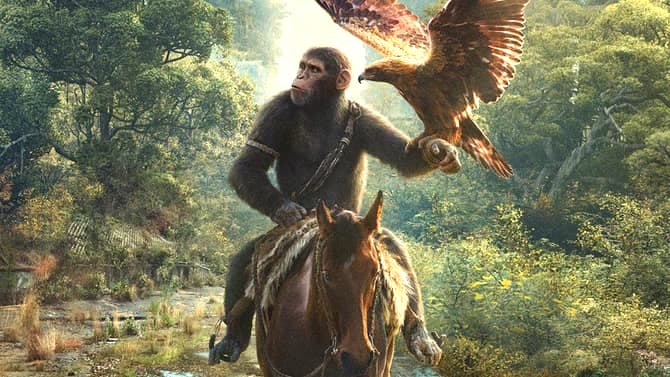
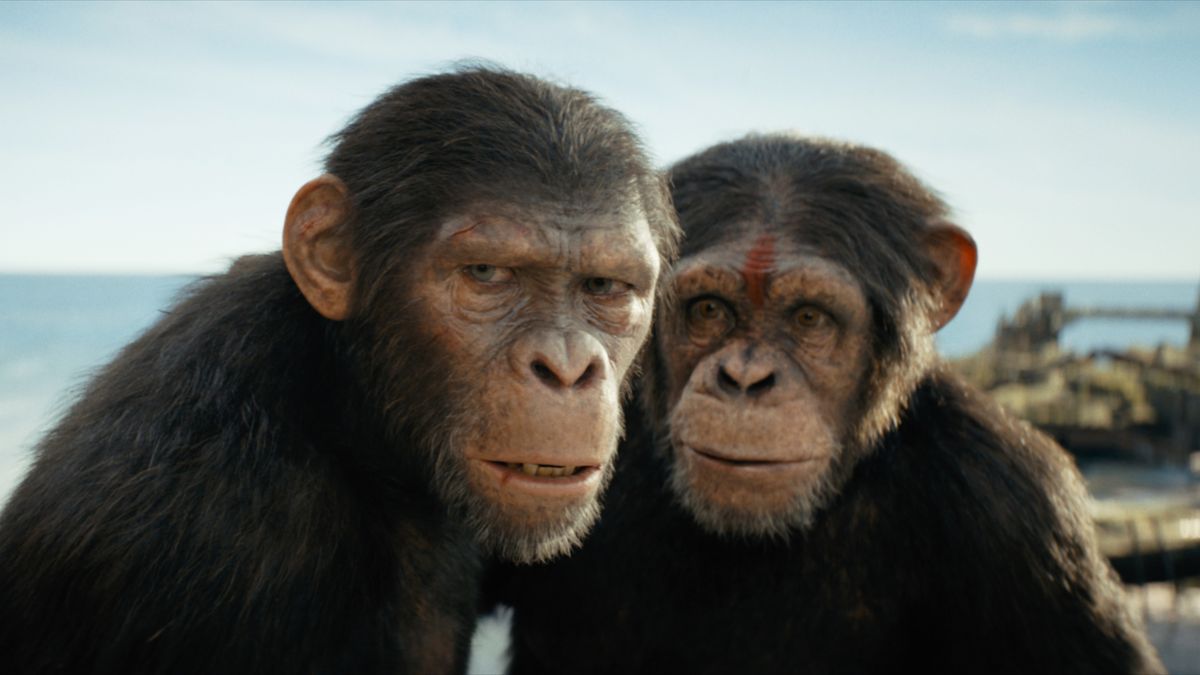
Wes Ball’s Kingdom of the Planet of the Apes begins with a glimpse of Caesar on his funeral pyre and then scampers nimbly onwards for many years, introducing us to a new hero, Noa (Owen Teague). Noa is one of a tribe of chimpanzee hunter-gatherers, who specialise in training eagles, which they send out to catch fish for them. The apes are now the dominant species on the planet and the few humans that Noa encounters are savages who, thanks to a mysterious virus, have lost their ability to speak.

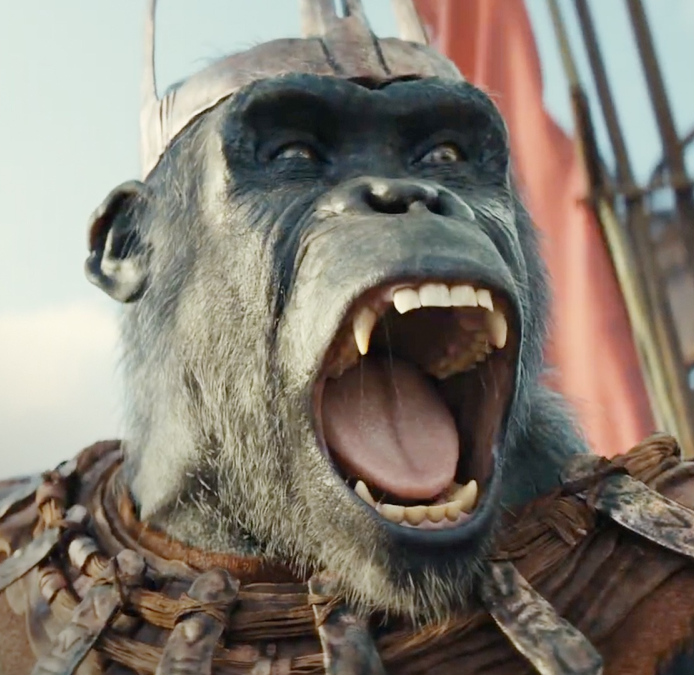
Noa is approaching a coming-of-age ceremony for which he needs a freshly-laid eagle’s egg but, when the one he’s been carrying around with him gets scrambled, he’s obliged to ride out in search of a replacement. He comes up against a gang of aggressive bonobos, under the despotic leadership of Proximus ‘Caesar ‘(Kevin Durand), who has realised that – much like the Romans before him – he can make the name a hereditary title and subvert everything that his illustrious progenitor ever believed in. Noa also meets a wise old orangutan called Raka (Peter Macon) and a human called Mae (Freya Allan), who, unlike most of her species, can speak eloquently. She has a secret mission to carry out in the ruins of the nearby city where Proximus reigns, so Noa and Mae travel there together. They are captured and made to swear allegiance to Proximus. Another captive human, Trevathan (William H. Macy), tells Noa that Proximus is spending much of his time trying to gain entry to a massive underground vault which may just contain a ‘book’ which could restore the power of speech to humanity….

If this is beginning to sound complicated, let me assure you that on the screen it’s even more so – and this gives the story a muddled quality, particularly in the saggy middle section of its lengthy running time. Don’t get me wrong, the film has many qualities to commend it. Like its three predecessors, the world-building here is brilliantly done and the exotic (Australian) locations are awe-inspiring to say the very least. Also, the mo-cap characters are depicted with astonishing nuance and it’s to the film’s credit that, despite a massive cast of simians, I am never confused as to who is who.

As the film thunders into its final stretches there’s a major revelation – and I remind myself that Wes Ball has made no secret of the fact that he sees KOTPOTA as the opening salvo in a trilogy. But looking around the scant audience for this afternoon’s performance, I can’t help wondering if there’s any appetite for it. Maybe this lucrative franchise is finally approaching its extinction. If that’s the case, it’s had a pretty impressive run – and, even if this instalment feels like something of a step down, it’s nonetheless a fantastic visual achievement.

Those with a taste for mo-cap marvels should swing down to their nearest multiplex, choose the biggest screen available and… go ape.

3.3 stars

Philip Caveney

The Batman

04/03/22

Cineworld, Edinburgh

Director Matt Reeves’ modest ambition for The Batman was to make ‘the best Batman movie yet.’

Well, he hasn’t done that – but he’s certainly made the longest. Weighing in at a bum-numbing two hours and fifty minutes, it brings to mind the conviction that while ‘less’ is often ‘more’, ‘more’ usually equals ‘less’ when it comes to movies. And, while this just about scrapes four stars in its present bloated form, it would have scored much higher with some judicious editing. I mean, like, excising fifty minutes.

What is it about Batman that makes directors keep returning to that oft-plundered well? The fact that this is a comic-book hero who doesn’t have any super powers is always appealing, and there’s that delicious interplay between the vigilante who takes the law into his own hands and those misguided fools who see him as a hero. In this regard, The Batman feels a lot more nuanced than many of its predecessors, but it’s also sobering to think that the best film of the franchise is the one that he doesn’t even feature in.

Joker, thanks for asking.

Mind you if you thought Christopher Nolan’s depiction of Gotham City was dark, prepare to turn the palette down several notches. Reeves’ Gotham (shot in studios all over the UK) is filmed in tones of obsidian and anthracite. In this Gotham, it never seems to stop raining and the city is ruled by corrupt public officials, who gleefully take bribes and exploit the working classes for their own enrichment. (Remind you of anywhere?)

It’s Hallowe’en and a masked villain called The Riddler (brilliantly played by Paul Dano, though we don’t actually see his face until late on in the proceedings) is gleefully murdering those in power, who have allowed their standards to slip. Batman/Bruce Wayne (Robert Pattinson), though hated by most of the police force, is invited to investigate the crimes by Commissioner Gordon (Jeffrey Wright), the only cop who trusts him.

The Riddler is leaving cryptic clues at the scenes of the crime and Batman is good at deciphering them. In the course of his investigations, he comes into contact with Selina Kyle (Zoe Kravitz), crime kingpin, Carmine Falcone (John Turturro), and The Penguin (an unrecognisable Colin Farrell, hidden beneath layers of latex and sounding for all the world like Robert De Niro).

As the proceedings unfold, it becomes clear to Bruce that his own father, whose murder initiated Bruce’s transition into the Caped Crusader, might not have been as innocent as his son has always supposed. Batman also comes to realise that there are many people out there who follow his vigilante tactics with relish – and who would really like to be him.

And, as loyal butler, Alfred (Andy Serkis) is quick to point out, Bruce’s father might have done the wrong thing – but for very sound reasons.

There’s a lot here that I really like. It offers a much more interesting vision of DC’s premier hero than we’re used to seeing – but too much time is spent wandering along dark alleyways that don’t advance the plot enough. It’s only as I’m starting to grow impatient with the film that it finally coalesces and ramps up the suspense, as it heads into a vaguely apocalyptic climax that is weirdly prescient and also, in a strange way, uplifting. Reeves has already proven his worth with the likes of Cloverfield and his astute retooling of the Planet of the Apes trilogy – but, inevitably, The Batman just feels too long for its own good.

This is a shame because Pattinson really works in the lead role (for once, I actually believe that nobody would suspect his Bruce Wayne of being Batman, since the two personas are so different). Kravitz is also compelling in the Catwoman role, and I fully expect to see her return to it. A nifty coda shows us exactly where Reeves plans to go next and, given the projected casting for the next lead villain, I have to confess I’m suitably intrigued.

But please, Matt, next time around… can we just have a bit less?

4 stars

Philip Caveney

War for the Planet of the Apes

14/07/17

Ape-related homages to Apocalypse Now are a bit like buses. You wait for ages and then two come along more or less at the same time. The first homage, was of course, Kong: Skull Island. The second is this, the third instalment in the Planet of the Apes reboot, a franchise that has proved to be surprisingly watchable considering the damp squib that was Tim Burton’s foray into the simian world. This new adventure is also eminently entertaining, but there’s a real problem at its heart, which few reviewers seem prepared to entertain – and that is its almost total lack of any roles for women.

We encounter just two female characters in the whole film. Young orphan, Nova (Amiah Miller), who is mute, and Lake (Sarah Canning), a chimpanzee, who is tasked with looking after Caesar’s young son, Cornelius. Because, of course, childminding is the one job that has to be done by a female. Apart from a couple of glimpses of faces in crowds, that’s it. And there are LOADS of characters in this movie. Why are they all male? This doesn’t feel like a deliberate slight on the part of director, Matt Reeves, but it’s a a major oversight, a warped and weirdly lopsided vision of society, and in this day and age, it should never have been allowed to happen – and it’s definitely knocked the overall points for this movie down a few notches.

That said, there is plenty to enjoy here. It’s three years after the events of Dawn, and Caesar (Andy Serkis) now leads his simian followers against what’s left of humanity. One soldier in particular, The Colonel (Woody Harrelson, as a Kurtz-type zealot) has set himself the task of wiping the apes off the face of the planet, blaming them for the demise of mankind. When he mounts a sneak attack on the apes’ hideout, Caesar suffers a personal loss, an event that unhinges him and sends him on the path of revenge, accompanied by three of his most trusted companions. On route to the Colonel’s headquarters, they encounter ‘Bad Ape’ (Steve Zahn), a former zoo inhabitant, whose presence here is clearly to provide some much needed comic relief. As the apes ride on horseback through increasingly snowbound terrain, the film echoes John Ford’s epic western  The Searchers  in its look and feel – and then, bizarrely, it all turns decidedly biblical, as Caesar evolves into a kind of hairy Christ figure, mocked, scourged and (just in case you missed the reference) crucified by his human oppressors.

Though the title might lead you to expect a full-on war movie, that’s really not what the film’s about;  it’s more cerebral than anything else – though there are some cracking battle scenes, including a major blitzkrieg towards the movie’s conclusion. All-in-all, it’s very watchable and, though it might not be quite as sharp as the two preceding stories, it’s nonetheless an absorbing piece of cinema and (lest we forget) a brilliant technical accomplishment. The apes are perfectly rendered in every detail – snow slicked fur is apparently the hardest thing to get right – and they are convincingly set within their locations. Serkis has been very vocal about giving motion-capture performers the kudos they deserve and War is a perfect advertisement for what this relatively young technique can achieve. It’s an epic, thought-provoking film.

But no real roles for women, human or ape? Come on, we can do better that that!

3.5 stars

Philip Caveney