Manchester

Singin’ in the Rain

30/12/25

Royal Exchange Theatre, Manchester

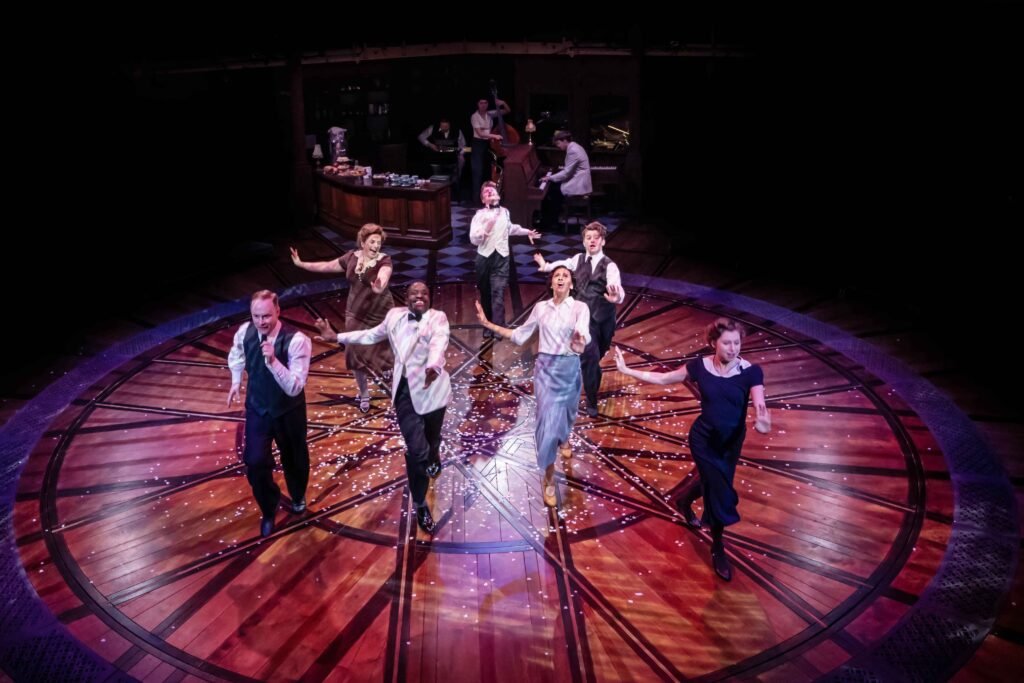
It’s Philip’s birthday, and his lovely daughter and her husband have treated us to a night out at our favourite theatre. We were press-night regulars at Manchester’s Royal Exchange before we relocated to Edinburgh a decade ago, and we’ve never lost our love for the alien-like glass pod, squatting improbably amid the opulence of the old corn exchange. But we’re here for more than just the bricks and mortar, of course, and director Raz Shaw’s revival of Singin’ in the Rain offers a whole lot of nostalgic fun – as well as another chance to see the venue’s well-used water feature in action.

The show’s lead, Louis Gaunt, is off sick tonight, so understudy Adam Davidson steps into Don Lockwood’s black and white Gatsby brogues, impressing with his slick performance of this incredibly demanding role. He and Danny Collins (as Cosmo Brown) make a formidable duo, hoofing up a storm and delighting the audience with their dance moves.

Laura Baldwin plays Lockwood’s silent movie co-star, Lina Lamont, who refuses to accept two major facts: she doesn’t have the requisite talent to succeed in the newfangled ‘talkies’ and her engagement to Don is just a PR stunt. Baldwin nails the character of the petulant diva, imbuing Lina with just enough vulnerability to make us sympathise with her, despite her cruelty and hubris. Meanwhile, Carly Mercedes Dyer dazzles as Lina’s nemesis, Kathy Seldon, who is not only an accomplished singer and actor, but also Don’s true love. Dyer’s vocals are soaringly beautiful, making it easy to believe that studio boss RF Simpson (Julius D’Silva) wants to hire her, even if it means betraying Lina, his most bankable star.

The movie clips are cleverly staged, designer Richard Kent perfectly utilising the in-the-round performance space to suggest the rotating of the cinema reels. Captions are projected onto semi-circular boards framed with vanity lights, while Alistair David’s exuberant choreography reinforces the circularity. The use of blackouts and freeze-frames is wonderfully comic: this is a very playful musical, gently satirising not only the characters but also the theatrical conventions they employ.

It’s no mean feat to take a well-loved classic and render it so fresh and appealing. But Shaw’s sprightly production manages to do just that, allowing each of the big numbers (by Nacio Herb Brown and Arthur Freedby) enough space to shine. My only slight criticism comes courtesy of Betty Comden and Adolph Green’s original screenplay: I think the Broadway Ballet sequence at the start of the second act is far too long. Although the dancing is magnificent, I can’t help feeling it interrupts the narrative, akin to a self-indulgent drum solo in a live performance of a song. That niggle aside, I have nothing but praise for this sparkling show. Collin’s rendition of Make ‘Em Laugh is comic perfection, while the titular number is a vibrant spectacle. But be warned: if you’re in the first two rows, you’re really gonna feel the effects of that infamous water feature…

We couldn’t have asked for a better way to see out 2025. Happy New Year!

5 stars

Susan Singfield

Brief Encounter

30/12/23

Royal Exchange Theatre, Manchester

It’s my birthday (hurrah!) and I’m in Manchester, visiting my daughter and her husband, which is already a massive improvement on last year. (In 2022, Susan and I found ourselves stranded in Carlisle for two nights when flooding interrupted our train journey back to Edinburgh. Deep joy.) As an added bonus, we’re also visiting the Royal Exchange Theatre, always a favourite venue when we actually lived in this neck of the woods. 

Tonight, we’re seeing Emma Rice’s adaptation of Noël Coward’s Brief Encounter, perhaps most fondly remembered for David Lean’s iconic 1945 film adaptation. But of course, it began life as a theatre production in a collection of works entitled Tonight at 8.30. Rice has had the brilliant idea of incorporating some of Coward’s songs into the narrative, making it not exactly a musical so much as a play with music cleverly incorporated into the narrative, with four musicians onstage throughout. This is an ambitious move and much more interesting than a straight recreation of its much-adored progenitor.

The plot is so familiar I won’t spend too much time recounting it. Laura (Hannah Azuonye) is awaiting her train at Milford Junction when she gets a bit of grit in her eye. GP Alec (Baker Mukasa), who happens to be having a cup of tea in the café when she stumbles in, comes to her assistance. From this inconsequential incident a friendship develops, which becomes increasingly problematic as the twosome keep bumping into each other. All too soon, they realise they are falling in love. 

But both of them are happily married and are tortured by the thought of deceiving their respective partners. So what should they do for the best?

Anyone familiar with Lean’s film will be aware that Rice sticks fairly close to that script (something that we confirm by rewatching it on the long journey home the following day), but she does some astute restructuring. Some of the film’s minor characters are given more developed roles here: the relationship between railwayman Albert (Richard Graves) and cafe manager Myrtle (Christina Modestou, most recently seen by B & B at the Edinburgh Fringe in the wonderful Grand Old Opera House Hotel) is more prominent and there’s also a developing romance between café worker Beryl (Ida Regan) and porter Stanley (Georgia Frost). The contrast between the polite conversations of the middle-class protagonists and the earthy, working-class station employees is effectively captured.

At key moments, the actors slip effortlessly into one of the ‘The Master’s’ torch songs, giving the proceedings a louche, cabaret feel, and there’s a brilliantly-choreographed routine where the whole cast move around the Exchange’s circular stage to a series of different musical pieces, culminating in a frenzied jitterbug. The performances are all exemplary, but I particularly enjoy Modestou’s soulful rendition of No Good at Love and Regan’s plaintive interpretation of Mad About the Boy

There’s also a delightful coup de théâtre involving the big station clock that hangs over the proceedings, while hats should also be lifted to the versatile Matthew Allen, who handles a whole string of smaller roles, singing, tap dancing and, at one point even playing the flipping saxophone! 

Sarah Frankcom directs with considerable skill – I fondly recall seeing her delightful production of Blithe Spirit in this very theatre, way back in 2009 – and, all in all, this is a delightful and occasionally surprising production that celebrates the spirit of its illustrious predecessor.

4.2 stars

Philip Caveney

Learning to Fly

17/11/23

Traverse Theatre, Edinburgh

We have an unusual reason to remember the name James Rowland.

Searching back through the annals of our reviews blog, I see that, on the 14th March 2019, we were in the Traverse Theatre, watching him perform A Hundred Different Words for Love, part of a trilogy of plays he was touring. We managed to see all three of them but, due to circumstances beyond our control, in the wrong order.

You don’t need long memories to recall that this was a troubling time for theatre-makers around the world – and indeed, the poor turnout for this show had nothing to do with Rowlands’ material but instead spoke volumes about how frightened audiences were of mysterious new virus that was afflicting the world. Tickets had been sold, but few customers were brave/reckless enough to turn up and take their seats. Sure enough, just two days later, theatres across the UK were instructed to close their doors – and it was a long time before they were safe to reopen them.

Happily, things have moved on since those dark days  – and Rowland’s latest offering, Learning to Fly, is a charming and affable piece, based around a recollection from the performer’s youth, a time when he lived in Didsbury, Manchester, near to Fog Lane Park. 

Weirdly, in the 1980s, I lived there too, but that’s another story.

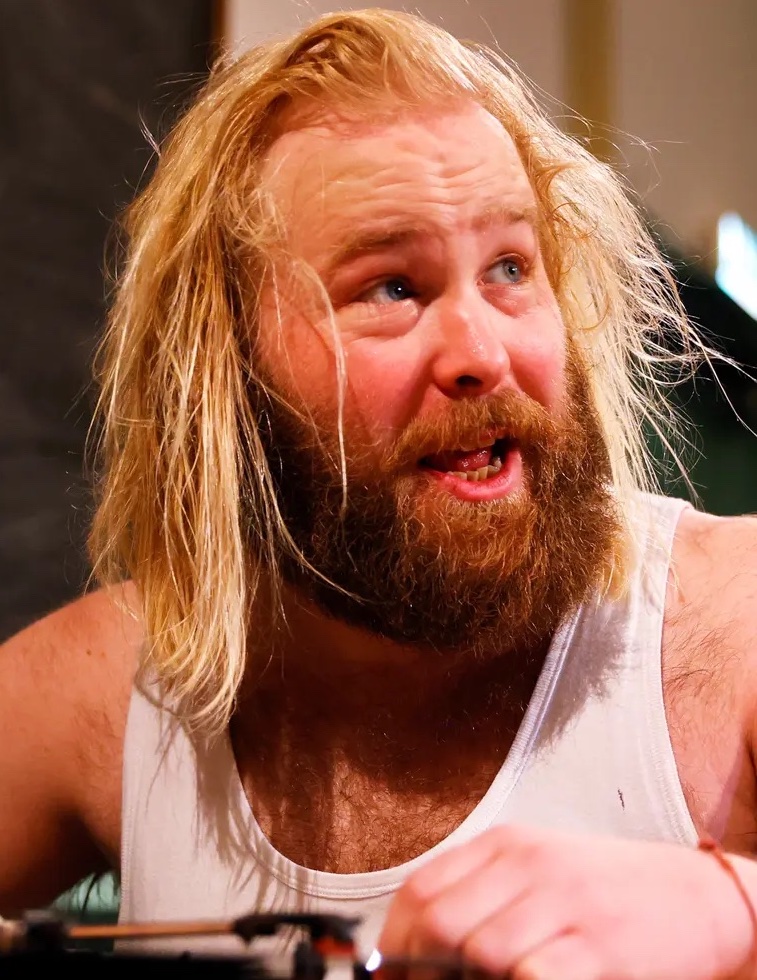
Rowlands is as likeable and swaggering as ever. I can hardly fail to forget that he performed one part of the aforementioned trilogy stark bollock naked, which certainly takes some confidence, but tonight he’s modestly dressed in a white singlet, trackie pants and trainers. He wanders onto the stage, has a brief chat with the audience about trigger warnings and the like, and then launches into his story.

He tells us about being fourteen years old and about an unspecified illness that keeps him from going to school; and how his struggling mother leaves him for one day a week in the care of Anne, an elderly neighbour, who never seems to leave her house and who spends most of her time listening to the music of Beethoven.

Against all the odds, the two of them  form an uneasy friendship, one that steadily grows over the weeks until one night, James does something unprecedented – something that will change their relationship forever…

Learning to Fly is a charming and beguiling piece, one that veers from outright hilarity to moments of pathos and regret. It’s easy to picture Rowlands as a youngster, steadfastly pursuing his own particular goals in life, which perhaps unsurprisingly, are not those of the average fourteen year old. I can believe that he would do something so spectacularly off-the-wall. 

If I’ve a criticism to make, it’s simply that some of the pay-offs are not always delivered as forcefully as I’d like – and there’s an indecisiveness to the conclusion that has tonight’s audience unsure of whether the time to applaud has actually arrived or not. 

But it would be an unsympathetic viewer indeed who doesn’t derive enjoyment from this unconventional mix of comedy, storytelling and music. 

Hopefully Rowlands’ current tour will be allowed to continue without the unwelcome interruption of a pandemic. Fingers crossed.

3.8 stars

Philip Caveney

King Lear

Royal Exchange Theatre, Manchester

29/04/16

Michael Buffong’s King Lear is a tour de force: gimmick-free yet undeniably modern, a fast-paced production that manages, like all the best Shakespeare, to be at once timeless and of its time.

Don Warrington is the eponymous old man, a case-study in futile bluster, self-destructing in his anger at the ravages of old age. I like the way his impotence is emphasised here: he’s never a magnificent, raging tyrant, just an old man who commands deference only as long as he wears his crown. Pepter Lunkuse’s Cordelia is also a revelation: for the first time, I see why she is Lear’s favourite. She’s as stubborn and destructive as he is, as incapable of compromise. She’s neither sweet nor resolute in this production: she’s a headstrong teenager, with the moral certitude only youth or extreme religion can provide. I love the way her lip curls at her sisters; she’s self-righteous and scathing, a Cordelia for the modern age (maybe this is how she was always meant to be?).

It’s a grim play, one of the Bard’s bleakest, and the comic relief from the Fool (Miltos Yerolemou) and Oswald (Thomas Coombes) is most welcome. They’re witty and engaging, pushing just far enough to undercut the tension and provide those all-important shades of light and dark. While we’re on the subject of grim, the notorious blinding scene is played for horror here; there’s nothing subtle in an eye gouging that results in “vile jelly” flying out across the stage into the audience. It’s so shocking there are gasps and groans – and that’s exactly as it should be, I think.

The storm scene is perhaps a little undermined by the fact that the Exchange’s new water-feature has been enthusiastically showcased in almost all recent productions, so what should be astonishing is more, “Oh, this again.” Still, it’s effective – the lightning strikes, the thunder claps and everyone is drenched.

Lear is a dense and complex play; there’s too much of it to cover in one shortish review. Suffice to say, I loved this production: a pacy, confident interpretation that trusts Shakespeare’s words to do their magic.

4.8 stars

Susan Singfield