

Mads Mikkelsen

Indiana Jones and the Dial of Destiny

28/06/23

Cineworld, Edinburgh

Steven Spielberg’s Raiders of the Lost Ark (1981) was a near-perfect movie, a fast-paced action adventure that harked back to the classic serials of the 1940s. It made a huge profit off a comparatively low budget, so – inevitably – there were going to be sequels. Indiana Jones and the Temple of Doom (1984) and Indiana Jones and the Last Crusade (1989) may not have had the perfection of their whip-tight progenitor, but were decent enough efforts in their own right. And that’s probably where the whole enterprise should have ended. 2008’s The Kingdom of the Crystal Skull was – to put it mildly – a major miscalculation, despite being helmed by the usually dependable Spielberg. For a very long time, there were vague rumours of a fifth outing which remained exactly that. Rumours.

After all, Harrison Ford was getting a bit long in the tooth, so… maybe not?

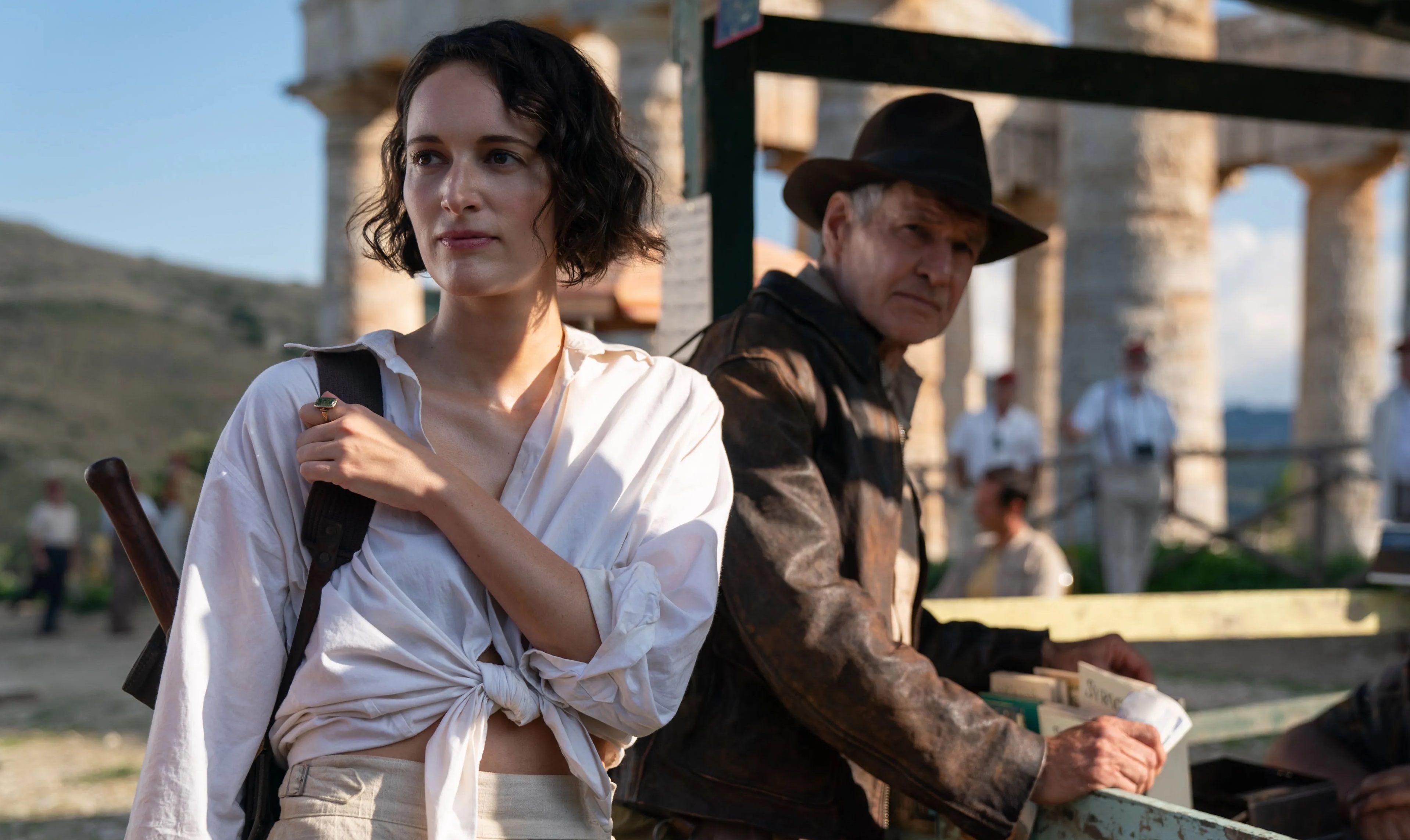
But now, directed by James Mangold, and written (mostly) by Jez Butterworth and his brother John Henry, everyone’s favourite archeologist is back in the game. When we reunite with him it’s via a flashback. It’s 1944, the Germans are rapidly losing the war and, thanks to the wonders of de-aging software, Indy looks like his former self. He’s working alongside his old pal Basil Shaw (Toby Jones) and the two of them are attempting to rescue an ancient antiquity, the Lance of Longinus, from a Nazi train packed with loot. Indy has just been taken prisoner, but needless to say, he’s soon free and wandering the length of the train, looking for the artefact. Also present is Dr Voller (the always excellent Mads Mikkelson), who has already decided the lance is a fake but has discovered instead, on the same train, the titular device (or at least half of it), built by Archimedes and capable of… well, that would be telling. A lengthy action set-piece ensues and it’s pretty good, serving as a promising opener.

But then we move to 1969. Mankind has just landed on the moon and Dr Jones is now earning a crust as a University lecturer, though his students seem much more interested in listening to rock music and smoking dope. Retirement beckons and it’s made very clear that Indy has lost his mojo. Then along comes his Goddaughter, Helena (Phoebe Waller-Bridge), who is also very interested in the Dial of Destiny, but mostly because she plans to sell it to the highest bidder. To give her fair credit, Waller-Bridge gives the franchise a much-needed update, and she’s good on the smart-arse wisecracks, but I’m not sure I quite buy her as an adrenalin-powered action hero. Then again, if I can accept an eighty-year-old male in the role, maybe anything is possible.

The bad guys soon come a-calling and, what do you know, they’re being led by Dr Voller, who has his own unthinkable plans for Archimedes’ invention and won’t hesitate to carry them out. Indy and Helena team up and a game of cat and mouse ensues with some protracted chases. A lengthy sequence featuring Ford on horseback (or at least, his stunt double) is perhaps the film’s standout, but the problem here is that there are just too many of these pursuits. A really complicated one featuring our heroes in a tuk tuk definitely overstays its welcome.

There are frequent nods to those earlier films – some of which work, others which feel meh – and there’s a surprisingly touching scene when Indy tells Helena about what happened to his son and why he and Marion Crane (Karen Allen) are no longer an item. John Rhys-Davies shows up once again as Sallah, but is given very little to do here and, naturally, Helena has a keen young assistant in the shape of Teddy (Ethan Isadore), who seems able to turn his hand to most things, including at one point piloting a plane. As you do.

With a running time over two-and-a-half hours, it’s to Dial of Destiny’s credit that it never really runs out of steam and, if the final conceit is hard to swallow, well, this is a series that’s known for it’s supernatural reveals. (Just don’t overthink the space-time continuum stuff because, on reflection, much of it really doesn’t add up.) I leave feeling that I’ve been suitably entertained but, before I’ve even made the short walk home, I’ve thought of at least half a dozen questions that remain maddeningly unanswered.

So, this is far from the disaster I anticipated but, when held up against that brilliant opening shot of Raiders, it’s frankly not in the same league. I can’t help feeling that, now it’s out in the world, this particular treasure chest should be triple-locked and left in a quiet place to gather dust.

3.8 stars

Philip Caveney

Another Round

11/07/21

Cameo Cinema

Alcohol. It’s a curse, right? So many people depend upon it, so many have their lives completely destroyed by it – and yet it still gets bought by the gallon on a daily basis…

It would have been so easy for Thomas Vinterberg to produce a dour, finger-wagging condemnation of his chosen subject, but happily, Another Round is much more nuanced that that. This is a film that also highlights the powerful allure of alcohol, a film that makes you understand why so many of us can’t help but dance to its tune. Furthermore, it’s a story about male friendship that manages to avoid the usual clichés to deliver something genuinely heartfelt and realistic.

Martin (Mads Mikkelsen) is a history teacher at a Danish high school. He’s been in his job for years, he’s happily married to Anika (Maria Bonnevie) and he has two teenage sons. But somewhere along the way he’s lost his drive and now finds himself teaching on auto pilot, making evident mistakes as his students look on in dismay. His sons seem to be hardly aware of him and Anika, a nurse, is permanently on the night shift. In short, he’s looking for something to inspire him.

On a night out with fellow teachers, PE instructor,Tommy (Thomas Bo Larsen), chemistry teacher, Nikolaj (Magnus Millang), and music teacher, Peter (Lars Ranthe), Martin picks up on something that Nikolaj mentions over a boozy dinner – a theory put forward by psychiatrist Finn Skårderud, namely that maintaining a constant blood alcohol level of 0.05% will make a person more relaxed and creative.

Martin decides to put it to the test, only to find that it actually appears to work. His pupils are reinvigorated by the ‘new’ Martin. In class he’s assured, slick, entertaining, and, as his alcohol level rises, so does his students’ enthusiasm for his teaching. It isn’t long before his three friends want to get in on the act, with sometimes hilarious – but ultimately tragic – consequences.

Another Round steadfastly refuses to be maudlin, ensuring that many of the alcohol-fuelled antics are positive ones and pointing out that the consequences of being drunk vary from person to person. Indeed, a climactic scene where Martin – a jazz ballet dancer in his teens – is inspired to strut his moves again, once he’s suitably fuelled with champagne, is a joyful, exuberant celebration of being ‘under the influence.’

Little wonder that, after viewing this intoxicating film, we headed straight for the bar to discuss it in an appropriate setting…

4.6 stars

Philip Caveney

At Eternity’s Gate

14/11/19

Here’s one I missed at the cinema, but – as is increasingly the case these days – it’s right there on Netflix for anyone to see at the click of a button. While this would definitely benefit from the immersive qualities of a big screen, beggars can’t be choosers.

Julian Schnabel’s film of Vincent Van Gogh concentrates on his years in Arles and, later, at Auvers Sur Oise. Willem Dafoe stars in what is possibly the role he was born to play, so convincingly does he settle into the great man’s persona, and he greatly deserved his Oscar nomination.

This is far from a straightforward biopic, however. Indeed, anybody who prefers a clear narrative arc will probably have a tough time with this. There’s a lot of footage of the artist, easel strapped to his back, wandering for miles across the French countryside in search of the elusive ‘perfect light’ and the film takes its own sweet time over those sections. But there’s no doubting the power of the sumptuous cinematography of Benoit Delhomme, which really does capture the unique look of Van Gogh’s paintings.

A lot of big names pop up in cameo roles. Oscar Isaac is a suitably swashbuckling Paul Gaugin, Rupert Friend is Vincent’s endlessly patient brother, Theo, and Mads Mikkelsen gets the dubious honour of portraying the priest at an asylum, who unashamedly informs the artist that his work is ‘ugly and without merit.’ Dafoe, meanwhile, suffers for his art in utterly convincing style and generates pity for Vincent as well as anger at the horrible treatment he receives on an almost daily basis.

There’s a powerful payoff when, after his mysterious death (which is frustratingly skipped over), we witness Vincent lying in his coffin, surrounded by his paintings and we cannot help but see that the mourners are already taking more interest in his work than they ever did when he was alive.

An interesting effort, then, and – while it lacks the jaw-dropping power of Finding Vincent – it’s still essential viewing for fans of one of history’s greatest artists.

3.8 stars

Philip Caveney


Rogue One: A Star Wars Story

17/12/16

There are prequels and there are sequels – and then there are ‘inbetweenquals’ like Rogue One: A Star Wars Story, helmed by brit director Gareth Edwards and starring Felicity Jones, making a surprisingly confident transition to action hero territory. But the ultimate question that must inevitably hang over this production is this: as a standalone, does its justify its place in the already extensive Star Wars canon? And the answer is… just about.

After JJ Abrams crowd-pleasing revamp (a film that even those who didn’t much care for Star Wars could easily enjoy), Rogue One is clearly aimed much more at the obsessive fans of the series – and it must be said that the must successful parts of this film really are the ones that recall classic moments from the original movies.

The events of this film take place sometime after the end of the clone wars and before those outlined in Episode IV – A New Hope. Young Jyn Erso (Jones) is the daughter of Death Star designer, Galen Erso (Mads Mikkelsen), now estranged from him because of his apparent return to the Empire after the murder of his wife at the hands of Orson Krennic (Ben Mendelsohn). Captured by stormtroopers and on her way to prison, Jyn is rescued by members of the Rebel Alliance and made to accompany handsome young rebel Cassian Andor (Diego Luna) on a mission to find her father, in order to try to discover a way to defeat the terrifying weapon before it makes mincemeat of all who oppose it. We already know, of course, that the Death Star was destroyed at the end of Episode IV – this film, then,  seeks to explain how the information about a fatal flaw, planted in the Death Star’s workings gets into Princess Leia’s hands in the first place.

Edwards makes a reasonable attempt at this – there’s some convincing world-building going on and enough references to later films to keep all the fan boys and girls happy. However, there’s a seemingly endless series of battles and the film only really hits its stride in the final third. There’s also one gasp-out-loud moment when a character turns around to reveal the face of deceased actor Peter Cushing – or rather a walking, talking CGI recreation of him, testament to just how adept these special effects have become – but sadly there’s not an awful lot here in terms of character development and it says a lot when some of the strongest aspects of the script are the droll quips of the film’s main android character, K2SO (voiced by Alan Tudyk), which lends some much-needed humour to what is a parade of rather po-faced antics.

Star Wars diehards will doubtless approve of this. It ticks enough boxes to earn its place in the pantheon, and there’s a cameo by classic character Darth Vader. Those like me, who enjoyed the first two films, hated the next four, but loved the relaunch, may simply find this a bit of a Star Bore. Choose wisely my young apprentices- and may the force be with you!

3.4 stars

Philip Caveney