

20/01/24
Cineworld, Edinburgh
It’s 10.30 on Saturday morning, and we’re already at the cinema, settled in for the day’s first screening. Because who’s got the patience to wait for a musical reboot of Mean Girls? Certainly not us.
We re-watched the 2004 original last night and were surprised at how fresh it felt. Sure, there were a few (quite a few) wince-inducing ‘of-its-time’ moments, but overall it was still funny, smart and subtly subversive.
As you’d expect, this 2024 version – based on the 2017 Broadway musical adaptation and directed by Samantha Jayne and Arturo Perez Jr – has been cleverly updated. Not only do we have social media, we also have a more diverse cast. Cady has been living in a country (Kenya) rather than a continent (Africa), and Janis is actually allowed to be gay.
For anyone who’s been living under a (30) rock, Tina Fey’s sassy script is a high school comedy/coming-of-age tale. Teenager Cady (Angourie Rice) has just arrived in the USA from Kenya, where her zoologist mum (Jenna Fischer) has been conducting some research. Previously home-educated, Cady is desperate to go to school, to mix with other kids and find out what she’s been missing. But the transition isn’t easy. High school is a jungle too, and Cady doesn’t know the rules of this new territory…
Initially befriended by happy misfits Janis (Auli’i Cravalho) and Damian (Jaquel Spivey), Cady soon comes to the attention of The Plastics – a trio of vacuous ‘popular’ girls at the top of the social pecking order. Much to everyone’s surprise, queen bee Regina George (Reneé Rapp) invites the gauche newcomer to hang out with them. It’s flattering to be asked so, when Janis suggests seizing the opportunity to infiltrate the group and feed back any intel, Cady doesn’t take much persuading. She soon finds that she actually likes Regina’s acolytes, Gretchen (Bebe Wood) and Karen (Avantika) – and that she wants to please Regina too.
When Cady falls for her calculus classmate, Aaron (Christopher Briney), Regina reveals her mean streak by seducing him, and Cady’s own dark side comes into force. She, Janis and Damian wage war on Regina, determined to topple her – and make Aaron dump her. But Cady enjoys wielding her new-found power just a little too much, and before she knows it she’s sacrificing her real friends. Has she actually become a Plastic?
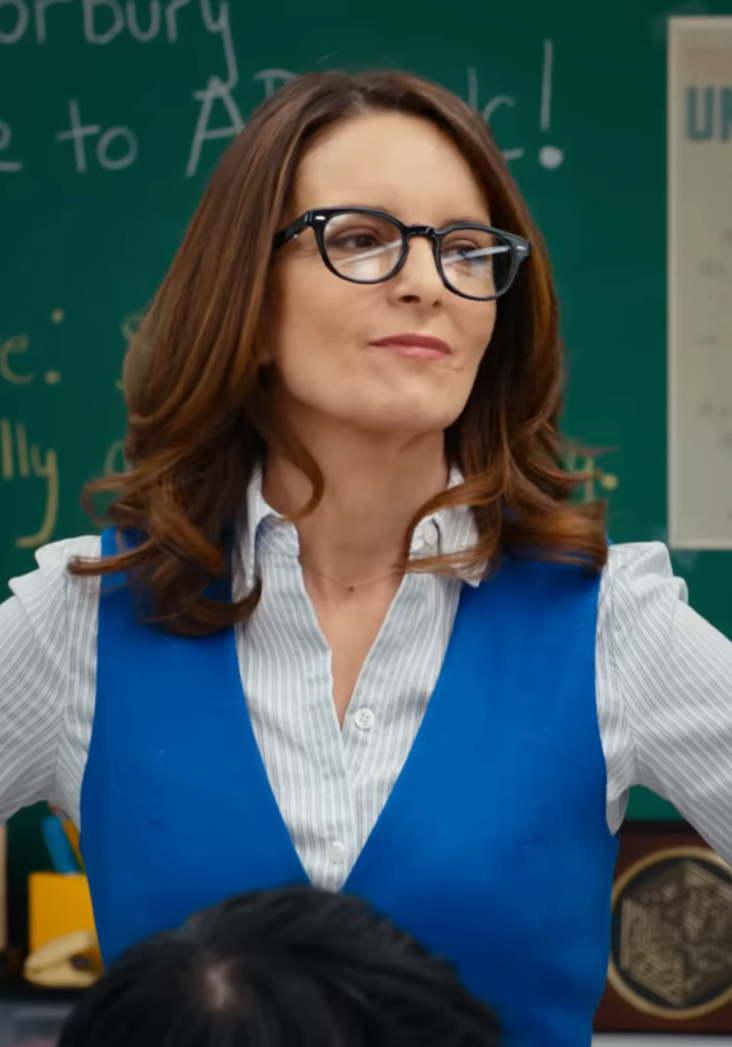
Mean Girls 2024 has all the verve and wit of the original and the musical numbers (by Jeff Richmond) really work, dialling up the histrionics and highlighting the humour. Rice is delightful in the lead role, and it’s great to see the original Cady, Lindsay Lohan, in a cameo. Tina Fey and Tim Meadows reprise their roles of Ms Norbury and Mr Duvall, and this works extremely well. Indeed, Fey looks almost exactly the same in both movies (I guess there’s an ageing picture in an attic somewhere). The supporting roles are more fleshed out here too, and I like learning more about both Karen and Gretchen.
I’m a little sad that the fat-shaming hasn’t been eradicated, that the nastiest trick Cady and her friends can play is to make a girl gain weight. Worse, the extra pounds Regina’s carrying actually have a greater impact in this incarnation, as the Plastics’ dance routine is ruined because she’s too heavy to lift. This feels like a blind-spot in an otherwise fabulous film.
It’s not enough to spoil things though. The new Mean Girls delivers just what it’s supposed to: a couple of hours of lively, well-crafted and eminently quotable fun. “Stop trying to make ‘fetch’ happen!”
4.3 stars
Susan Singfield


 Bouquets & Brickbats