

08/08/25
Traverse Theatre, Edinburgh
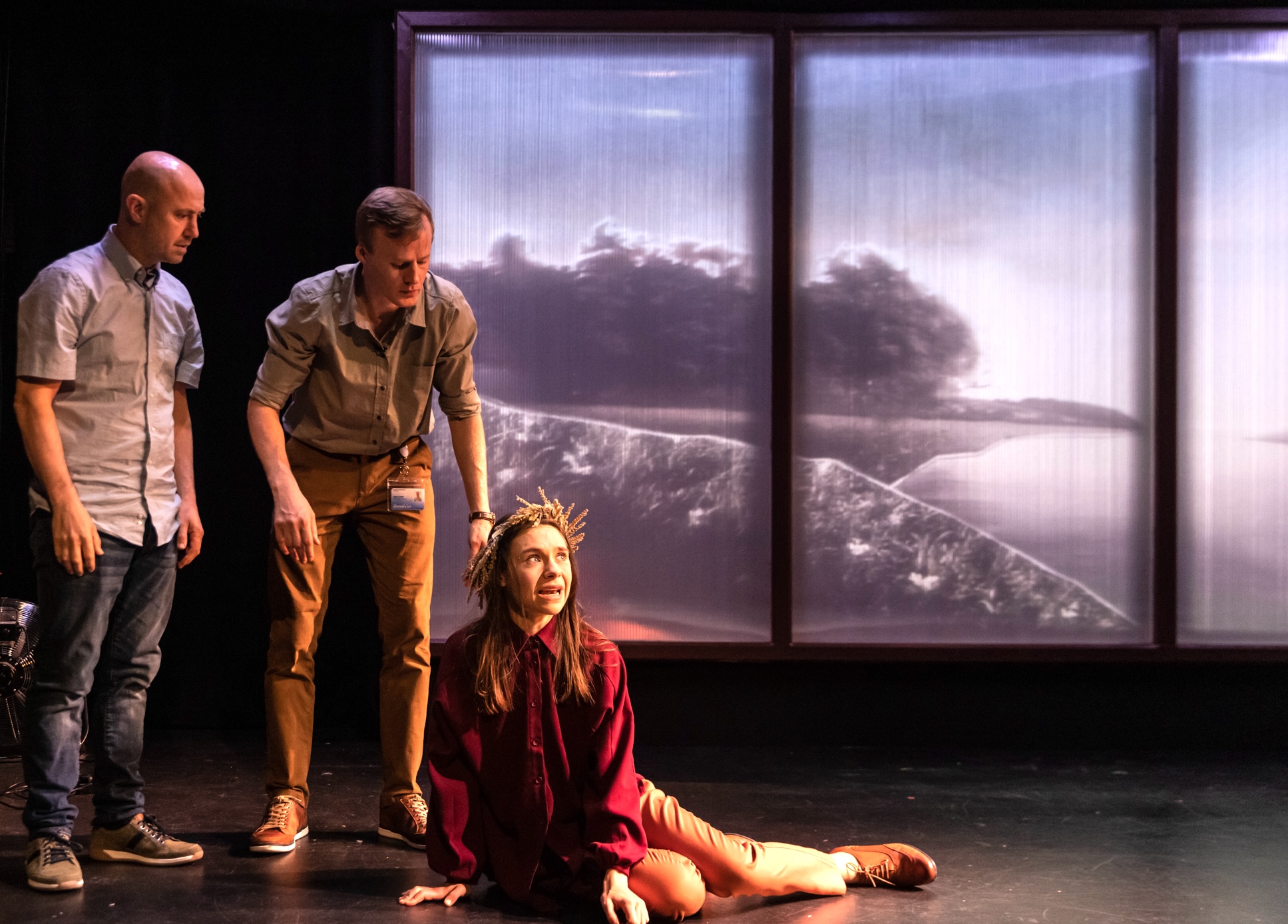
King Lear is my favourite Shakespeare play and, fittingly, Lost Lear is my favourite 2025 Fringe production (so far). Dan Colley’s interpretation of the tragedy sees a retired actor, Joy (Venetia Bowe), who is struggling with dementia, reliving her role as the eponymous monarch. The care home staff accede to Joy’s version of reality, willingly reading in for Goneril, Regan, Cordelia and the fool. It’s kinder than confronting her with the bleak, unhappy truth, says Liam (Manus Halligan) to Joy’s estranged son.
But Conor (Gus McDonagh) takes a little more convincing. He’s uncomfortable playing Cordelia. He doesn’t want to understand the play; he wants answers from the mother who gave him up at birth. Sadly, Joy is largely unreachable, and it’s only through the bard that the pair can connect.
Colley’s beautifully-conceived script intertwines excerpts from Lear with moments in the here and now, gently but relentlessly uncovering the horrors of cognitive decline. There is a stillness at the centre of the piece, belying the chaos of the “cataracts and hurricanoes” as Joy/Lear rages at a world s/he no longer understands. But there is layer upon layer here: this is as much an exploration of stagecraft, poetry and the nature of performance as it is of ageing, care work and the complexities of love. It’s not just a play to watch, it’s one to study too – and I make sure to buy the script as I leave the theatre, so that I can delve into it again after I’ve had some time to think.
Bowe is utterly compelling in the lead role: an imperious, querulous woman, quite difficult to like. But Liam and the other staff (Clodagh O’Farrell and Em Ormonde) treat her with such quiet respect that we take our cue from them, affording her the sympathy that everyone in her position needs. Halligan and McDonagh perform with absolute precision too, but theirs are very much supporting roles, the moons to Joy’s planet.
The set design (Andrew Clancy) and tech (Ross Ryder, Suzie Cummins, Kevin Gleeson) are integral to Lost Lear: cameras are used for extreme facial close-ups and there are microscopic projections too, creating the backdrops. I have rarely seen puppetry so well done as it is here, and never with such relevance. The tragedy is both miniaturised and magnified, viewed from inside and out.
As the metaphorical curtain falls, I turn to Philip and find him silently sobbing, his shoulders heaving, tears falling down his face, caught up in memories of his own mother’s battle with Alzheimer’s. Lost Lear feels worthy of its progenitor: a clever, multi-faceted drama; a treatise on the nature of life and death.
5 stars
Susan Singfield
 Bouquets & Brickbats