Jonathan Pryce

The Penguin Lessons

16/04/25

Cineworld, Edinburgh

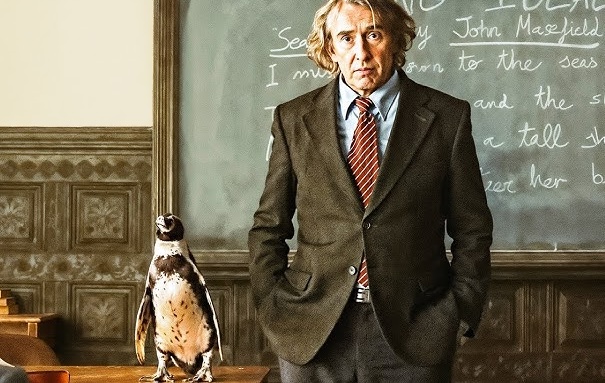
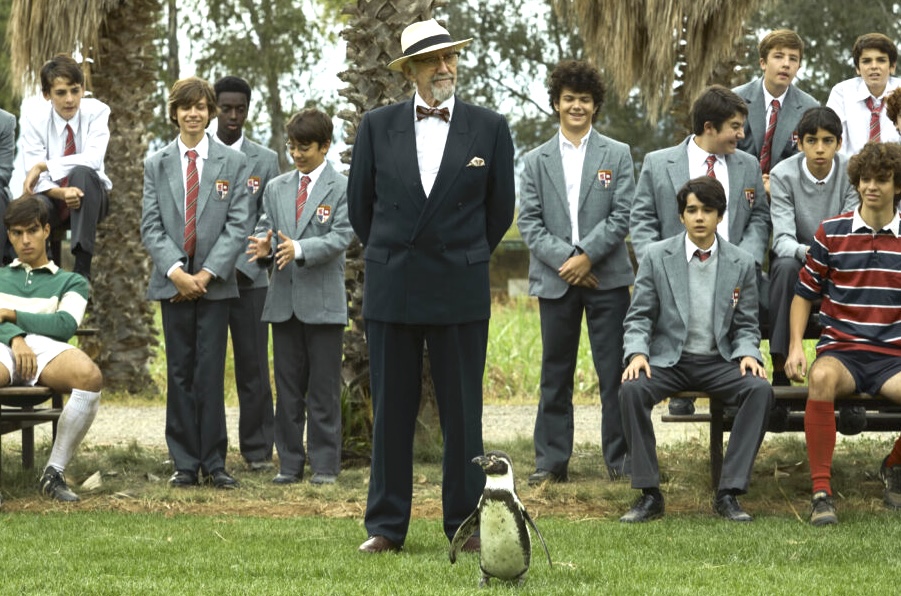
Adapted from Tom Michell’s memoir by the ever industrious Jeff Pope, The Penguin Lessons begins in 1976, when Michell (Steve Coogan) is a somewhat disaffected English teacher, beginning a new post in a private school in Argentina. He arrives in a country that has recently undergone a brutal coup and takes up his post under the watchful gaze of Headmaster Buckie (Jonathan Pryce), a man who prefers to put the needs of the school first and pretend that the current political upheaval is of no consequence. The only friend Tom makes on the staff is Tapio (Björn Gustafsson) a well-meaning but humourless Finlander, who seems to have the knack of saying the wrong thing every time he opens this mouth.

On a brief visit to Ecuador, Tom chances upon a group of oil-covered penguins washed up on a beach. One of them is still alive and – mainly because he’s trying to impress a young (married) woman he’s met in a dancehall – Tom takes the luckless bird back to his hotel room and cleans him up. Having acquired the penguin – Tom dubs him ‘Juan Salvador’ – he finds it impossible to get rid of it, the penguin following him hopefully everywhere he goes. Eventually, Tom has no option but to take Juan Salvador back to the school and keep him hidden in his room… until, in a moment of madness, fuelled by the indifference of his privileged pupils, Tom is prompted to bring the creature into the classroom…

The Penguin Lessons could so easily descend into a mawkish comedy at this point – and there’s no denying that Juan Salvador (or at least the penguin actor who portrays him) is impossibly cute, coaxing adoring sighs from the audience every time he waddles engagingly onto the screen. But Pope’s script skilfully touches on darker themes, dealing with the brutal regime of the Junta and the plight of the ‘disappeared,’ the thousands of people arrested by Perón’s forces. Tom manages to distance himself from the situation until Sofia (Alfonsina Carrocio), the daughter of the school’s housekeeper, Maria (Vivian El Jaber), is arrested on the street and taken away to be ‘interrogated.’

Coogan is on impressive form here, portraying Tom as a cynical, hardbitten loner with something lurking in his past. The short scene where we discover the reason for his remoteness is affecting because it is so understated and yet so utterly believable; likewise, the scene where Tom is prompted to confess to Maria that he could have tried to help Sofia as she was being arrested but was ‘too scared.’

Peter Cattaneo directs with a lightness of touch that effortlessly fuses the film’s disparate elements. There are many who will criticise its ambition but, to my mind it’s beautifully handled: a funny, touching story set against a tumultuous background.

And now, if you’ll excuse me, I’m off to p-p-p-pick up a penguin.

4 stars

Philip Caveney

One Life

02/01/24

Cineworld, Edinburgh

One Life, written by Lucinda Coxon and Nick Drake, is the true story of Nicholas “Nicky” Winton (played at different life stages by Johnny Flynn and Anthony Hopkins), the self-effacing man who orchestrated his own Kindertransport, managing to rescue over six-hundred children from Nazi occupied Czechoslovakia in 1938.

Winton never sought recognition; despite this extraordinary endeavour, he was by all accounts a resolutely ordinary man. But, fifty years on, urged by his wife, Grete (Lena Olin), to tackle the clutter in his study, he finds himself confronted by an old scrapbook, carefully detailing the names and foster homes of the refugees he helped. It’s an important artefact and Winton doesn’t want it to languish unseen in a library. The plight of the Czechs at the start of the war must not be forgotten; the scrapbook must be seen, must be used as a reminder that it’s our duty to help those in need.

Winton approaches his local press but they don’t know what to do with it. Undeterred, he calls on his erstwhile colleague, Martin Blake (Ziggy Heath/Jonathan Pryce), to see if can pull any strings and, before long, Elizabeth Maxwell is on board. From there, it’s not a great leap to the pages of the Daily Mirror, owned by her husband, and thus to wider recognition. Readers of a certain age might remember the 1988 episode of the always tonally-uneven That’s Life! where Esther Rantzen (played with gusto by Samantha Spiro) veered from tittering about nominative determinism to reuniting Winton with some of the youngsters he helped, now middle-aged and keen to meet their saviour.

But Winton was always quick to point out that he didn’t work alone, that he was just one member of a team, so I shouldn’t neglect to mention the others here. Along with Blake, Doreen Warriner (Romola Garai) and Hana Hejdukova (Juliana Moska) worked tirelessly in Prague, identifying those in need of refuge and sorting out their paperwork. Meanwhile, Nicky’s mother, Babette (a rather magnificent Helena Bonham Carter), slogged away in the UK, fundraising, finding foster families and chivvying the government.

Hopkins’ performance is heartbreaking. It’s hard to convey the inner turmoil of a quiet and unassuming man, but Hopkins makes it look easy. In his face, we see how Winton’s sadness about the children he couldn’t save clouds his whole life, even as he’s lauded for what he has achieved. Flynn is a surprisingly good physical match for Hopkins, and he perfectly encapsulates the younger Winton’s clarity and sense of purpose. The children need saving. So he saves them.

I don’t know how anyone can sit through this film without weeping. The cruelty inflicted on the Jews is breathtaking. Director James Hawes doesn’t dwell long on any one act of inhumanity. Instead, he shows us snippets of frightened faces, close-ups of guns, a family huddled together under a blanket, the thin arm of an evacuee stretching piteously towards a parent. Heightened by Volker Bertelmann’s moving score, the cumulative effect is devastating. I don’t want to believe that such evil is possible.

669 only accounts for a small percentage of those who needed help, but every one of those is a person; every one of those matters. Winton’s stoic “Save one life, save them all” mantra stands, and this clear-eyed, unsentimental film shows us why.

4.3 stars

Susan Singfield

The Wife

08/10/18

The Wife, directed by Björn L Runge, opens in 1992, when novelist Joe Castleton (Jonathan Pryce) picks up the telephone to hear that he has won the Nobel prize for literature. As soon as he realises who is calling, he insists that his wife, Joan (Glenn Close), picks up the extension before any details are revealed: he wants to share the news with her. She’s delighted; they clamber up on to the bed, holding hands, and begin to jump. But it’s not long before we feel the first frostiness between them: “I’ve won the Nobel! I’ve won the Nobel!” Joe shouts, and Joan visibly shuts down. (How does Close do that? There’s not even a flicker on her face, but we see the light fade from her eyes. It’s astonishing.) Clearly, all is not as rosy as it seems…

There’s a revelation at the end of the film that I won’t spoil in this review. I will say, though, that there is no big surprise, and I guess that’s deliberate – it’s not very well concealed. In fact, it’s pretty clear from the trailer where we are headed. But this is much more about the ‘how’ and ‘why’ than it is about the ‘what’ – The Wife is very much a character-led piece, the study of a relationship, and the lies and compromises that make it tick.

Close is extraordinary in the role, combining flinty intelligence and self-control with a much softer, love-fuelled tenderness. Pryce is also very good, his puffed-up pride and self-importance masking his deep-rooted insecurity. We follow Joe and Joan from their first meeting, back in 1958. Young Joan (Annie Starke, Close’s real-life daughter) is an aspiring writer, studying at the prestigious Smith College; Joe (whose youthful incarnation is played by Harry Lloyd) is her professor. He’s married with a baby, but that doesn’t stop them falling in love. And, more than thirty years later, here they are, proving that their relationship was worth it: they’re thriving. He’s a celebrated literary author; she’s the kingmaker behind the throne. They have two children and one grandchild. Theirs is a story of success.

But their son, David (Max Irons), is not happy. He’s a writer too, and desperate for his father’s approval. But Joe can’t give David the validation he seeks: even though Joan insists that David’s work shows real talent, Joe can only offer muted praise.

In Stockholm, as the big Nobel prize ceremony draws ever nearer, the tension bubbles ominously, and it’s clear that something has to give. But what will prove the final catalyst? Will it be Joan’s simmering resentment at being rendered invisible, relegated to the role of ‘shopping with the other wives’? David’s anger at his father’s implied criticism? Or the slippery Nathaniel Bone (Christian Slater), would-be biographer, and his desire to write an exposé?

The Wife is an engaging drama, astute in its depiction of the petty details that inform arguments with loved ones, the fondness and fury that bind families together. And it shows us too how we never really know the truth about other people’s lives, only what they choose to let us see.

4.3 stars

Susan Singfield