
Joe Alwyn

The Brutalist

25/01/25

Cineworld, Edinburgh

It’s evident from the very beginning of The Brutalist that director Brady Corbet is determined to establish his own rules. Instead of rolling vertically, like every other credit sequence you’ve seen, the words slide horizontally across the screen and resemble the work of a groundbreaking graphic designer. Using VistaVision – a screen format popularised in the 1950s – the film has its own distinctive look. It has a prodigious running time of over three-and-a-half hours, but, much like the old epics of David Lean, viewers are afforded a fifteen-minute interval, so we can avail ourselves of a toilet break.

It’s a wonder then that The Brutalist is so utterly compelling that I barely even notice its length. This is monumental in every sense of the word and perhaps the biggest wonder of all is that it’s been created on a budget of less than ten million dollars – a fraction of most films conceived on this scale.

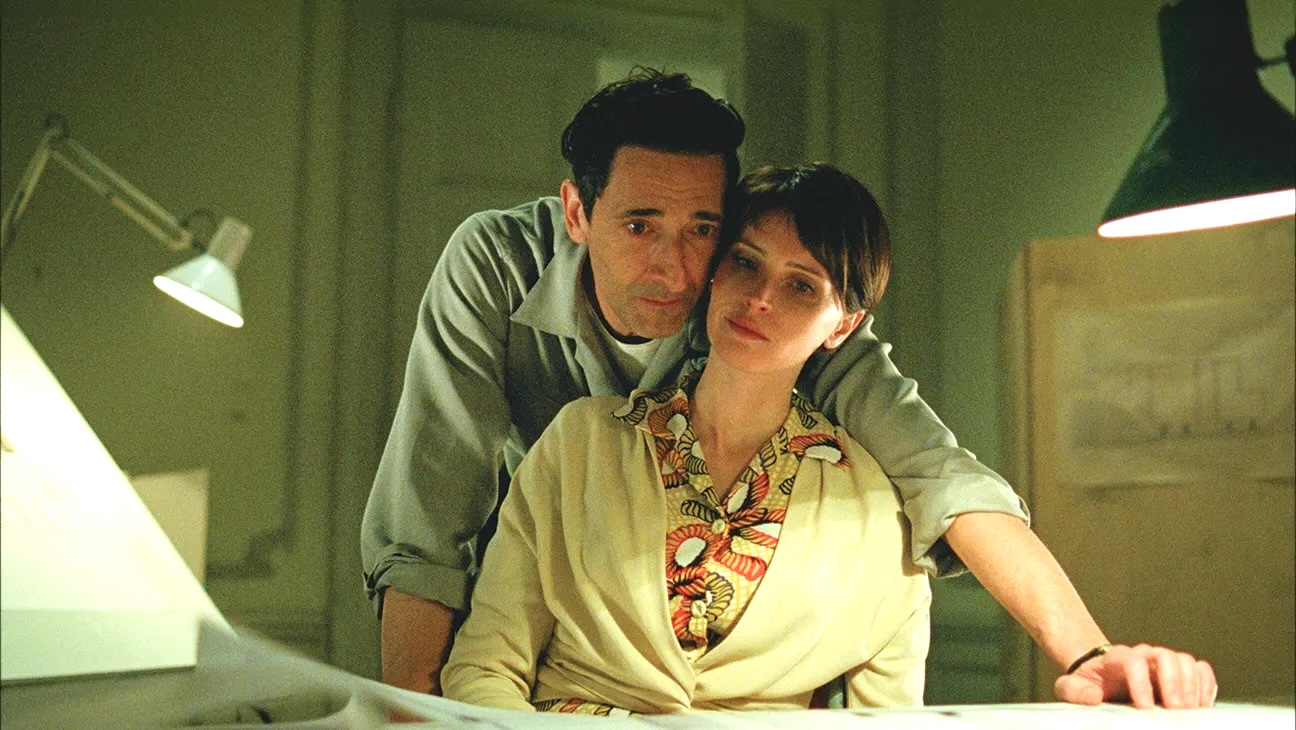
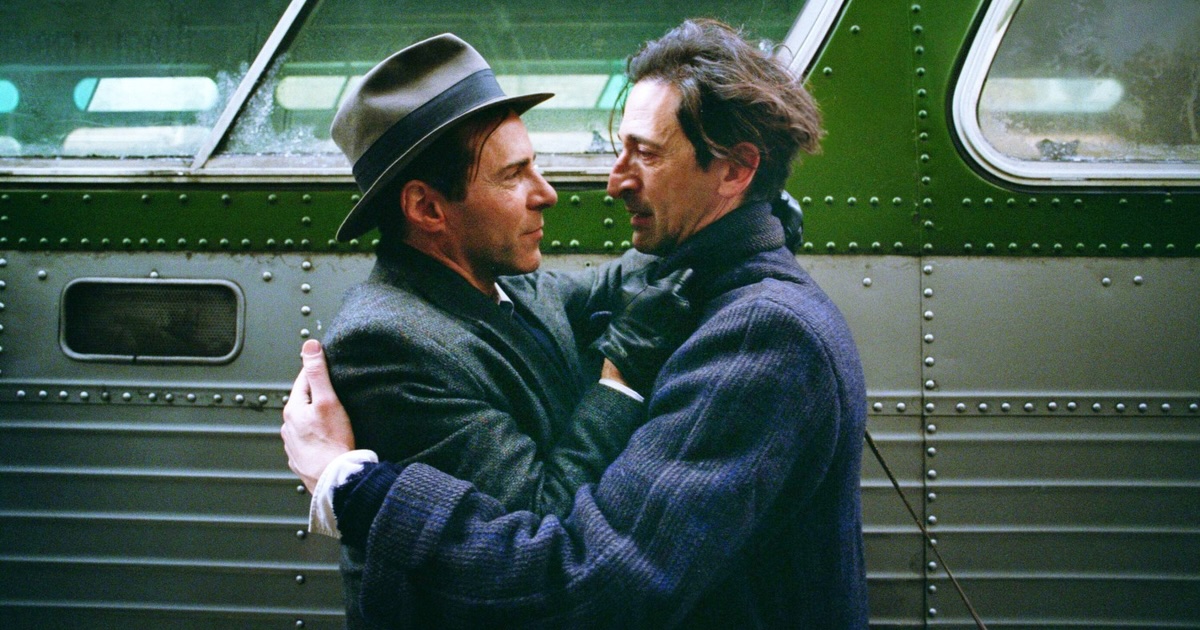
The story begins in 1947 with a series of fragmentary glimpses of Jewish refugee, László Tóth (Adrien Brody) travelling by ship from his native Hungary to begin a new life in America. He has been forcibly separated from his wife, Erzsébet (Felicity Jones), and his orphaned niece, Zsófia (Raffey Cassiday), and imprisoned in Dachau concentration camp for most of the war, but has now been offered sanctuary in Pennsylvania by his cousin, Attila (Alessandro Nivola), and his Catholic wife, Audrey (Emma Laird). The couple run a small furniture store and Attila is well aware that, before the war, László worked as an architect of the Bauhaus School. His design skills, Attila thinks, will come in useful.

Attila is approached by Harry Lee Van Buren (Joe Alwyn), who wants to commission László to redesign his father Harrison’s private library as a birthday surprise. Rather than do a straightforward upgrade, László transforms the room into a stunning work of art. When Harrison (Guy Pearce) arrives home earlier than expected, he clearly doesn’t approve of what’s been done in his absence and flies into a rage, ordering László and Attila to leave. Harry subsequently refuses to pay for the work and, as a consequence, László finds himself thrown out of his cousin’s place, with no better prospect than labouring to earn his daily bread. With his friend, Gordon (Isaac de Bankholé), he sinks into heroin addiction.

But when the redesigned library appears in the pages of an influential style magazine, Harrison undergoes a dramatic change of heart. Suddenly, he wants to be László’s patron, to converse with him, to fully understand his working methods. What’s more, he has influential Jewish friends who will be able to help him to bring Erzsébet and Zsófia over from Hungary to be with him. And then Harrison starts talking about a new commission: a massive civic centre dedicated to his late wife, a place where the local community can meet and enrich their lives.

But in the fullness of time, László will discover that such indulgences come at a price that will utterly compromise his artistic freedom – and will impinge upon his life in ways he could never have anticipated…

The Brutalist is a remarkable film in so many ways, not least because of Brody’s powerful performance in the lead role, a tortured artist, forced to compromise his talent at every turn. Pearce is also terrific as the self-aggrandising Harrison and Alwyn excels as his sneering, deeply unpleasant son, a man used to getting his own way in everything he approaches. Jones doesn’t enter the story until the film’s second half but submits a beautifully nuanced performance as Erzsébet, a woman still physically tortured by the aftermath of the starvation she suffered during the war. I should also mention Daniel Blumberg’s wonderful score, which provides the perfect accompaniment to Lol Crowley’s eye-popping cinematography.

The film has plenty to say about the creative process and it nails perfectly the powerful seduction that success offers to any artist – the fateful allure of patronage and its unpalatable compromises. Brady’s screenplay, co-written with Mona Fastvold, is wise enough to hint at unspeakable things rather than spelling them out – and it keeps me hooked until the final frame.

Will Brody lift the ‘best actor’ gong at this year’s Oscars? It’s a strong possibility in a year that features a whole bunch of commendable performances. Meanwhile, go and see The Brutalist and marvel at its epic qualities – and, if possible, watch it on an IMAX screen to best appreciate the wonders of VistaVision.

5 stars

Philip Caveney

Harriet

25/11/19

Anyone who has witnessed the superb double-punch that was Bad Times at the El Royale and Widows will surely have the same conviction as me: that Cynthia Erivo is destined to be a major player in the cinema. So her presence in the lead role of Harriet feels suspiciously like an affirmation. This is a part she was born to play and it’s hard to imagine anyone better suited to depict this spirited, fearless woman. Filmmakers have been playing with the idea of a Tubman biopic for something like twenty-five years now, back when producers actually considered offering the role to Julia Roberts! Wow. But here, finally, is the film we’ve been waiting for and, in terms of a performance, Erivo knocks it right out of the park. 

We first encounter Harriet Tubman in 1846, when she’s Araminta Ross, a slave ‘belonging’ to the Brodess family in Maryland, and dreading the prospect of being sold further south, as her two sisters were when she was a child. She’s also prone to having religious visions, a legacy of a fractured skull delivered by her ruthless owner, Edward. Harriet is married to John Tubman (Zackery Momoh), a so-called free man, and has acquired legal papers to prove she too should be free. But Edward is adamant that he will never give up such a valuable piece of property. When he dies, his equally odious son, Gideon (Joe Alwyn), needs to pay off his father’s gambling debts and decides that he will sell Harriet. She takes the only option she feels is left to her and runs away, leaving John behind for fear of getting him involved in her illegal act.

Through sheer grit and determination, she makes the one-hundred-mile trip to Philadelphia unharmed, and is introduced to William Still (Leslie Odom Jnr), a major player in the Underground Railroad, a secret organisation dedicated to bringing slaves from the Southern states to freedom in the North. Harriet takes her new ‘free’ name and tells William she wants to go back to Maryland to rescue her husband and the other members of her family, but he doubts that a lone woman could ever achieve such a task. Undaunted, she heads back anyway, risking her own capture to bring her loved ones to freedom. Once there, she finds that John, believing her dead, has married and is due to be a father. But the rest of her family still need guiding to safety. This achieved, Harriet extends her help to strangers. And when changing laws mean that she has to take her ‘passengers’ as far north as Canada, she doesn’t hesitate to do so…

Harriet is a film that eloquently communicates the true horrors of slavery. Whip marks on people’s bodies bear silent testimony to the horrors of the antebellum South, and the story doesn’t hold back on shaming the people who perpetuated slavery and who were even willing to go to war in order to preserve it. Gideon Brodress is depicted as a truly loathesome example of humanity and, sadly, the corridors of power are populated by others just like him. 

Tubman, by the way, is one of the few women who served as a soldier during the American Civil War, leading a black regiment to rescue 750 captive slaves at Combahee River. It would be hard to imagine a more worthy recipient of our respect and yet, when it was recently suggested that her image should replace that of Andrew Jackson on the $20 bill, a certain Donald Trump had the change ‘postponed’ until 2026. Which demonstrates that we may not have come as far as we might like to think.

Till then, Kasi Lemon’s moving and important film must suffice as Harriet Tubman’s memorial. Unsurprisingly, it isn’t getting the kind of massive rollout that more commercial movies are receiving, but I urge you to see it, if only for Erivo’s dazzling performance in the title role.

4.5 stars

Philip Caveney


Billy Lynn’s Long Halftime Walk

11/02/17

Let’s start with an admission: we’re watching Billy Lynn’s Long Halftime Walk in 2D, and at 24fps at our local Cineworld. So we’re not going to be able to comment on its technical wizardry, not on whether the 4K 3D 120fps makes Ang Lee’s experiment worthwhile, nor on whether we agree with the critics who claim it makes the film uncomfortable to watch. But, as only five cinemas worldwide are equipped to show this movie in its full glory, our experience is more likely to chime with that of our readers. And so we’ll focus on the film behind the tech.

Based on a novel by Ben Fountain, BLLHW tells the tale of a squad of young American soldiers, brought home from Iraq for a victory tour, following the circulation of video footage showing their doomed-but-heroic fight to save their sergeant’s life. Billy (Joe Alwyn) is struggling to cope, ambivalent about the war, and unsure of much except his loyalty to his squad. They are rewarded with a day out: they are guests of honour at a football game, trotted out to stand behind Destiny’s Child to wild applause during halftime. And there is talk of a film deal, too: they’ll be famous, wealthy, given everything they need.

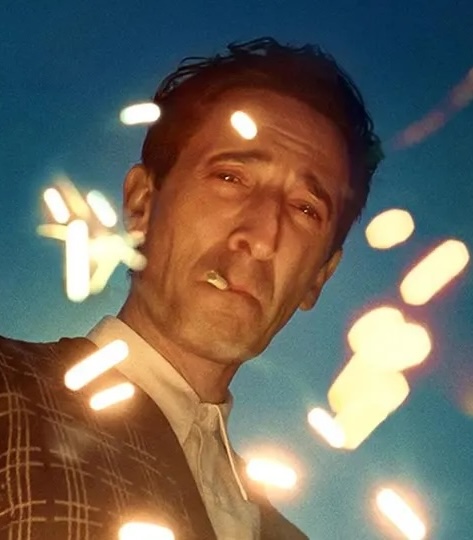
Joe Alwyn’s performance is subtle and nuanced: his pain is palpable. The realities of his war are revealed through a series of short flashbacks, sparked by the flash of a firework or a poignant word. It’s a touching story: he hasn’t much to stay home for, but neither does he want to go back to Iraq. His sister, Kathryn (Kristen Stewart), tries to persuade him to see a psychiatrist; she’s scared of losing him and can see that he has PTSD. And it’s heartbreaking to watch him struggle with the decision. There are no easy answers here.

I enjoyed this film a lot, and not just because of the novelty of seeing Vin Diesel in a role where he’s required to act. It’s not action-packed, and there are no clichéd moments of wonder or revelation. It’s a slow, wordy piece about ambiguity, about what we ask young men to do, and how little we know of the toll it takes. The response to Bravo Squad on their return to the US is confused: they’re heroes, but they’re ordinary. They’re revered, but they’re mocked. They’re film worthy, but no one will pay them properly. In the end, they only have each other, and their instincts – and, if that’s not enough, well that’s too bad. It’s a fascinating story, and well worth two hours of your time.

4 stars

Susan Singfield