Joaquin Phoenix

Eddington

18/08/25

Cineworld, Edinburgh

For reasons too boring to go into, tonight’s schedule is clear – and an Unlimited preview of the new Ari Aster film is simply too tempting to ignore. Aster is an interesting writer/director and, though his last film, Beau Is Afraid, was disliked by those who enjoyed Hereditary and Midsommar, I thought there were some very interesting ideas in there.

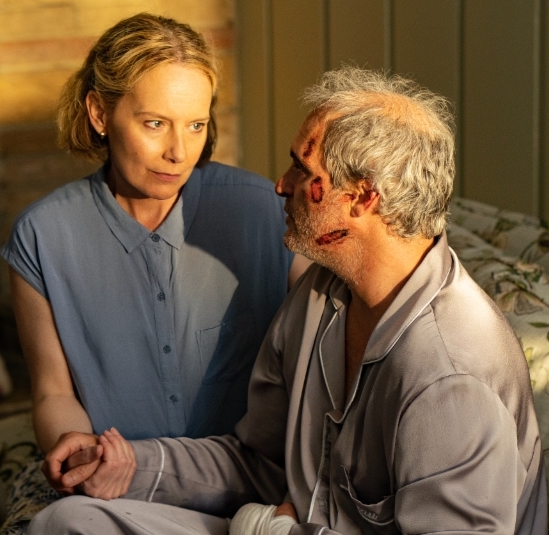
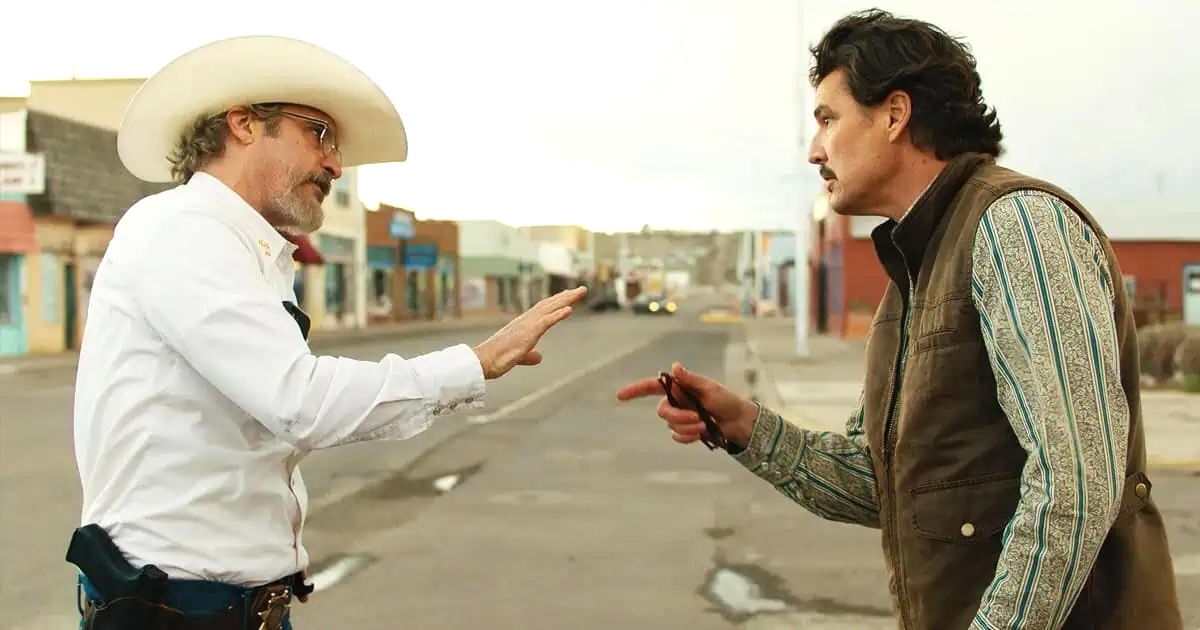
Eddington reunites Aster with Joaquin Phoenix as Sheriff Joe Cross, attempting to keep control of the titular desert town in the midst of the COVID pandemic. (Amazingly, this is perhaps the first film I’ve seen that focuses on the effects of the lockdowns and, for that reason alone, it deserves to be seen.) Cross is asthmatic and does not take well to the constraints of a face mask. Since there have, as yet, been no cases of COVID in Eddington, Cross resists wearing one at all times, even though Mayor Ted Garcia (Pedro Pascal) has made it mandatory that they should be worn whenever people are sharing indoor space.

Garcia is currently running for re-election and there are big posters of him everywhere but Cross has an old grudge against the Mayor, stemming from something that happened to Cross’s wife, Louise (Emma Stone), back when she was a teenager. Louise is now a frail and mentally unstable woman, unable to handle stressful situations, a condition that isn’t helped by the presence of her mother, Dawn (Deidre O’Connell), in the family home. Dawn is addicted to conspiracy theories and openly denounces COVID as fiction.

After a confrontation between Cross and Garcia, Cross suddenly decides that he wants to run for the position of Mayor of Eddington himself, and he enlists a couple of hapless deputies to help with his campaign. But the killing of George Floyd by a police officer during a riot in Minneapolis instigates the local teenagers to launch a Black Lives Matter protest in the town centre. Cross and his two officers head out to confront the kids and, everything begins to spin out of control…

Some films suffer from a lack of original ideas but the problem with Eddington is that it has far too many of them. They virtually fall over each other as they tumble out in all directions and I cannot deny that the result is something of a mess. Furthermore, there are so many characters competing for screen time that great actors like Stone, Pascal and Austin Butler – who appears briefly as deranged cult leader, Vernon Jefferson Peak – are reduced to little more than cameo roles.

That said, I’m never bored by what’s happening onscreen and much of what’s here is darkly funny. It’s clear from early-on that things are destined to become explosive and, once the fuse is lit, I can only sit back and watch appalled as the shit hits the fan.

More than anything else, Eddington is a commentary on American politics and the ways in which online culture – exacerbated by the isolation of the lockdowns – has polarised the opinions of everyday people, resulting in the massive divides that now hold sway in the USA (and closer to home). This may not be a perfect film, but it’s certainly worth a trip to the cinema to watch as the chaos unfolds.

3.8 stars

Philip Caveney
A Complete Unknown

17/01/25

Cineworld, Edinburgh

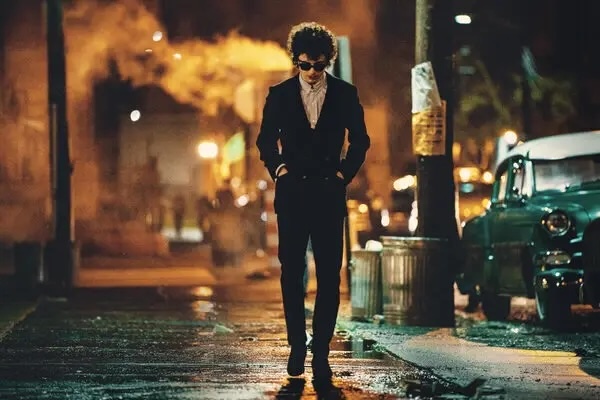
Writer/director James Mangold has been down the music biopic route before with 2005’s Walk The Line (featuring Joaquin Phoenix as Johnny Cash), but the news that he was planning a film about Bob Dylan felt like a decidedly tall order. After all, Robert Zimmerman is the proverbial mystery wrapped up in an enigma, a man who has unabashedly invented (and reinvented) the details of his own story from the very start of his career. It’s to Mangold’s credit then, that A Complete Unknown is such a triumph, eschewing the idea of a ‘whole life’ depiction and choosing instead to focus on five turbulent years from the musician’s life.

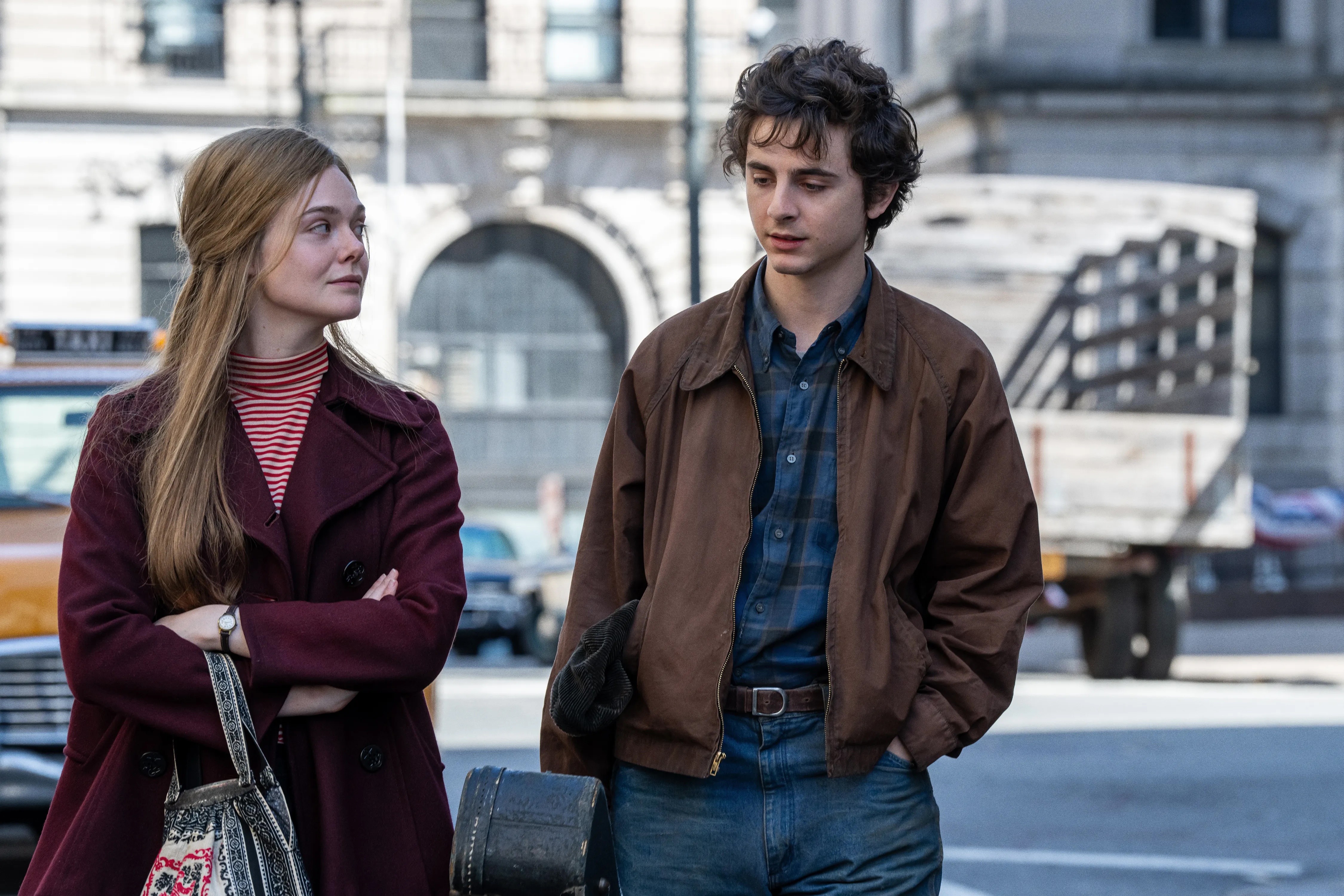
it’s 1961 and a twenty-year-old Dylan hitchhikes from his home in Duluth, Minnesota to Greystone Park Psychiatric Hospital in New Jersey, where folk legend Woody Guthrie (Scoot McNairie) is slowly succumbing to the ravages of Huntingdon’s Disease. Guthrie is Dylan’s hero and he has come here to sing to him, as song he’s written all about the man. Present at the impromptu performance is Guthrie’s friend and fellow folk stalwart, Pete Seeger (Edward Norton). He’s impressed both by the song and the performer’s confidence, so he takes Dylan under his wing and starts introducing him to the flourishing folk scene in the coffee houses of New York City.

It isn’t long before his regular appearances start to gain him a reputation. At one concert he meets Sylvie Russo (Elle Fanning, a thinly disguised version of Dylan’s real life muse, the late Suze Rotolo), and the two of them become lovers and constant companions. He also meets folk singer Joan Baez (Monica Barbaro), already something of a star on the folk circuit. Baez covers some of Dylan’s songs and helps to bring his work to a wider audience, and inevitably, a romantic entanglement ensues between them.

And then, Dylan begins to tire of the strictures of the folk scene and finds himself increasingly drawn to the trappings of rock music – the fashions, the poses, the volume. But he is to discover that folk puritans are opposed to sullying ‘their’ music with electric guitars and keyboards. It becomes clear that the transition won’t be an easy one to make…

These days, I am by no means a Bob Dylan fan, but I did follow him during the mid sixties and have always held a soft spot for Highway 61 Revisited – which, coincidentally, is the album around which this film reaches its climax. In the lead role Timothée Chalamet is quite simply astonishing, offering a performance that goes beyond the realms of mere impersonation. He actually performs all the songs and plays guitar on them. (A post screening Q & A tells me that he didn’t play the instrument before this film, but had the opportunity to work on his character for five years and figured he might as well go all-in). Co-star Barbaro had barely sung a note before she landed the role of Joan Baez, but she somehow nails the woman’s unique vocal style effortlessly.

And then of course, there are the songs, each one indelibly memorable and delivered with enhanced power at this IMAX screening, so that the film’s two hour plus running time seems to positively flash by. Dylan, as portrayed by Chalamet, is a whole contradiction of characters, by turns vulnerable, scheming, hard bitten and amorous, sneering, vindictive, reckless and determined. Of course, Chalamet has been nominated for an Oscar and, should he be successful, then it will be well-earned.

A Complete Unknown is a remarkable achievement, a film that captures the era in which it’s set with absolute veracity and which chooses to focus on one of the most important moments in music history. It’s fascinating to watch it unfold. (Okay, so a few small details have been tweaked – that infamous cry of ‘Judas!’ occurred at the Free Trade Hall, Manchester, not the Newport Folk Festival, but it matters not one jot.) This is a movie to enjoy on the big screen with the best sound system available. After the recent financial failure of the brilliant Better Man, I’m reluctant to speculate on what this film might achieve at the box office, but for my money, it ticks all the boxes.

It’s a musical feast. Dig in.

5 stars

Philip Caveney

Joker: Folie à Deux

04/10/24

Cineworld, Edinburgh

Todd Philips’ 2019 film, Joker, was cinematic Marmite. For every viewer that loved it (and I was firmly in that camp), there was an equal number of comic book fans who detested it, largely because the film had no truck with the conventions of the genre that inspired it. Instead, here was an unflinching exploration of a mentally ill man, abandoned by the healthcare system and ultimately championed by a bunch of deluded followers. It was grubby, brutal and utterly devastating.

Folie à Deux is equally divisive, though this time around what has incensed most social media pundits is the fact that the film is… well, there’s no other way to say this: a musical. In 2024, the genre appears to have fallen into total disrepute with movie fans, to the extent that even films like Wicked are reluctant to depict any actual singing and dancing in their trailers in case it puts off potential viewers.

Go figure.

It’s two years after the events of Joker and Arthur Fleck (Joaquin Phoenix) is languishing in Arkham State Hospital, overseen by callous prison warder Jackie (Brendan Gleeson), who seems to delight in humiliating him at every opportunity. (Interestingly, it’s Jackie who tells the nearest thing to an actual joke in this story and, it has to be said, it’s a corker.)

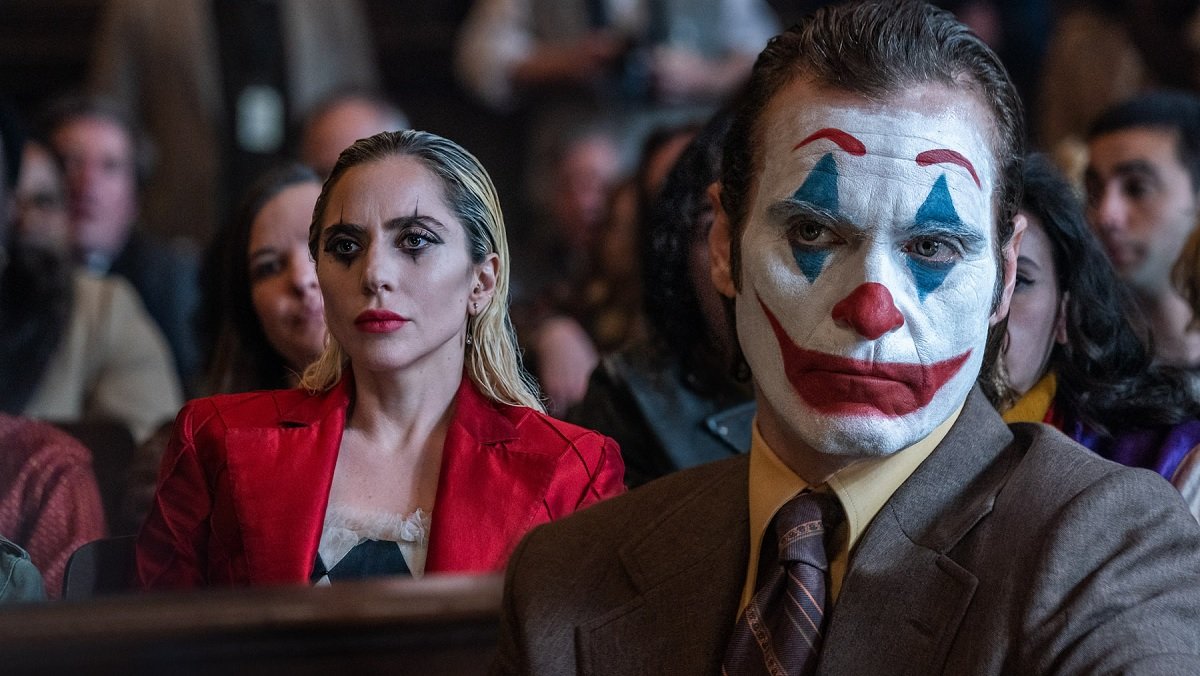
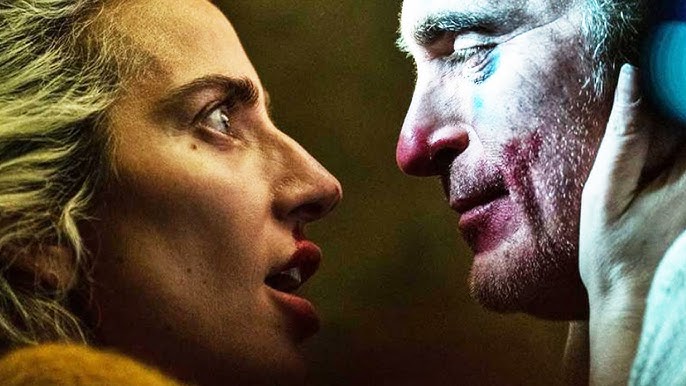
Arthur is fast approaching his day in court, schooled by his defence lawyer Maryanne (Catherine Keener), who is pretty sure that a plea of ‘dissociative identity disorder’ will save him from the death penalty. And then, attending an in-prison musical therapy session where inmates are encouraged to sing their troubles away, Arthur meets Harleen ‘Lee’ Quinzel (Lady Gaga) and, for the first time in his life, he has a reason to want to survive… and to slap that makeup back on his gaunt visage.

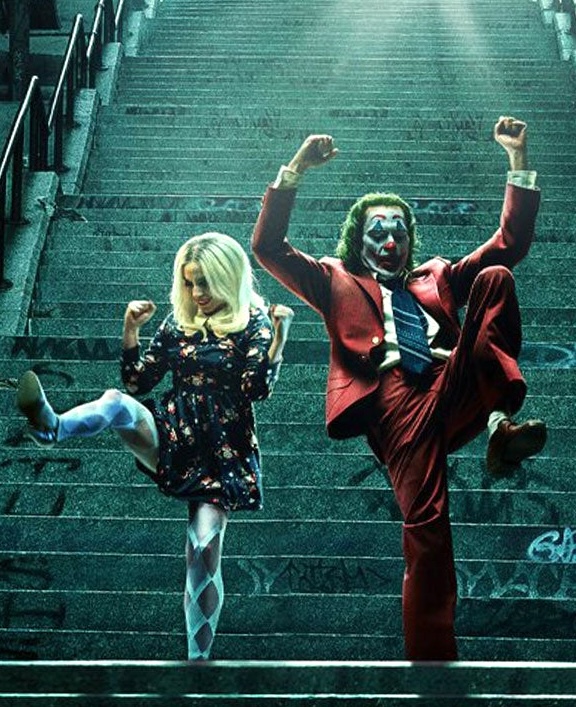
The term ‘musical’ is used quite loosely here. Phoenix and Gaga work their way through a series of solid gold bangers from the likes of Sinatra and Jaques Brel, but it’s made clear from the outset that these sequences occur in the cerebral landscape of Arthur’s head, his way of making sense of what’s happening to him. (Those with long memories may be reminded of Dennis Potter’s Pennies from Heaven, which adopted a similar approach.) A scene where Arthur is being interviewed by TV journalist Paddy Meyers (Steve Coogan) is a good case in point. Midway through the interview, Arthur suddenly breaks into song and dances around his cell – but Paddy remains blissfully unaware of his antics.

Phoenix is an actor of extraordinary ability and he slips into this unfamiliar discipline with his usual aplomb, using his newly slimmed-down frame to accentuate every move. Gaga, who has much more experience in the field, is also sensational, able to imbue an old chestnut like Get Happy with a strangely sinister edge, making me feel that I’m hearing it for the first time. As with the previous film, Philips steadfastly refuses to moderate his approach for the spandex brigade, doubling down on the grime and squalor. Folie à Deux is every bit as unsparing and unforgiving as its predecessor, whilst somehow managing to retain a beautiful humanity.

This may not be the perfectly-honed movie that was Joker, but for my money, it runs it a close second and is far (very far) from the embarrassing misfire that so many are describing it as. Some irate comic fans seem to have been hoping for a rerun of its predecessor, but what would be the point of that? I can’t help feeling they’ve somehow missed the point.

But then, I’m always happy to admit that I love a good musical.

4.6 stars

Philip Caveney

Napoleon

25/11/23

Cineworld, Edinburgh

Over his long career, Ridley Scott has taken on all manner of subjects, in pretty much every genre you can name. It’s interesting to note that his very first feature film, The Duelists, was set during the Napoleonic era, so perhaps it was only a matter of time before he returned to the period and took on the story of the little Corsican – a subject that has brought many other directors to their personal Waterloo. In this particular case, it’s taken forty-six years to get there.

Some cinephiles will tell you that the ultimate Napoleon movie has already been realised way back in 1927, when Abel Gance produced a staggering version of the great man’s life under the same title. It was certainly remarkable and I speak as someone who sat through one of Kevin Brownlow’s restorations of the film in the early 80s – all five and a half hours of it (complete with a live symphony orchestra and several judicious toilet breaks). Compared to that, Scott’s two hours and thirty-eight minutes seems relatively jaunty.

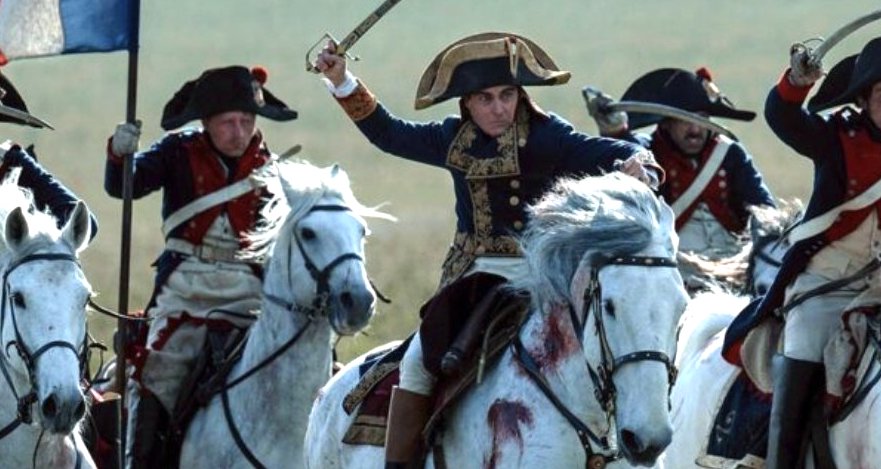
Those who have complained that this version is historically inaccurate may be missing the point. Scott is clearly far more interested in the legend than the reality. It’s a matter of record, for instance, that Napoleon probably owes his defeat at Waterloo to the fact that he suffered from bleeding haemorrhoids and couldn’t sit on his horse – but that’s a film that nobody wants to see.

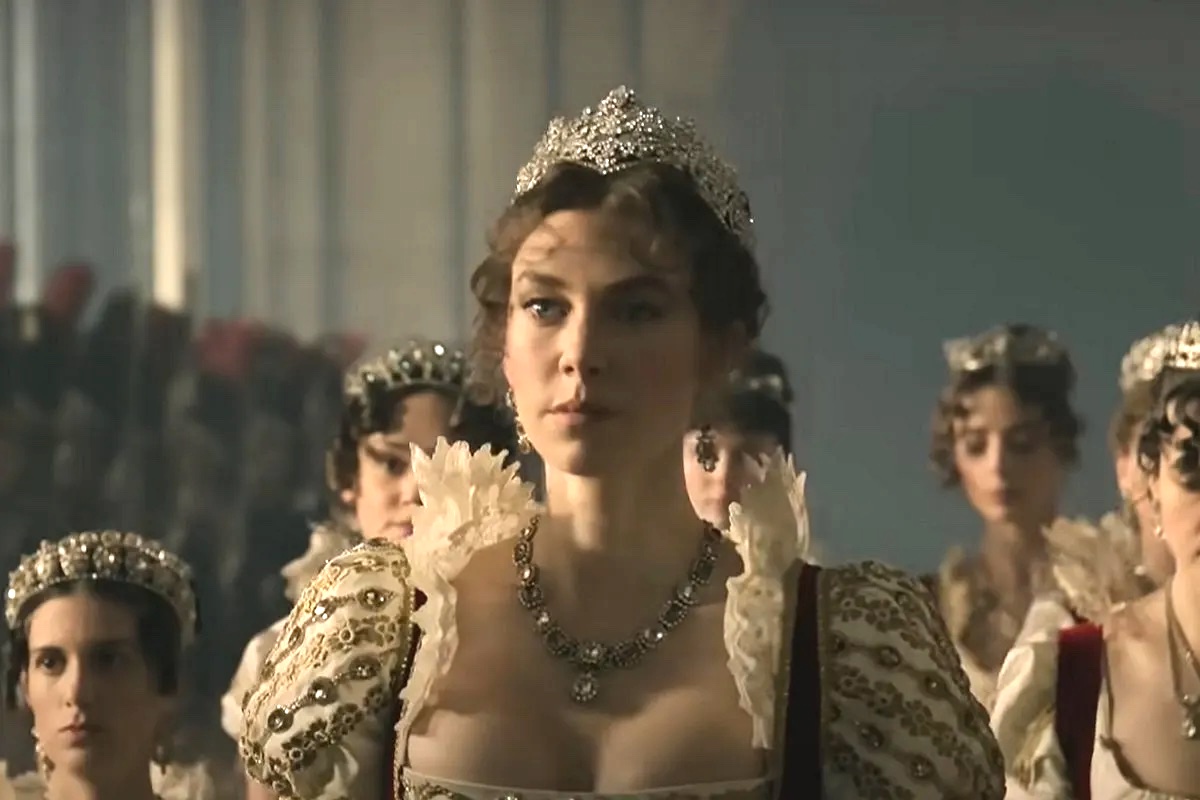
And yes, Joaquin Phoenix may be too old for this role, and surely needed some de-ageing for those early scenes, but he makes a great job of it, mining the man’s hubris and determination to the core, even descending into brattishness when taunted with the spectre of England’s superior navy. Vanessa Kirby offers up a more opaque Josephine, playing everything so close to her bosom that we’re never entirely sure if she actually loves her husband or merely sees him as her personal plaything. Their complex relationship is at the beating heart of this film and perhaps it would have been more fairly titled Napoleon and Josephine.

The inevitable result is that pretty much everybody else in the film is reduced to cameo roles, including Rupert Everett as the Duke of Wellington and an unusually hirsute Mark Bonnar as Napolean’s early confidante, Junot. David Scarpa’s screenplay makes a determined attempt to find some humour amidst all the pomp and misery.

But of course, Scott is the king of spectacle and if it’s battle scenes you’re looking for, there are plenty of them here, so thrillingly recreated that I find myself wincing at every explosion, every visceral thrust of a sabre. Each of the major confrontations is depicted in a different way and I particularly relish the scenes set in the Russian winter, where Napoleon is left bewildered by the fact that his adversaries refuse to meet him on the battlefield, even choosing to torch Moscow rather that surrender it to him. This is stirring stuff, the awful choreography of destruction played with absolute conviction and I cannot think of a director who could have made a better job of it.

Producers Apple Films have already announced that a four hour plus director’s cut of Napoleon is waiting somewhere down the line, and while this has worked for Scott before with Kingdom of Heaven, I’m not convinced that a longer film can hope to add much to the exhilarating theatrical release, which has me gripped pretty much from start to finish.

4.4 stars

Philip Caveney

Beau Is Afraid

21/05/23

Cineworld, Edinburgh

Beau would appear to have every reason to be afraid.

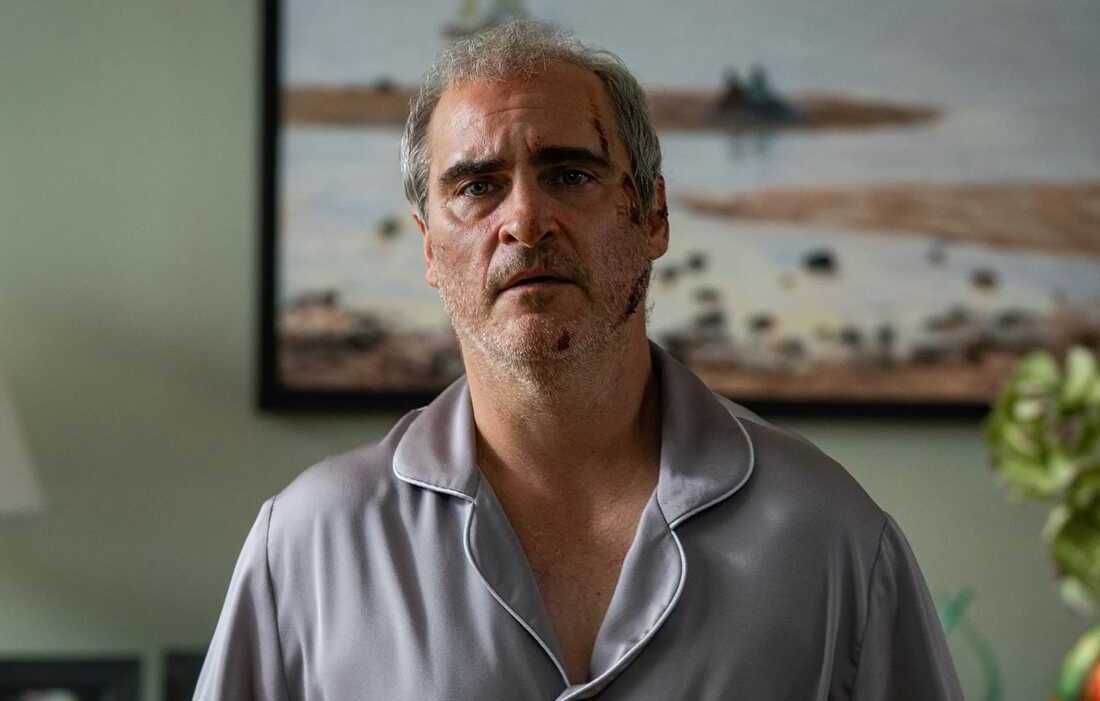
When we first encounter Beau (Joaquin Phoenix), he’s living in a run-down flat in the heart of an American city that appears to have been set-dressed by Hieronymus Bosch. There are rotting bodies lying in the street, vicious fights are breaking out on every corner and he can’t even visit the convenience store without being pursued by a naked man who wants to stab him. His ever-smiling therapist (Stephen McKinley) tells him that it’s all the result of anxiety and makes sure he’s topped up with as many unpronounceable drugs as he can swallow – but he must be sure to take them with WATER!

A long-planned and somewhat overdue visit to his domineering mother, Mona (Patti Lupon), is the catalyst for a paranoiac sequence of unforeseen events, that put Beau into the hands of seemingly friendly couple, Grace (Amy Ryan) and Roger (Nathan Lane). But once ensconced in their home in the country, he soon realises that everything there is not as cosy as it seems. Why does the couple’s teenage daughter, Toni (Kylie Rogers), appear to hate him? And what’s the story with Jeeves (Denis Ménochet), the deranged army veteran who lives in a caravan in the garden? Why does he look at Beau in that sullen, threatening manner? The entire film plays like an endlessly protracted nightmare from which its lead character cannot awaken and though Beau still strives to make that all-important visit to his Mom, everything he does is destined to go horribly, catastrophically wrong…

Ari Aster is an interesting director, who excels at amping up an audience’s anxiety levels and, in the process, creating genuinely terrifying scenarios – but I felt his two previous features, Hereditary and Midsommar, both careered out of control in their final stretches and Beau Is Afraid suffers from the same complaint. While there are many memorable scenes here and a degree of invention that puts Aster amongst the forefront of contemporary filmmakers (check out the lengthy sequence where Beau wanders through a series of gorgeous animated landscapes), there’s still the conviction that he’s not quite as in control of his own storytelling as he needs to be.

With a bladder-straining running time of nearly three hours, the film’s conclusion feels needlessly protracted and there are some sections here – particularly a lengthy oedipal confrontation with his mother – that could probably have been edited out to make a tighter, more coherent movie.

Make no mistake, this is still a recommendation, because much of what’s on display here is absolutely dazzling. But you really can have too much of a good thing.

4.2 stars

Philip Caveney

Joker

05/10/19

Joker arrives in the UK amidst a deluge of controversy. To some minds, it’s a work of genius. To others, it’s a dangerous and divisive polemic that invites troubled souls to indulge in their darkest, most dangerous fantasies. To my mind, the film belongs fully in the former slot, but it would be naïve to suggest that it’s not a searing indictment of American society, and that it doesn’t feel suspiciously like a call to arms. Though the names of a couple of films on a cinema marquee place the action in 1981, make no mistake: this is all about the America of today – and it’s not a pretty picture. The rich corporations rule this Gotham while the poor, the sick and the dispossessed are marginalised and brushed under the carpet.

Joaquin Phoenix puts in an extraordinary performance in the central role. He’s Arthur Fleck, a scrawny, malnourished loser, living with his ageing mother, Penny (Frances Conroy), in a dilapidated apartment in Gotham City. Arthur dreams of being a successful comedian, but lacks the ability to understand jokes or even deliver the routines he writes, since he suffers from a condition that makes him laugh involuntarily at random intervals. He earns a crust as a street-clown and children’s entertainer but, even in these roles, he’s beset by problems, picked on by street gangs and openly mocked by his fellow clowns. Meanwhile, he fantasises hopelessly about his neighbour, Sophie (Zazie Beets), and fills the empty hours watching his chat show idol, Murray Franklin (Robert De Niro), on TV. But the cruelty he experiences on an almost daily basis is building something uncontrollable deep within him… something that will eventually inspire others to follow him.

Director and co-writer Todd Philips, previously best known for lame buddy comedy The Hangover, has really struck a powerful chord here. His reimagining of the Joker’s origin story is bleak but compelling stuff and, despite Phoenix’s dazzling starburst at the film’s core, the supporting characters are all well drawn and the hellish cityscapes in which the story unfolds are strikingly shot. Throw in a brooding musical score by Hildur Guönadóttir and you have a movie that grips like a vice from start to finish. The influences are evident and clearly not accidental. Martin Scorcese’s Taxi Driver and The King of Comedy are both openly referenced, and eagle-eyed film fans will also spot a brief homage to Sidney Lumet’s Network. It’s lovely also to see De Niro in a serious role for the first time in what seems like ages.

It’s ironic to note that this film goes straight to the top of my favourite DC movies, particularly as it doesn’t feature a superhero of any description – unless you count a glimpse of the infant Bruce Wayne, who will of course grow up to be Joker’s main adversary – and, doubly ironic, when you consider that my previous favourite was The Dark Knight, which also featured a memorable Joker in Heath Ledger. I guess the simple truth is that the Joker has overshadowed Batman in most of the films they’ve featured in together; he’s just a more interesting character.

Joker is a must-see: a brilliant evocation of an American city at flashpoint. The central message may trouble you – indeed, it really should trouble you – but this is giant steps ahead of most of the superhero stuff that’s currently out there.

5 stars

Philip Caveney


The Sisters Brothers

15/04/19

The western movie has ridden some twisted trails over the years, but few of them are quite as strange as the one followed by The Sisters Brothers. The first feature in English by French director Jacques Audiard, it’s based on the acclaimed novel by Patrick De Witt. It’s a good deal more philosophical than your average oater and it takes it owns sweet time to relate a decidedly bizarre tale.

The titular brothers are hired guns, working for the mysterious Commodore (a thankless non-speaking role for Rutger Hauer). Eli (John C Reilly) is the shy, sensitive one, who’s clearly not cut out for this kind of work, but is nonetheless deadly with a revolver, whenever push comes to shove. He tends to play second fiddle to the more nihilistic Charlie (Joaquin Phoenix), a habitual drunkard, who somehow manages to turn everything he touches into absolute chaos.

For their latest mission, the brothers are despatched to rendezvous with another hired gun, John Morris (Jake Gyllenhaal), in order to apprehend the charismatic Herman Kermit Warm (Riz Ahmed), a man with a spectacular (and, it would seem, almost magical) secret. But when Morris bumps into Warm, he soon falls under the man’s peculiar spell and the two of them quickly become business partners – a move which makes the brothers’ latest mission even more complicated than they expected.

This is a weirdly metaphorical film, where strange images loom out of mythic landscapes – a film where blazing horses career through the night and chunks of gold shimmer invitingly at the bottom of a creek – where opportunities pop up unexpectedly from the sagebrush only to metamorphose into death traps. As the brothers bicker and quarrel their way across the screen, we begin to learn that they are pioneers of their own misfortune, doomed to keep running from the seemingly endless adversaries that are pitched against them – and, even when they too find themselves partnering with their former target, it is only to unleash more dangers.

The Sisters Brothers certainly won’t be for everyone – and, with a running time of just over two hours, it will try the patience of those who want something more straightforward. But once settled into its peculiar rhythm, I find myself beguiled and occasionally startled by it. This is a Western the like of which I’ve never seen before and, trust me, I’ve seen many. I enjoy the ride.

4 stars

Philip Caveney

You Were Never Really Here

10/03/18

There’s plenty to admire in You Were Never Really Here. Lynne Ramsay’s edgy, coiled-spring of an action movie, based on a novella by Jonathan Ames, is deeply unsettling, even if I can’t help drawing comparisons with an even better film, Taxi Driver, with which it shares a central premise.

Ramsay’s take on the idea is a much more fragmentary affair than Martin Scorcese’s 1976 masterpiece, flickering eerily in and out of past trauma and often showing us images that turn out to be no more than sick fantasies in the head of the central character.

That character is Joe (Joaquin Phoenix),  a shambling, bearlike presence in this film, muttering in monosyllables and wandering morosely from scene to scene as he metes out grim retribution to those he believes are beyond saving. He’s a traumatised ex-soldier and former FBI agent, who now earns a crust  tracking down missing girls – and sadly there seems to be no shortage of them in the cities of America. In his down time, Joe cares for his aging mother (Judith Roberts), with whom he shares a touching, almost childlike bond.

Joe has a healthy paranoia about being seen by others (hence the title) and always does his level best to stay off the radar. His services are enlisted by Senator Albert Votto (Alex Manette), whose teenage daughter, Nina (Ekaterina Samsonov) has been kidnapped by a well-connected paedophile. She is being held hostage in a city hotel room, so Joe goes in to rescue her, armed with his favourite weapon, a ball-peen hammer. But he soon comes to fully appreciate just how powerful Nina’s kidnapper is – and it isn’t long before he has become a target for the man’s deadly enforcers.

This is an uncompromisingly brutal film, the many scenes of violence somehow made even more affecting by the fact that we glimpse them from a distance, or through the impassive monochrome gaze of a hotel’s security cameras. The action is liberally crosscut with harrowing memories of Joe’s troubled childhood, when he and his mother were regularly terrorised by Joe’s abusive father. It soon becomes apparent that what Joe is seeking more than anything else is some kind of redemption for his own suffering.

This is not an easy film to watch, but it’s nonetheless mesmerising. Phoenix is utterly convincing in the central role, there’s a bruising score by Johnny Greenwood, and Ramsay directs with a confident, almost hallucinatory style, never over-explaining the story, allowing her viewers to reach their own conclusions through the barrage of conflicting images she immerses them in.

It’s a powerful brew, not for the faint-hearted.

4.5 stars

Philip Caveney