Jared Leto

House of Gucci

02/12/21

Cineworld, Edinburgh

A talented young man is motivated by his manipulative wife to take hold of the power that lies within easy reach. He just needs to be ruthless in order to obtain it. Despite his qualms, he follows her advice and is led onwards to his own destruction.

This is, of course, the plot of Macbeth, but it’s also one that fits House of Gucci like a perfectly designed leather glove. Ridley Scott’s film, based on the book by Sara Gay Forden, relates the true life events that led up to the assassination, in 1995, of Maurizio Gucci, the major shareholder in one of the world’s most successful fashion brands. If proof were ever needed that real life can be weirder than fiction, then here it is, writ large.

When we first meet Maurizio (Adam Driver) it’s the 1970s and, though he’s well aware that he’s the potential heir to the Gucci fortune, he’s already decided he wants none of it and is training to be a lawyer. Then, at a party, he meets Patrizia Reggiani (Lady Gaga), who – having recognised the possibilities that Maurizo’s surname offers – has soon romanced him to the point where he wants to marry her.

Maurizio’s sickly father, Rodolfo (Jeremy Irons), decides she’s a ‘gold-digger’ and advises his son to steer clear, but Maurizio is smitten enough to renounce the family fortunes in order to be with her. It isn’t long before Maurizio and Patrizia are married and a baby daughter is on the way. Meanwhile, she keeps reminding Maurizio that he needs to step up to the plate and take control of his inheritance…

After the assured (but sadly unsuccessful) The Last Duel, this film feels like another Ridley Scott body- swerve. He’s always been a director that refuses to be pigeon-holed and this really couldn’t be more different from its predecessor, but where TLD felt perfectly judged, HOG is just flabby and unfocused, a parade of caricatures cavorting in a series of fancy locations. It rarely feels like these people are real and have actual lives.

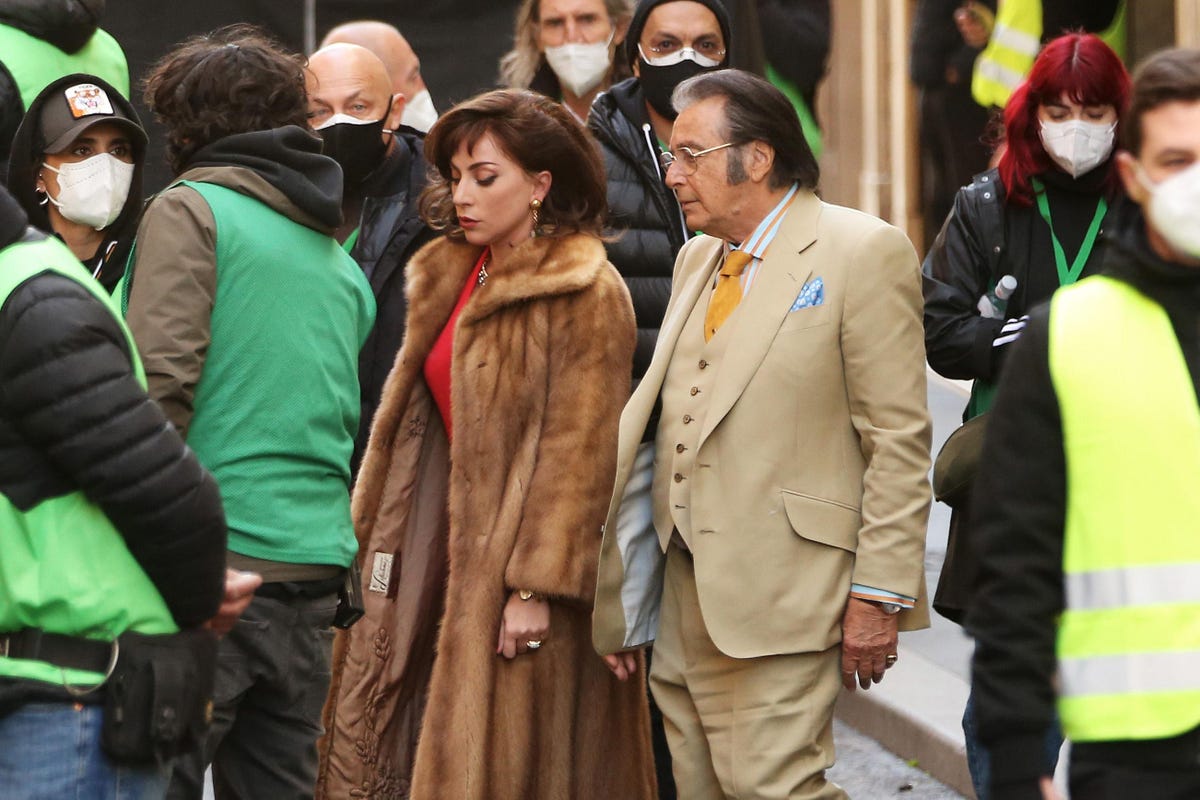
While Lady Gaga certainly puts in a game performance as the success-obsessed Patrizia, even Al Pacino as Maurizo’s Uncle Aldo struggles to rise above the clunky dialogue he’s been given.

And then there’s the enigma of Jared Leto as Aldo’s deluded son, Paolo, who fancies himself as a fashion designer but has no evident talent to back him up. It’s panto season, so perhaps that explains why Leto feels the need to deliver his lines in a kind of high pitched sing-song fashion, but it just seems… really odd. What’s more, with a two-hour-thirty-eight minute running time, there’s a lot here that should have been cut back. The film doesn’t really find its mojo until the final third, but by then it feels like a case of too little, too late. There’s a welcome appearance by Call My Agent‘s Camille Cottin as the new woman in Maurizio’s life, but she’s not given enough to do.

It certainly doesn’t help that most of the people involved are venal, unscrupulous capitalists and it speaks volumes when Pacino’s Aldo – an unapologetic tax dodger – emerges as the film’s most sympathetic character.

In the end, this is something of a disappointment.

3 stars

Philip Caveney

Blade Runner 2049


05/10/17

The original Blade Runner (1982) is widely regarded as a classic of the sci fi genre. People forget that on its release, it didn’t receive much acclaim. The critics were distinctly sniffy about it and, for that matter, it didn’t exactly pack out the multiplexes. But, over the intervening years, its stature has grown, especially as original director Ridley Scott couldn’t seem to stop tinkering with it. This must surely be the only film where the Director’s Cut is actually shorter than the theatrical release?

When the news broke that there would be a sequel – and furthermore, that Scott would only be producing, rather than directing, expectations plummeted. But the appointment of Denis Villeneauve to the director’s seat definitely helped to bolster confidence; (his Arrival was one of the most acclaimed films of last year) and besides, Scott’s recent return to another of his franchises, with Alien Covenant, hadn’t exactly been the massive success everybody had predicted. Maybe it was the right thing to go forward with a new hand on the helm. Then the advance reviews for Blade Runner 2049 broke and it was, apparently, a masterpiece, a jaw-dropping work of staggering genius. The truth of course, is that it isn’t quite that, but it is an assured and credible sequel to the original film, which is pretty much all we could have hoped for.

It’s thirty years since the events of Blade Runner and a new generation of replicants – ones that are supposedly incapable of insurrection, are now taking on the work that humans disdain, including hunting down and ‘retiring’ the last remaining Nexus 6 models, who are still insisting on going about their business. ‘K’ (Ryan Gosling) is one of the new breed of ‘skin job’, working as a Blade Runner for the LAPD, under the direction of Lieutenant Joshi (Robin Wright). While hunting down renegade replicant Sapper Morten (Dave Bautista), K makes an unexpected discovery. Buried in a box beneath one of the world’s last surviving trees, are the remains of a woman. The pathology department soon establishes that she died in childbirth. The problem is, a serial number hidden in her bones identifies her as a replicant. And replicants are supposedly incapable of procreation. This is news that threatens to have world-changing repercussions and one, when you think about it, that is the basis for most religions.

If Villeneauve’s brief was to mirror the look and feel of the original movie, then this has to be regarded as a success. The squalid grandeur of the cityscapes are breathtakingly realised, the recreation of a smog laden, overcrowded dystopian Los Angeles is perfectly achieved – even Hans Zimmer’s eerie score manages to echo the feel of the Vangelis original while still somehow managing to be its own beast. The references to the first story are all cleverly integrated. Nothing ever feels tacked on.

But this is more than just an accomplished rehash. I particularly liked the concept of Joi (Ama de Armas), K’s virtual reality companion, which gives you an idea of where the likes of Siri and Alexa are eventually going to wind up. A VR creation capable of feeling love for its owner? This element is the film’s strongest card, (and a scene where Joi ‘borrows’ the body of another woman in order to make love to K is a standout); but there are plenty of other thought-provoking ideas in here, much more than the usual cartoonish ones we’ve become used to in this genre. They will have you discussing their implications long after the credits have rolled.

What exactly does it mean to be human? How important are memories to our evolution and to what degree can we trust them? And perhaps, most baffling of all… why does Harrison Ford never seem to get any older?

Okay, so the film isn’t quite perfect. Jared Leto’s Niander Wallace  – the man who has inherited and improved upon the Tyrell Corporation’s achievements – is a bit wearisome, to tell you the truth, given to intoning his lines like an Old Testament prophet; and while I appreciate that there must be fight scenes in a film like this, the climactic punch up between K and a supercharged female adversary seems to go on for just about forever. But the ending is cool. I really didn’t see that coming…

Inevitably, arguments will rage about this one. Some people are going to hate it. Some are going to insist that it’s way better than the original. But for me that will always be a solid gold five star picture, while this one? Close, but no cigar. Maybe just a slim panetella.

4.6 stars

Philip Caveney