

01/10/25
Traverse Theatre, Edinburgh
Adapted from Sarah Moss’s novel, Shireen Mula’s Night Waking is complex and demanding, exploring motherhood, colonisation and the ramifications of history. Nicola Jo Cully performs this challenging two-hour monologue with aplomb, segueing between a range of disparate characters, convincingly portraying the protagonist’s mounting despair.
To be fair, despair seems like a reasonable response to the situation Anna finds herself in. Temporarily uprooted from Oxford to a remote Scottish island, she feels marooned, alone all day with her two young children, while her husband, Giles, conducts his ornithological research into the declining puffin population. Her own academic career has stalled since she became a mum, and her attempts to write are stymied by the overwhelming demands of childcare and housework. She’s already feeling angry and depressed – murderous, even; suicidal – so the discovery of a baby’s bones in the garden is the final straw.
And it’s not the only skeleton in the manor house’s cupboard. Giles has recently inherited the island, and historian Anna is horrified when she uncovers evidence of the atrocities his ancestors perpetrated. No wonder the locals are so unfriendly; old resentments run deep.
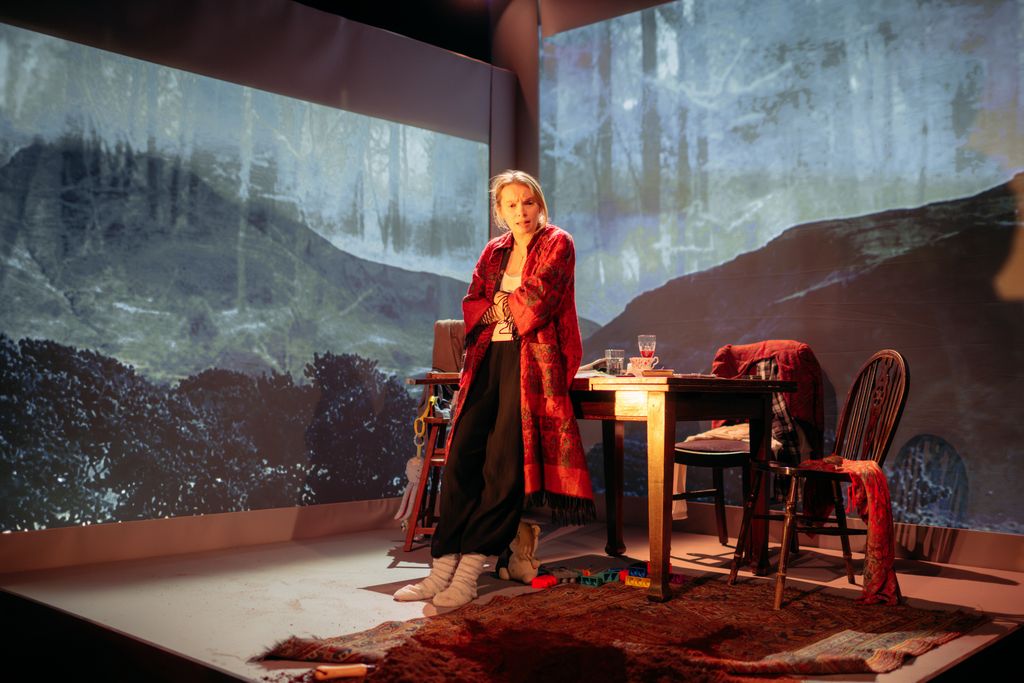
I love the overlapping nature of the storytelling here, the way the script skips back and forth in time, slowly peeling back the layers to reveal more about both Anna’s situation and the island’s dark history. Rebecca Atkinson-Lord’s agile direction is complemented by Hugo Dodsworth’s impressive set and video design: the projected background images jolting us from one scene to another, as scattered and disconnected as Anna’s sleep-deprived thought processes; the open grave an unmistakable metaphor for digging up the past.
However, I’m not always convinced by the content. The historical aspects are a matter of record so – shocking though it is – I can easily believe that landowners forcibly shipped the impoverished islanders to Canada, and that infant mortality rates were devastatingly high. It’s the contemporary sections that stretch credulity. Am I really supposed to accept that an Oxford professor would allow her husband’s complete abdication of parental responsibility? That an educated, well-to-do 21st century man would interrupt his wife’s work meeting because their baby won’t stop crying? Any family wealthy enough to own an entire island would surely hire a nanny if they were struggling to cope.
A play to admire, perhaps, rather than to enjoy, Night Waking is wide-ranging and ambitious, as thought-provoking as it is informative, and I find myself utterly absorbed in Anna’s tale. The play’s closing statement, revealing how little has changed for the Highland’s inhabitants over the years, provides a hammer-blow of a conclusion.
4 stars
Susan Singfield

 Bouquets & Brickbats