
Harry Melling

Pillion

04/12/25

Cineworld, Edinburgh

Adapted from Adam Mars Jones’ 2019 novel, Box Hill, Pillion is – I think it’s fair to say – something of an oddity. Described by one of its stars as a ‘dom-com,’ it’s set within the world of BDSM and has been assigned an 18 certificate for nudity and explicit sex. And yet there are elements at play here to appeal to a much broader audience than you might expect.

Colin (Harry Melling) is an affable young fellow, still living with his parents. He works as a traffic warden and occasionally sings as part of his father Pete’s barber-shop quartet. Pete (Douglas Hodge) is every bit as genial as his son, but he’s coming to terms with the fact that his wife, Peggy (Lesley Sharp), is in the final stages of her life after a long struggle with cancer. Colin’s parents know he is gay; in fact, Peggy has devoted her final months to trying to get him fixed up with a suitable boyfriend, but he doesn’t like any of the dates she sets up for him.

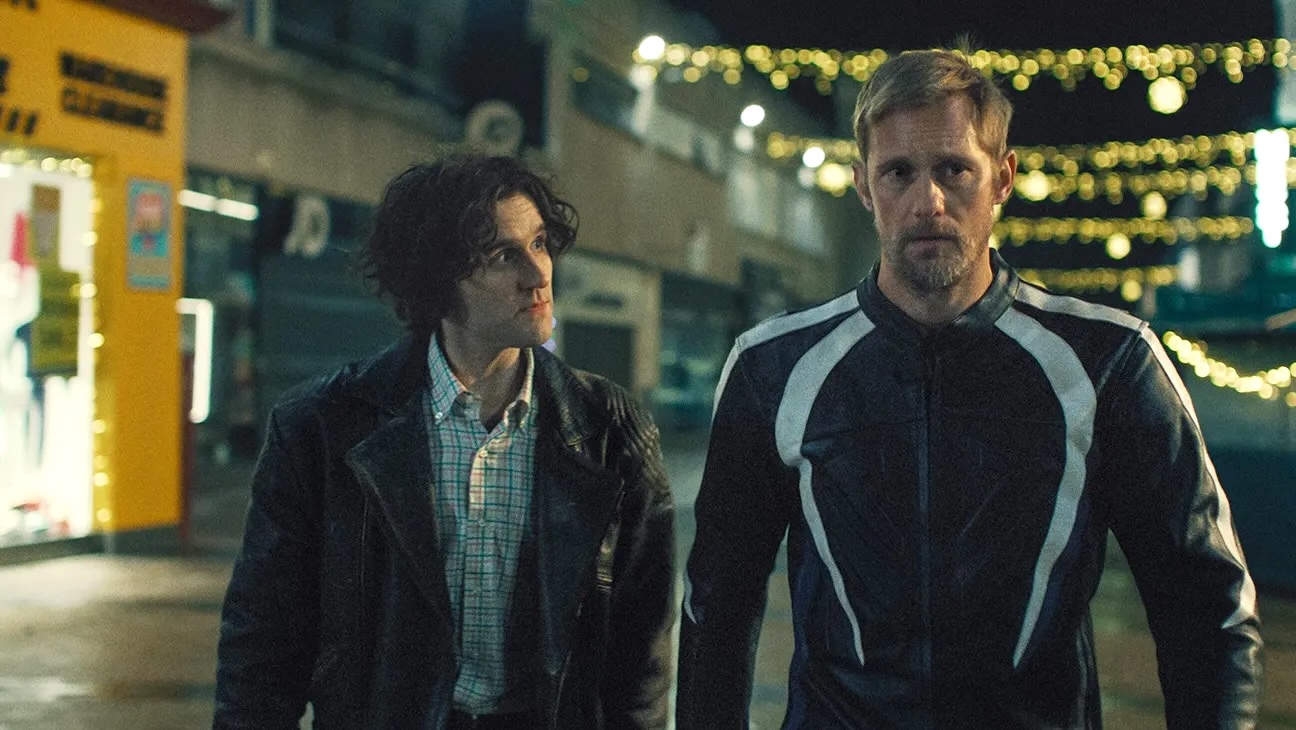
And then, at the local pub where the group regularly performs, Harry encounters Ray (Alexander Skarsgård), a handsome but monosyllabic biker. Something clicks between them and, when Ray hands Colin a note (on the back of a beermat), instructing him to be at a certain place at a certain time, Colin doesn’t hesitate to comply.

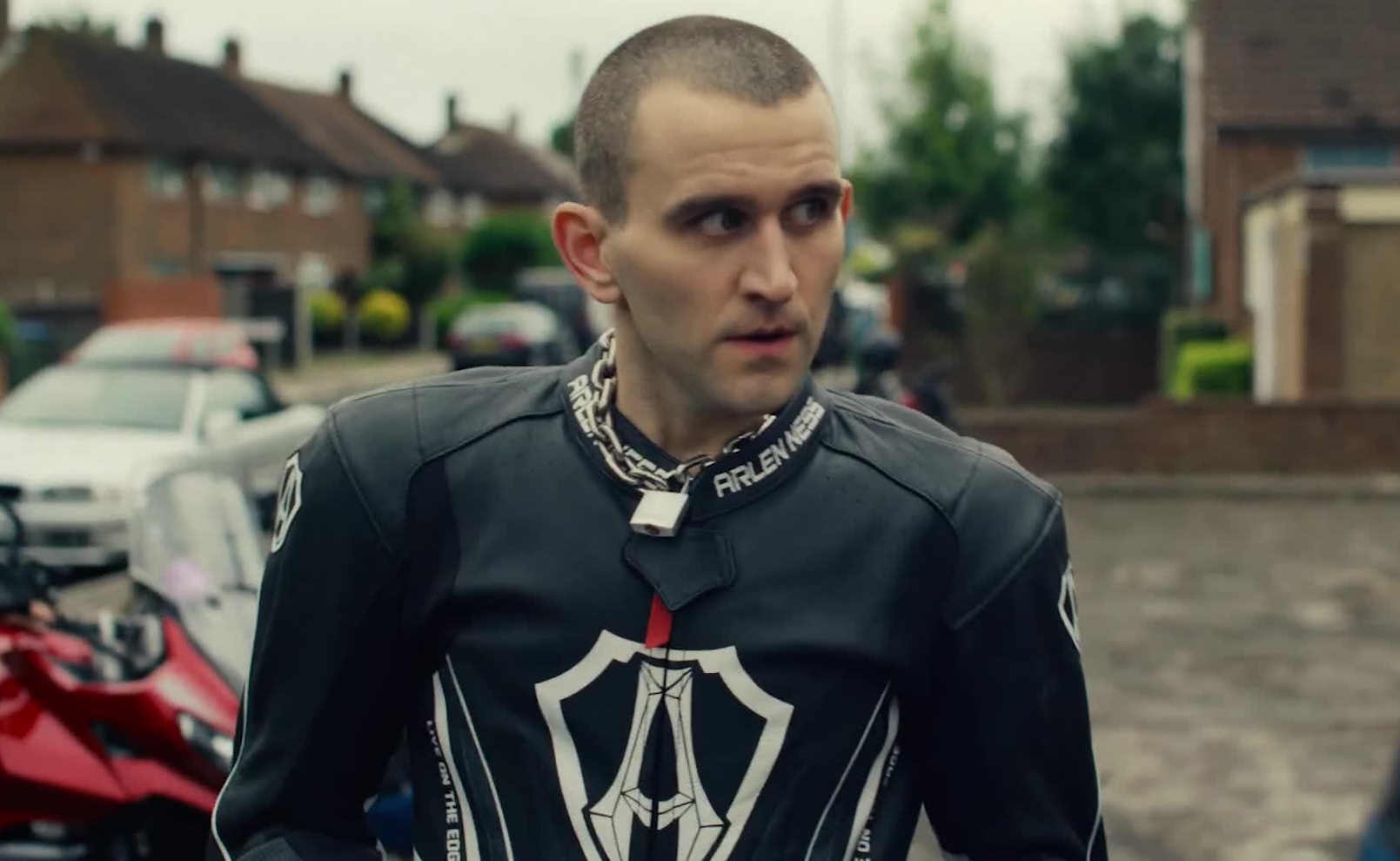
It isn’t long before Colin is on his knees in a dark alleyway giving Ray a BJ – and shortly thereafter, he’s initiated into the small group of submissive followers who ride pillion with Ray’s biker friends, ready to accede to their masters’ sadistic whims. Soon Colin has shaved off his long hair and is decked out in racy leather outfits, complete with a padlock around his neck.

In these scenes the 18 certificate is certainly well-earned – but it’s important to note that Colin enthusiastically consents to every indignity that’s meted out to him. Indeed, he seems to thrive on this new regime, as he discovers a sense of community that he’s never had before.

There’s more to the film than just the sexual content. A wonderfully toe-curling scene where Peggy cajoles Colin into bringing Ray to the family home for dinner and then delivers her unflinching opinion of him is a particular delight – and I’m quite unprepared for the genuinely poignant conclusion. There are also several scenes that make me completely re-evaluate everything that has gone before.

Both Melling and Skarsgård are outstanding in their polar opposite roles: one so vulnerable and desperate to show his devotion; the other locked away, sullen and uncommunicative. Director/screenwriter Harry Lighton handles the difficult material with skill and it’s no great surprise to learn that Pillion has recently walked away from the British Independent Film Awards with five trophies, including best film and best debut screenwriter. It’s also stirred up some indignant editorials in the press, enquiring how the BBC could have ‘lowered itself’ to commission something like this.

But there are all kinds of voices in the world and Pillion sheds fresh light onto a subject about which I previously knew very little. Of course, it won’t be to everyone’s taste but I can honestly say that I haven’t seen quite anything like this before, which – to my mind – is one of the highest recommendations a film can aspire to.

4.6 stars

Philip Caveney
Harvest

22/07/25

Filmhouse, Edinburgh

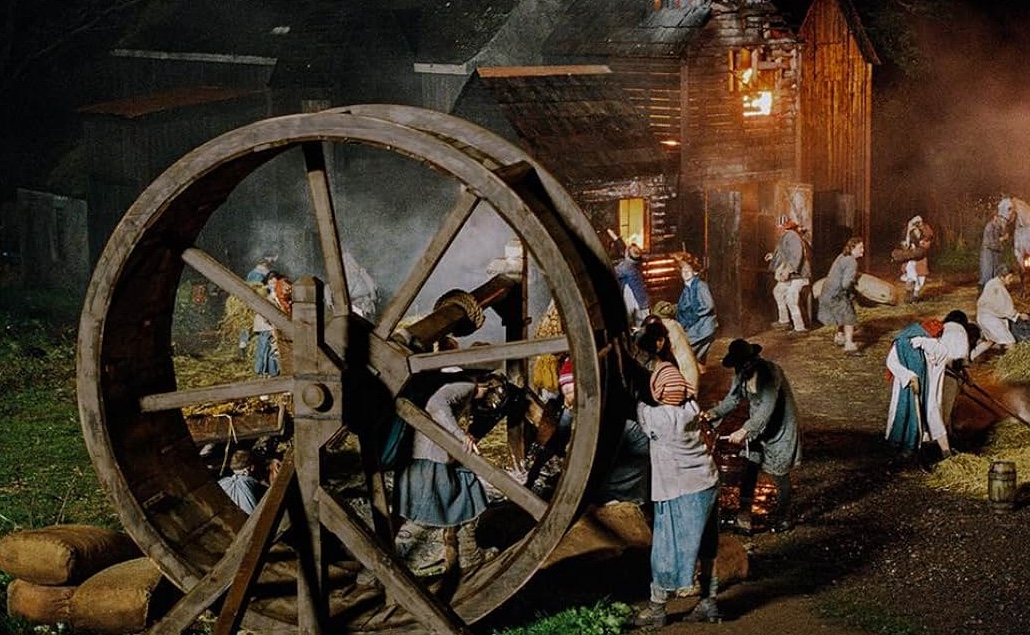
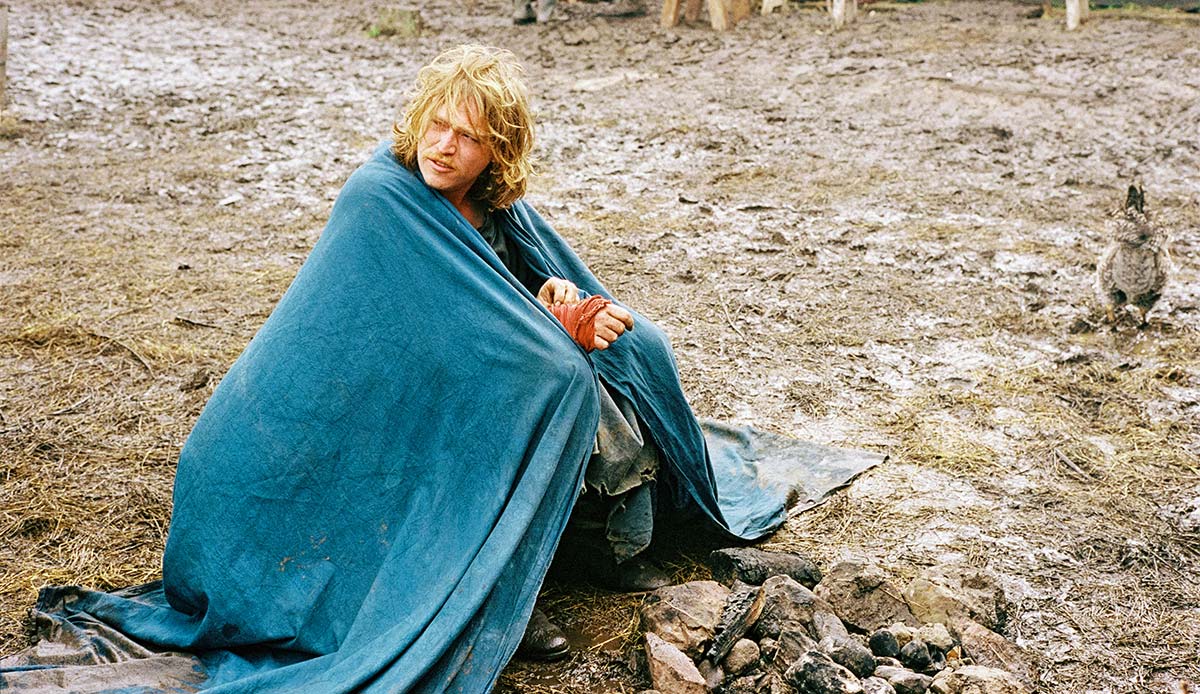
Set at some unspecified time in the middle ages, somewhere in the Highlands of Scotland, Harvest is an allegory about land – about the people who work on it and the people who own it. Adapted from Jim Crace’s 2013 novel by Joslyn Barnes and the film’s director Athina Rachel Tsangari, the story plunges us headlong into the lives of a group of villagers, who spend their days toiling endlessly on a farm under the watchful gaze of Mayor Charles Kent (Harry Melling, doing his utmost to distance himself from the role of Neville Longbottom).

Kent seems a considerate and generous employer, who dresses much like his employees and goes to great lengths to reward them for their efforts. Amongst the workforce is Walter Thirsk (Caleb Landry Jones), who was Kent’s childhood companion. The two men endeavour to keep their friendship going, even if this alienates Thirsk from his fellow-workers, who see him as ‘privileged’.

Both men have lost their wives. Thirsk is now trying to forge a new relationship with Kitty Gosse (Rosey McEwen) but Kent has no partner and, more significantly, no heirs to whom he can pass ownership of the land. When Kent introduces Thirsk to Philip ‘Quill’ Earle (Arinzé Kene), it becomes clear that a change is coming. Quill is a cartographer, here to make a map of the farm and its surrounding land. Thirsk finds himself wondering what all this is in aid of.

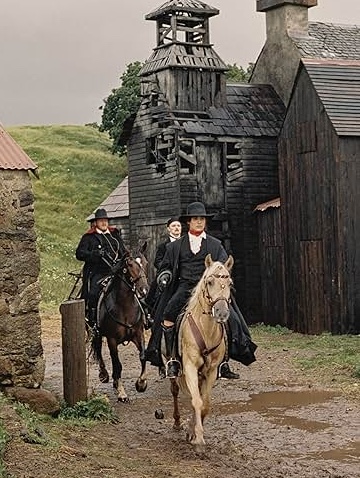
Sure enough, it isn’t long before Kent’s supercilious cousin, Edmund (Frank Dillane), arrives on horseback with a retinue of heavies to back him up. It turns out that the estate belongs to him, and that his intention is to plunder its natural resources, before adding sheep and fences and forcing the residents to leave.

This sensual and atmospheric tale, which was nominated for The Golden Bear at the Venice Film Festival, plays fast and loose with historical authenticity. While the story clearly evokes the Highland Clearances of the eighteenth and nineteenth centuries, Edmund and his followers have the black-clad look of Puritans from an earlier period. Furthermore, much of the dialogue sounds suspiciously contemporary: especially the banter of a couple of neighbouring men, who have ventured too close to the village and find themselves treated very roughly for their transgression. The decision to adopt these anachronistic elements is, I’m sure, deliberate – an attempt perhaps to point out that the disparity between the classes is an age-old issue and that very little changes with the passing years.

The film is at its best in the psilocybin-fuelled harvest celebrations, where masked figures leap and cavort across the screen like characters from a Hieronymus Bosch painting; and I particularly enjoy the sequences where Quill shows Thirsk how he goes about mapping land. But not everything here is quite so assured – and, with its lengthy running time, the film occasionally feels a little too ponderous for its own good. Furthermore, I’m mystified by the fact that this has earned an 18 certificate, presumably for a brief scene that strikes me as merely unpleasant, but hardly on a par with many of the blood-soaked 15 certificate folk-horror movies that have aired in recent years.

For the most part, I enjoy Harvest, but with some reservations. Ultimately, it won’t be for everyone, but those looking for an alternative to the latest glut of superhero movies, this may be worth seeking out.

3.6 stars

Philip Caveney

The Pale Blue Eye

12/01/23

Netflix

It’s the year 1830 and, at West Point military academy, a student has been found hanged. More puzzlingly, his heart has been removed post mortem. Veteran detective August Landor (Christian Bale) is recruited by Captain Hitchcock (Simon McBurney) and Superintendent Thayer (Timothy Spall) to investigate. He is somewhat surprised to discover that he has an ally amongst the cadets in the gangling form of Edgar Allan Poe (Harry Melling), who – as well as exhibiting a flair for writing dark poetry – is also an amateur sleuth. Soon, another murder occurs…

Director Scott Cooper has worked with Bale before (most memorably on the hard hitting western, Hostiles), but The Pale Blue Eye, based on a source novel by Louis Bayard, is a much more laid back affair, handsomely filmed and starring a clutch of accomplished character actors in minor roles. However, the women in particular have a thin time of it. Any film that offers the likes of Gillian Anderson and Charlotte Gainsbourg such thankless, underwritten roles should hang its head in shame.

Ultimately, The Pale Blue Eye is a two-hander between Bale and Melling (the latter having a field day as the wide-eyed, melodramatic young author). The result is an atmospheric story, with a distinctly Gothic flavour and some genuine surprises hidden within its twisty-turny plot – so it’s a pity that the eventual solution to the mystery is so risible – and that the reasons for the murders should prove to be so clumsily reductive about both disability and violence against women.

Poe aficionados will doubtless have fun spotting the various references to the great author’s work, but ultimately this feels like a missed opportunity.

3 stars

Philip Caveney

The Old Guard

22/07/20

Netflix

Charlize Theron’s steady advance into the realms of the action hero continues apace with this Netflix Original, directed by Gina Prince-Bythewood and based – unsurprisingly – on a comic book by Greg Rucka. Theron plays ‘Andy’ (or Andromadache of Scythia, if you want to be more formal about it), a centuries-old warrior princess. She’s the leader of a group of immortals who spend their spare time as mercenaries, jetting off to the world’s war zones to offer help to those who need it – kicking much ass as they do so.

The team also features Booker (Matthias Schoenarts), Joe (Marwan Kenzari) and Nicky (Luca Marinelli), characters Andy has encountered at various points across the world’s turbulent history, none of whom has much of a backstory – or at least not that the writer has bothered to share with us. When the team’s latest mission turns out to be a double cross, they quickly realise that somebody wants to capture them, and it becomes clear that CIA operative, Copley (Chiwetel  Ejiofor in a rather thankless role), is a key player in this operation.

Meanwhile, young GI, Nile (Kiki Layne), is wondering why a supposedly fatal injury she’s recently acquired in the line of duty hasn’t finished her off. Could it be that she’s the next new recruit for Andy’s team? Sure enough, Andy is soon showing her the ropes…

To be fair, The Old Guard isn’t the total debacle that many reviews have labelled it. It’s hokum, for sure, but it’s niftily directed hokum, which features several developments you don’t often see in a mainstream punch ’em up. Women are placed at the forefront of the action, for instance, while Joe and Nicky are lovers and proud to declare the fact to anyone who’ll listen.

But the story doesn’t always convince. We’re told that members of the team are immortal until ‘it’s time to die,’ which seems to be a case of having your cake and eating it – while Copley’s actions are frankly incomprehensible, lauding Andy and her crew in one breath and ratting them out in the next. His involvement with ruthless scientist and all-round bad egg, Merrick (Harry Melling), is unconvincing to say the least. What exactly are his motives?

Still, this is sprightly enough to pass a couple of hours with ease –  even if the obvious attempt to set this up as the first in a series is a tad optimistic.

3.4 stars

Philip Caveney