

01/01/2026
Cineworld, Edinburgh
Our first film of 2026 was supposed to be our last film of 2025. But we were in North Wales where, for some inexplicable reason, Marty Supreme simply wasn’t yet available in cinemas and we were obliged to watch The Housemaid instead. So obviously, when it came time to start the process anew, there was only one logical choice.
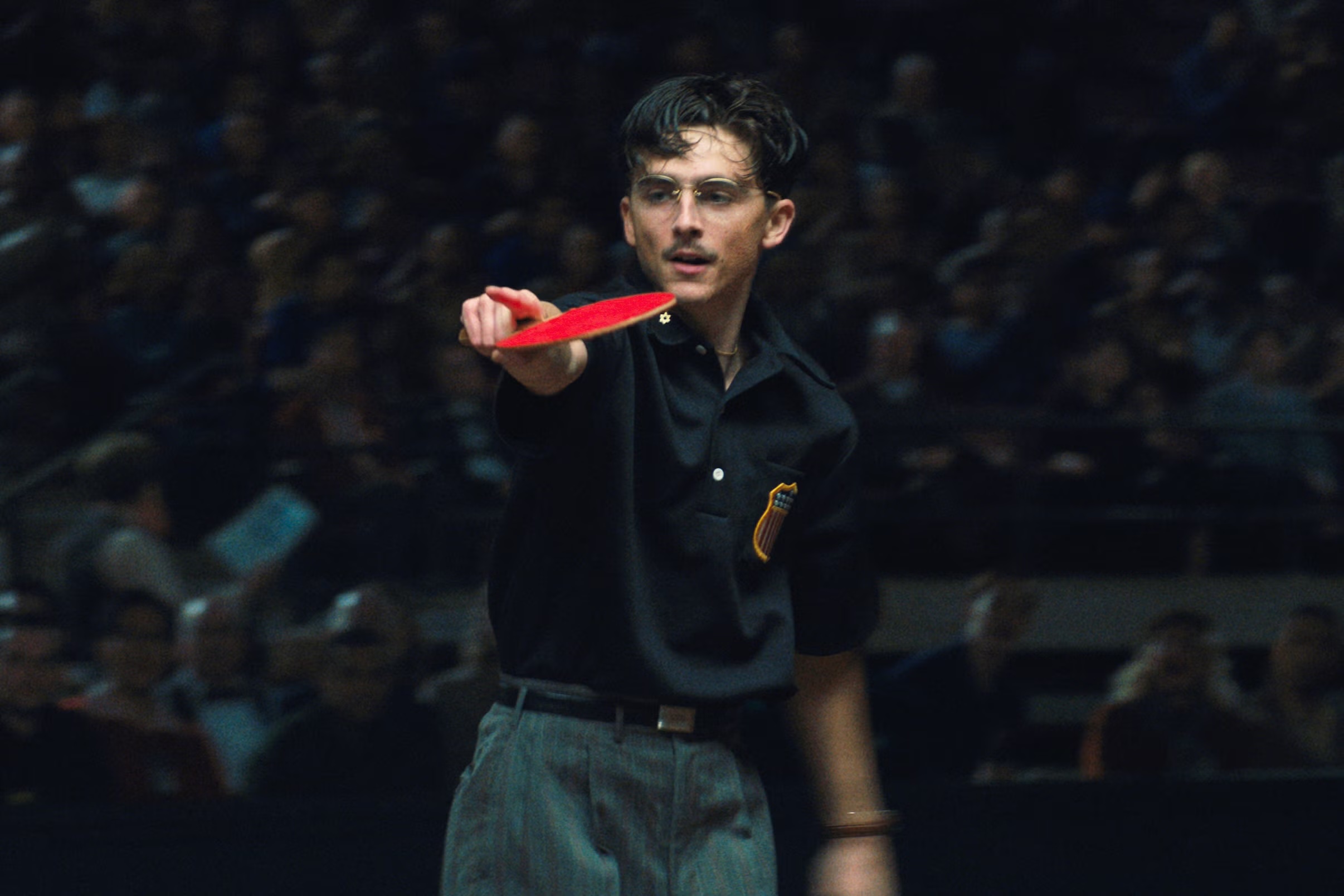
It’s clear from the opening scenes that Josh Safdie’s frenetic odyssey about ambitious young table tennis player, Marty Mauser (Timothée Chalamet), is going to be something very special. The titular character is loosely based on a real-life ping pong star, the late Marty Reisman – though whether the man who inspired this story was the swaggering, single-minded, motor-mouthed huckster portrayed here is up for debate.
Certainly, many of the incidents portrayed in the script – co-written by Safdie and Ronald Bronstein – echo real life events, though the filmmakers are quick to point out that it’s all fictional.
When we first encounter Marty, he’s grudgingly working at his Uncle Murray’s shoe shop in New York City. This is solely to fund his upcoming journey to England, where he’ll be competing in the 1952 World Table Tennis Championship. He’s also enjoying a clandestine affair with Rachel (Odessa A’zion), an unhappily-married woman who works in the shop next door, and whom Marty soon manages to impregnate. In fact, we actually witness this biological process over the film’s opening credits.
Once at the championships, Marty hooks up with former movie actress, Kay Stone (Gwyneth Paltrow). He sees her as a possible source of funding for his future endeavours and, after a swift telephone seduction, he enjoys a quick dalliance with her. Her husband is wealthy industrialist Milton Rockwell (Kevin O’ Leary), a manufacturer of fountain pens.
Meanwhile, as the ping pong tournament progresses, Marty easily vanquishes all the opposing players until, in the final, he’s matched against Japanese player, Koto Endo (Koto Kawaguchi). The newcomer’s idiosyncratic style of play utterly throws Marty. He loses the match and is obliged to return to America humiliated – but his determination to win turns into an overwhelming obsession…
To label Marty Supreme as ‘a film about table tennis’ would be something of an understatement. Yes, it is that – and the many sequences that depict the sport are undeniably gripping – but it’s also a multi-faceted examination of ambition, greed and the almost pathological need to win at all costs. Chalamet has always been an accomplished actor but here he delivers a performance of such staggering intensity, it just might be the one that finally steers him in the direction of that coveted Oscar podium.
I also want to mention production designer Jack Fisk, who came out of retirement for this film, and captures the dark squalor of 1950s America with exceptional skill. A technical Oscar for his work would also seem a likely fit.
As for the director, anyone who saw Uncut Gems – which Safdie co-directed with his brother, Benny – will know that he has a penchant for ramping up anxiety to almost unbearable levels. That quality is certainly very much in evidence here as the film careers from one stress-inducing set piece to the next, barely allowing me time to draw breath. The movie is also packed with legions of oddball characters who surge onto the screen, capture my interest and just as swiftly vanish. The film is sometimes weird, occasionally startling and always heart-stoppingly brilliant.
If the self-aggrandising Marty isn’t the kind of character who usually inspires a viewer’s allegiance (he’s self-centred and utterly convinced of his own talent), Safdie is wise enough to surround him with even more despicable people, chief among them oily fat-cat Rockwell, who, at one point, takes the greatest pleasure in humiliating Marty for the entertainment of his friends. The result is that I’m always rooting for our antihero, even when I’m horrified at the depths he’s prepared to sink to.
This is quite simply a gobsmacking film – and I have no doubts whatsoever that it’s destined to feature in our ‘best of’ list for 2026. Make sure you catch it where it belongs, on the biggest screen you can find.
5 stars
Philip Caveney


 Bouquets & Brickbats