Gillian Anderson

The Salt Path

08/07/25

Update

In the aftermath of the bombshell dropped by Chloe Hadjimatheou in this weekend’s Observer, where she exposes the lies this story is based on, it feels right to reassess our original response to the movie. Our opening sentence included the words “raised eyebrows”. Perhaps we shouldn’t have been so gullible.

But we’re in good company, including Penguin Random House, Number 9 Films and more than two million readers worldwide. Chivalrous Jason Isaacs, sitting next to Raynor Winn on The One Show sofa, gently corrects her when she says it all began when she and her husband “got into a financial dispute”. “You were conned out of everything you had,” he says sympathetically. “You might not be able to say it but I can.”

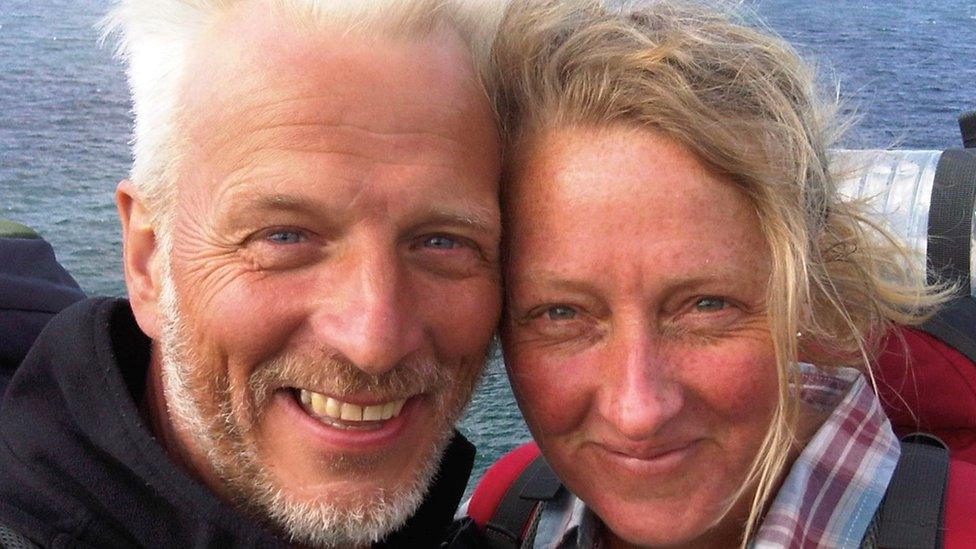
The Winns’ audacity is breathtaking. According to Hadjimatheou, the real con-artist is Raynor, aka Sally Walker. Aka embezzler of £64k from her employer; aka borrower of £100k to pay back her ill-gotten gains and thus avoid a criminal trial. When their house was repossessed, it wasn’t because a good friend betrayed them; it wasn’t a naïve business investment gone wrong. It was the simple calling-in of an unpaid debt, ratified by the courts. Did Walker and her husband Ti-Moth-y really believe the truth would stay buried as they appeared on national television to publicise their untruths?

So how gullible were we, really? Like many, we believed the basic premise. Why wouldn’t we? Sure, it was clear that the exact circumstances of the couple’s slide into destitution were being glossed over, and of course their story was shaped into a neater narrative than real life provides. But we had no reason to doubt the fundamentals. (How could anyone have guessed they had a ‘spare’ property in France?) In fact, my interest piqued by the movie, I went on to read Winn’s books. I liked The Salt Path, although I was disappointed not to learn more about the calamitous investment. I found books two and three (The Wild Silence and Landlines) less interesting: just more of the same, but – now that the couple were housed and embracing successful careers – without the jeopardy. In these sequels, the focus shifts to Moth’s terminal illness, corticobasal degeneration, and the miraculous curative effect that hiking has for him. While the first book tentatively suggests that strenuous exercise might be beneficial for those with this rare condition, by the third we’re deep into dubious ‘wellness’ territory, with Winn’s ‘own research’ supposedly trumping anything a neurologist might purport to know.

Still, we won’t be taking down our review (you can read it in full below). We stand by it as a reaction to a well-acted and nicely-crafted film that we enjoyed. Of course, its message of grit in the face of adversity doesn’t have quite the same potency it did, now that we know the protagonists are a pair of grifters, but, if we can steel ourselves to view it as a work of fiction, it’s an affecting and moving piece.

Susan Singfield and Philip Caveney

01/06/25

Cineworld, Edinburgh

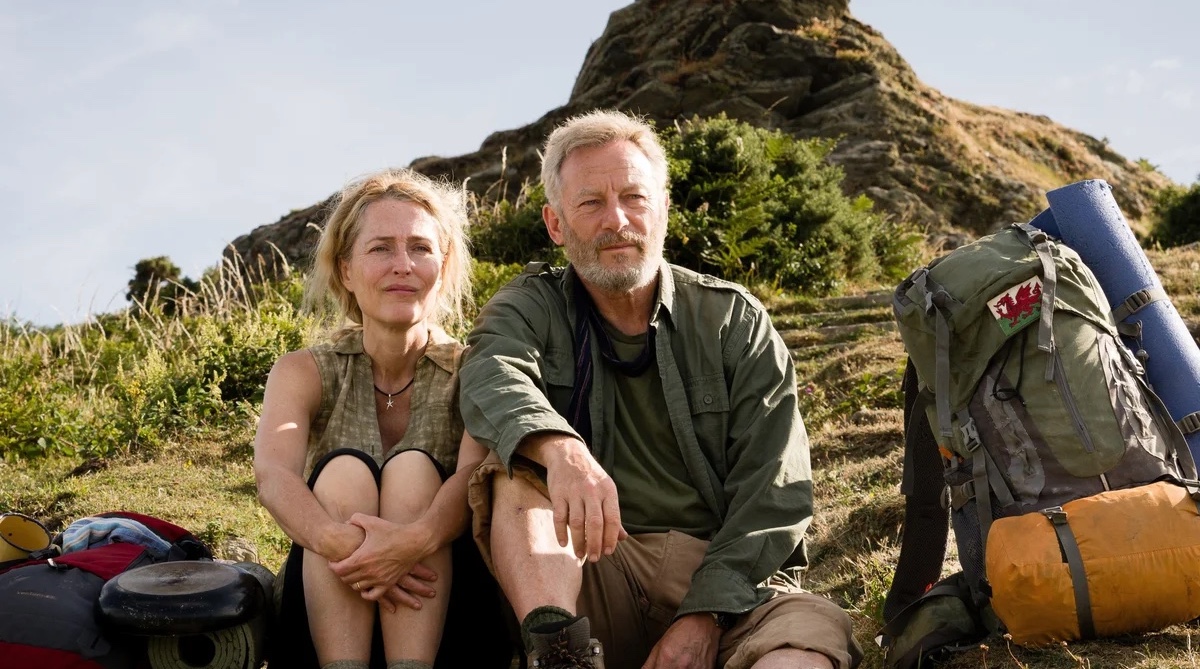
I’ve often remarked that real-life stories, depicted as fiction, would more often than not be the case for raised eyebrows. Take the case of Raynor and Moth Winn, for example: a married couple who, after a badly-judged business investment went tits up, found themselves evicted from their family farm, unable to obtain any financial help, bar a paltry £40 a week benefit. Around the same time, Moth was diagnosed with a rare (and inoperable) degenerative brain condition. Their response? To set off to walk the South West Coastal Path, a trip of hundreds of miles, telling themselves that if they just kept walking, something was sure to turn up…

Okay, so in a move they could surely never have anticipated, the book that Raynor wrote about the experience eventually went on to sell two million copies… but it would be a hard-hearted reviewer who begrudged them this success.

In this adaptation by Rebecca Lenkiewicz, we first encounter Raynor (Gillian Anderson) and Moth (Jason Isaacs) as they fight to save their last real possession – a small tent – from the ravages of the incoming tide. The couples’ back story is told in a series of fragmentary flashbacks, though director Marianne Elliott is less interested in the events that brought the couple to this sorry situation, than exploring the possibilities of what their newfound freedom brings them.

As the two of them progress on their journey, struggling at first but gradually adapting to a different kind of life, it becomes clear that there is something to be said for casting off the familiar shackles of a home and a mortgage. The couple find an inner strength they didn’t know existed and, along the way, they rediscover what drew them together in the first place. This could easily have been overly -sentimental but manages to pursue a less obvious route.

The story takes the duo across some jaw-dropping locations around Cornwall and Devon and the majesty of the scenery is nicely set against Chris Roe’s ethereal soundtrack. Anderson and Isaacs make a winning duo, conveying the real life couple’s indomitable spirit and genuine devotion to each other, while the various situations they stumble into range from the comical to the deeply affecting.

The film’s final drone sequence cleverly encapsulates its central message in one soaring extended shot. There have been some mean-spirited early reviews for The Salt Path but I find it genuinely moving and a cinematic journey worth sharing.

4.2 stars

Philip Caveney and Susan Singfield

Scoop

06/04/24

Netflix

What is the purpose of dramatising recent news events unless it’s to shine a different light on them? Scoop, directed by Philip Martin, doesn’t do that. Instead, it’s a pretty straightforward retelling of something we can all remember: Prince Andrew’s 2018 car-crash interview on BBC’s Newsnight.

Although it’s very watchable, the only fresh thing we’re actually offered here is a little look at some behind-the-scenes admin, and – frankly – that’s not enough. Based on Samantha McAlister’s memoir, her role as the ‘booker’ is almost laughably prominent. I’m sure she was very good at her job, but I don’t really care. “Person does the work they’re paid to do” isn’t much of a revelation. Nobody’s watching this because they’re interested in a “brilliant” TV producer. Self-aggrandising Sam (Billie Piper) gets the bus to work, eats kebabs and relies on her mum for childcare. Am I supposed to take something away from this?

We don’t get any original insights into Prince Andrew’s involvement with Jeffrey Epstein; we don’t learn anything new about his sexual exploitation of trafficked women. (I’m not calling him a paedophile because that’s not what he is. ‘Sexual predator’ and ‘rapist’ are the correct words. Abuse of women is bad enough; we don’t have to call it something else.) We don’t glimpse his reaction to the fall-out. We do see how attached he is to his teddy bears, which is amusing but hardly illuminating. The only vaguely unexplored territory covered is the impact on Prince Andrew’s aide, Amanda Thirsk (Keeley Hawes), who is portrayed here as a naïve and trusting woman, believing both Andrew’s assertions of innocence and McAlister’s assurances that this interview will be good for him. A brief moment with Andrew’s daughter, Beatrice (Charity Wakefield), also offers a little much-needed emotion, her lip quivering as she counters her father’s dismissal of Twitter (“I don’t look at that”) with a muted, sad-eyed, “I do.”

Rufus Sewell’s and Gillian Anderson’s impersonations of the key players are spot-on, although credit for that must be shared by the costume and make-up designers (Matthew Price and Kirstin Chalmers). The likenesses are uncanny. I just don’t know what they’re for.

I can’t help feeling that this is a pointless exercise. The actual interview – in all its startling horror – is available for anyone to see, so why bother watching a facsimile of it?

2.8 stars

Susan Singfield

The Pale Blue Eye

12/01/23

Netflix

It’s the year 1830 and, at West Point military academy, a student has been found hanged. More puzzlingly, his heart has been removed post mortem. Veteran detective August Landor (Christian Bale) is recruited by Captain Hitchcock (Simon McBurney) and Superintendent Thayer (Timothy Spall) to investigate. He is somewhat surprised to discover that he has an ally amongst the cadets in the gangling form of Edgar Allan Poe (Harry Melling), who – as well as exhibiting a flair for writing dark poetry – is also an amateur sleuth. Soon, another murder occurs…

Director Scott Cooper has worked with Bale before (most memorably on the hard hitting western, Hostiles), but The Pale Blue Eye, based on a source novel by Louis Bayard, is a much more laid back affair, handsomely filmed and starring a clutch of accomplished character actors in minor roles. However, the women in particular have a thin time of it. Any film that offers the likes of Gillian Anderson and Charlotte Gainsbourg such thankless, underwritten roles should hang its head in shame.

Ultimately, The Pale Blue Eye is a two-hander between Bale and Melling (the latter having a field day as the wide-eyed, melodramatic young author). The result is an atmospheric story, with a distinctly Gothic flavour and some genuine surprises hidden within its twisty-turny plot – so it’s a pity that the eventual solution to the mystery is so risible – and that the reasons for the murders should prove to be so clumsily reductive about both disability and violence against women.

Poe aficionados will doubtless have fun spotting the various references to the great author’s work, but ultimately this feels like a missed opportunity.

3 stars

Philip Caveney

Viceroy’s House

06/03/17

It’s 1947 and Lord Louis Mountbatten (Hugh Bonneville) is given the dubious honour of being the last British Viceroy of India. With his magisterial wife, Edwina (Gillian Anderson) at his side, he arrives in Delhi with the full knowledge that he has been handed a poisoned chalice. The India that he leaves behind will be subject to the innate animosity between its Hindu and Muslim inhabitants. There is already much talk about the founding of a new country, Pakistan. Meanwhile, Hindi Jeet Kumar (Manish Dayal), working as a servant in the Viceroy’s House, reunites his acquaintance with Aelia (Huma Qureshi) a young Muslim woman he met some years earlier and who has now been promised by her father, Ali (the late Om Puri) to another man, as part of an arranged marriage. But as Jeet and Aelia spend time together, they begin to realise they are falling in love…

The partition of India is a fascinating and shameful slice of recent history and frankly one that deserves a better film than this. ‘Show don’t tell’ is a well known adage in storytelling but sadly, nobody seems to have told the screenwriters of this tale, as repeatedly, characters tell us of far more interesting events happening offscreen. The occasional use of a bit of vintage newsreel isn’t enough to pep things up and inevitably, I found my attention wandering. It’s no good telling me about a massacre on a train. I need to see it!

The performances are, as you might expect, exemplary. Bonneville dashes off the kind of ‘decent fellow’ routine he could do in his sleep, while Anderson portrays a character that is so painfully posh, she can’t even seem to walk without affectation. The film chooses to skip over her real life affair with Nehru (played here by Tanveer Gani) and there’s a suggestion that the Mountbattens stayed on after partition in order to help ease the transition, which is at best fanciful and at worst, a downright lie. Mahatma Ghandi (Neeraj Kabi) totters on for a scene or two and Michael Gambon offers a decent turn as the oleaginous General Hastings, but there’s the distinct feeling that a much more compelling story is happening just a few streets away from the gilded corridors of the titular palace. Most damning of all, the love affair element feels somehow superfluous, grafted on to make this more palatable to a wider audience, but as it stands, this is like history seen through Downtown Abbey coloured glasses – lacking in grit, action and verité.

Not awful, you understand, just a bit so-so.

3.2 stars

Philip Caveney