Frank Sinatra

Better Man

01/01/2025

Cineworld, Edinburgh

Our first cinema trip of 2025 is to see a film that actually came out last year – Boxing Day to be precise. A further complication is that this would certainly have made our list of the best films of 2024 had we managed to squeeze it in a day earlier. No matter. Better Man is brilliant and I have every reason to believe I’ll still feel as strongly about it when it comes time to compile this year’s selection.

Pop biopics can be tricky beasts. You can play it straight like Bohemian Rhapsody, you can evoke a multi-layered fantasia, as in Rocket Man – or you can go for a balls-out, head-scrambling slice of pure invention, which is what Michael Gracey (of Greatest Showman fame) has done with the life story of Robbie Williams. I should probably add here that I’m not a rabid fan of Williams and his music (though Angels has long been a go-to for me on the rare occasions when I get to do a bit of karaoke). Had I not picked up on early rumours of this film’s delights, I would probably have let it slip under my radar.

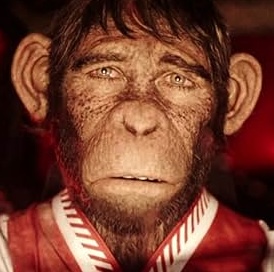
It’s hardly a spoiler to mention that Williams doesn’t even appear in his own biopic, apart from singing his best-known songs, but is instead portrayed by a CGI generated ape, mo-capped by Jonno Davies. This device is a stroke of genius, highlighting Williams’ sense of alienation, while also removing all worries of an actor not looking enough like the real man. Somehow, the metaphor renders many of the resulting scenes incredibly moving.

We first encounter our hero as a cheeky little monkey, living in a humble home with his mum, Janet (Kate Mulvany), his beloved gran, Betty (Alison Steadman), and his fame-obsessed dad, Peter (Steve Pemberton) – a pound shop Frank Sinatra, who heads off to seek his own fortune when Williams is just a boy. His son spends the rest of his life seeking his old man’s approval.

At the ripe old age of fifteen, fame unexpectedly beckons when Robbie auditions for a place in a new boy band being set up by would-be pop impresario Nigel Martin Smith (Damon Herriman). Against all the odds, he makes the cut – though it’s clear from early-on that he and the other band members are merely there to act as backup to Smith’s prodigy, Gary Barlow (Jake Simmance). As Take That embark on a punishing schedule of appearances around the UK’s gay clubs, it soon becomes clear that Robbie is having trouble handling the pressures of fame…

On paper, this may all sound straightforward enough but, as reimagined through Gracey’s mindset, the film is a collection of exhilarating, exuberant and occasionally devastating set pieces: there’s a wonderfully playful dance routine through the streets of London set to Rock DJ; a swooning waltz between Robbie and Nicole Appleton (Raechelle Banno) on the deck of a ship; and, best of all, a raucous rendition of Let Me Entertain You at Knebworth, which quickly escalates into an epic battle between Robbie and hordes of his inner demons. The film never flags but steps deftly into each successive interpretation with perfect timing. I keep having to stop myself from applauding.

Williams has been criticised for dishing the dirt on actual people, but it should be said that the person who comes in for most of the criticism is Robbie himself, often acting up like a spoiled brat with too much money in the bank. Viewers should be warned that the film is unflinching in its treatment of mental illness and self-harm. A funereal sequence set to the aforementioned Angels is particularly affecting and I don’t mind admitting that I view it through floods of tears.

One last thing: I know I say this far too often but, for the full effect, do see this one on the big screen. It’s a fabulous piece of filmmaking that effortlessly oversteps the relative simplicity of its subject to create something genuinely spectacular. And even if you don’t care one jot for Robbie Williams’ music, this one will still hit you in the feels.

5 stars

Philip Caveney
Joker: Folie à Deux

04/10/24

Cineworld, Edinburgh

Todd Philips’ 2019 film, Joker, was cinematic Marmite. For every viewer that loved it (and I was firmly in that camp), there was an equal number of comic book fans who detested it, largely because the film had no truck with the conventions of the genre that inspired it. Instead, here was an unflinching exploration of a mentally ill man, abandoned by the healthcare system and ultimately championed by a bunch of deluded followers. It was grubby, brutal and utterly devastating.

Folie à Deux is equally divisive, though this time around what has incensed most social media pundits is the fact that the film is… well, there’s no other way to say this: a musical. In 2024, the genre appears to have fallen into total disrepute with movie fans, to the extent that even films like Wicked are reluctant to depict any actual singing and dancing in their trailers in case it puts off potential viewers.

Go figure.

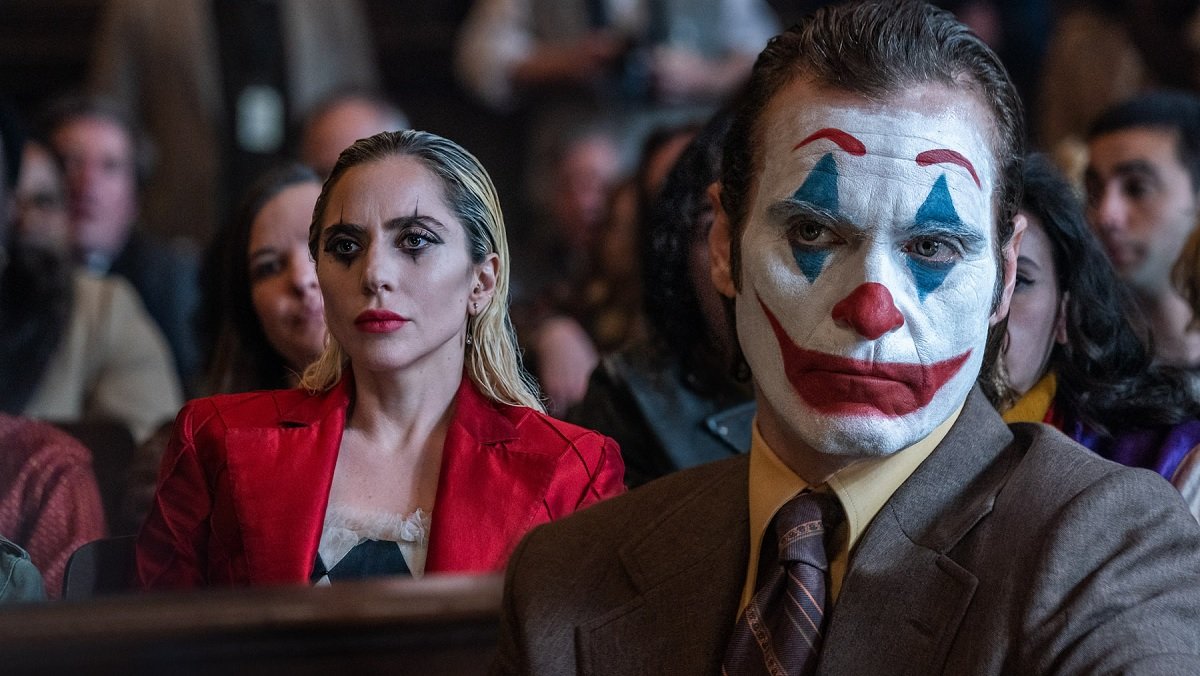
It’s two years after the events of Joker and Arthur Fleck (Joaquin Phoenix) is languishing in Arkham State Hospital, overseen by callous prison warder Jackie (Brendan Gleeson), who seems to delight in humiliating him at every opportunity. (Interestingly, it’s Jackie who tells the nearest thing to an actual joke in this story and, it has to be said, it’s a corker.)

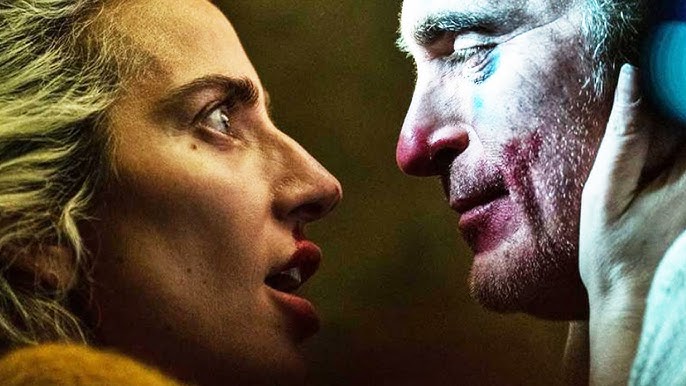
Arthur is fast approaching his day in court, schooled by his defence lawyer Maryanne (Catherine Keener), who is pretty sure that a plea of ‘dissociative identity disorder’ will save him from the death penalty. And then, attending an in-prison musical therapy session where inmates are encouraged to sing their troubles away, Arthur meets Harleen ‘Lee’ Quinzel (Lady Gaga) and, for the first time in his life, he has a reason to want to survive… and to slap that makeup back on his gaunt visage.

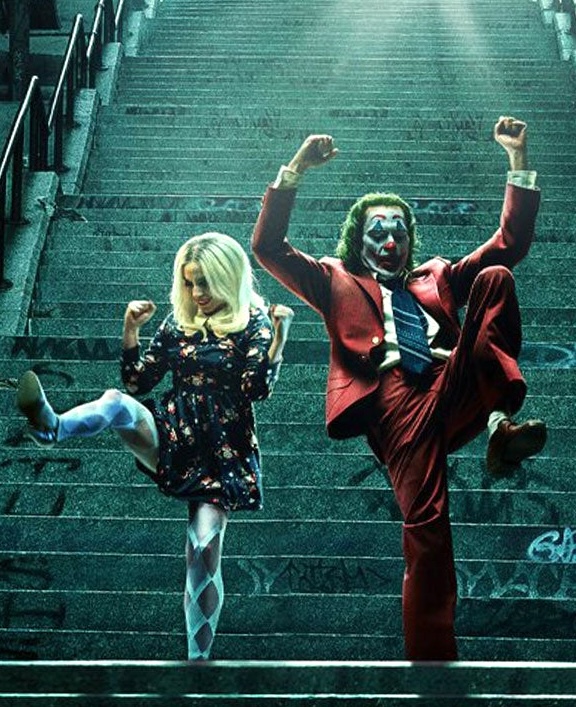
The term ‘musical’ is used quite loosely here. Phoenix and Gaga work their way through a series of solid gold bangers from the likes of Sinatra and Jaques Brel, but it’s made clear from the outset that these sequences occur in the cerebral landscape of Arthur’s head, his way of making sense of what’s happening to him. (Those with long memories may be reminded of Dennis Potter’s Pennies from Heaven, which adopted a similar approach.) A scene where Arthur is being interviewed by TV journalist Paddy Meyers (Steve Coogan) is a good case in point. Midway through the interview, Arthur suddenly breaks into song and dances around his cell – but Paddy remains blissfully unaware of his antics.

Phoenix is an actor of extraordinary ability and he slips into this unfamiliar discipline with his usual aplomb, using his newly slimmed-down frame to accentuate every move. Gaga, who has much more experience in the field, is also sensational, able to imbue an old chestnut like Get Happy with a strangely sinister edge, making me feel that I’m hearing it for the first time. As with the previous film, Philips steadfastly refuses to moderate his approach for the spandex brigade, doubling down on the grime and squalor. Folie à Deux is every bit as unsparing and unforgiving as its predecessor, whilst somehow managing to retain a beautiful humanity.

This may not be the perfectly-honed movie that was Joker, but for my money, it runs it a close second and is far (very far) from the embarrassing misfire that so many are describing it as. Some irate comic fans seem to have been hoping for a rerun of its predecessor, but what would be the point of that? I can’t help feeling they’ve somehow missed the point.

But then, I’m always happy to admit that I love a good musical.

4.6 stars

Philip Caveney

In Other Words

01/03/19

Traverse Theatre, Edinburgh

‘A play about dementia set to the music of Frank Sinatra.’

On paper, it doesn’t sound like the most appealing proposition, does it? But this clever piece, written by Matthew Seager, is an affecting study of the ways in which dementia, that most insidious of illnesses, can gradually overtake someone’s life. It also examines the pressures placed upon partners, who increasingly find themselves becoming carers. I have some personal experience here, because the last ten years of my mother’s life were affected by Alzheimer’s – and watching the way Arthur (Seager) and Jane (Angela Hardie)’s close and  loving relationship is gradually destroyed by the inexorable onset of dementia is, of course, tragic and compelling.

We first encounter the couple at their clumsy introduction in a bar, back when they were young and carefree – and we watch their first tentative dance to the titular Sinatra song, the one that is destined to become a touchstone in their lives – but, almost immediately, we slip forward to their harrowing present as Arthur deteriorates before our eyes, transforming into a mute, quivering figure in a chair, the unpalatable reality signalled by a flickering standard lamp and ominous, echoing sound effects. The performances from the two leads are exemplary, and the simple but effective staging works well, snapping me backwards and forwards in time without ever confusing me. It’s poignant to see present day Arthur suddenly transform to his younger, more vital self.

If there’s anything missing from the story, it’s a look into the the characters’ external lives. We learn very little about what they do outside of their relationship. Where, for instance, do they work? What are their interests (other than the music of Mr Sinatra)?And there’s only one brief scene that has a passing reference to any friends they might have. Perhaps Seager wants to concentrate all his attention on the couple’s mutual dependency, but it’s harder to mourn what’s been lost when we haven’t been shown a full picture of it. I’m also a little unsure of how old Arthur is supposed to be when he first begins to exhibit signs of the illness.

But there’s no doubting the sincerity of the story or the fact that it tackles a very important subject with sensitivity and understanding. Seager first became interested in the idea when he worked alongside people with dementia and noticed how regular exposure to music served to calm their mounting terrors. I also know from personal experience that people in the grip of dementia can be perfectly lucid about events that happened decades earlier, but have no memory of what happened minutes ago – a condition that is expertly conveyed here. I cry quite a lot during this performance as it evokes personal memories.

After this brief showing at the Traverse, In Other Words moves on to The Tron Theatre in Glasgow. See it if you can and be prepared to weep.

4 stars

Philip Caveney