
Film

Mission Impossible: The Final Reckoning

22/05/25

Cineworld, Edinburgh

And so, it would seem, the end is nigh – though I’m cynical enough to believe that will depend entirely on The Final Reckoning’s box office. It’s been a long and varied ride for Mission Impossible. As I’ve observed before, most franchises start strong and have a couple of decent follow-ups, before eventually running out of ideas and becoming pale shadows of their former selves. MI – based on the popular 60s TV series – began its cinematic journey way back in 1996 (originally helmed by Brian de Palma) and then struggled through a bunch of variable sequels until director Christopher McQuarrie came on board for 2015’s Rogue Nation. In that film, all the disparate elements finally gelled.

For my money, 2018’s Fallout was MI’s pinnacle: tense, propulsive, gloriously inventive, it kept me hooked right to the final frame and earned itself a five star B&B review. 2023’s Dead Reckoning wasn’t quite as perfect and the fact that it was a Part One didn’t help, particularly when Part Two wasn’t set to rear its head for another couple of years. Realising, no doubt, that viewers’ memories will need a significant nudge, The Final Reckoning opens with a kind of overview: a greatest hits package offering glimpses of a younger, leaner Ethan Hunt going through his frenetic paces.

After that, we arrive in a darker, gloomier world than we’re used to seeing in MI, where super-powerful AI Big-Bad, The Entity has taken control of the entire planet’s nuclear weapons and appears to be on the verge of initiating World War Three. (Sound familiar?) Ethan Hunt is now in hiding after the shenanigans of Part One so the American President (played by Angela Bassett, who, let’s face it, is the leader we all wish America currently had) puts out an urgent plea for him to show himself and to bring along that mysterious key he got hold of in Part One.

Will Ethan step up to this new challenge? Well, what do you think?

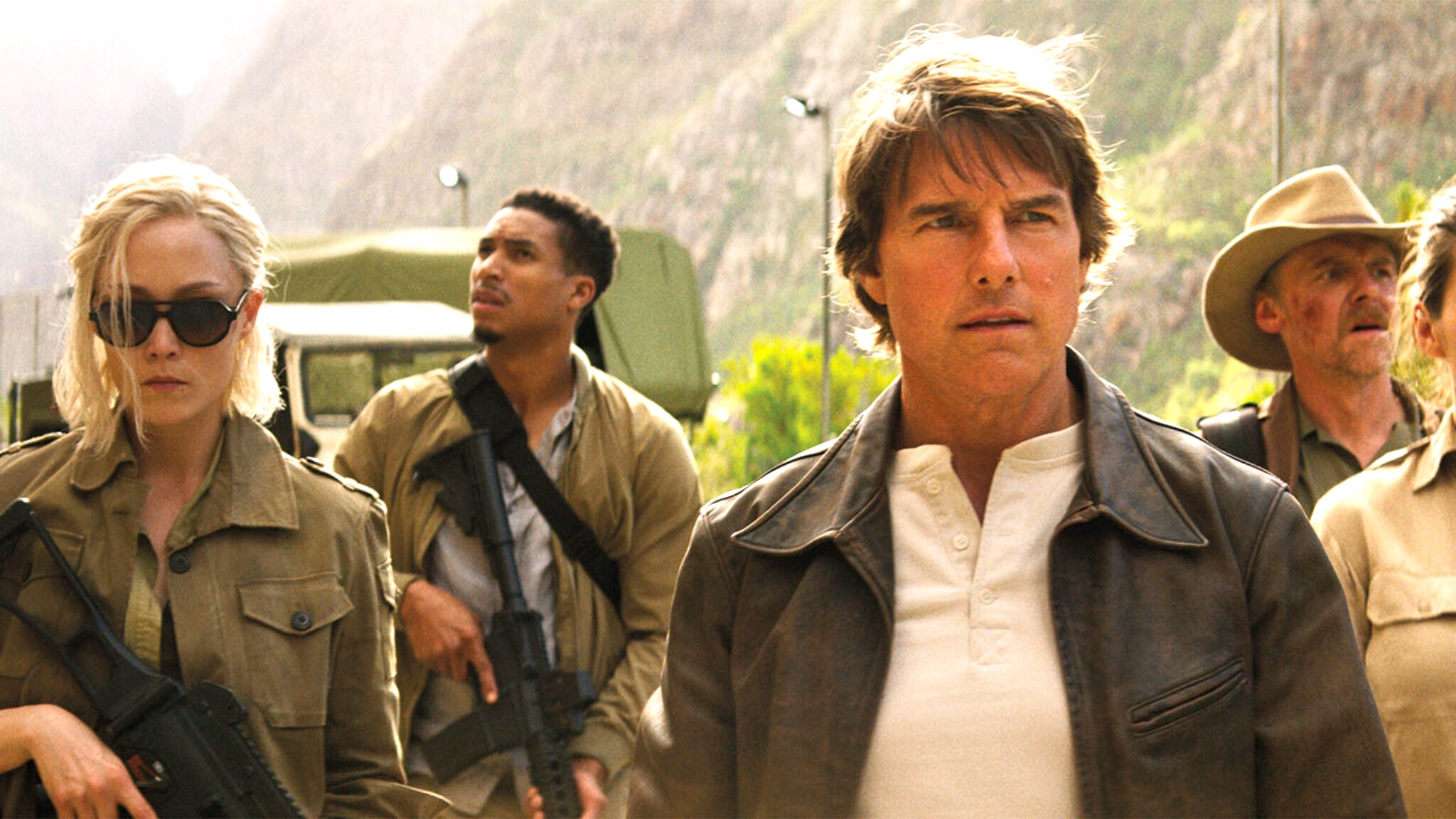
Aided by Grace (Hayley Atwell), Luther (Ving Rhames) and Benjie (Simon Pegg), plus former adversary, Paris (Pom Klementieff), Hunt devises ever more ingenious ways of taking on the all-powerful Entity and, if the storyline is patently absurd, well of course it is. This is Mission Impossible, FFS!

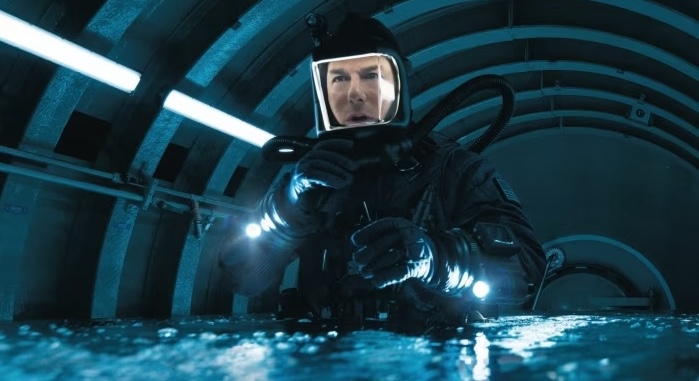
To give Cruise and McQuarrie their due, they have put everything they’ve got into making this the ultimate MI adventure and, to a large degree, they’ve succeeded. There are some incredibly-assured sequences, not least a claustrophobic and nail-biting return to that Russian submarine we saw in Part One. There’s also a nerve-racking aerial routine, where Hunt clambers all over the fuselage of a single-engined plane (in mid-flight) in a desperate bid to come face-to-face with human villain, Gabriel (Esai Morales). The fact that Cruise has done all these stunts for real is, of course, admirable, though I do wonder what professional stunt performers must think about such grandstanding. (I note from the credits that Cruise actually employs a stunt double, which begs the question ‘What does that man do to earn his fee?’ Make the coffees?)

On the debit side, the film’s ponderous running time does leave me with the onerous task of choosing the right moment to nip out for a toilet break – and I’d argue that thirty minutes could easily be clipped from this, simply by removing some of those references to past adventures. Having a call-back to a character who actually appeared in the very first movie is a nice touch, but I ask myself how much does it actually add to the story?

Still, kudos to Team Cruise-McQuarrie, who have devoted so much of their time, energy and (let’s face it) money to this franchise. But it does seem like the right time to bow out. And I’m pretty sure I’m not the only film fan who wistfully remembers Cruise in films like Jerry McGuire, Rain Man and Magnolia, where he was actually required to act and turned out to be pretty damned good at it.

I’m already looking forward to seeing what he does next.

4 stars

Philip Caveney
Spring Awakening

12/03/25

Bedlam Theatre, Edinburgh

It’s mind-blowing to think that Frank Wedekind’s Frühlings Erwachen was written in 1890, when Kaiser Wilhelm II ruled the Deutsches Reich, Queen Victoria was on the British throne and Robert Gascoyne-Cecil (nope, me neither) was our PM. In a world where women weren’t even allowed to show their ankles, it’s not surprising that it was sixteen years before someone dared to stage this controversial exposé of the dangers of repression, with its bold depictions of teenage sexuality – not to mention rape, suicide and abuse.

Steven Sater and Duncan Sheik’s musical adaptation premiered on Broadway in 2006, exactly one hundred years after Wedekind’s play finally opened at Berlin’s Deutsches Theater, under the direction of Max Reinhardt. Despite the addition of some banging rock songs and more than a few profanities, this modern version actually pulls more punches than the original, most notably by omitting the rape and softening the ending. Nonetheless, it still has the capacity to shock, and to remind us that we make sex dangerous by hiding it, by making it taboo.

Set in 19th century Germany, this is a story about a group of young people coming of age under the stifling weight of moral expectations. Wendla (Hattie Sumners) asks how babies are made. Scandalised, her mother (Sophie Davis, who plays all the adult women) first shouts and then equivocates, condemning her daughter to an ignorance which will have severe consequences. Meanwhile, Moritz (Shaun Hamilton) is struggling to keep up with his schoolwork, and fear of failure takes him to a devastating place. Melchior (Daniel Fischer) seems stronger than the others: thanks to a combination of intelligence and a liberal mother, he’s more knowledgeable than his friends, and therefore better equipped to cope with life. Still, the authoritarian regimes of school and church soon drag him under too; no one is safe in this society.

Theatre Paradok’s production succeeds in conveying those most fundamental of teenage emotions: exuberance and despair (I’m guessing the student cast don’t have to dig that deeply to remember how raw and overwhelming those feelings can be). Sheik’s eclectic soundtrack is beautifully interpreted by musical directors Nonny Jones and Ruairidh Nicholson, the choral numbers being particularly impressive. The live band – hidden in the wings – are terrific, and plaintive solos by Sumners, Gemima Iseka-Bekano (Ilse) and Hamilton evoke some strong responses.

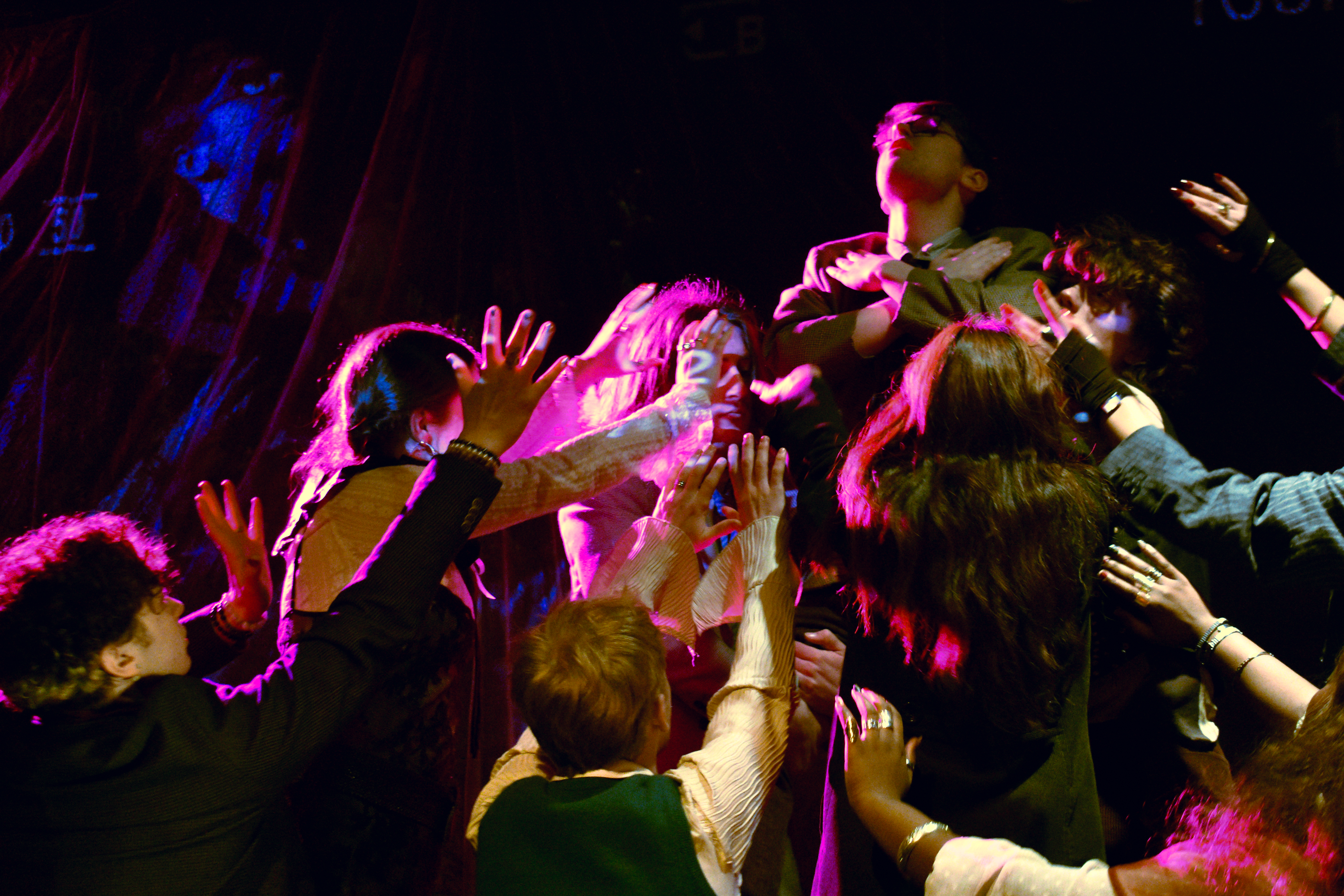
The show’s aesthetic is great. I love the androgyny of the costumes, with feminine dresses worn over masculine suits; the queer coding is fabulously done. The set is simple but very effective: items of underwear are stapled to a curtain framing a large gauze backdrop, onto which short animations and live videos are projected, creating an ethereal doubling effect and amplifying the characters’ emotions.

Directors Rue Richardson and Jane Morgan manage their large cast with aplomb. The play is dynamic and visually very appealing, from the arresting choreography (by Františka Vosátková, along with Richardson, Morgan and Andrea Adriana Prawono) to the boisterous shenanigans of the teenage boys. The gauze curtain makes metaphors literal: dead characters appear from ‘beyond the veil’, while ‘a veil is drawn’ over Wendla and Melchior’s lovemaking. However, Ernst (Michael Butler) and Hänschen (Max Middleton)’s homosexual relationship is placed boldly centre-stage – perhaps a subtle nod to the idea that some things shouldn’t be re-closeted.

I do have one criticism, and it’s the emergency exit door, stage left, which is open to the elements. Bedlam is a chilly venue at the best of times; tonight, with an outside temperature of 1°C, I could do without sitting in a freezing draught. And it’s not just the cold that’s a problem, there’s the noise of the city too: traffic and sirens and people passing by, all making a claim on my attention. I can see that the options are limited by the need to house the band, but – for the sake of one entrance and one exit – it’s surely not worth making the audience so uncomfortable.

Nevertheless, this production of Spring Awakening is a triumph: a lively, thought-provoking piece of theatre, as relevant now as it was more than a century ago.

4.2 stars

Susan Singfield


Bridget Jones: Mad About the Boy

22/02/25

Cineworld, Edinburgh

Watching a Bridget Jones movie is like catching up with an old schoolmate – not necessarily someone you were especially close to back in the day, but with whom there’s enough shared history to make these meet-ups fun. No doubt this is particularly true for “women of a certain age” – Bridget’s age; my age – who’ve grown older with her as part of our cultural landscape.

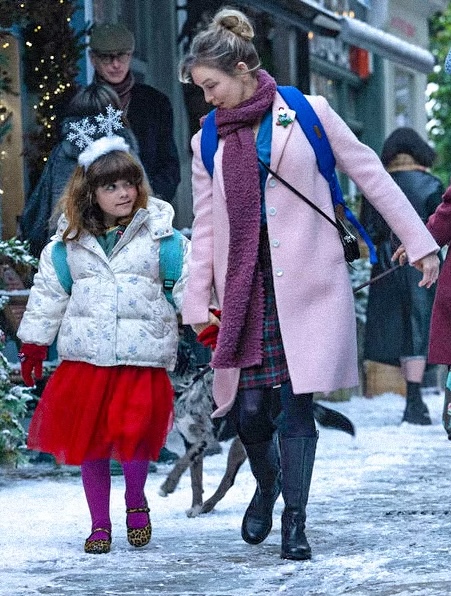
Thankfully, Bridget (Renée Zellwegger) has finally grown wiser; I found her ditsy-fuck-up persona a wee bit irritating when I last saw her (in 2016’s Bridget Jones’s Baby). What was endearing in a woman barely into her thirties, contemplating the fact that she’s somehow suddenly supposed to be an adult, was just irksome in a pregnant forty-something with a kick-ass job. Now in her fifties, Bridget has settled into success: she’s proud of the skills that make her such an excellent TV producer, and she’s even prouder of Billy and Mabel (Casper Knopf and Mila Jankovic), her two delightful kids.

But this iteration of Bridget is a lot sadder too: she’s a widow. Her husband, Mark Darcy (Colin Firth), was killed a couple of years ago on a peace-keeping mission in the Sudan. The issue of mourning is nicely handled, staying just the right side of mawkish. We see Bridget and her kids slowly moving forward, acknowledging their grief while also trying to find joy. The new levels of emotional depth work well, but this is still essentially a rom-com, so there’s a raft of unsuitable guys for Bridget to dally with.

First up is her old flame, Daniel Cleaver (Hugh Grant). Bridget has him firmly in the friend-zone nowadays, and I like this development. He’s as much of a player as he ever was – his language inappropriate; his attitude to women still neanderthal – but he’s rendered (more or less) palatable thanks to his kindness to Bridget and his rueful acknowledgement of his own failings. Also, of course, Grant imbues him with a rogue-ish charm, so it’s hard to hate him as much as I might in real life.

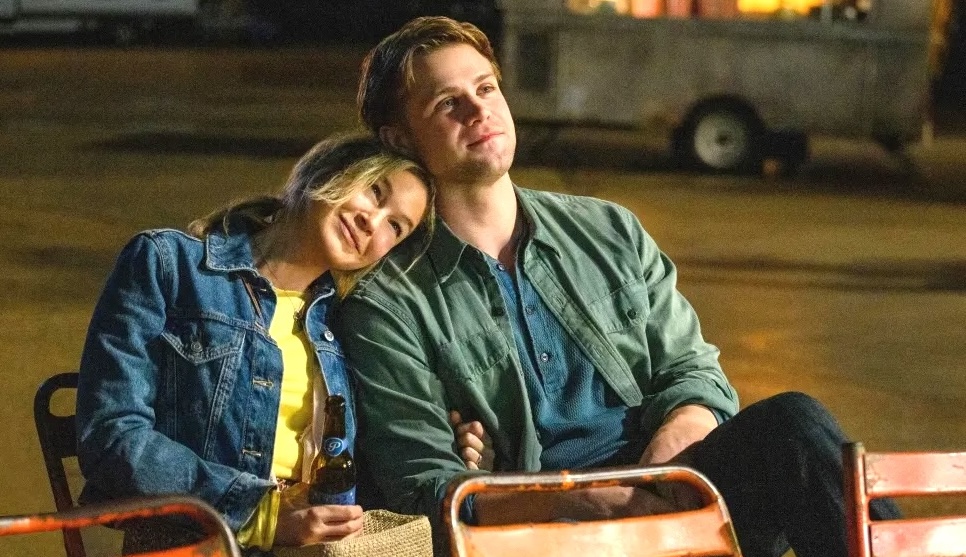
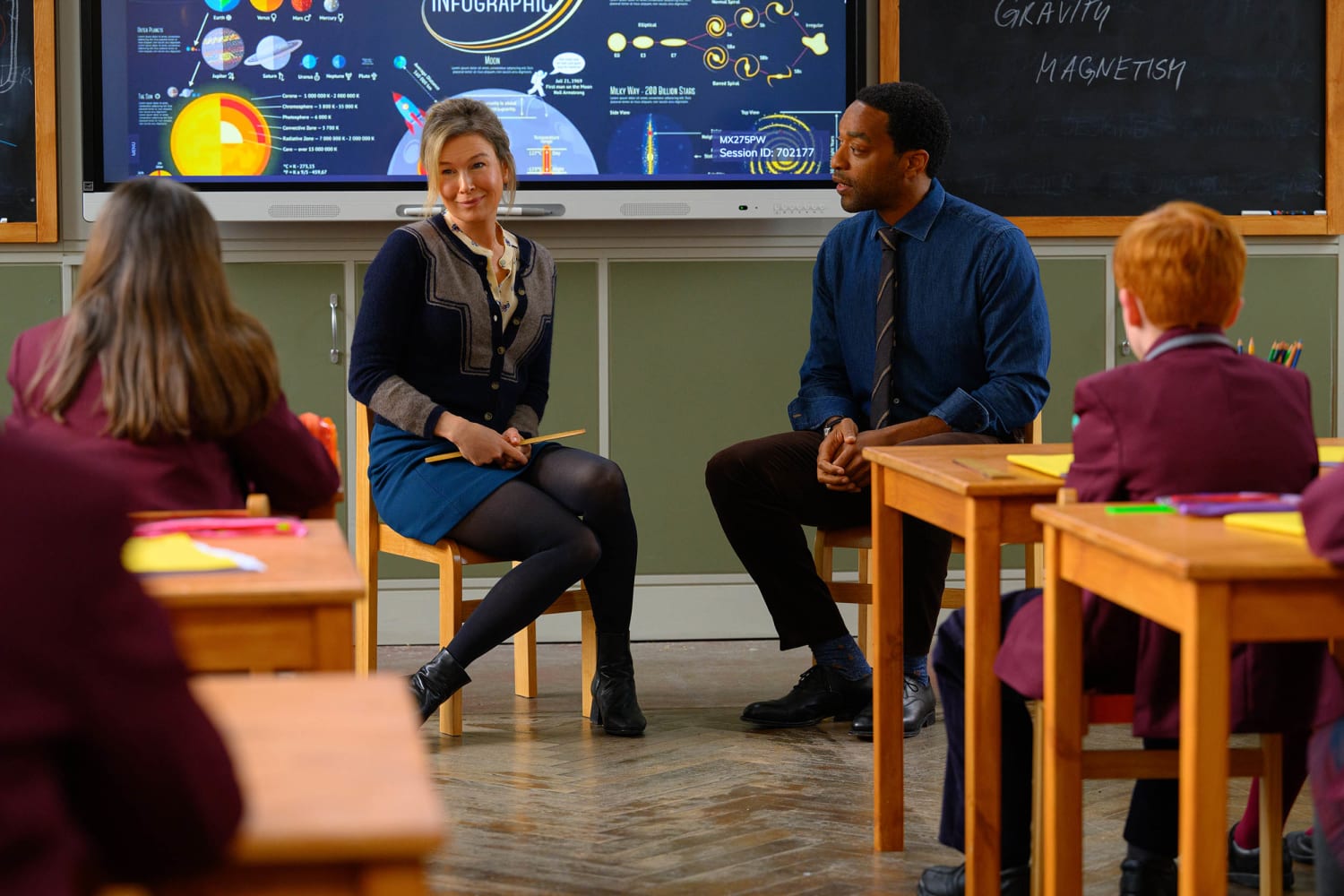
So, if Cleaver’s not a contender for a new relationship, who is? Enter Roxster (Leo Woodall) and Mr Wallaker (Chiwetel Ejiofor). The former is a twenty-nine-year-old PhD student, all rippling muscles and boyish smile; the latter is Billy’s uptight primary school teacher, a stickler for rules and punctuality – although he does turn out to have a decent set of abs as well. It’s no surprise that Bridget finds herself drawn to Roxster – nor that Mr W reveals a softer side, which makes her like him too. Which one will Bridget end up with? (Things might have moved on – at least Bridget doesn’t seem to hate her body any more – but the story hasn’t strayed so far from its ‘happy ending’ cliché that she might conceivably choose to be alone.)

Zellwegger is as likeable as ever, and I have tears in my eyes as I see Bridget emerging from her misery to recover some of her ebullience – dancing and laughing and being silly. It’s great to see her old friends and adversaries pop up as well: director Michael Morris and scriptwriters Helen Fielding, Dan Mazer and Abi Morgan successfully present a parade of ‘greatest hits’ shout-outs without ever making them seem shoe-horned into place. Big knickers? Check. Penguin pyjamas? Check. Falling over? Check. Check. Check. Running after a lover in the snow? Big check.

In short, I like this film a whole lot more than I’m expecting to. Bridget will never be my bestie, but I’d love to check in with her when we’re both in our sixties, and see what scrapes she’s getting up to then…

4 stars

Susan Singfield

A Real Pain

12/01/25

Cineworld, Edinburgh

On paper, it sounds like a terrible idea: a comedy about chalk-and-cheese Jewish cousins on a tourist trip to a concentration camp. I’m sorry, what? But Jesse Eisenberg’s script successfully navigates the many potential pitfalls, and A Real Pain emerges as a thoughtful exploration of how we try to make sense of the horrors of recent history, expertly leavened by the mismatched buddy lols.

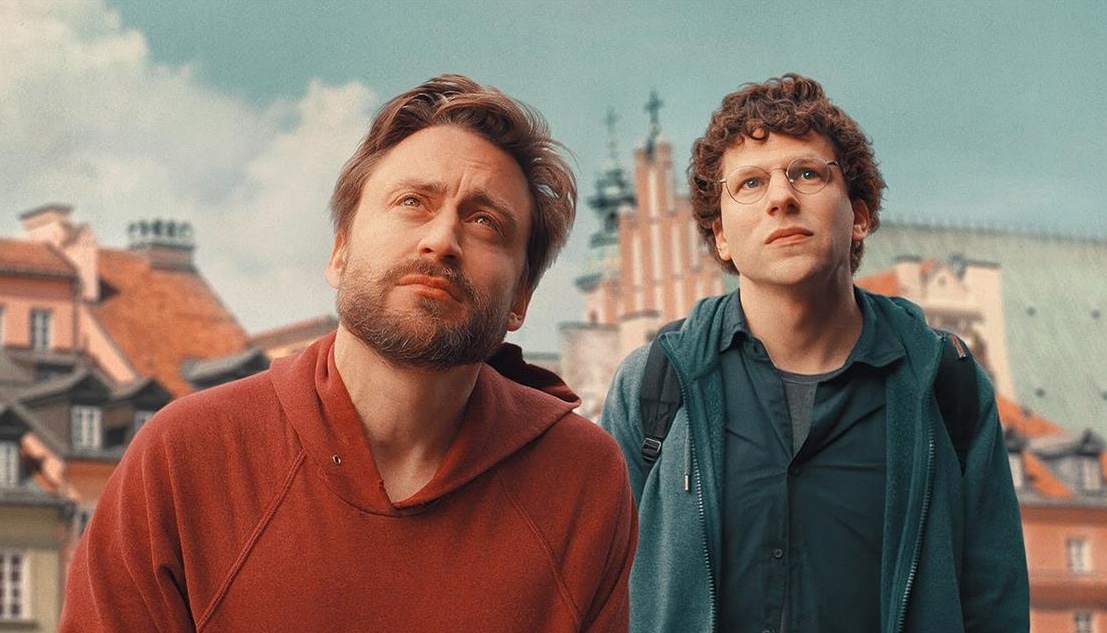
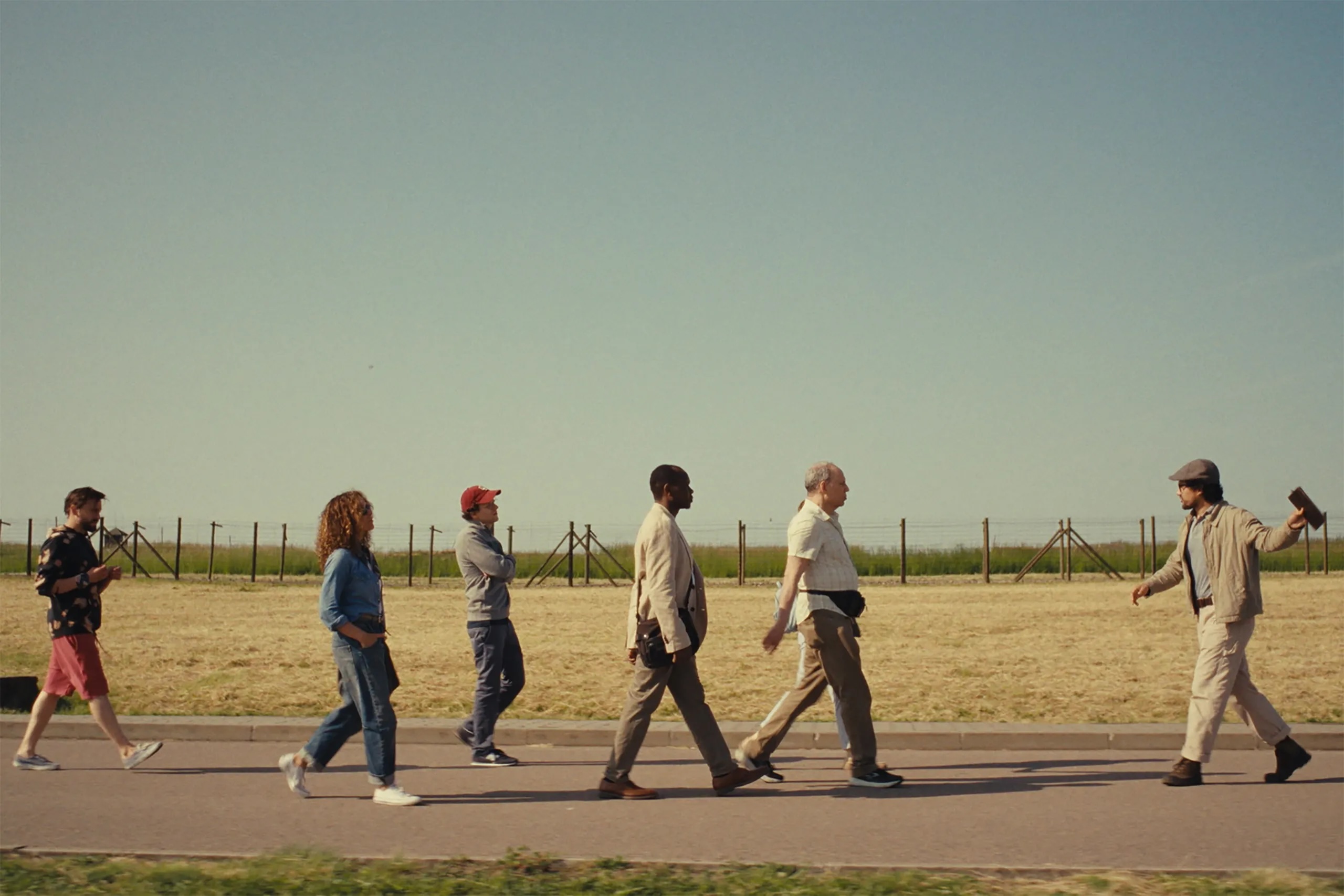
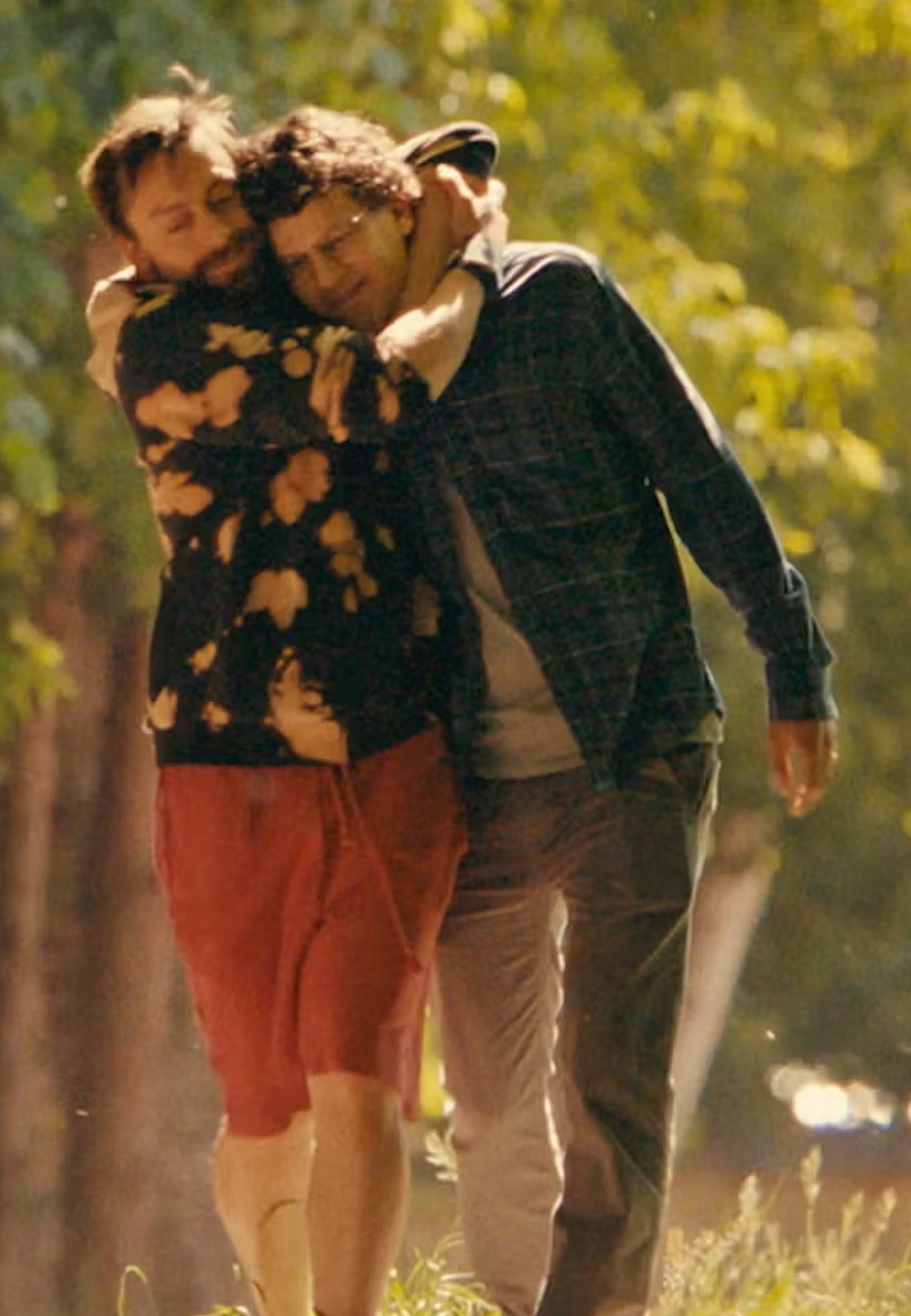
This is very much Eisenberg’s project: he also directs and co-stars as David, the uptight, neurotic half of the central pair. Kieran Culkin is Benji, the cousin he was inseparable from when they were young. Their backstory emerges through the dialogue: as they approach forty, we learn, David doesn’t want to hang out with Benji like he used to. He’s moved to NYC, where he has a wife, a child and a career to focus on. Benji, on the other hand, has yet to find his groove. Sure, he’s funny, charming and very popular, but he’s also living in his parents’ basement, depressed, without a steady job. Their paths rarely cross. But then their beloved Grandmother Dory dies, leaving money in her will for the two of them to travel to Poland, to see the house where she grew up and the camp that she survived. It feels like a canny final plan, to reunite her grandsons while also honouring the past.

It helps, of course, that Eisenberg and Culkin are both such strong actors, easily securing the audience’s sympathy. Culkin in particular shines here in the showier role, Benji’s vulnerability writ large, despite his devil-may-care attitude. Even as he’s selfishly appropriating the window seat – again – or disrupting a whole train carriage with a tantrum, it’s impossible not to feel protective of him, the carapace he’s constructed so obviously fragile. Eisenberg provides the comedic foil; he’s the helpless observer apologising for his cousin’s outbursts, blinking with embarrassment as Benji transgresses social mores.

The supporting cast are also well-drawn, a convincing mix of characters, contentedly muddling along. British tour guide James (Will Sharpe) is an affable chap. He’s not Jewish but he is an Oxford graduate with a detailed knowledge of Polish history. The two solo travellers are Marcia (Jennifer Grey), a recently-divorced woman in her early sixties, and Eloge (Kurt Egyiawan), a survivor of the Rwandan genocide who has emigrated to the USA and converted to Judaism. Married couple Mark and Diane (Daniel Oreskes and Liza Sadovy) complete the group; like David and Benji, they’re visiting Lublin because it’s where their family comes from – and where many of them were killed.

The scenes in the Majdanek concentration camp are very moving. Eisenberg sensibly eschews any directorial flourishes here: there’s no music, no flashbacks, no fancy editing tricks. The bare walls speak for themselves, atrocities literally etched onto them in the blue stains left by poison gas. The tour group moves through in silence; their return bus journey passes quietly too, as they reflect on what they’ve seen – and what it means. Later, smoking a joint on the hotel roof, David points out three lights. “That’s the camp,” he says. “It’s so close” – a perfect example of the understated poignancy that makes the movie work so well.

A Real Pain is a clever film, a tight ninety minutes of carefully-structured storytelling, with never a dull moment. Eisenberg straddles the line between respect and irreverence, gently mocking people’s reactions without ever trivialising the Holocaust. It’s no mean feat to create such a heartwarming, thought-provoking tragicomedy.

4.4 stars

Susan Singfield

Megalopolis

03/10/24

Cineworld, Edinburgh

Well, I can’t say I wasn’t warned. Francis Ford Coppola’s long-nurtured passion project, Megalopolis, arrives garlanded with the kind of vitriolic advance reviews that instantly sank its chances of making any money at the box office. But why all the furore? What has the man done that’s so unspeakable? You’d think he’d murdered somebody. Instead, at the age of eighty-six, he’s made a vanity project, self-financing the hundred million dollar film by selling one of his vineyards. (We’ve all been there.) He hasn’t bankrupted a movie studio, which makes a refreshing change.

Lest we forget, Coppola has made some underwhelming films before. Yes, he gave us The Conversation, The Godfathers (One and Two) and of course, Apocalypse Now, but there was also One From the Heart and er… Jack, both of which were less than perfect.

It’s important to note that right from the opening credits, Megalopolis is described as ‘A Fable,’ so those who describe it as ‘unrealistic’ may be missing the point.

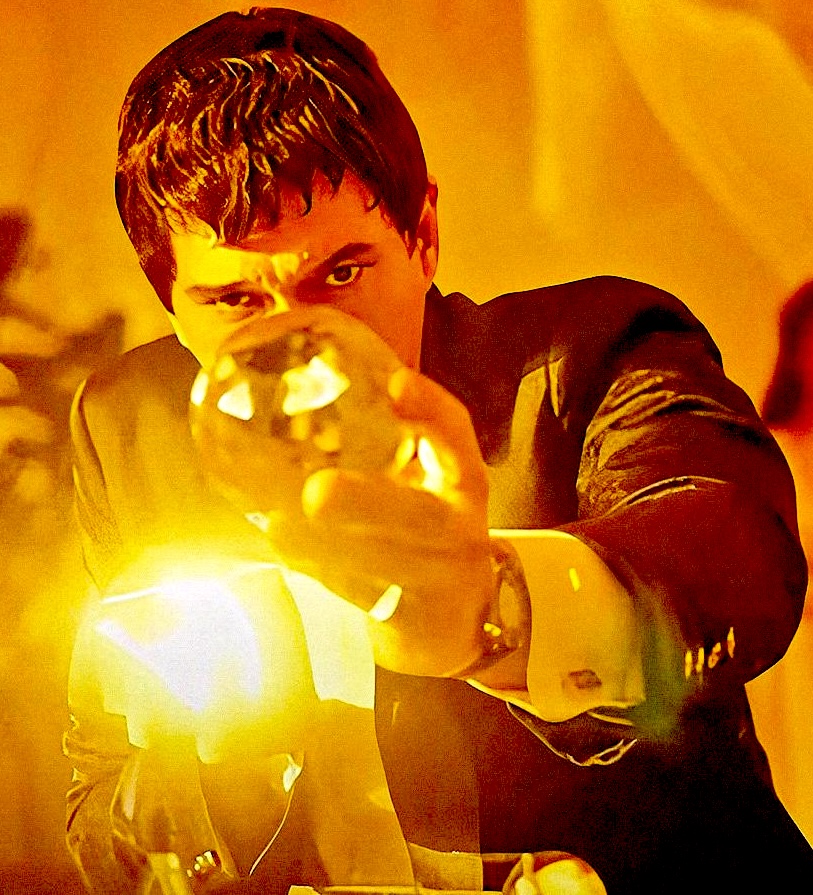
Somewhere in an imagined future, New York has become New Rome, and those that run the city have taken on the aspects of senators and emperors, strutting around in toga-like garments and looking very pleased with themselves. Cesar Catalina (Adam Driver) is a sort of genius / town-planner, who has discovered a mysterious and indestructible building substance called Megalon. He has also found a way to stop time by clicking his fingers (as you do) and has a penchant for lapsing into Shakespeare soliloquies for no apparent reason.

Cesar is currently intent on building the titular inner city area, which he believes will be the first step in creating a bright new future, but his main adversary in this project is Mayor Cicero (Giancarlo Esposito), who seems to be opposed to any kind of progress. Cicero’s daughter, Julia (Nathalie Emmanuel), on the other hand, finds herself increasingly drawn to Catalina and it’s not long before sparks begin to fly between them. It’s clearly going to cause trouble.

There are other powers at work in the city. TV presenter, Wow Platinum (Aubrey Plaza), is suffering from failing audience figures and is keen to take a step up in the world by marrying Cesar’s rich uncle, Hamilton Crassus III (Jon Voight). She uses her nephew, Clodio (Shia LaBeouf), to help her to get there, by any foul means he can devise. (The odious Clodio is clearly inspired by Donald Trump, right down to the bloody insurrection he foments and is perhaps the one place in the ‘fable’ that does relate to real life.)

Overall, Megalopolis doesn’t work and it’s not that it’s short of ideas. On the contrary, it is virtually struggling to contain them all and it doesn’t help that there are too many big names in cameo roles here, most of them improvising their lines. The likes of Dustin Hoffman and Talia Shire flit briefly across the screen and it feels as though Coppola, having secured their services, is unsure of exactly what to do with them. Sometimes, when you work too hard on a project, you stop seeing it objectively.

On the plus side, the film looks magnificent in IMAX, a succulent, shimmering wonder to behold (Coppola did his own cinematography) and, in the film’s latter stages, there are sequences that might best be described as psychedelic, the massive screen appearing to erupt at regular intervals in a blaze of light and colour. If you’re going to see this, do try to catch it in the cinema, because its going to lose all of its majesty on streaming. The running time of two hours and eighteen minutes soon elapses and, after everything that Coppola has given us over the years, surely it’s not too much to ask that movie buffs make the effort to actually go out to see it.

3 stars

Philip Caveney

Present Laughter: NT Live

26/01/20

Festival Theatre, Edinburgh

It’s hard to believe that National Theatre Live is already celebrating its 10th anniversary. This brilliant initiative, which makes the very best theatrical productions accessible to a much wider audience than they could ever reach on the stage, has been a resounding success. Like many people, we usually view them at the cinema – but there’s something very fitting about seeing this West End winner on the big screen at the Festival Theatre.

The play invites us to witness a few turbulent days in the life of highly successful actor, Garry Essendine (Andrew Scott). Recently turned forty and about to embark on a prestigious tour of Africa, Gary is suffering something of a mid-life crisis and, at the play’s opening, wakes up after a night of drunken debauchery to discover that he has slept with ingenue Daphne Stillington (Kitty Archer). Unfortunately, she is still hanging around his swish apartment, hoping for breakfast and that meaningful relationship he promised her last night.

Her presence is tolerated with little more than a raised eyebrow by Garry’s long-suffering assistant, Monica (Sophie Thompson), and by his ex wife, Liz (Indira Varma), who has long ago abandoned her personal feelings in favour of managing and protecting the Garry Essendine ‘brand.’ Both women know that such indiscretions are parr for the course.

But further complications rear their heads when Garry’s married business associate, Morris (Abdul Salis) confesses to having an affair with Joe (Enzo Cilenti), and it isn’t long before the self-same Joe has arrived at the apartment and is making flirtatious advances to Garry.

Coward fans will know that in the original play, Joe was Joanna, but this gender-swap is an astute move on the part of director, Matthew Warchus, reminding us that Coward was a closeted gay man at a time when such inclinations could never be expressed onstage. As the tempo steadily rises, and the play careers like an out-of-control vehicle from one frenetic scene to the next, it’s no surprise to hear the complaint, ‘I feel like a character in a French farce.’

The actors are all pretty much note-perfect: Luke Thallon is particularly assured as a sycophantic fan prepared to move heaven and earth to be near his idol, while Sophie Thompson is an absolute delight as Monica, enmeshed in a love-hate relationship with her employer and sometimes in danger of veering towards the former. But make no mistake, this show belongs to Scott and his undeniable talent. His embodiment of the vain, childish and self-obsessed Garry Essendine is an absolute comic tour de force. I’ve seen plenty of Noel Coward plays over the years but I’ve never laughed as uproariously as I do at this one.

I think he’d be thoroughly delighted by this version, though, which is fresh and vivacious enough to make me think that I’d like to see more of The Master’s plays reimagined for our times.

There are more top flight theatrical productions scheduled to view at the Festival Theatre. Why not treat yourself?

4.6 stars

Philip Caveney


Lucy

MV5BODcxMzY3ODY1NF5BMl5BanBnXkFtZTgwNzg1NDY4MTE@._V1_SX214_AL_

22/08/14

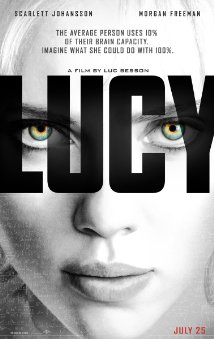
Once upon a time, Luc Besson was France’s foremost action director. Recently, he’s been more successful as a writer/producer, with guilty pleasures like Taken and Transporter to his credit, but it’s a long time since he directed anything of the calibre of Leon or The Fifth Element. Lucy is his attempt to swagger his way back into the big league and while it lacks the kinetic pleasures of his best efforts, it’s nonetheless an entertaining film with an intriguing premise.

Scarlett Johansson plays the eponymous heroine, a luckless student who finds herself tricked by her loser boyfriend into taking a suitcase stuffed with drugs to the hotel room of ruthless crime lord, Mr Jang (Min Sik-Choi). The assignment doesn’t go at all well and these early scenes of Lucy in the dragon’s den, intercut with images of prowling cheetahs hunting their prey, are confidently put together and the strongest moments in the film. Things get rather more complicated when Lucy finds herself the victim of a illicit operation with a bag full of drugs sewn into her intestine. When the bag ruptures, the contents spill through her system and (for reasons that aren’t convincingly explained) Lucy begins to use more and more of her brain’s capacity. Whereupon amazing things begin to happen…

Conveniently, Morgan Freeman is on hand as Professor Norman, an expert on human evolution, to deliver a lecture about what might happen should a human being’s brain power ever be increased. He is at pains to point out that at present, we only use 10 percent of our brains’ potential capacity. This is (apparently) complete nonsense, but don’t let that bother you too much, since it’s merely a device to enable Luc Besson to experiment with the old special effects. Apparently, taking too much of the mysterious drug can turn a meek young student into a kick-ass fighter, able to murder people without raising so much as an eyebrow and to make heavy objects move just by thinking about it.

I’ll be honest, this isn’t Luc Besson’s best film, not by a long shot, but it galumphs along like nobody’s business and it never drags. Meanwhile, Johansson is rapidly becoming this generation’s Marilyn Monroe – the camera adores her and she glides through the proceedings with such assurance, that the viewer barely has time to notice how silly the plot is. Ultimately, this is a partial return to glory for the Gallic action man, but we all know he can do better than this. Still, until another Leon comes along, this will have to do.

4 stars

Philip Caveney
Guardians of the Galaxy

10516837_10204674014348873_1833507818339749558_n

09/08/14

The creators of Guardians of the Galaxy would probably like to think that their film is a cut above your average space opera – and indeed, there is much about it that I absolutely loved. But I would also have to admit that there are several elements that seem horribly cliched. The plus points: an unusual cast that includes a talking racoon (voiced by Bradley Cooper) and a monosyllabic talking tree (Vin Deisel). Hero Chris Pratt’s nicely sardonic patter neatly undercuts the film’s more pompous passages, and for once here’s a kick-ass heroine (Zoe Saldana) who has a bit more depth than your average green-skinned alien. And then there’s that sublime soundtrack of 80’s classics…

But there are several not so good points. A needlessly complicated plot. Everyone seems to be chasing a metal orb with the power to destroy the galaxy, but at times, it’s hard to fathom anyone’s motivation. The inevitable evil villain (Lee Pace as Ronan) who talks as though he’s just swallowed a bottle of rohypnol and spends most of his time smiting his enemies. The occasional walk-on megastar – Glenn Close and Beniccio Del Toro, dressed up to the nines but given very little to do. And one of those huge special effect climactic battles where the ‘Guardians’ seem to destroy half of a city in their attempts to save it. (See Team America: World Police.)

Of course, the runaway success of this first instalment means that the series will have a sequel and it will probably be even bigger, louder and just as prone to cliche. For me, this is a film in opposition with itself and the score reflects that imbalance.

3.8 stars

Philip Caveney
Begin Again

10556338_10204476290845909_2470303956486663091_n

13/07/14

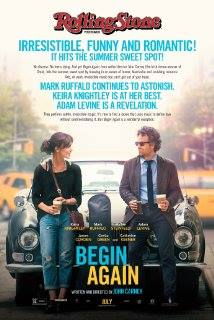
Writer/director John Carney is, of course, the man who created the phenomenon that is Once. Begin Again, is basically a better-heeled version of the same story. Man meets woman, they make a record together, the lyrics of the songs reflect on the story.

So, not exactly a stellar jump for Carney but one that nonetheless has charms of its own. Mark Ruffalo is Dan, an independent record producer who’s career has taken a nosedive after the breakup of his marriage to Miriam (Catherine Keener). One night, drunk in a club, he witnesses a song by singer/songwriter Greta (Keira Knightly) and decides he wants to make an album with her. But she too is damaged goods, having recently been dumped by her partner, Dave (Adam Levine) a self-centred musician currently making a meteoric breakthrough into the big time. Against all the odds, Dan and Greta manage to record their record live on the streets of New York…

OK, leaving aside the sheer impossibility of actually doing that, this is an entertaining movie that demonstrates a real understanding of the current music industry. Knightly makes more than a decent fist of performing the songs (anyone who saw her in the Edge of Love will already know that she can carry a tune) and the ‘will they. won’t they?’ relationship with Ruffalo cooks up some fair chemistry. The scene where Ruffalo visualises the production he’s going to do of Greta’s song is fabulous and probably worth the price of admission alone. This is a entertaining film, but next time out, Carney is definitely going to have to spread his net a little wider.

4.2 stars

Philip Caveney

Boyhood

10527893_10204463183598236_6163534707237508187_n

11/7/14

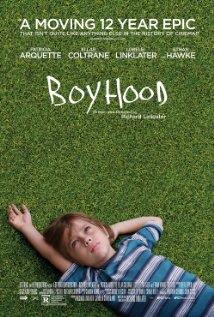
Richard Linklater is what used to be known, in the classic days of Hollywood, as a maverick director. Which pretty much means that you never know what to expect from him next. From his assured debut with Dazed and Confused, through School of Rock and the various animated experiments he’s done, he’s kept his viewing public well and truly unbalanced. But who could have anticipated Boyhood?

The USP of this movie is that Linklater filmed his scenes over a twelve year period, using the same cast. The boy of the title is Mason (Ellar Coltrane). When we first meet him he’s a six year old, desperately trying to come to terms with the breakup of his parent’s marriage. Mom, is Patricia Arquette, an independent woman who longs for a career but is hampered by her unerring ability to choose the wrong man every time. Dad is Ethan Hawke, wild, feckless but incredibly likeable. And Mason’s sister is Samantha (Lorelei Linklater, the director’s own daughter). Storywise, what we get is a series of episodic vignettes that follows Mason and his extended family across the years, seeing everyone literally age 12 years in the process. The result is as delicious and it is extraordinarily magical. How many times have we seen three different kids brought in to represent one character? And how often have we seen actors buried under layers of latex to indicate the passing years.

Boyhood is a triumphant film, one that elicits genuine emotions, following as it does the (quite literal) rites of passage as a boy passes from childhood into manhood. And what a superbly eclectic soundtrack! After a recent drought in the cinema, this comes as a much needed drink of cool, refreshing water. Absolutely unmissable.

5 stars

Philip Caveney