Ewan McGregor

Guillermo del Toro’s Pinocchio

19/12/22

Netflix

Guillermo del Toro is one of my favourite film directors – and Disney’s Pinocchio one of the formative films of my childhood. So when I first hear the news that the Mexican director is planning to deliver his own version of Carlo Collodi’s classic tale, it’s naturally something I eagerly look forward to – for a very long time. Indeed, it turns out that del Toro has actually been working on this astonishing stop-frame animation for something like fifteen years.

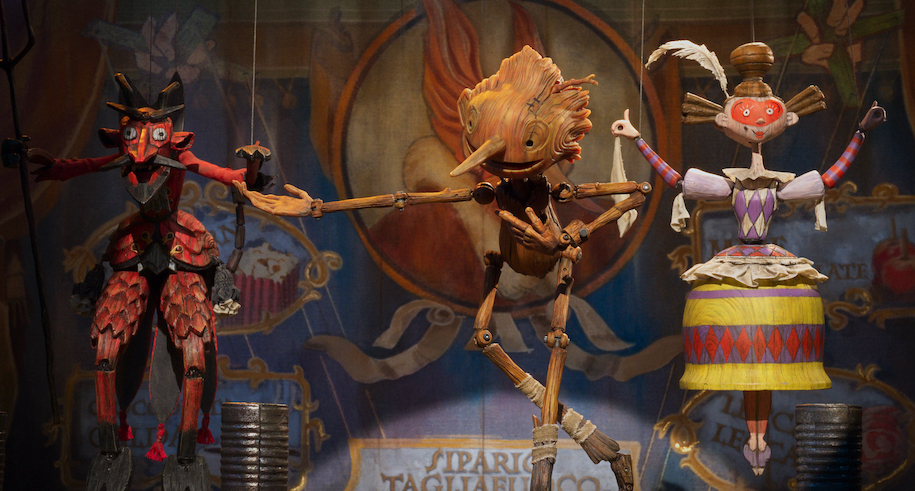
As the release date finally approaches, I look everywhere for a cinema in Edinburgh that’s planning to show del Toro’s film on the big screen, but alas, with the Filmhouse out of action, it cannot be found. So Netflix it must be. As it turns out, some visions are so powerful, so perfect, that they can blaze out of a small screen like meteors. Guillermo del Toro’s Pinocchio is an astonishing film, that has the audacity to take everything we know about the story and give it a thorough makeover. What’s more, the changes that he makes (he co-wrote the screenplay with Patrick McHale) all seem to enrich the original, making it more logical, more explicable.

Revelation number one: when we first encounter woodcarver, Geppetto (David Bradley), he has a real son, Carlo (voiced by Gregory Mann). But Carlo dies tragically when Italian air force planes unload their bombs onto the church, where Gepetto is working on a huge crucifixion. This backstory helps flesh Geppetto out and makes his subsequent actions more believable – especially when Pinocchio is forged from the very tree planted to mark Carlo’s grave.

Revelation number two: the Pinocchio that Geppetto eventually carves in a drunken rage looks nothing like a ‘real boy’. He’s a strange, spindly, half-finished marionette, generally shunned and mistrusted by the people in his home village. Contrary to the original tale, it’s the villagers who have to learn to accept Pinocchio, rather than the other way around.

Revelation number three: this version is set in Italy in the 1930s, under the rule of Benito Mussolini. Pinocchio’s adventures on the ‘Donkey Island’ are exchanged for scenes where he unwittingly becomes a poster boy for fascism. (It’s nakedly clear what del Toro is saying here. And it makes perfect sense, because to take on Disney’s most iconic scenes would be a pointless exercise. If you can’t better a scene, do something entirely different, right?)

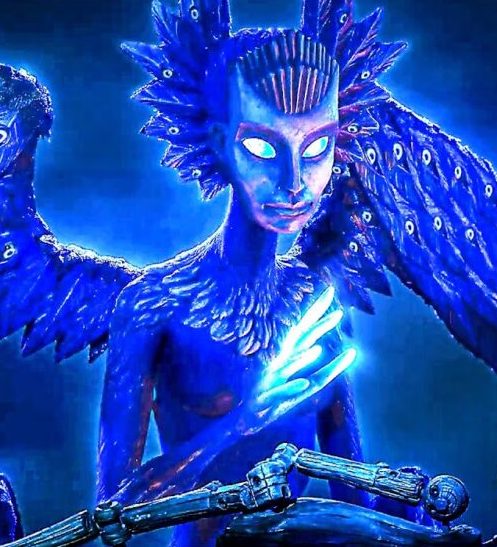
There’s more, much more, packed into the film’s two hour run. We meet Sebastian J Cricket (Ewan McGegor), an ambitious, self-aggrandising would-be author, who only agrees to take on the task of being Pinocchio’s ‘conscience’ in the hope off getting a book deal. There’s Count Volpe (Christoph Waltz), the greedy, venal owner of a travelling freak show, who spots an opportunity to make lots of money and who bullies his monkey assistant, Spazzatura (Cate Blanchett) at every opportunity. And wait till you see what the animators (and Tilda Swinton) have done with the infamous Blue Fairy, rechristened here as the Woodland Sprite. More than anything else, there are fundamental changes to the character of Pinocchio himself. He’s no longer the obnoxious, pig-headed lout of the novel, but a sweet, misguided misfit, desperately trying to be liked. A scene where he can’t understand why all the villagers hate him, but adore the other wooden figure nailed to a cross on the church wall is a stand-out.

It’s not just the levels of invention in the story that make this such a unmitigated triumph. It’s the loving attention to detail: every character, every set, every painted landscape; it all pulses and dazzles with imagination of the highest calibre. There’s so much to see here, it’s clearly going to need repeated viewings to really take it all in. And watching it makes me wish that dear old Ray Harryhausen was still alive to see where modern technology has brought the art of stop-motion animation.

Many films have the word ‘masterpiece’ attached to them, but few deserve it as thoroughly as this one. All you need to do it hit the Netflix button, so… no pressure.

5 stars

Philip Caveney

Doctor Sleep

11/11/19

Stephen King famously disliked Stanley Kubrick’s adaptation of his 1980 novel, The Shining – so much so that, in the 90s, he scripted a television series with the same name, one which he felt stuck closer to his original concept. (I haven’t seen it but the general opinion seems to be that it was lacklustre.) So it’s odd to see him executive producing this adaptation of the sequel, Doctor Sleep, considering it has a whole section devoted to Kubrick’s vision, complete with convincing lookalikes of Jack Nicholson and Shelley Duval. Go figure.

It’s many years after the events of The Shining and little Danny Torrence has, improbably, grown up to be the dead spit of Ewan McGregor. Now called Dan Torrence (see what he did there?), he’s understandably a troubled soul, addicted to alcohol and cocaine and still haunted  by visions of his time at The Overlook Hotel – indeed, he has regular conversations with the late Dick Halloran (Carl Lumbly standing in for Scatman Crothers). Driven to desperate measures, Dan decides he has to change, so he takes off to a new town where nobody knows him, and where he has a chance of starting over. As the months pass, he cleans up his act and eventually takes a job as a hospital orderly, where he soon develops a reputation for easing the passing of dying patients and where he acquires the nickname of Doctor Sleep.

But trouble is coming in the shape of Rose the Hat (Rebecca Ferguson) and her band of travelling vapour junkies, addicted to murdering anyone with telepathic abilities and inhaling their unique aura in order to keep themselves alive, long past the time when they should be shuffling off to oblivion. When they fix their hungry sights on a talented teenager called Abra (Kyliegh Curran), she reaches out to Dan, who has been a kind of psychic pen-pal of hers for years, asking for his help. He reluctantly answers her call but the desperate struggle to elude these murderous wanderers inevitably leads back to a very familiar location…

Writer/director Mike Flanagan has done something more than the usual cheapie horror adaptation here. He takes his own sweet time to unload the various strands of the story, cross-cutting effortlessly from Dan to Abra to Rose and giving a very real sense of the events unfolding over the years. There are a few eerie moments along the way, but the supposedly scary scenes never connect as solidly as they might. The overall feel is one of unease rather than out-and out terror. Both McGregor and Ferguson submit nuanced performances and Curran has an appealing presence.

The main problem, however, lies in the film’s final act when Dan, Abra and Rose go hotfoot to Colorado for what feels suspiciously like The Overlook’s Greatest Hits.  Flanagan’s team have done an uncanny job of recreating the look of Kubrick’s horror masterpiece, but the internal logic feels decidedly off: there’s never any real justification for them going there in the first place and I find myself asking too many awkward questions of the how, when and where variety as events gallop headlong towards a climactic cosmic punch-up.

It would have been braver, I think, to give us an Overlook that doesn’t already feel way too familiar. As it stands, this decision delivers a fatal wound to the proceedings, making the adventure’s final stretches a bit of an ordeal – and with a hefty running time of two hours and thirty-two minutes, sleep feels, at times, too close for comfort.

3.4 stars

Philip Caveney

T2: Trainspotting

449395d0

29/01/17

It’s twenty years after the events of Trainspotting and the only running feet in evidence belong to a stranger, pounding a treadmill in a busy gym. But as we quickly discover, mortality waits in the wings, ready to claim the lives of the unwary.

Following the death of his mother, Renton (Ewan McGregor) returns to his home city to pay his respects and to look up his old cronies. Spud (Ewen Bremner) is still a hopeless junkie and just about ready to end his own life when Renton comes (quite literally) to his rescue. Sick Boy (Jonny Lee Miller) is running his auntie’s dilapidated pub and attempting to make a dishonest living by blackmailing a series of victims with the help of his Bulgarian girlfriend Veronika (Angela Nedyalkova). Begbie (Robert Carlyle) is still languishing in prison, but with the help of another inmate and a well-aimed shiv, manages to effect an escape. Time has not mellowed him in the slightest and he is still intent on avenging himself on the man who double-crossed him all those years ago. It’s strangely satisfying to note that Carlyle still excels at playing the consummate psychopath and it’s all too easy to understand Renton’s terror of his old adversary.

With T2, director Danny Boyle has crafted a sequel that more than pays lip service to its iconic predecessor. In fact, in certain respects, it betters the original. As a study of the city of Edinburgh, for instance, it’s a massive step up – Trainspotting was largely filmed in and around Glasgow, but T2 takes advantage of many of its home city’s most screenworthy locations. The cinematography of Anthony Dodd Mantle looks absolutely stunning and, as you would hope, there’s an energetic and propulsive soundtrack, a mixture of new material and golden oldies.

John Hodge’s screenplay is particularly astute, taking time to pay homage to many of the original film’s most iconic scenes and in many cases, subverting them. Renton’s ‘choose life’ speech is given a contemporary reboot, (spoken in of all places, in the fourth floor brasserie at Harvey Nicks) while Spud takes on the mantle of novelist Irvine Welsh as he starts to write down the foursome’s youthful adventures as a kind of prototype novel. (Keen-eyed viewers will spot the real Welsh in a cameo, reprising the role of wheeler-dealer Mikey). Occasional flashbacks to the first film and to the childhoods of the four main characters lend a bitter-sweet air of melancholy to the proceedings.

Not everything is perfect. It would have been nice to see Kelly McDonald and Shirley Henderson given a little more to do here and I would have liked to hear more from Renton’s widowed father (James Cosmo), but I suppose you can’t have everything. These shortcomings aside, T2 ranks as one of the most satisfying sequels ever, largely because it has the intelligence to honour its origins without being allowed to turn into a pale imitation. The packed Sunday afternoon screening we attended paid eloquent testimony to the fact that Danny Boyle has a palpable, and well deserved hit on his hands.

T2 also features one of the most memorable final sequences of recent years as Renton, back in his childhood bedroom, finally rocks out to a new version of Lust For Life.

Don’t miss this one, it’s a keeper.

4.6 stars

Philip Caveney