Edinburgh

Tracks of the Winter Bear

19/12/15

Traverse Theatre, Edinburgh

It’s Christmas time, and the theatres are full of pantomimes and children’s tales. And that’s fine: I love a good panto, and some of my favourite stories are written (primarily) for a younger audience. But variety is the spice of life, they say, so the Traverse’s grown-up alternative is a very welcome thing.

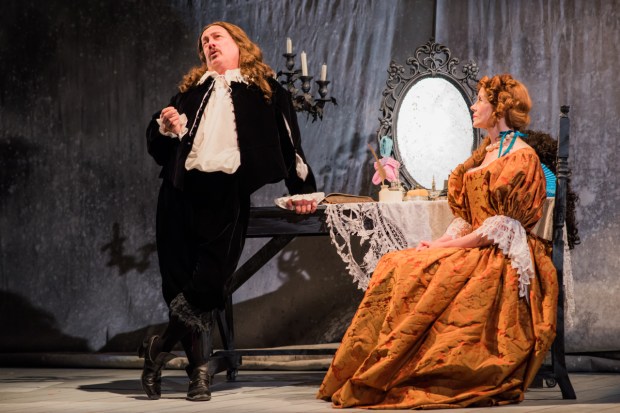
Tracks of the Winter Bear comprises two short plays, companion pieces exploring the themes of love and loss. They’re separate yet linked, both intrinsically Edinburgian, set in the Abbeyhill district of the city. The same pub is referenced in both (The Regent Bar), and the two protagonists (Shula and Jackie) are  both lonely, middle-aged women, trying  – in their very different ways – to make some sense of their lives.

Act 1, by Stephen Greenhorn, is my favourite of the two. Using reverse chronology, it charts the tragic love affair of Shula (Deborah Arnott) and Avril (Karen Bartke). It’s a bleak but ultimately beautiful piece, with thoughtful, nuanced performances; Arnott, in particular, seems to embody the brittle hurt of grief.

Act 2 is an altogether stranger beast, telling the tale of a mangy polar bear and a washed-up Mother Christmas, both escapees from a tawdry Winter Wonderland theme park. The bear, cast adrift and hunted in an unknown land, speaks in the voices of those she has killed. Mother Christmas, or Jackie – played with bar-room swagger by the delightful Kathryn Howden – befriends her with promises of shortbread and love, and the two embark on an unlikely journey ‘home.’ It’s a fascinating premise and it’s very well-played (Caroline Deyga’s Bear is physically compelling), but it seems a little uncertain of its way, forsaking the early, earthy humour for a less engaging attempt at profundity.

Both pieces use what is essentially the same set, a narrow, snow-covered traverse stage (ironically, this is the first time we have seen this configuration at the, ahem, Traverse theatre). It’s curtained with a light gauze, which serves both to hint at snow in the air, and to create a misty, fairy-tale-like quality. The mirror-audience, visible throughout, magnifies my own reactions; it’s the perfect staging choice for this production, I think.

Overall, then, this is definitely one to watch. It’s interesting and original, and a welcome respite from all the feel-good fare.

4 stars

Susan Singfield


Burger

IMG_1693

24/11/15

Fountainbridge, Edinburgh

To be honest, I’d intended to go somewhere else entirely. (Kampung Ali, a low priced Malaysian joint on the road into Fountainbridge, really worth checking out) – but as luck would have it, the night I called it was booked out for a ‘musical evening’ and no food was being served. Rats!

Then I remembered Burger, just a bit further up the same road, a place which (let’s face it) has a name that gives you a fairly good intimation of what you might expect to find on the menu. And I thought, hey,  why not give it a shot?

It’s a utilitarian kind of joint, plain furnishings, no frills, but it’s clean and bright and friendly. You order at the counter, you’re given a little gadget which flashes when your food is ready (they are very quick here) and you collect the food yourself. The meal is served on a tin tray and the restaurant prides itself on being environmentally friendly. Even the cutlery is made from biodegradable corn starch. Of course, a burger isn’t likely to be top of anybody’s gastronomic highlights, but this was nicely done, (and it’s amazing how many places can get a simple burger wrong). The beef patties were thick and juicy, served on a lightly toasted brioche bun and featured generous amounts of cheese, sliced tomatoes, onions and gherkins, together with a splash of the restaurant’s tangy homemade sauce. Ketchup and French’s mustard were available if required.

The chips, cooked with their skin on, actually tasted as though they’d been made from fresh potatoes, which might sound obvious, but sadly, isn’t always the case. I kept things straightforward, going for the classic option, but there are other burgers of ever increasing complexity and price tags (katsu chicken burger anyone?) For those who don’t really care for burgers, there’s also a selection of hot dogs. I know, live dangerously.

My meal, with a can of drink, came to a very reasonable £9.35. Sometimes you want something quick and simple and in that situation, Burger  hits the spot very nicely. Perfect for a no nonsense meal and for those who are watching the pennies. The earth won’t move but you’ll come out feeling pleasantly full and here, that seems to be the object of the exercise.

4 stars

Philip Caveney

Scotland Short Play Award 2015

Unknown-1 Unknown

Traverse Theatre, Edinburgh

28/05/15

The Traverse is a writers’ theatre, its commitment to new writing intrinsic to its existence. This makes it an exciting place to visit; one thing here is always certain: you won’t be watching a tired old revival or an over-exposed crowd-pleaser.

Last night’s showcase of the four finalists in the Scotland Short Play Award 2015 was a case in point: a genuinely compelling selection of pieces, all simply staged but powerfully performed, with all the wit, vigour and contention you could hope for from a group of emerging young playwrights.

First up was Morven by Emily Ashton. This was a disturbing howl of a play, with Nicola Roy superb as the anguished mother, who may or may not have murdered her child. Hounded by both press and social workers, at once devastated and furious, the eponymous Morven forced the audience to confront the idea that we can never really know the truth about some stories, no matter how clear cut they appear in the tabloids. The play’s structure was simple, and the director (Tony Cownie) utilised this to advantage, employing some nice techniques, e.g. the disembodied voice of the invisible questioner filling the theatre; the headline-like questions projected onto the wall; the Katie Mitchell-esque ‘live’ projections emphasising the minutiae of Morven’s movements and expression (not least, in fact, at the end, when the projection ceased to mirror Morven, showing how dissociated even she had become). A cracking start.

The second play was Romance by Ross Dunsmore, and this was our favourite of the night. A two-hander, performed with charm and gusto by Joanne Thompson and Cristian Ortega, it explored the complexities of a teenage relationship in the social media age, laying bare the insecurity and vulnerability that leads young girls to share explicit images of themselves. If that sounds bleak, it does the play a disservice, as this was laugh-out-loud funny, depicting the sweetest of boys remaining doggedly  loyal to the girl he likes. It even had a hopeful, warm-hearted ending. In some ways, it made a mockery of the media hysteria around sexting. ‘Yeah ok,’ it seemed to say, ‘people do stupid stuff, and there can be ugly consequences, but – you know – this too will pass. It doesn’t have to be the end of the world.’ A poignant, endearing and humorous play. Lovely stuff.

Next was Cameron Forbes’ It Never Ends, another two-hander about a modern relationship, this time focused on the slightly older demographic of the undergraduate. This was perhaps the most controversial piece of the night, dealing as it did with two young people heading out to a club, both keen to let loose: get drunk, get high and get laid. Their intentions were clear and stated, and the first half of the play was full of hope and hedonism, dancing and fun. The following morning, however, waking up in a stranger’s bed, the young woman had no recollection of their sexual encounter, and crept away, bereft and violated. There was no redemption here, and no easy ‘answer’ for the audience. The young man was not a rapist (he was as inchoate as she) but she certainly felt raped. Neither of them found the joy they were seeking. It’s a sad and complex issue, and the tragedy was made clear here.

The final play of the night was Potterrow by Martin McCormick. This was the most ambitious piece by far, and perhaps the least suited to the fifteen-minute time-frame. Nevertheless, it was a fascinating monologue, charting a man’s breakdown: a new parent’s sleep deprivation leading to paranoia and obsession, and – eventually – to the murder of an old woman whose dog fouls The Meadows. We were never quite sure if he was a policeman or not, or if the uniform he wore was just another symptom of his ailing mind. The footprints laid out on sheets across the stage mapped out the man’s demise, and also emphasised how often he became derailed, his intentions thwarted along the way. The performance, by Gavin Jon Wright, was both nuanced and convincing. This playwright is certainly one to watch.

All in all, then, this was a fascinating night, and bodes well for the future of theatre. With these young playwrights at the helm, things look very promising indeed.

4 stars

Susan Singfield

Pomegranate, Edinburgh

UnknownUnknown-1

28/05/15

Situated just off Leith Walk, Pomegranate is an unpretentious bistro-style cafe serving Middle Eastern cuisine. The bright vibrant decor gives the place a cheery atmosphere, but be warned, the only wines and beers on offer are of the non-alcoholic variety, so if you want to drink something more punchy with your meal, bring your own. (No corkage is charged, which makes eating here even better value for money.)

There were three of us to dine and we were all very hungry. For starters we chose Soujek (Spicy Lebanese sausages sautéed in tomato, green pepper, garlic and chilli), Baly Merishke (barbecued lemon-scented chicken wings) and Kubba Halub (Seasoned minced lamb, mixed with sultanas, encased in crushed rice.) All three starters were lovely – the sausages were enveloped in a rich spicy sauce, the chicken wings crisp yet succulent and the Kubba Halub had a crunchy exterior and a melt-in-the-mouth centre.

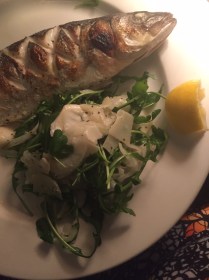
On to the mains – I sampled the Joujeh (half a chargrilled chicken marinated in lemon, tomato and garlic), Susan went for the Chargrilled Whole Sea Bass (marinated with lemon and Persian sumac and served with a side of bamya – a beef and okra stew, or tapsi – an eggplant sauce). Our companion, who’d eaten here before, went for his favourite,  Qozy Lamb (braised lamb on the bone, served with tapsi or bamya.) Once again all dishes were note perfect and came accompanied with generously-sized mounds of clean-tasting basmati rice and the restaurant’s own naan breads, thinner and somewhat crispier than their Indian brethren, but absolutely delicious.

Did we eat everything that was put before us? Yes, we did and licked our platters clean. Did we have any room to sample the selection of great-sounding desserts on offer? No we did not. But one thing’s for sure. If you’re looking for great tasting middle Eastern cuisine in the heart of Edinburgh, this is where you should come. Outstanding! Oh yes, and I promised to mention our waitress for the evening, the charming and friendly Alicja, who looked after us in friendly but unobtrusive style!

4.5 stars

Philip Caveney

The King’s Speech

Unknown001562_regular

King’s Theatre, Edinburgh

23/05/15

The King’s Theatre, Edinburgh, has a reputation for being beautiful. “If you like the Lyceum,” several friends have told us, “just wait until you see the King’s.” And, to be fair, the building is gorgeous: all perfectly preserved Art Deco woodwork, and a frankly overgenerous serving of boxes, with a staggering eighteen ornate (and empty) loges dominating the auditorium. So, yes, the theatre is lovely to look at.

Unfortunately, I didn’t love the play. The story was too familiar from the over-praised film (I enjoyed the film, I really did, but it felt more like a decent TV drama than the Oscar-winning heavyweight it was lauded as), and the subject too unsympathetic. It’s hard to empathise too much with such a vastly over-privileged man.

The performances were good: Jason Donovan made an appealingly irreverent Lionel; Claire Lams a wonderfully acerbic Queen. But the dialogue was plodding, and the direction lacked the lightness of touch that elevated the film. Set changes, for example, were more complex than necessary, interrupting the flow and slowing the pace. The simplicity of the wooden wall panels was negated by the constant shifting of superfluous props: the location was clear as soon as a door slid open; I didn’t need three desks, a bookshelf and a couple of armchairs to tell me where we were.

I liked the way the political machinations were writ large in this play, and how Lionel Logue’s refreshing lack of agenda was shown to contrast so heavily with the naked, ugly self-interest of the clergy, the government and the royal family itself. But, overall, this was not for me.

2.3 stars

Susan Singfield

Whose Lunch is it Anyway? Stu and Garry’s Free Improv Show

UntitledUntitled1

The Stand, Edinburgh

03/05/15

Stu Murphy and Garry Dobson’s residency at The Stand is an inspired way for the comedy club to draw in the punters during that entertainment dearth otherwise known as ‘Sunday lunchtime.’ We’ve seen the pair before (a twenty-minute slot during a night of stand-up), but this is the first time we’ve managed to catch their full-length act, and it really didn’t disappoint.

For starters, it’s free. I suppose it would need to be; this improbable time slot depends on people taking a punt, and thinking, ‘Well, why not?’ The place was bursting (although, as the eponymous duo pointed out, it was raining, and it was a bank holiday weekend). Perhaps the numbers aren’t always so good. We didn’t eat, but plenty around us did. This seems to be a popular gig for the hungry and hungover.

As for the act, it’s just a series of well-trodden improvisation games, but they’re played so well and with such joy and mischief, that it’s a real delight to be there. The comedians are inventive, clever, witty and warm. I can’t think of a better way to round off a weekend.

Oh – and Philip even got to go onstage, after volunteering to be the ‘puppeteer,’ controlling Stu’s every move during one (hilarious) scene. Now there’s funny for you.

4 stars

Susan Singfield

The Apartment, Edinburgh

Unknown

17/04/15

Edinburgh has a whole host of excellent restaurants but The Apartment, in Barclay Place, is undoubtedly one of its best, not only in its eclectic choice of ingredients, but also in terms of value for money. The set menu offers two superb courses for £15 and three for £17 (£19 after 7 pm). There’s also a selection of Chef’s specials, a choice of three kinds of healthy skewers, steaks and (a nice touch here)  three dishes that can be ordered as small or large portions, the former clearly aimed at customers with a lot more control than I have! On the night we visited, we were greeted by the maitre d, an affable and chatty Irishman, who certainly knew how to make us feel relaxed and happy. The staff are attentive, without being pushy and the surroundings, though smart and modern, are nonetheless atmospheric and entirely convivial.

For starters we had Pan Fried Squid with Chervil and Butter Sauce and Chicken and Black Pudding Terrine with Star Anise Apricots. If the descriptions sound enticing, let me assure you that the food absolutely lived up to them! The squid was deliciously light and suffused with a subtle lemon tang, while the black pudding had a spicy ‘melt-in-the-mouth’ quality, that ensured the platter was virtually licked clean.

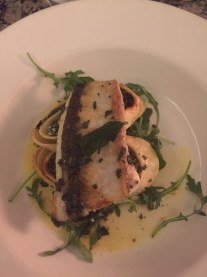
On to the main courses: I went for the Roasted Pork Loin with Merguez, Soupy Puy Lentils and Crispy Pancetta while Susan ordered the Grilled Plaice Fillets with Wild Garlic Mash, Brown Shrimp and Mussel Vinaigrette. Once again, both courses were note perfect – the pork was succulent and perfectly offset by the dark, earthy lentils and the spicy Spanish sausage, while the fish was light and flaky, swimming in that citrusy mussel vinaigrette. Yum!

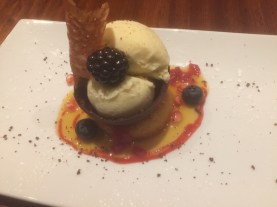
Was there room for pudding? You bet! And frankly, who could resist the Mille Feuille with Lemon & Lime Curd or the Dark Chocolate Pot with Dulche De Leche and Blueberry Jelly? Not us, that’s for sure. The former was light and buttery, the latter… well, if chocolate’s your thing, then you’re going to be very happy with this.

The meal was accompanied by a very decent Sauvignon Blanc which at £17 for a bottle, was once again, excellent value.

So, should you find yourself in Edinburgh, hungry and  in need of something a little bit special, take my advice and steer yourself up towards Bruntsfield and The Apartment. You won’t be disappointed.

5 stars

Philip Caveney

Hedda Gabler

images images-1

10/04/15

Lyceum, Edinburgh

Edinburgh’s Lyceum is a beautiful Victorian theatre, and a delightful place to visit in its own right; it’s hard to imagine anyone could be unimpressed by the perfectly preserved intricacies of its decor; the sumptuous blues, golds and reds, redolent of old-fashioned luxury. It’s lovely.

If this, along with the choice of an Ibsen piece, suggests a staid, old-fashioned production, then nothing could be further from the truth. This version of Hedda Gabler (adapted by Richard Eyre and directed by Amanda Gaughan) is vivacious and sprightly; as fast and funny as it is heartbreaking and tragic. Nicola Daley, as Hedda, is never less than utterly engaging; she clearly revels in the role, and captures perfectly the awful attractiveness of Hedda’s reckless malevolence. By the end, we feel sorry for Hedda, but we never lose sight of how dangerous she is.

The supporting cast is strong too: I love Sally Edwards’ Aunt Juju – a real Miss Bates of a character – as irritating and vapid as she is charming and kind; Benny Young, as Judge Brack, oozes sly debauchery concealed beneath a layer of respectability so thin that only Juju is taken in. Jade Williams convinces as the outwardly naive – but ultimately hard-headed – Thea, and Jack Tarlton’s swaggering energy makes Loevborg’s wild dissolution a physical, menacing thing.

The set is marvellous too: the light, fresh, open design makes for a queasy juxtaposition with the suffocation Hedda feels in her home, her marriage, her social class. It underscores the point for us that poor George will never be able to give her what she needs; no open window will ever offer enough air.

I loved this play. I can’t fault it. I’m still thinking about the characters twenty-four hours later, contemplating their behaviours and their fates. A fabulous piece of theatre.

5 stars

Susan Singfield