

18/04/24
Cineworld, Edinburgh
Advance reviews for Back to Black have been mostly underwhelming, writers mostly castigating the film for not finding anything that hasn’t already been covered in Asif Kapadia’s (admittedly brilliant) 2015 documentary, Amy. (https://bouquetsbrickbatsreviews.com/2015/07/04/amy/)
Those in the know have also muttered darkly that certain players in the story have been let off a little too lightly for comfort. While it’s certainly true that Sam Taylor-Johnson’s biopic resolutely refuses to apportion any blame for what happened to Amy Winehouse, it doesn’t detract from the fact that this film is both eminently watchable and genuinely, heart-breakingly tragic.
We first encounter Amy (Marisa Abela) as a teenager in Camden, already a talented performer, inspired by her beloved Nan, Cynthia (Lesley Manville), a jazz singer back in the day. She’s also encouraged by her taxi-driver dad, Mitch (Eddie Marsan), who isn’t shy of indulging in a bit of crooning himself. If Matt Greenhalgh’s screenplay features an overload of exposition in the opening scenes, it soon settles down enough to allow viewers to enjoy the ride.
A&R man Nick (Sam Buchanan) hears Amy’s demo tape and is keen to sign her up to the Simon Fuller agency, but she’s quick to point out to him that her idea of ‘girl power’ is Sarah Vaughan and that she ‘ain’t no fuckin’ Spice Girl.’ Success, it seems, must come on her terms or not at all. But of course, she rises like a meteor and, almost before you can say ‘Go Amy!,’ she has an album out, a residency at a local pub and a rapidly-growing legion of fans.
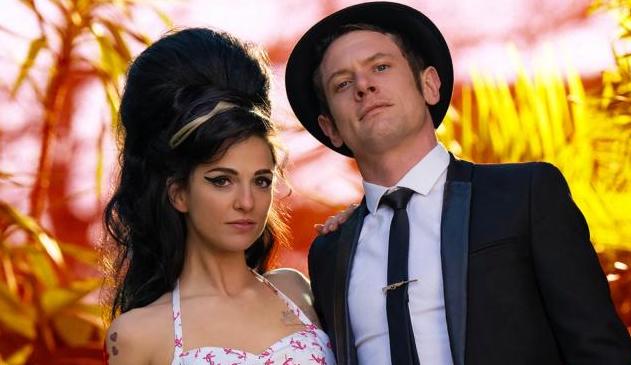
But Amy’s world is turned upside down when she encounters Blake (Jack O’ Connell), a Camden Jack-the-Lad with a nice line in deadpan patter and a coke habit that’s already getting him into trouble. Despite the fact that Amy hates drugs and Blake doesn’t care for booze, the two of them become lovers. What can possibly go wrong?
Of course, what happens after that is a steadily mounting disaster played out under the baleful glare of the paparazzi (who, I suspect, are the ones who should really shoulder some of the blame for what happened) and the result is much like watching a slow-motion car crash. I cannot look away. Abela is astonishing in the lead role, playing Amy with absolute conviction, alternately hard as nails and fragile as cut glass. She also supplies her own vocals. I’m no Winehouse aficionado, but to me it sounds spot on. O’Connell, an undervalued performer, is also terrific, encompassing Blake’s strengths and failings perfectly. The scene where Amy and Blake first meet is beautifully handled and it’s clear from the outset why they become so besotted with each other, so utterly incapable of extricating themselves from the ensuing carnage.
In the finest biopic tradition, there are recreations of famous performances, which once again capture the look and feel of the period, and it would be a hard-hearted soul indeed who doesn’t shed a tear in the scene where Amy performs a heartfelt rendition of Love is a Losing Game, after hearing that Blake has, once again, turned his back on her.
Of course, it’s always difficult to depict something so familiar and find new horizons within it, but I can’t help feeling that Taylor-Johnson has been unfairly maligned on this one. Back to Black offers us a compelling insight into Amy’s character, and it never flags. Abela is a revelation and, provided she can successfully avoid the spectre of typecasting, she really should have a bright future ahead of her.
4 stars
Philip Caveney


 Bouquets & Brickbats