Dev Patel

Monkey Man

07/04/24

Cineworld, Edinburgh

Dev Patel’s debut film as a director is an ultra-violent revenge thriller set in an Indian city called Yatana that looks very much like Mumbai. Patel plays Kid, a man entirely motivated by the need to find the corrupt Police Chief, Rana (Sikandar Kher), who is responsible for the brutal murder of Kid’s mother back when he actually was a, well, kid. Why it’s taken him so long to get around to this is never explained.

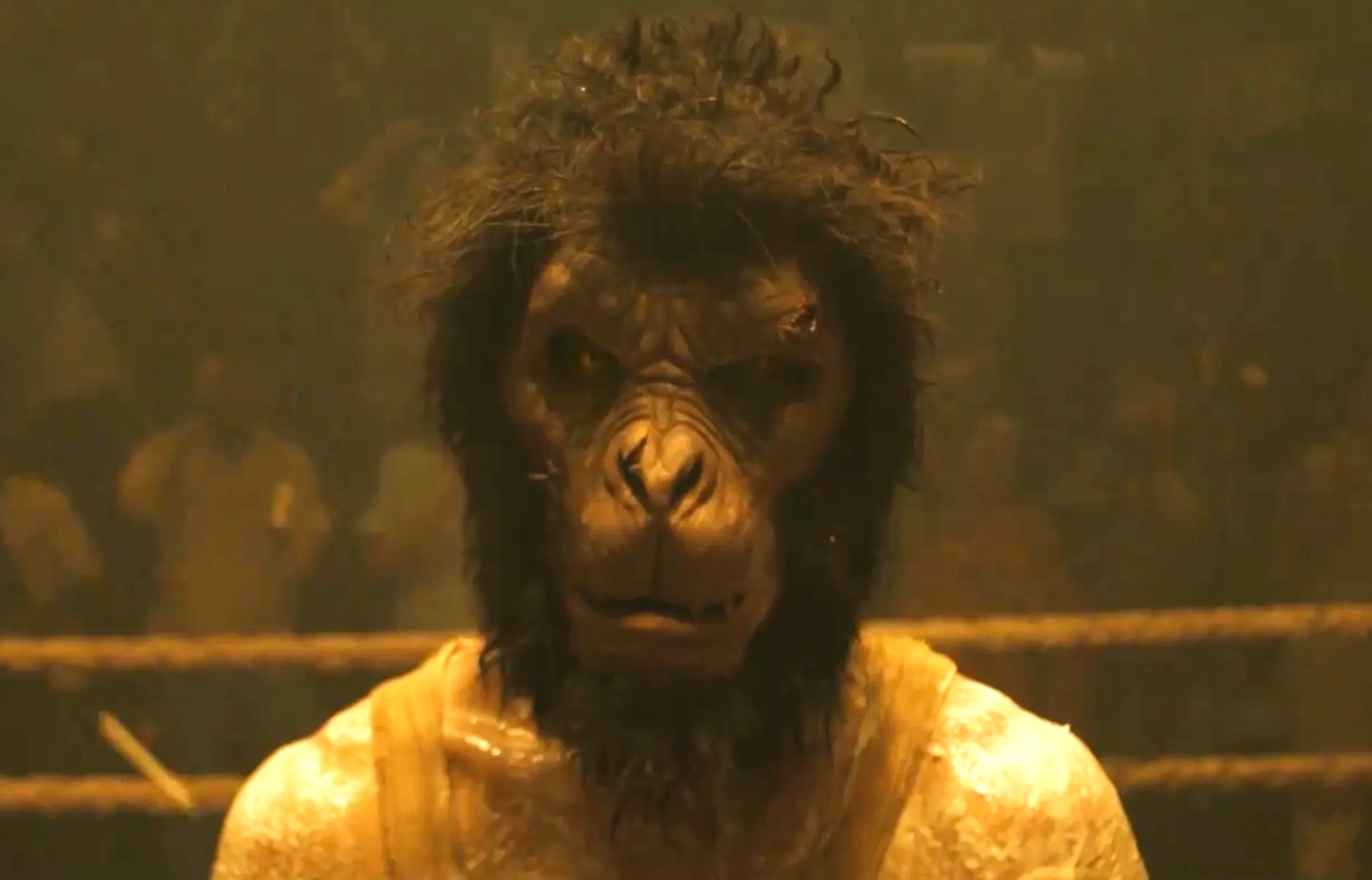
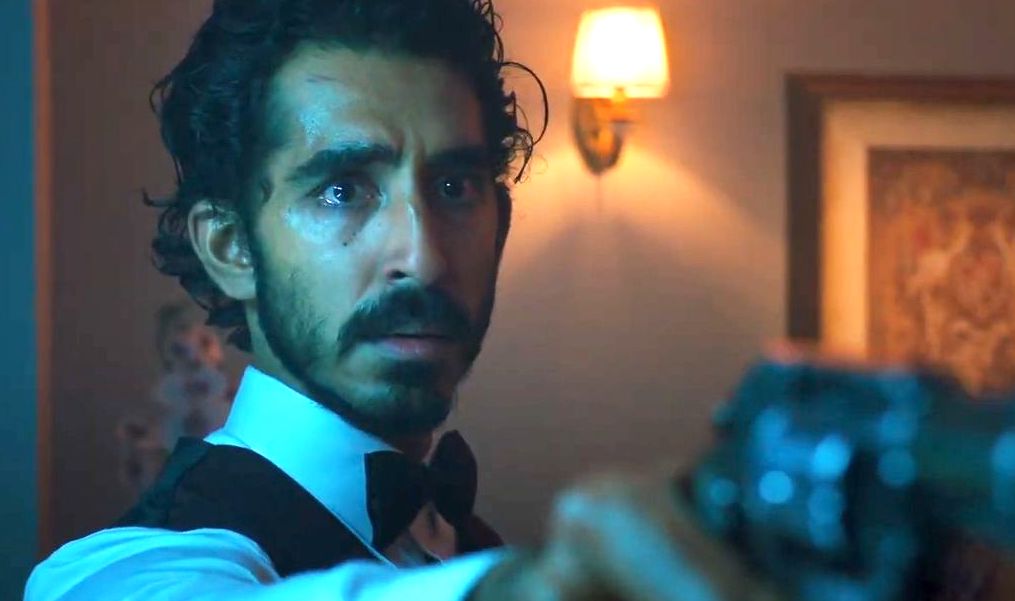
Kid currently earns a buck by taking part in a series of no-holds-barred fights, hosted by sleazy MC, Tiger (Sharlto Copley), and attended by baying crowds. He hides his identity behind a realistic monkey mask – inspired by the Indian god, Hanuman – but he doesn’t win his bouts, preferring instead to make easy money by taking dives. Meanwhile, he finds a way of procuring work as a barman at the swish city nightclub where he knows Rana likes to spend his spare time. His sole ambition is to get to Rana and kill him.

While Monkey Man has a distinctive look (largely thanks to cinematographer Sharon Weir) and occasionally hints at the more interesting film it could have been, it feels hampered by its reductive plot and an evident desire to be a kind of Asian John Wick. Those films are actually mentioned by one character early on and, in the final extended punch-up, where Kid fights his way from the basement of the hotel to the VIP room at the top, it’s hard not to think of Gareth Evans’ The Raid – though these films feel almost restrained compared to the levels of bone-snapping, blood-drenched violence on offer here. That 18 certificate is there for a reason.

Patel’s character dominates the film to the extent that none of the other actors gets much of a look in. An early attempt to introduce perky sidekick, Alphonso (Pitobash), is disappointingly abandoned, and Kid’s brief interplay with a sympathetic sex worker, Sita (Sobita Dhulipala), is never allowed to develop into anything more substantial.

Occasionally Patel – who co-wrote the screenplay with Paul Angunawela and John Collee – tries to usher in more original elements. There are references to Indian folklore, pastoral flashbacks to Kid’s rural childhood and there are some astute observations about bogus spiritual leaders, who exploit the poverty of their followers, but these themes are repeatedly punched and kicked into submission by a seemingly endless succession of extended fight scenes. The first one, set largely in a kitchen (with a varied supply of potential weapons), is brilliantly choreographed and has me flinching and gasping in all the right places. But it’s followed by another fight and then another one and the repetitiveness of them begins to work against the material.

Eventually, I start to feel bludgeoned and bored, which I’m pretty sure is not the effect Patel was looking for.

In the chaos of flying fists and breaking bones, I also find myself asking questions. If Kid simply wants revenge on a single man, why not wait until he’s alone, rather than surrounded by hundreds of bodyguards? What’s the point is maiming all those people who are simply carrying out their duties? (Mind you, I’d be the first to admit that wouldn’t make for a particularly memorable film, either.)

Action junkies will doubtless tell me that I’m wrong about Monkey Man, that it’s a kick-ass, adrenalin-fuelled marvel, but the occasional flashes of brilliance it does contain merely enforce my view that this film could so easily have been an absolute knockout, instead of the long and messy brawl that it is.

3 stars

Philip Caveney

Roald Dahl/Wes Anderson

29/10/23

Netflix

A new film by Wes Anderson is always an interesting proposition. Four new films – the longest of which has a running time of just thirty-seven minutes – is a downright intriguing one.

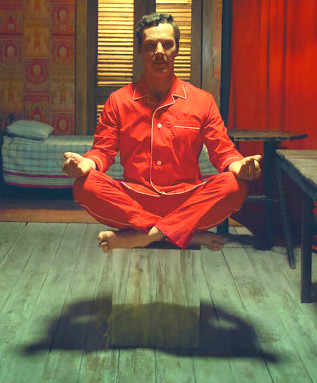
It must be said from the start that these are less motion pictures than illustrated stories (imagine, if you will, a kind of turbo-charged Jackanory and you’ll get the general idea). First up, there’s the aforementioned longest entry in the quartet, The Wonderful Story of Henry Sugar, which – to begin with – is told by Dahl himself (uncannily impersonated by Ralph Fiennes). The author begins to relate the story of the mysterious Imdad Khan (Ben Kingsley), a man who can see without using his eyes. Khan’s story is then picked up by two doctors (Dev Patel and Richard Ayoade) and they, in turn, transfer their attention to the titular character (played by Benedict Cumberbatch), a man who becomes obsessed with the notion of becoming an expert card cheat. (As you do.)

It’s all delivered as narration (at a breakneck pace) and, of course, the set dressing has the usual Anderson style: a series of exquisite puzzle-boxes, expertly linked together, opening and closing as the tale unravels. It’s beautiful to watch, but ultimately the story leaves me with a powerful sensation of so what?

The Swan (narrated by Rupert Friend) is, for me, the strongest narrative here, the distressing tale of a young boy called Peter (Asa Jennings), who is horribly bullied by a couple of local lads with access to a rifle (always a recipe for trouble) and which culminates in a poignant and rather distressing conclusion. The story is delivered by Friend as he wanders along a series of labyrinthine passageways and this is perhaps the most kinetic of the films.

The Rat Catcher features Fiennes as the central character, a rather creepy individual who visits a garage and offers his services to the proprietor (Friend again), while the tale is told by a narrator (Ayoade). The subtext of this one is rather less straightforward, as is the style. I can’t remember ever seeing an actor miming invisible objects in a film before! The rat catcher has assimilated all the qualities of the creatures he’s supposed to be eradicating and, when he fails in his attempts to locate them (in a haystack), he tries to make up for his failure in a demonstration of unpleasantness. Again, I feel that the story’s conclusion is rather underwhelming.

Finally there’s Poison, an account set in post-colonial India, in which Harry (Cumberbatch) lies in bed convinced that a krait (a venomous snake) is lying asleep on his chest and that the slightest move will cause it to bite him. A local police officer (Patel) and a doctor (Kingsley) are enlisted to resolve the situation and, to give them their fair due, they do their level best. The story culminates in a short and rather shocking demonstration of racism, which some viewers will find unsettling, but is surely the whole point of Dahl’s story – that former white rulers will always refuse to acknowledge their own failings. Strangely, Poison seems to have a similar theme to its predecessor.

With such brevity, it seems fairest to judge the four films as a whole – and indeed, Anderson has said that what attracted him to the idea is the notion that they comprise a kind of interlocking narrative. While this quartet is always visually compelling, I can’t help wishing that this inimitable director had settled on some better examples from Dahl’s extensive back catalogue. There are plenty to choose from.

If you have Netflix, they’re certainly worth clicking through. If nothing else, you’ll be charmed by their quirkiness and the uncompromising style that exemplifies Anderson’s approach to cinema.

3.4 stars

Philip Caveney

The Green Knight

02/10/21

Amazon Prime

Has there ever been a more divisive movie than The Green Knight?

Unceremoniously pulled from its intended theatrical release and plonked onto Amazon Prime, it’s interesting to look at the audience reviews, which feature a plethora of five star ratings and an equal number of one stars. The latter break down into three distinct groups. Many people decry that the film is simply ‘too dark’ for their modest screens – and I have to agree that, if ever a film demanded to be seen at the cinema, this is the one.

More worrying are the blatantly racist comments about the casting of Asian actor, Dev Patel, as the ‘quintessential British hero’ Sir Gawain. But this is a work of chivalric fiction, written anonymously in the fourteenth century. It’s not as if director, David Lowery set out to do a biopic about Winston Churchill. Gawain could be played by any actor and Patel is terrific in the role.

The third strand is the most baffling: people complaining that, over the film’s two hour duration, ‘absolutely nothing happens’ – even though most of them casually add that they stopped watching after twenty minutes or so! The truth is that a lot happens in this film, even if the story unfolds at a leisurely pace, and what happens is fascinating stuff, open to a viewer’s own interpretation.

Our hero is the nephew of The King (Sean Harris), and we’re first introduced to Gawain as a slovenly layabout, happily carrying on with commoner Essel (Alicia Vikander), but, despite her entreaties, showing no inclination to marry her. One Christmas Eve, Gawain is summoned to a feast at the castle where he is invited to sit at his Uncle’s side. At this point, there’s an unexpected visitor, the titular Green Knight (Ralph Ineson). He rides in and issues a playful challenge. If any man will face him in combat, he will offer them the chance to strike him with a sword. But in one year’s time, that man must present himself to the Green Knight and receive the same treatment in return. Gawain recklessly steps up to the plate and, no doubt fuelled by a little too much alcohol, lops off the knight’s head, thinking perhaps that it will end there – whereupon the ancient warrior picks up his severed bonce and gleefully rides away.

One year later, as Christmas looms, Gawain is understandably nervous. After some procrastination, and girdled by a protective belt fashioned by his witchlike mother (Sarita Chowdhury), he sets off for the Green Chapel to meet with his adversary.

A classic quest dutifully unfolds. On his travels, Gawain meets with a duplicitous young thief (Barry Keoghan), a talking fox, and a mysterious lord (Joel Edgerton). He also has a close encounter with the lord’s wife – also played by Vikander – who tests Gawain’s mettle as a ‘gallant knight’…

The Green Knight is a splendid film. I love the gorgeous cinematography, its grubby depiction of a medieval world. I enjoy the various themes that criss-cross throughout the story. Here is a profound meditation on death, on coming of age, on the need for a brash young man to find his maturity. It explores the constant struggle between pagan beliefs and the rising power of Christianity (note how the Green Knight is depicted as the Green Man of mythology). I love the strange hallucinogenic interlude where Gawain encounters a race of giants and I marvel at the fact that, hours after the credits have rolled, we’re still discussing the meaning of some of the film’s weirder moments.

Of course this won’t be for everyone. And of course, some will see it as pretentious. But in many ways, The Green Knight is one of the most original films I’ve ever seen. It should have had its proper chance to dazzle us on the big screen.

4.6 stars

Philip Caveney

The Personal History of David Copperfield

21/01/20

I arrive at the cinema expecting great things. The trailer for Armando Iannucci’s The Personal History of David Copperfield promises a rollicking ride through one of Dickens’ best loved tales, and I’m excited to see how it unfolds.

The promise is kept: it is a rollicking ride. A bit too rollicking, if I’m honest, careening  through the 350,000 word novel at breakneck speed. Well, it’s a lot to fit into two hours. There’s nothing here I’d lose – no padding or filler required – but I’d be tempted to add an extra thirty minutes to the running time, just to give the story space to breathe.

Dev Patel is the eponymous hero of his own life, and very good he is too, all genial affability despite his social-climbing and urgent need to impress. Born a gentleman, he’s forced into poverty when his widowed mother remarries, and his stepfather (Darren Boyd) takes against the boy. Young David is not too worried at first: the poverty he’s witnessed so far – visiting Peggotty’s quirky, loving family in their upturned boat/house – has given him a romanticised impression of the working person’s lot. A back-breaking job in a bottle factory soon disabuses him of this worldview, and he determines to find a way to live a better life.

Tilda Swinton and Hugh Laurie form a show-stealing double-act as David’s aunt Betsey Trotwood and her cousin Mr Dick respectively; in fact, there are almost too many perfectly-captured vignettes featuring too many wonderful actors. There’s Anna Maxwell Martin playing school mistress Mrs Strong – whoosh! There’s Benedict Wong as the ever-thirsty Mr Wickfield, and Rosalind Eleazar as his daughter, Agnes – whoosh! Daisy May Cooper’s Peggotty is warmly, wittily portrayed; Morfydd Clark’s Dora Spenlow a frothy, silly delight. I do like the sense of breathless chaos: the lack of deference to period drama genre-norms; the diverse casting that proves it can (and should) be done. There’s just no time to focus in on anything before it’s gone.

In short, each scene is beautifully rendered; each character cleverly drawn. But the story feels a little superficial, with none of the darkness or political poignancy of Dickens’ semi-autobiographical novel.

3.8 stars

Susan Singfield


Lion

20/01/17

Lion is the true-life story of Saroo Brierley, a young man on a quest to find his family. The opening sequences depict a home life that, while far from idyllic – they are desperately poor: Saroo’s mother is a manual labourer, collecting rocks from dawn till dusk; Saroo and his brother steal coal to sell for milk; none of them can read or write – is nevertheless loving and nurturing.

What follows is startling and devastating: at the train station, five-year-old Saroo, told to wait for his brother, seeks a place to sleep on a decommissioned train. When he awakes, the train is on the move, and it doesn’t stop until it reaches Kolkata – 1000 miles away from Saroo’s home town. Saroo doesn’t speak Bengali, and he doesn’t know the proper name of his village, so he can’t tell anyone who he really is. It’s utterly heartbreaking to see the plight of the street kids he joins: the dangers they face, and the sheer numbers of them. (And Sunny Pawar, who plays young Saroo, is just delightful, all big eyes and vulnerability. He’s definitely one to watch.) Eventually, Saroo is placed in an orphanage and, from there, adopted by a kindly couple from Tasmania.

The second half of the film has a more sombre feel; it’s less immediately engaging, but compelling nonetheless. Adult Saroo, played by Dev Patel with customary aplomb, is an all-Aussie guy, a surfer with long hair and a promising career ahead. He has a girlfriend, a good relationship with his adoptive parents; things have worked out well for him. (Sadly, life has not been so kind to Mantosh (Divian Ladwa), the second boy adopted by the Brierleys, whose past demons won’t let him rest, and see him seeking solace in heroin.) But when Saroo spends an evening with Indian friends, buried memories are evoked, and he embarks on a lonely mission to find his long-lost family – using Google Earth to assist his search.

It’s a deceptively gentle tale of love and loss, offering insight into the moral and social complexities of adopting children from poorer lands. The film is not overtly political, and it doesn’t dwell on the causes of the poverty that lead to Saroo’s suffering. But neither does it shy away from showing us grim realities: this is one man’s story, a microcosm of a larger problem. It’s impossible not to feel moved and humbled. And very thankful that, for Saroo at least, it has a happy ending.

4.2 stars

Susan Singfield

The Second Best Exotic Marigold Hotel

MV5BMTU3MjkxNjc0OV5BMl5BanBnXkFtZTgwMjc0NDg0NDE@._V1_SX214_AL_

05/03/15

In 2011, The Best Exotic Marigold Hotel made the cinema industry sit up and take notice. Here was a modestly budgeted film that raked in a hefty profit, but more significantly, it took it from the kind of mature audience that cinema usually fails to attract (i.e. not just 12 year old boys). So it was inevitable that sooner, rather than later, there’d be a sequel. And here it is, complete with a title that sounds worryingly like a self-fulfilling prophecy. It should be remembered that the original film was based on a rather good source novel by Deborah Moggach. This one appears to be an original screenplay, if by original, you mean borrowing an idea that famously appeared in an episode of Fawlty Towers. The kindest thing you can say about it, is that it’s a curate’s egg of a film, good in parts but those parts are few and far between.

Sonny (Dev Patel) is soon to marry his fiancé, Sunaina (Tina Desai), but first he plans to expand his operation by opening a second hotel and at the film’s inception, has gone to America to seek finance. In this enterprise he’s aided by the caustic Mrs Donnelly (Maggie Smith) her character slightly diluted from her original bitchy incarnation, but nonetheless still awarded most of the funniest lines. Meanwhile the usual suspects from Marigold 1 parade around having affairs with each other (Celia Imrie’s character, Madge, appears to have turned into a borderline good time girl,) while Evelyn (Judy Dench) and Douglas (Bill Nighi) are still failing to connect, even when it’s perfectly clear that the two of them are simply made for each other. Into this hotbed of geriatric passion wanders Guy Chambers (Richard Gere) who might or might not, be the hotel inspector who can grant Sonny’s expansion plan. Before you can say, ‘Basil Fawlty,’ Guy has the hots for Sonny’s widowed mother and much (alleged) hilarity ensues. The problem is, that this is all so obvious, it might as well have been performed as a series of semaphore manoeuvres. A last minute ‘twist’ fails to offer any surprises whatsoever. And what’s happened to Sonny’s character? In Marigold 1, he was charming in a bumbling, hapless sort of way, but here he’s a car crash of a person who can’t open his mouth without offending everybody in the vicinity.

On one hand, TSBEMH deserves respect for daring to portray senior citizens as genuine characters with real lives and real concerns; on the other hand, points must be deducted for its outdated portrayal of India as a country that has somehow never escaped the bonds of colonialism. The first film managed to skirt skilfully around these issues, but this time it just wades on in, seemingly without thinking. The climactic wedding features lots of dancing and larking about, but also comes with a large dollop of sentimentality, which once again, the first film was careful to avoid.

So, second best by name and certainly second best by nature. Ideally, the film makers should have gratefully accepted their groundbreaking hit and moved on to another idea, but of course, the movie business will always respond to a hit by throwing more money in it’s general direction. Can we ‘look forward’ to The Third and Final Exotic Marigold Hotel? God, I hope not.

3 stars

Philip Caveney

Chappie

MV5BMTUyNTI4NTIwNl5BMl5BanBnXkFtZTgwMjQ4MTI0NDE@._V1_SX214_AL_

18/03/15

Few directors have made such a triumphant cinematic debut as South African,Neill Blomkamp. His first feature District 9 was an assured production, a canny blend of science fiction and social commentary, that blasted his career into the stratosphere. His next offering, Elysium was rather less successful but nonetheless, very watchable, even when it suggested that a human being could undergo drastic bodily surgery without bothering to remove his T-shirt. Chappie, however, is a real dog’s dinner of a film. Not only is it incredibly derivative (it comes across as an unwieldy amalgam of Robocop and Short Circuit) it features clumsy scripting and some pretty terrible performances in key roles.

In a futuristic Johannesburg, everyday policing is carried out by ‘Scouts,’ humanoid robots, capable of making their own decisions. They are the brainchild of Deon (Dev Patel) a nerdy worker in a giant corporation who dreams of one day creating a true AI – a robot capable of independent thought and the appreciation of art and music. This idea is pooh poohed by Deon’s workmanlike boss, Michelle (Sigourney Weaver, with very little to do but sit behind a desk and look stern.) Deon’s success is also envied  by his macho associate, Vincent (Hugh Jackman), who has his own law enforcement project waiting in the wings and doesn’t mind taking a few shortcuts. When Deon runs some unauthorised experiments on a damaged Scout, the result is Chappie, (voiced by Blomkamp regular, Sharlto Copley) but things become complicated when Deon and his creation are kidnapped by a couple of local hoodlums, Ninja and Yolandi, who want to use the robot for their own nefarious purposes. They set about teaching Chappie how to be bad…

As in his previous films, Blomkamp is great at achieving a credible look in his futuristic world and the motion capture work employed here is of the very highest quality, so it’s a shame that the same care and attention hasn’t been lavished upon a credible script. Events pile haphazardly one on top of the other, but seem to follow no discernible logic, while the aforementioned Ninja and Yolandi are portrayed by a couple of South African rappers (they haven’t even bothered to change their names) who between them display the acting skills of… well, a couple of South African rappers. Frankly, they stink up the screen, which drives a fatal nail through the heart of the film.

The word is out that Blomkamp’s next project will be part of the Alien franchise, but he’ll have to work very hard indeed to rise above the scrappy disappointment that is Chappie. What a shame.

2.8 stars

Philip Caveney