Danielle Jam

Sunset Song

30/05/24

Lyceum Theatre, Edinburgh

Lewis Grassic Gibbon’s Sunset Song is widely regarded as one of the most important Scottish novels of the 20th century. There are many who first encountered it as a set text in school and have carried it in their hearts ever since. Playwright Morna Young was evidently one such teenager and this is her adaptation of the tale in collaboration with Dundee Rep. I’ll confess that I’ve never got around to reading the book myself. Set in the 1900s, it’s a dour and sometimes bleak story based around the misadventures of the Guthrie family, farmers who live and work in (the fictional) Kinraddie in the wilds of Aberdeenshire.

When we first meet Chris Guthrie (Danielle Jam), she’s young and ambitious, a keen reader and already planning to seek a career as a teacher. In this, she has the grudging support of her father, John (Ali Craig), though he’s a hard taskmaster, never slow to hand out physical punishment to Chris and her siblings whenever they step over what he perceives as ‘the line.’ 

Chris’s much-loved mother, Jean (Rori Hawthorn), mentally broken by the recent birth of twins, takes matters into her own hands, killing herself and her new babies. Two younger children decide to flee  the family home to start a new life in Aberdeen and it isn’t long before Chris’s older brother, Will (Naomi Stirrat) follows their example and heads off to seek his own fortune in Argentina. This leaves Chris to run the farm with her father and, after he suffers a debilitating stroke, to fend off his sexual advances. When tragedy strikes yet again, Chris finally has an opportunity to start over but (maddeningly) she decides to stay where she is and marry local boy Ewan (Murray Fraser). But by now, the world is heading into a massive global conflict and it’s hardly a spoiler to say that more heartbreak is looming on the horizon…

While it does of course feature more than its fair share of harrowing occurrences, it’s to this production’s credit that it manages to convey difficult themes without ever feeling too prurient. Young’s adaptation remains true to the novel’s Doric dialogue, though occasionally I feel I’m told things that I would rather see – and the decision to have no costume changes when actors embody several different characters does mean that I’m occasionally confused as to who is who.

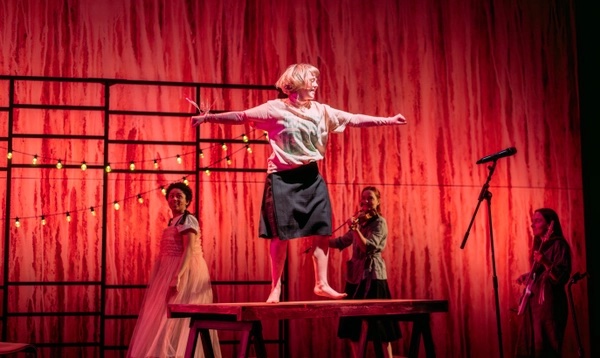
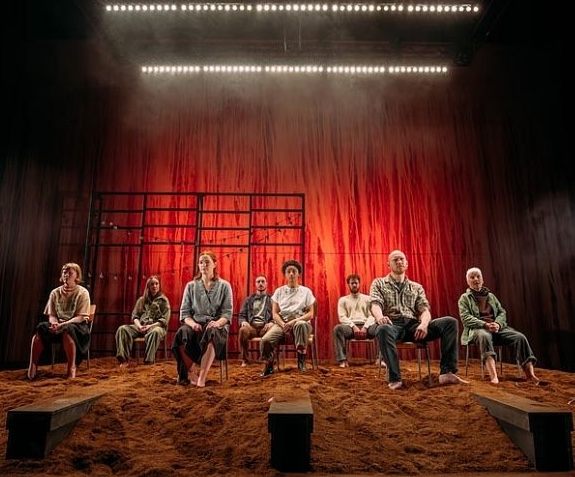
Emma Bailey’s simple but effective set design is based around a large rectangular section of soil, across which the characters walk barefoot, fight, make love and celebrate. The story’s central theme couldn’t be more evident. To the Guthries, the earth is all-important. It provides sustenance, a wage and a reason to go on living. And of course, it is also the place to which they will eventually return. As if to accentuate this, the backdrop is a closeup of a field of wheat.

On either side of the soil, musical instruments are arranged and the cast occasionally break off to deliver Finn Anderson’s evocative songs, singing in plaintive harmonies, pounding propulsive drums, strumming electric guitars and at one point even launching headlong into a spirited wedding ceilidh. These elements offer a welcome respite from the unrelenting bleakness of the story.

Finn de Hertog’s direction is assured and I particularly enjoy Emma Jones’ lighting design, which manages to convey that simple slab of soil in so many different ways. I like too that many of the props the actors require are clawed up out of the ground like a strange crop.

But much as I’d like to, I can’t really warm to the story, which at times feels uncomfortably like a series of disasters unleashed upon one luckless family.

3.6 stars

Philip Caveney
Dracula: Mina’s Reckoning

11/10/23

Festival Theatre, Edinburgh

Bram Stoker’s Dracula is one of those novels, like Alice in Wonderland, that is more famous for its enduring imagery than for its story. Its iconic characters are part of the fabric of our culture, recognised instinctively, even by those who have never so much as picked up the book. Such tales are ripe for retelling, like ciphers waiting to be reshaped for our times.

Into that space steps Mina’s Reckoning, a reimagining of the world’s most famous vampire, written by Morna Pearson and directed by Sally Cookson. This all-female and non-binary production redresses the gender imbalances in the source material: here, the women are elevated from mere victims and damsels-in-distress and are actually afforded some agency.

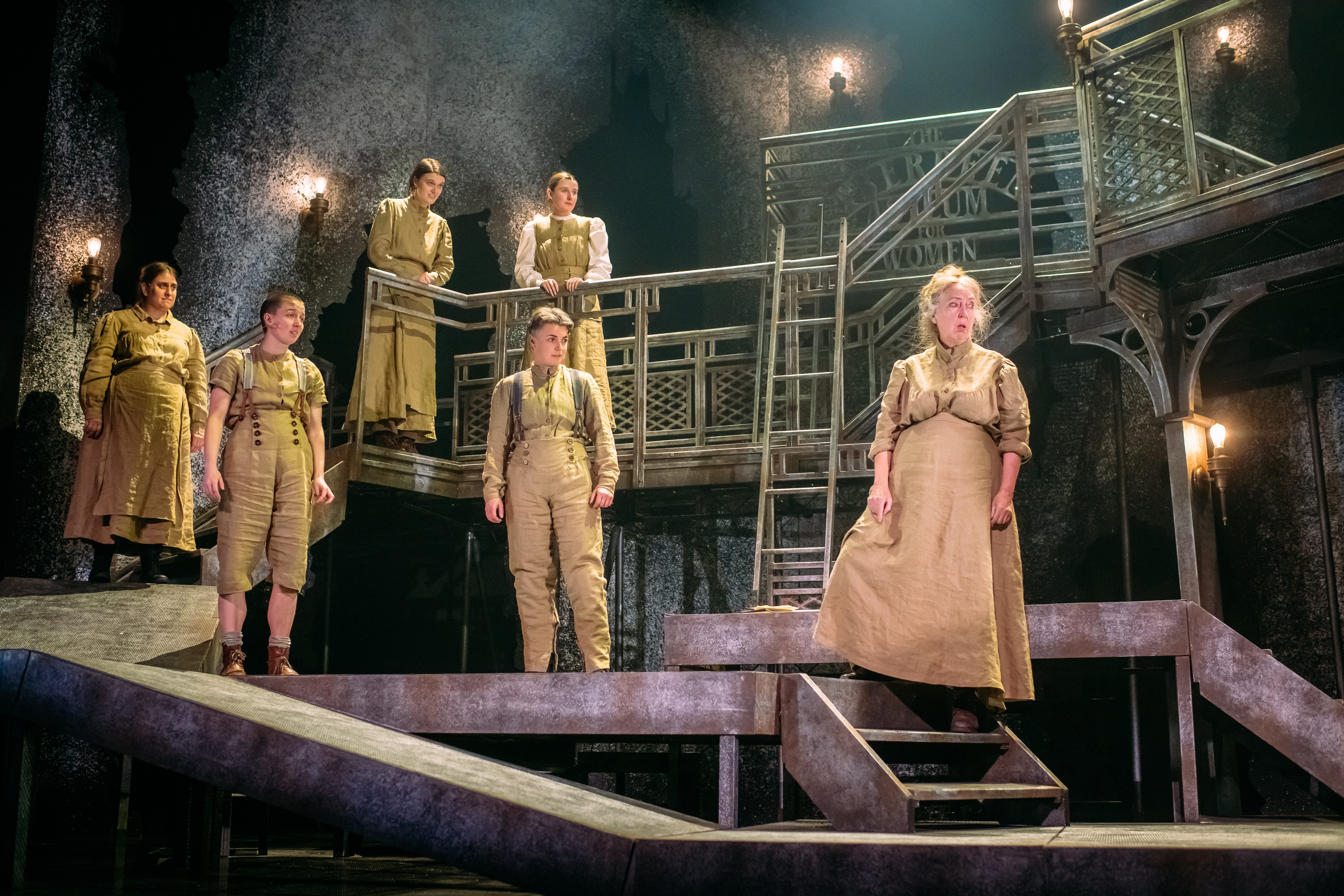
Whitby is out and north-east Scotland is in, justified by the fact that Scots writer Emily Gerard provided much of the inspiration for Stoker’s novel: it was from her work that he learned about the Romanian superstitions that inform some of the most compelling ideas in his book. More specifically, we’re in Cruden Bay, in a women’s asylum, where some of the characters speak in the Doric dialect. The Scots angle works well, the rhythms of the language creating an earthy poetry. The play opens with Mina (Danielle Jam) banging on the asylum door, demanding to be let in. She has Jonathan’s journals and wants Dr Seward (a wonderfully comic Maggie Bain) to help her ward off the evil that’s on its way.

The long first act sticks pretty closely to Stoker’s tale, albeit with more jokes and some judicious pruning (the boring suitor sequences are gone, thank goodness, and so are the details of Jonathan’s interminable journey). The second, shorter, act is much better, precisely because this is where the creative reimagining takes place, allowing Mina to come into her own. It’s a shame that the piece skews this way: it feels unbalanced. I’d like a shorter set-up and a longer unravelling.

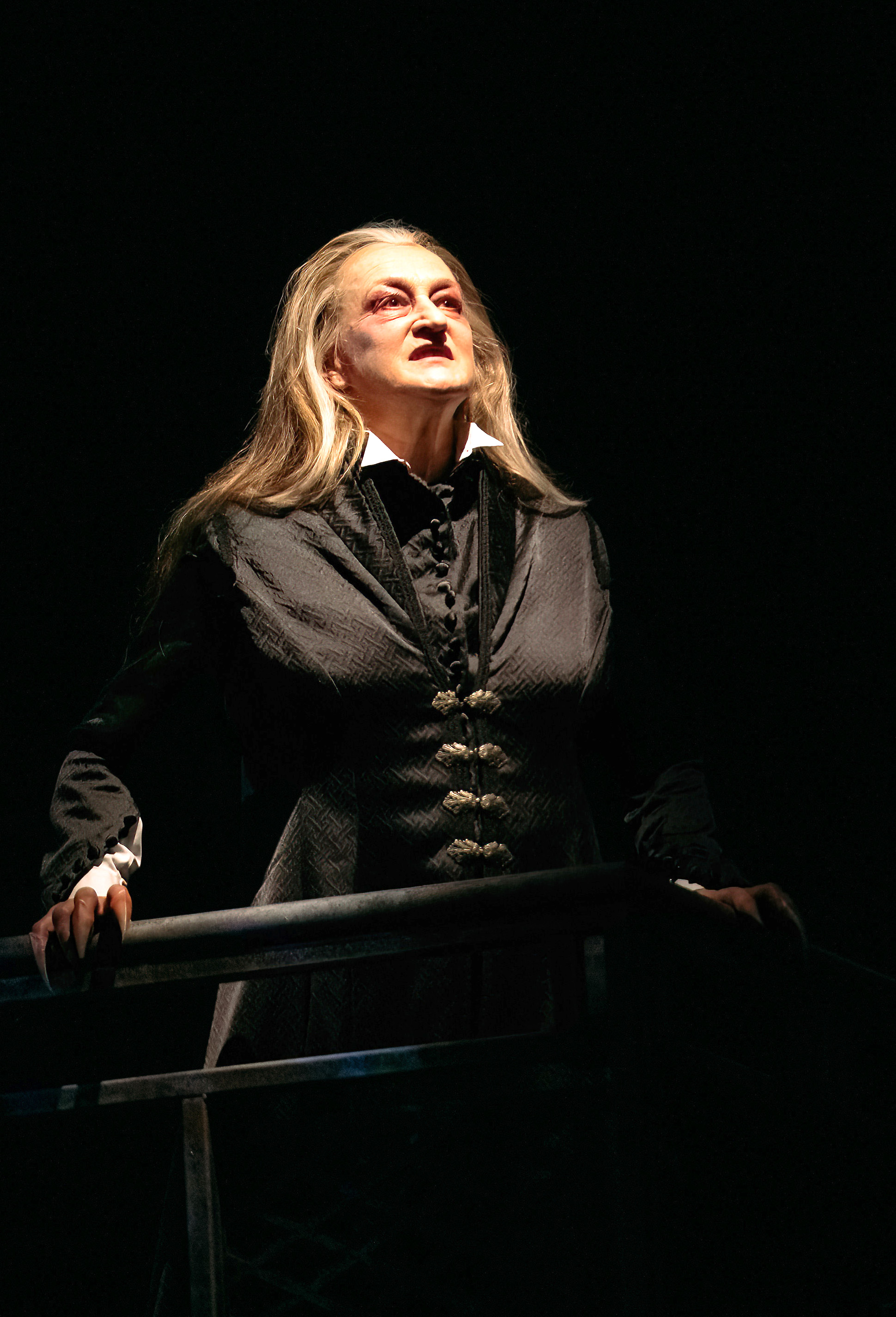
It’s a great idea to recast Dracula as a woman and Liz Kettle clearly relishes the role. She’s a bold presence, at once attractive and repellant, exactly as the Count should be. Here, the blood-sucker is more nuanced than her original incarnation, both supervillain and saviour. As Mina seals her Faustian deal, we recognise what Dracula is offering her, and understand exactly why she makes the choice she does.

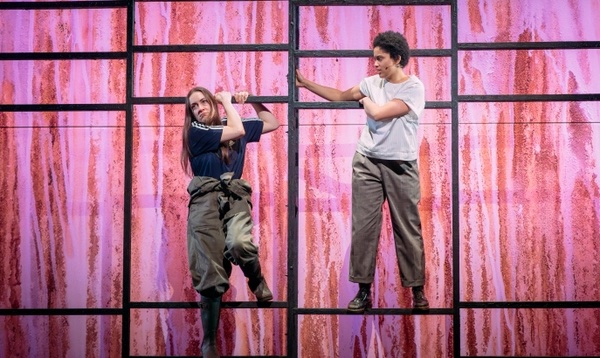
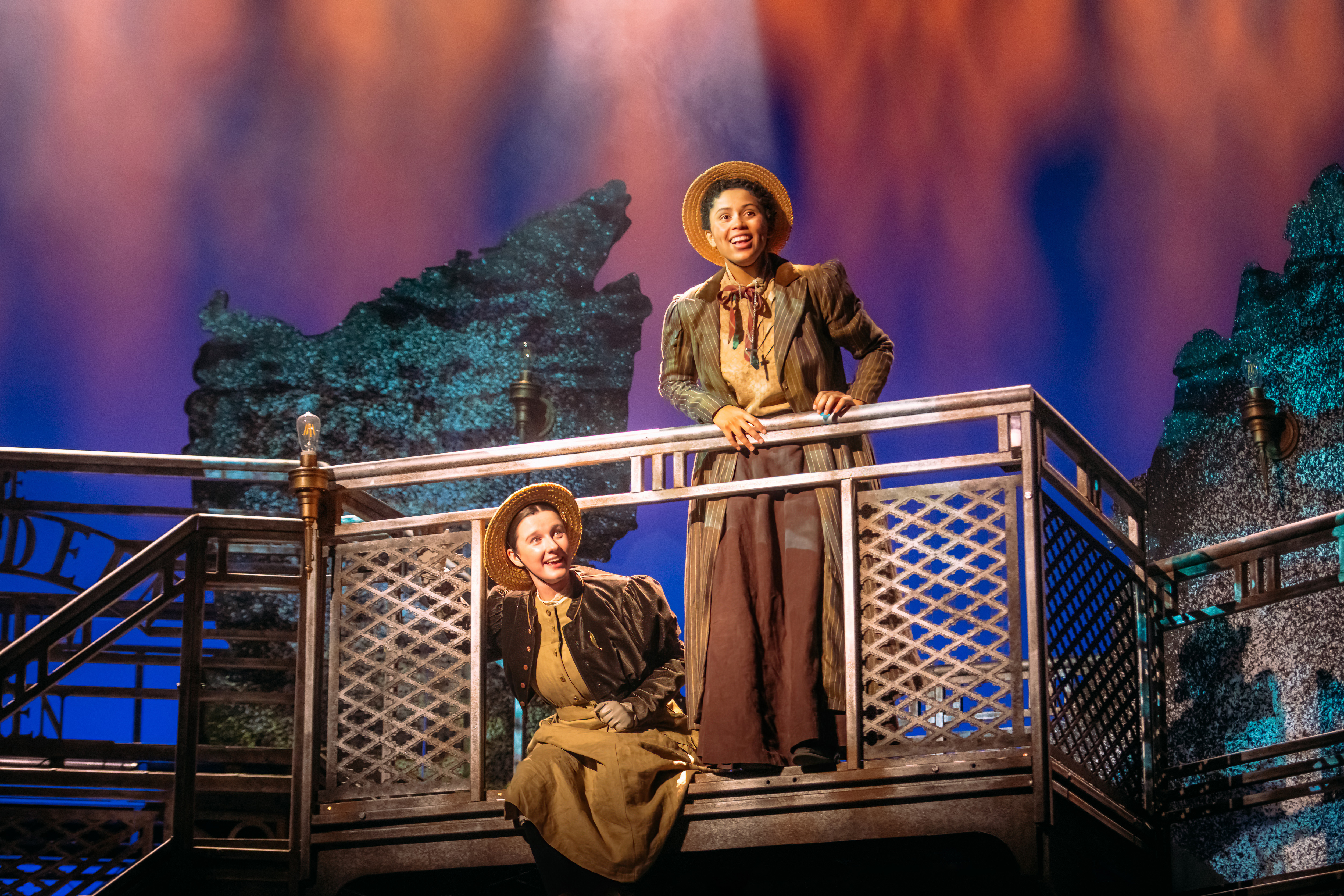
Kenneth MacLeod’s set is both the production’s strength and its weakness. It’s clever and imposing, evoking the chillingly austere asylum as well as the grand gothic castle – all staircases and hidden corners – and I like the use of Lewis den Hertog’s video projections and Aideen Malone’s lights to stain the walls red with blood, turning them into journals, then night skies, then stormy seas. However, the set’s cage-like qualities – the bars and rails imprisoning the women – also create a sense of distance, so that it’s hard to feel close to the characters and to empathise with them. What’s more, it makes the whole play less scary because we’re not immersed in the ghoulish goings-on.

Benji Bower’s music is wonderfully eerie and evocative but the sound drowns out the dialogue at times, which is a shame, as it obscures some of the finer details of the plot. Likewise, the ensemble work is excellent, but comes at the expense of the individual characters, as the inmates of the asylum blend together.

Albeit a little uneven, there’s a lot to like about this NTS and Aberdeen Performing Arts production, in association with Coventry’s Belgrade Theatre. The powerful image of Kettle, striding the ramparts – grey hair flowing, coat tails billowing – is one that will stay with me for a long time.

3.8 stars

Susan Singfield

James IV: Queen of the Fight

05/10/22

Festival Theatre, Edinburgh

For the fourth part of her epic series about Scottish history, Rona Munro chooses to focus her gaze upon a little known episode in the reign of James IV – the influence of two ‘Moorish’ women on the Scottish court and the events that lead to the writing of Ane Blak Moor, a derogatory (and openly racist) poem written by the Makar, William Dunbar (Keith Fleming).

In 1504, Lady Anne (Laura Lovemore) and her servant, Ellen (Danielle Jam), arrive at the Scottish court. Anne is to be lady-in-waiting to James’s young English bride, Margaret (Sarita Gabony), so Ellen is left to form her own alliances. She soon finds a role within the royal household – as an entertainer – and eventually finds herself the confidante/lover of King James (Daniel Cahill). She plays the titular ‘Queen of the Fight’ – a kind of MC – in the symbolic tournaments he leads. But Margaret’s jealousy of the woman she perceives as an interloper will have significant consequences for James and his followers – and shows how, even though the King apparently champions diversity, when push comes to shove, racism rears its ugly head.

The real strength of this production is the way that Munro finds contemporary echoes in these historical characters, who talk and act like the kind of people you might encounter in modern-day Edinburgh. This is particularly apparent in Dunbar, who is obliged to cut his cloth according to the changing mood, in order to eke a meagre living from his writing. His grumpy observations about his precarious existence put me in mind of a typical freelancer, forever having to apply himself to the fickle moods of the court. Clearly some things never change. (No, no, never been there myself…)

This is a handsomely mounted production, from Jon Bauser’s elaborate set designs to the sumptuous costumes by Karen Short. (I love the way the play begins with the characters in contemporary clothes, before they are dressed in their period finery.) There are some wonderfully boisterous fight scenes too, the participants swinging broadswords at each other with wince-inducing gusto.

There’s so much to enjoy here – I’m especially amused by Gabony’s petulant, seventeen-year-old bride, too moody to even get out of bed – and there are Dame Phemy’s delightfully caustic remarks (Blythe Duff); she has worked in the court longer than anyone and has everybody (including the King) dancing to her tune.

Queen of the Fight is proof, if ever it were needed, that historical fiction doesn’t have to be dull and strait-laced. Here is a production that positively thrums and pulses with energy and one that genuinely earns an exuberant and heartfelt ovation.

4.6 stars

Philip Caveney

Thick Skin, Elastic Heart

26/10/10

Traverse Theatre, Edinburgh

Thick Skin, Elastic Heart is billed as ‘a hybrid poetry/drama production’ and I’ll admit, based on that description, my expectations are not particularly high. Let’s just say, I’ve been somewhat underwhelmed by such shows in the past. You know the kind of thing. Short pieces of poetry, thoughtful silences, and smatterings of polite applause…

And when I learn that the theme of the show is ‘millennials,’ I’m not exactly overjoyed. I seem to have heard people banging on about that subject a lot recently…

Which only goes to show how wrong you (I) can be.

Touring company Sonnet Youth make a point of showcasing some local talent at every performance so tonight we open with a selection from young poet, Catherine Wilson, who delivers a series of wry, amusing, observational pieces that range from the sweet and poignant, to the downright hilarious. Wilson is a confident, engaging performer and this gets eveything off to a strong start.

And it only gets better.

The pieces that follow, all written by Drew Taylor-Wilson, offer observations on the complexity of modern life: the awful paranoia of job interviews, the tribulations of sexual relationships, a deeply affecting piece about miscarriage… this runs the gamut of the emotions, each successive piece contrasting with the last, so there’s never a sense of repetition – unless it’s deliberate. The show is performed with considerable alomb by Charlotte Driesler, Robert Elkin, Danielle Jam and Cameron Fulton. And it’s not just a series of poems delivered one after the other. Lucy Wild’s choreography has the four performers moving effortlessly around the stage, sometimes delivering monologues, often speaking in unison, augmenting each section with simple costume changes and skilful interaction. To say that I’m spellbound would perhaps be an understatement.

I’ve rarely seen this kind of thing done so well and it exerts a powerful grip on my attention from start to finish. The applause at the end is anything but polite.

After just two nights at The Traverse, the show is moving on for a series of one-off engagements across Scotland. If this should happen to land anywhere near you, do yourself an immense favour and grab a ticket.

I’m confident you’ll be as pleasantly surprised as I was.

4. 4 stars

Philip Caveney