Dani Heron

Black Hole Sign

08/10/25

Traverse Theatre, Edinburgh

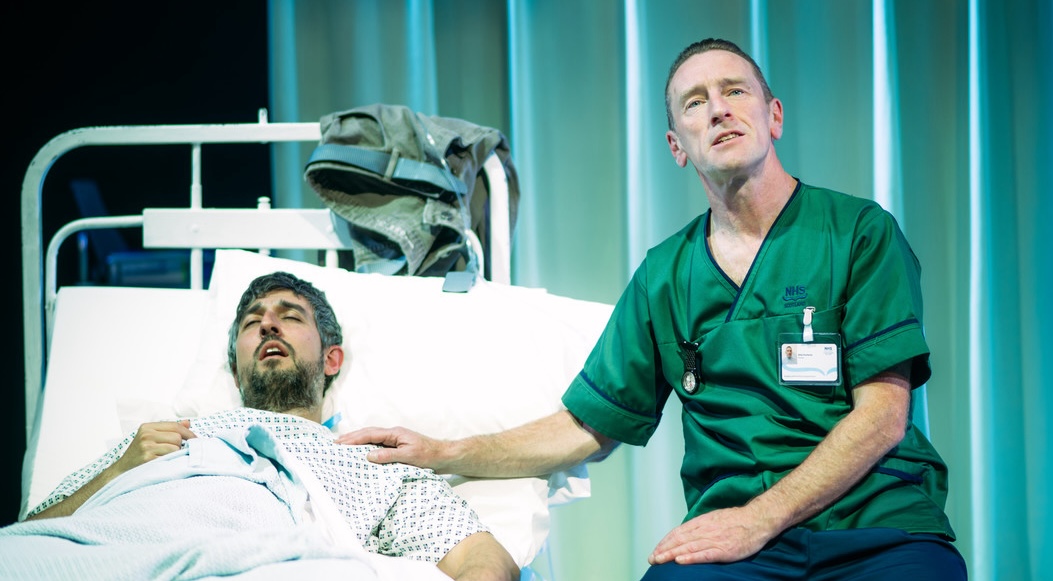
There’s a great big metaphor hanging over the unnamed hospital where this dark comedy takes place. A hole has appeared in the roof of A&E and water is dripping down onto the floor. As the story progresses, so the problem steadily worsens, the ingress ever more destructive. 

But senior charge nurse Crea (Helen Logan) and her team can only soldier on regardless, doing their best for their patients, no matter what. Crea has phoned for help about the roof only to be told (by a recorded voice) that she is number 74 in a queue. Her team include her right-hand woman, Ani (Dani Heron), currently doing a bit of soul-searching about her own future; affable porter, Tommy (Martin Docherty), who has long carriesd a torch for Crea; and Lina (Betty Valencia,) an almost cartoonishly helpless student nurse, who arrives chewing gum to ‘help her anxiety’ and who seems incapable of walking past a litter bin without knocking it over.

It’s clearly going to be a tricky night. Mr Hopper (Beruce Khan), a former alcoholic, is admitted with the fatal condition that gives the play its title, an inoperable affliction of the brain that is going to keep deteriorating and will cause his death in a matter of hours – but there’s no sign of anybody visiting him. Meanwhile, octogenarian Tersia  (Ann Louise Ross) is suffering from a urinary infection and is causing havoc as she experiences hallucinatory episodes that make her think that she is at a 1970s disco. The silver glittery shoes she’s wearing are all too real though.

At various points the play keeps cutting to an enquiry, some time later, where the members of staff have been called as witnesses and we learn that something really bad happened on that fateful night, resulting in a tragic death. It’s all too clear that somebody is going to have to pay the ultimate price for this disaster.

Playwright Uma Nada-Rajah is herself a staff nurse, who works in critical care, so it’s little wonder that, despite the sometimes slapstick levels of humour on display, the piece feels authentic, clearly inspired by events that the writer has actually experienced. It’s not the eviscerating howl of despair I came in expecting but then, such grim polemics can sometimes make for difficult viewing, so here the bitter pill has been sweetened with a shot of humour. Amidst the laughter, important points are being driven home.

It’s clear from the outset that tonight’s audience is on board with this fast-moving production, cleverly directed by Gareth Nicholls, though I must confess to being somewhat puzzled by a lengthy blackout, which – considering how little has changed when the lights come back up – seems unnecessary.

This niggle aside, the hearty applause at the play’s conclusion suggests that everyone present is in agreement with the story’s subtext. The National Health Service – one of the greatest institutions of modern times – is on its last legs and anything that forces this pressing concern into the spotlight is more than worthy of our attention.

4 stars 

Philip Caveney
Adults

06/08/23

Traverse Theatre, Edinburgh

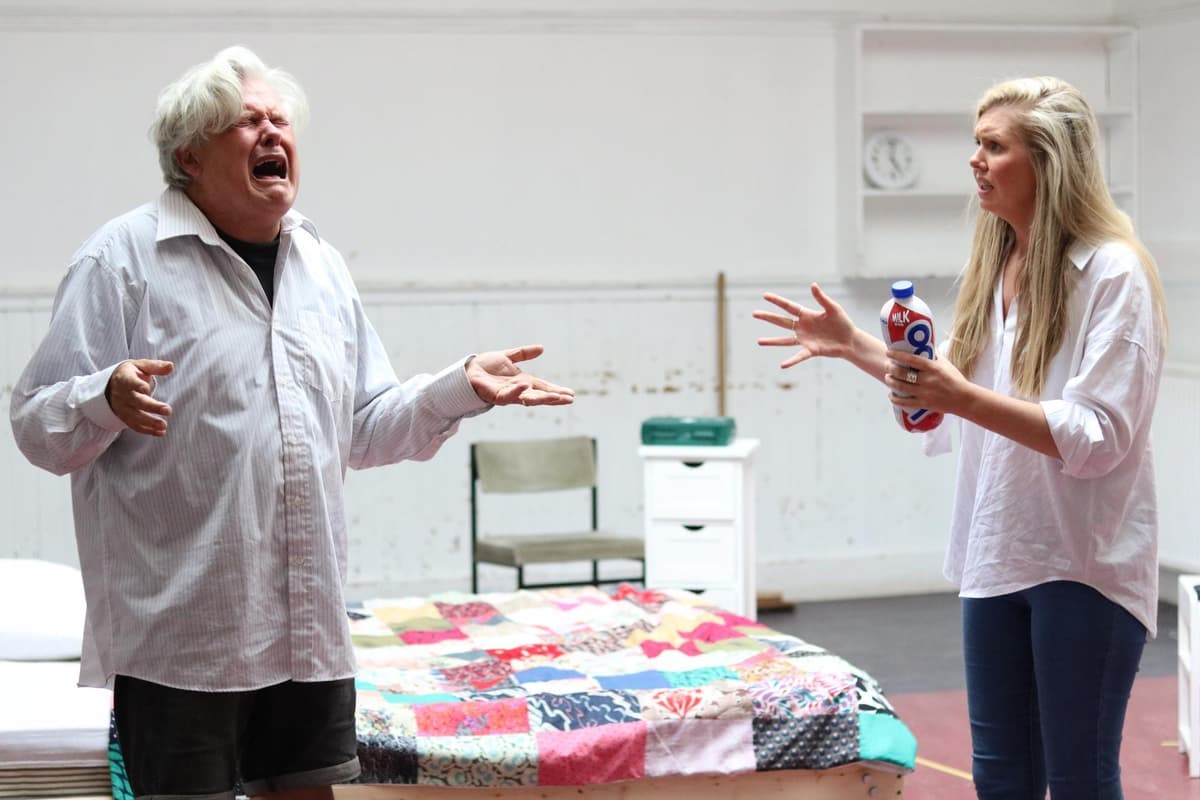
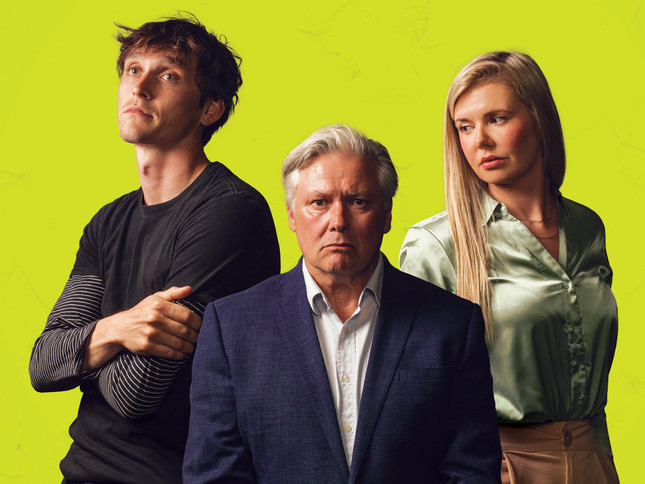
Zara (Dani Heron) has got things sorted, or as sorted as they can be, given the current state of the world. Admittedly, being a sex worker isn’t exactly living the dream, but her brothel is an ethical one – run as a workers’ collective – and she’s proud of the judgement-free service she and her colleague, Jay (Anders Hayward) provide. But still, it’s more than a little awkward when a new customer turns out to be her old teacher…

Mr Urquhart, or Iain (Conleth Hill), isn’t best pleased either. He was nervous anyway, and now he’s scared and embarrassed; he feels exposed. He’s only here to see if acting on his vague attraction to young men might help alleviate his misery, because he can’t go on as he is, hopeless and desperate, sick of his job, his marriage, even his kids…

As if the classroom reminiscences weren’t cringey enough, when Jay turns up – late – he’s got his baby daughter in tow. How can any of them collude in building a fantasy, when reality keeps intruding?

I’ve been a fan of playwright Kieran Hurley’s work since I saw Chalk Farm way back in 2013. He can always be relied upon to offer witty, thought-provoking material, with relatable, convincing characters, and Adults proves this once again. Both Zara’s skittish bravado and Jay’s reckless desperation are perfectly captured by Heron and Hayward, but it’s Hill’s depiction of Iain’s self-loathing and defensiveness that drives the piece. He’s done everything right, hasn’t he? So why does it all feel so wrong?

Directed by Roxanna Silbert, Adults has a stillness at its core, leading the audience to really listen, to hear what all three characters say, to see them for the complex, fascinating people they are. We’re all doomed, the message seems to be, so we might as well try to offer each other a bit of comfort while we can. Every generation will blame the one that’s gone before; it’s the way of the world. And every generation will fuck things up in their turn; we never manage to create that ‘better world’ we always say we want for our kids. It’s tragic – but here it’s belly-laugh funny too.

Sharp, incisive and hugely entertaining, Adults is another must-see offering from 2023’s TravFest.

4.4 stars

Susan Singfield

Rebus: Long Shadows

09/10/18

King’s Theatre, Edinburgh

Edinburgh’s most famous detective is making his theatrical debut, and I’m really looking forward to seeing how the iconic character fares in his home town. But we spend all day unsure if the play is going ahead after lead actor Charles Lawson was taken ill on-stage last night – the sort of dramatic twist nobody wants to experience. We wish him a speedy recovery. In the meantime, we’re relieved to hear that understudy Neil McKinven has stepped into the role, and that the show will go on.

Long Shadows is a new, original Rebus story, co-written specifically as a piece of theatre by Ian Rankin and Rona Munro. It’s a sensible decision: instead of shoe-horning a complex novel into a two-hour slot, this tale is suited to its form, and pared down, free of the literary clutter that scuppers so many adaptations. It fits into the novels’ time line though: this is retired Rebus, unable to let the job go, still haunted by the ghosts of all the crimes he didn’t solve.

In this incarnation, though, the ghosts are made flesh, with murdered teenagers Maggie (Eleanor House) and Angela (Dani Heron) given a formidably physical presence, a sort of chorus of the dead. I like this device: it gives the girls a voice, makes them real characters instead of mere victims, showing us their combined strength instead of focusing on their frailty. There’s also wit in using these ghosts as stage hands, making the scene transitions seamless, and emphasising the idea that the girls help shape the narrative.

We’re in cold case territory. DI Siobhan Clarke (Cathy Tyson), Rebus’s longterm sidekick, finally has the chance to see known killer, Mordaunt (played tonight by Andy Paterson), pay for his crimes. Technology has improved, and there’s DNA evidence tying him to Angela’s murder, twenty-five years ago. He’s got away with it so far, and Siobhan is determined not to let any loose ends threaten this opportunity to take him off the streets. She visits Rebus to see what he remembers, to see if he has any idea what the defence might have hidden up its sleeve.

Inevitably, all roads lead to Cafferty, Rebus’s Moriarty, played here with great aplomb by John Stahl. He’s exactly as I imagine him from the books, all machismo and panache, charm and thuggery. And Maggie’s death, seventeen years ago, is woven expertly into the mix, brought to mind by the arrival on Rebus’s stair of her teenage daughter, Heather. It’s a clever plot, with twists and turns that keep me guessing. I can’t deny it’s all quite expositional, a lot of telling-not-showing of the past; we’re watching people sit and talk about events rather than seeing them unfold before our eyes. But it’s enlivened by the presence of those ghosts, the gobby teenagers who won’t be shut up, and by strong performances all round.

McKinven does a sterling job. In the first act, he’s faultless: the role belongs to him. He does have a script in the second act, but he doesn’t refer to it often. It makes sense: the first act is much more of an ensemble piece, and McKinven, in his usual multiple roles, clearly knows this section well. But the latter half is essentially a three-hander between Rebus, Cafferty and Clarke; presumably McKinven has habitually spent this time in his dressing room, relaxing, before appearing briefly in the concluding scene. No matter, the script stuffed into his pocket doesn’t look out of place – Rebus is always carrying case files around. And he only seems to need it to place what’s coming next: he’s acting the dialogue, not reading it. And maybe, by tomorrow, he won’t need it at all. Either Lawson will be back, or McKinven will have learned the lines.

The set, designed by Ti Green, is perhaps my favourite thing about this whole production. I love the simplicity of it, the economy. There are no unnecessary props or pieces of scenery; it’s as uncluttered as the script. But it’s wonderfully evocative: Edinburgh’s tall grey walls and winding paths, tunnels and closes, stairs and bridges, all there at once, their purpose and atmosphere changing with the light. It’s almost breathtaking when the streets of the Old Town are turned instantaneously into a glass penthouse on the Quartermile by the stupidly simple method of lighting the side panels from behind. It’s a revelation as remarkable as those related to the crime.

So, a welcome addition to the Rebus pantheon, and certainly a must-see for fans of the irascible ex-detective.

4 stars

Susan Singfield