Christophe Waltz

Frankenstein

25/10/25

Filmhouse, Edinburgh

Guillermo del Toro was always going to make his version of Frankenstein one day – the seeds were sown in his 1992 Spanish-language film, Cronos, the first of his features that I ever saw in the cinema and the one that convinced me he had a big future ahead of him. 

Now he’s finally got around to doing the job properly, courtesy of Netflix, who stumped up the $120m budget. For a while it looked as though there wouldn’t be any chance of seeing it in an actual cinema before the transfer to streaming. This would have been a crime because del Toro’s adaptation of the tale looks absolutely sumptuous on the biggest screen at Filmhouse and I’m delighted to see that the auditorium is  pretty busy for a Saturday afternoon showing.

Frankenstein is, of course, one of the most filmed books in history, but it’s probably fair to say that only a handful of the 423 movie adaptations (not to mention the 287 TV episodes – yes, I did Google it) have come anywhere close to capturing the essence of Mary Shelley’s seminal horror story. While del Toro does throw in a few original twists of his own (of course he does!), he sticks fairly close to Shelley’s narrative – indeed, he’s even credited her as his co-screenwriter. The tale is told in three distinct parts.

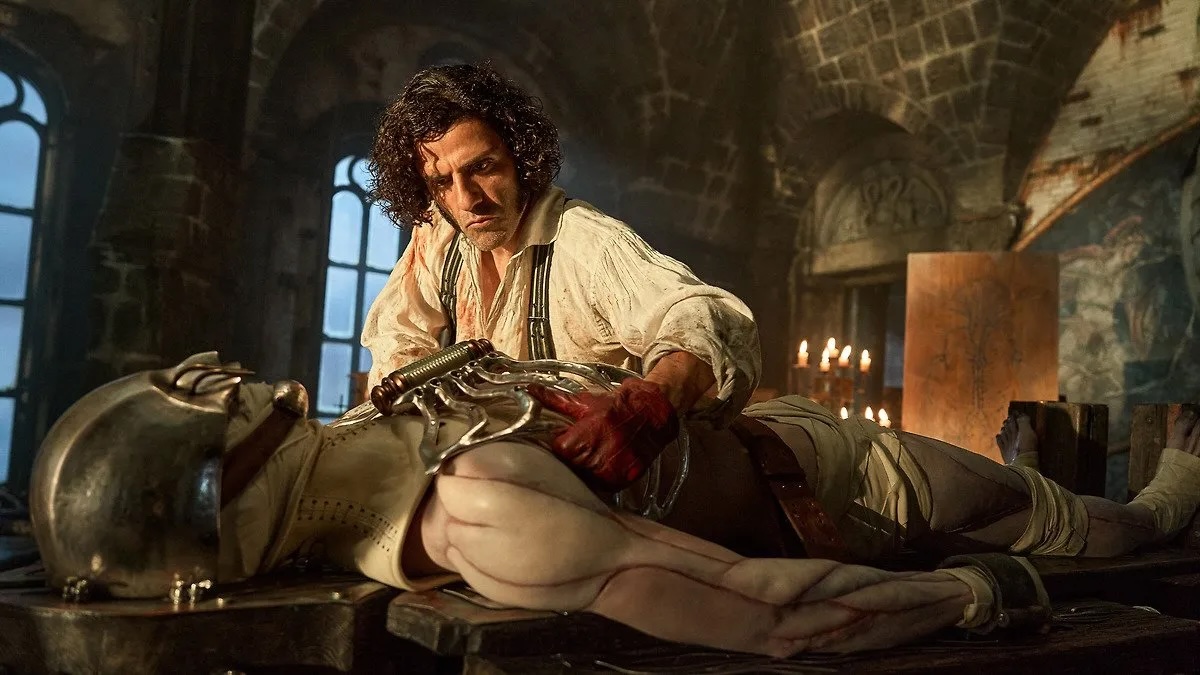
In the opening Prelude, we join Captain Andersen (Lars Mikkelsen) and the crew of his sailing ship, who are stranded on the ice in remote Arctic waters. There’s a sudden explosion nearby, from which the crew rescue Victor Frankenstein (Oscar Isaac), who has been pushed almost to the point of death by a monstrous assailant. After witnessing The Creature (Jacob Elordi) plunging into icy waters, they carry Victor onto the ship – but, once revived, he assures Andersen that his pursuer will not actually be dead and will surely come for him…

Before that happens, he needs to tell his story.

Victor then narrates The Creator’s Tale and we flashback back to his childhood where, under the rule of his despotic father, Leopold (Charles Dance), Young Victor (Christian Convery) first becomes obsessed with life and death. Keen-sighted viewers may spot something familiar about Victor’s barely-glimpsed mother, Claire. Something distinctly Oedipal is happening here.

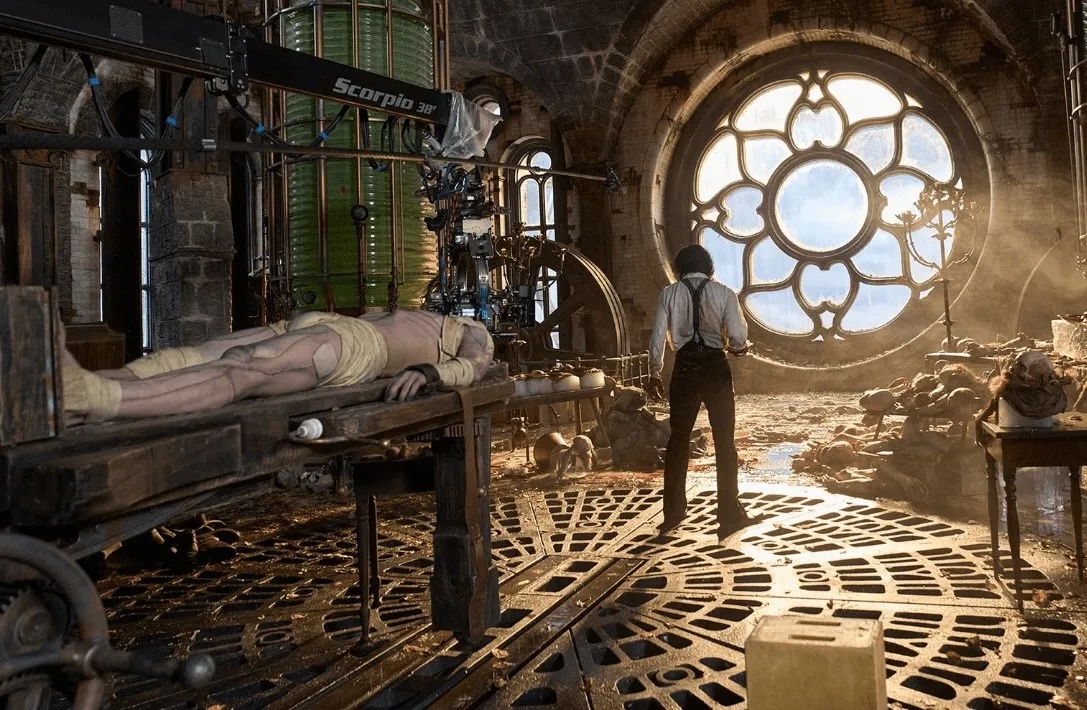
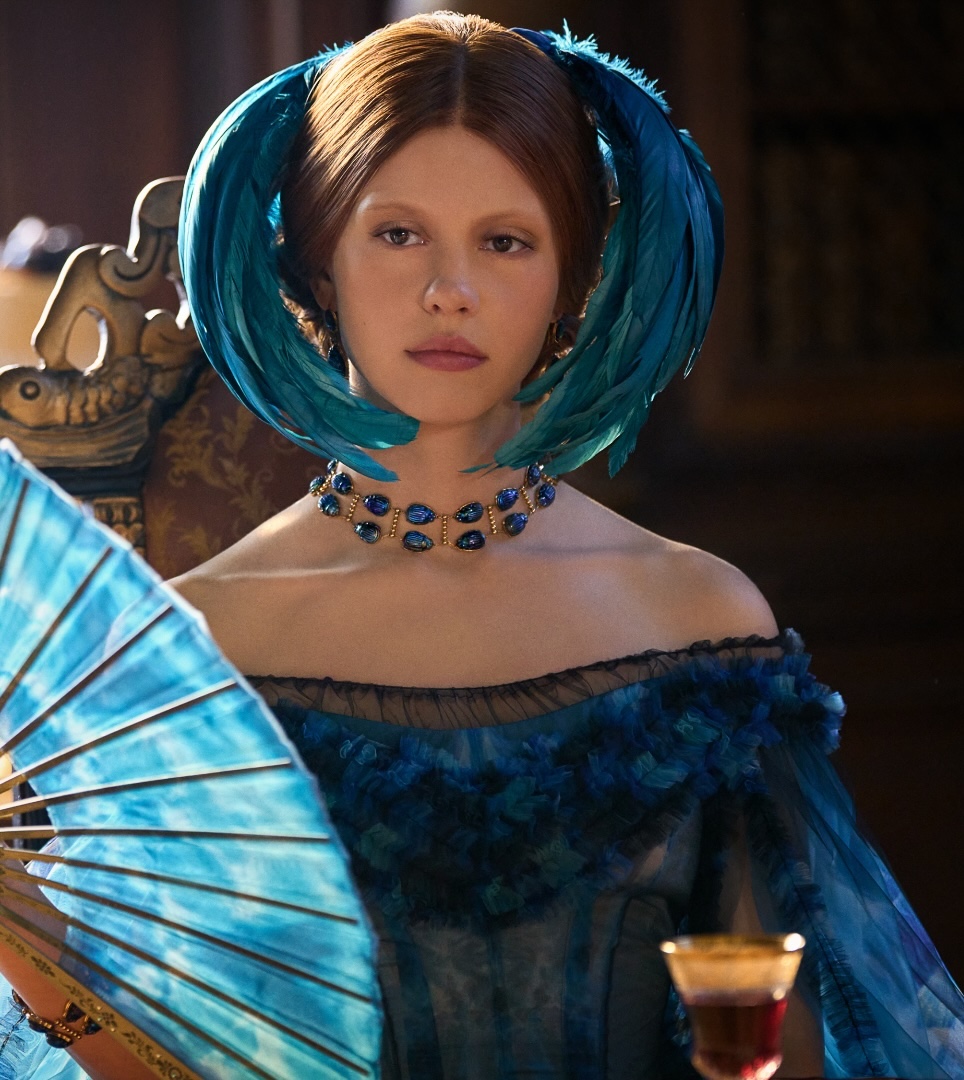
We then cut to some years later. A grown-up Victor is causing controversy at medical school in Edinburgh with the grisly experiments he’s conducting on cadavers (and I get to revisit some of the sets that were evident around my home city in September 2024). We are introduced to Victor’s younger brother, William (Felix Kammerer), and his fiancée, Elizabeth (Mia Goth). We also meet Harlander (Christophe Waltz), a character created for the film, a wealthy man who, for clandestine reasons, is perfectly happy to finance Victor’s attempts to take his experiments all the way.

But Victor’s account is later contrasted with The Creature’s Tale, where we learn of the years when the monster and his creator were apart: how The Creature lived in a barn alongside a kindly blind man (David Bradley); how he mastered the art of speaking (with a distinctly Yorkshire accent); and how he slowly began to realise how shabbily he’d been treated…

It’s not just because I’m a devout Guillermo del Toro fan that I think this film is a million times better than every other Frankenstein-generated movie I’ve watched down the decades. Isaac is a revelation in the title role, nailing both the character’s sense of privilege and his fatal short-sightedness. Elordi, meanwhile, offers a fresh take on the Creature that really brings out his innate vulnerability and his desperate need to relate to others, something that’s been attempted before with much less success. 

The film is packed with sumptuous locations and thrilling action set-pieces, that have it hurtling through its lengthy running time. Cinematographer Dan Lausten captures every scene with an almost luminous intensity, Kate Hawley’s costume designs are exquisite, and there’s a beautiful score courtesy of Alexander Desplat. If I have a minor niggle it’s that the CGI-generated wolves in one long sequence aren’t quite as convincing as they need to be – and perhaps both Mia Goth and Felix Kammerer might have been given a little more to do?

But these are nitpicks. As ever in these situations, I’m urging people not to wait for this to drop onto streaming, because this level of filmmaking deserves to be watched on the biggest, brightest screen available, one of – dare I say it? – monstrous proportions.

I’ll get my coat.

4.8 stars

Philip Caveney

Guillermo del Toro’s Pinocchio

19/12/22

Netflix

Guillermo del Toro is one of my favourite film directors – and Disney’s Pinocchio one of the formative films of my childhood. So when I first hear the news that the Mexican director is planning to deliver his own version of Carlo Collodi’s classic tale, it’s naturally something I eagerly look forward to – for a very long time. Indeed, it turns out that del Toro has actually been working on this astonishing stop-frame animation for something like fifteen years.

As the release date finally approaches, I look everywhere for a cinema in Edinburgh that’s planning to show del Toro’s film on the big screen, but alas, with the Filmhouse out of action, it cannot be found. So Netflix it must be. As it turns out, some visions are so powerful, so perfect, that they can blaze out of a small screen like meteors. Guillermo del Toro’s Pinocchio is an astonishing film, that has the audacity to take everything we know about the story and give it a thorough makeover. What’s more, the changes that he makes (he co-wrote the screenplay with Patrick McHale) all seem to enrich the original, making it more logical, more explicable.

Revelation number one: when we first encounter woodcarver, Geppetto (David Bradley), he has a real son, Carlo (voiced by Gregory Mann). But Carlo dies tragically when Italian air force planes unload their bombs onto the church, where Gepetto is working on a huge crucifixion. This backstory helps flesh Geppetto out and makes his subsequent actions more believable – especially when Pinocchio is forged from the very tree planted to mark Carlo’s grave.

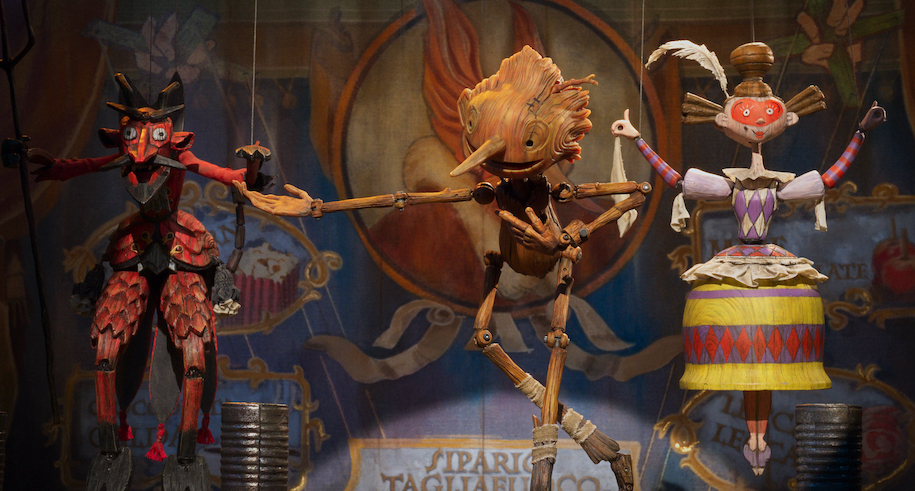
Revelation number two: the Pinocchio that Geppetto eventually carves in a drunken rage looks nothing like a ‘real boy’. He’s a strange, spindly, half-finished marionette, generally shunned and mistrusted by the people in his home village. Contrary to the original tale, it’s the villagers who have to learn to accept Pinocchio, rather than the other way around.

Revelation number three: this version is set in Italy in the 1930s, under the rule of Benito Mussolini. Pinocchio’s adventures on the ‘Donkey Island’ are exchanged for scenes where he unwittingly becomes a poster boy for fascism. (It’s nakedly clear what del Toro is saying here. And it makes perfect sense, because to take on Disney’s most iconic scenes would be a pointless exercise. If you can’t better a scene, do something entirely different, right?)

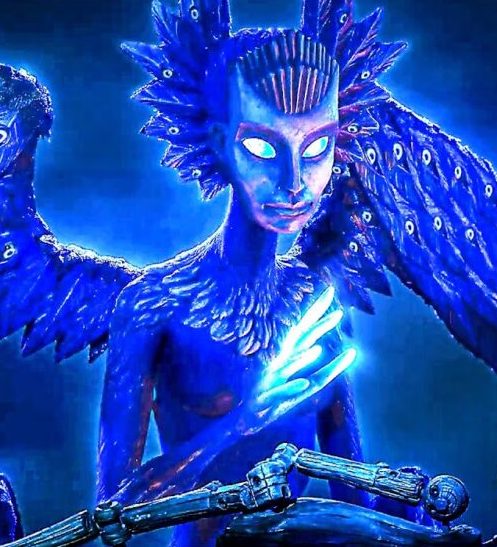
There’s more, much more, packed into the film’s two hour run. We meet Sebastian J Cricket (Ewan McGegor), an ambitious, self-aggrandising would-be author, who only agrees to take on the task of being Pinocchio’s ‘conscience’ in the hope off getting a book deal. There’s Count Volpe (Christoph Waltz), the greedy, venal owner of a travelling freak show, who spots an opportunity to make lots of money and who bullies his monkey assistant, Spazzatura (Cate Blanchett) at every opportunity. And wait till you see what the animators (and Tilda Swinton) have done with the infamous Blue Fairy, rechristened here as the Woodland Sprite. More than anything else, there are fundamental changes to the character of Pinocchio himself. He’s no longer the obnoxious, pig-headed lout of the novel, but a sweet, misguided misfit, desperately trying to be liked. A scene where he can’t understand why all the villagers hate him, but adore the other wooden figure nailed to a cross on the church wall is a stand-out.

It’s not just the levels of invention in the story that make this such a unmitigated triumph. It’s the loving attention to detail: every character, every set, every painted landscape; it all pulses and dazzles with imagination of the highest calibre. There’s so much to see here, it’s clearly going to need repeated viewings to really take it all in. And watching it makes me wish that dear old Ray Harryhausen was still alive to see where modern technology has brought the art of stop-motion animation.

Many films have the word ‘masterpiece’ attached to them, but few deserve it as thoroughly as this one. All you need to do it hit the Netflix button, so… no pressure.

5 stars

Philip Caveney

Big Eyes

MV5BMjA2ODM5MDE3N15BMl5BanBnXkFtZTgwOTIxNjc1MzE@._V1_SX214_AL_

30/12/14

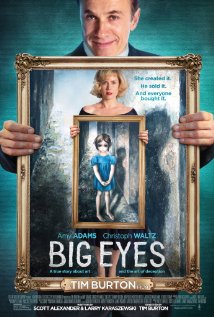
Tim Burton’s latest offering eschews the weird and wonderful fantasy for which he is best known and concentrates instead on a ‘so weird it has to be true’ tale about bad art and flawed people. In many ways, this is Burton’s best work since Ed Wood, with which it shares some DNA – scriptwriter Scott Alexander worked on both movies.

The film opens in the late 1950’s and Burton has skilfully evoked the era in his own exaggerated, slightly surreal way. Amateur painter, Margaret (Amy Adams) has just run out on her husband, taking her young daughter Jane along with her for the ride. She finds work and in her spare time tries to sell her paintings, a series of (rather dodgy) portraits of big-eyed children. She soon encounters Walter Keane (Christophe Waltz) another wannabe artist and the two of them hit it off. Within weeks they are married. When Keane’s flair for publicity starts to kindle interest in Margaret’s art, he persuades her to let the world believe that he is actually their creator and to release them under the signature of ‘Keane.’ She reluctantly goes along with it. But neither of them have realised quite how successful Margaret’s paintings will become. As the millions begin to roll in, Margaret finds herself increasingly tortured by the deceit that they have created; and the desire to be recognised as an artist. When the marriage starts to founder, it’s clear that one way or another, the truth will have to come out.

This is an intimate, small scale story that gets to the heart of the thorny subject of intellectual property. Adams and Waltz are both superb in their roles (Waltz has some particularly funny scenes, particularly in the courtroom drama at the film’s conclusion) and Burton is always better, I think, when his creative juices are reined in and he works with somebody else’s script. (Like many critics, I feel he’s lost his way lately – Alice In Wonderland was a particular disappointment, even though it racked up huge receipts at the box office.) Big Eyes however, is an excellent film and one that stands with his best work.

4.4 stars

Philip Caveney