Breathless

Nouvelle Vague

15/02/26

Filmhouse, Edinburgh

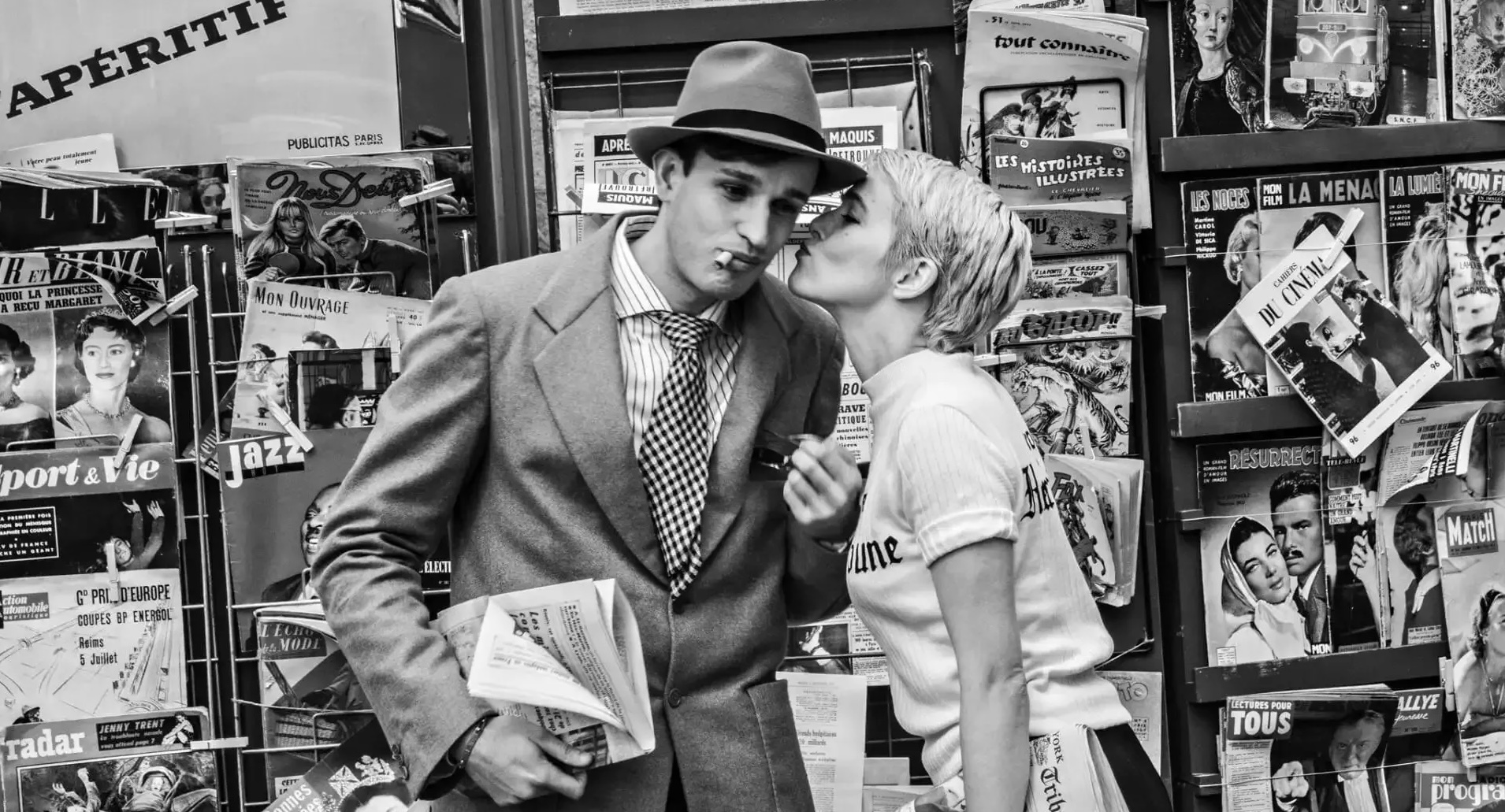
I’m a longtime fan of American director, Richard Linklater, and I suspect that what I like most about him is his eclecticism: I never know what kind of thing he’s going to come up with next. Despite this, the advance word about Nouvelle Vague comes as a genuine surprise. It’s about the filming of Breathless (A Bout de Souffle), shot on location in Paris and featuring a cast of (mostly) French actors speaking their own language. There are so many elements here that could have gone spectacularly wrong – and, of course, there were plenty of nay-sayers concerned about cultural appropriation. But no worries, this film is in an unqualified delight from start to finish.

It’s 1959 and the various members of the influential group of film critics known as Cahiers du Cinéma are starting to make their respective marks on the industry. François Truffaut (Adrien Rouyard) is about to wow the audience at Cannes with his debut feature, The 400 Blows, and Claude Chabrol (Antoine Besson) has also made an impact with a self-financed film, Le Beau Serge. But the group’s leading light, Jean-Luc Godard (Guillame Marbec), has yet to dip his toes into directorial waters.

At Cannes, he manages to persuade veteran film producer George de Beauregard (Bruno Dreyfűrst) to finance his debut, which will be loosely based around a script conceived by Truffaut, itself inspired by the misadventures of real-life car thief, Michel Portail. Luc Godard has already signed affable young actor Jean Paul Belmondo (Aubry Dullin) for the lead role, but when the director bumps into American star, Jean Seberg (Zooey Deutch), fresh from her role in Bonjour Tristesse, he becomes convinced that she is the only woman who can play the second lead in his movie and sets about doing everything he can to persuade her to come on board.

But, back in Paris, budget in place and cast duly assembled, it soon becomes clear that Luc Godard has his own ideas about how a film should be directed – and they’re not like anything that’s gone before…

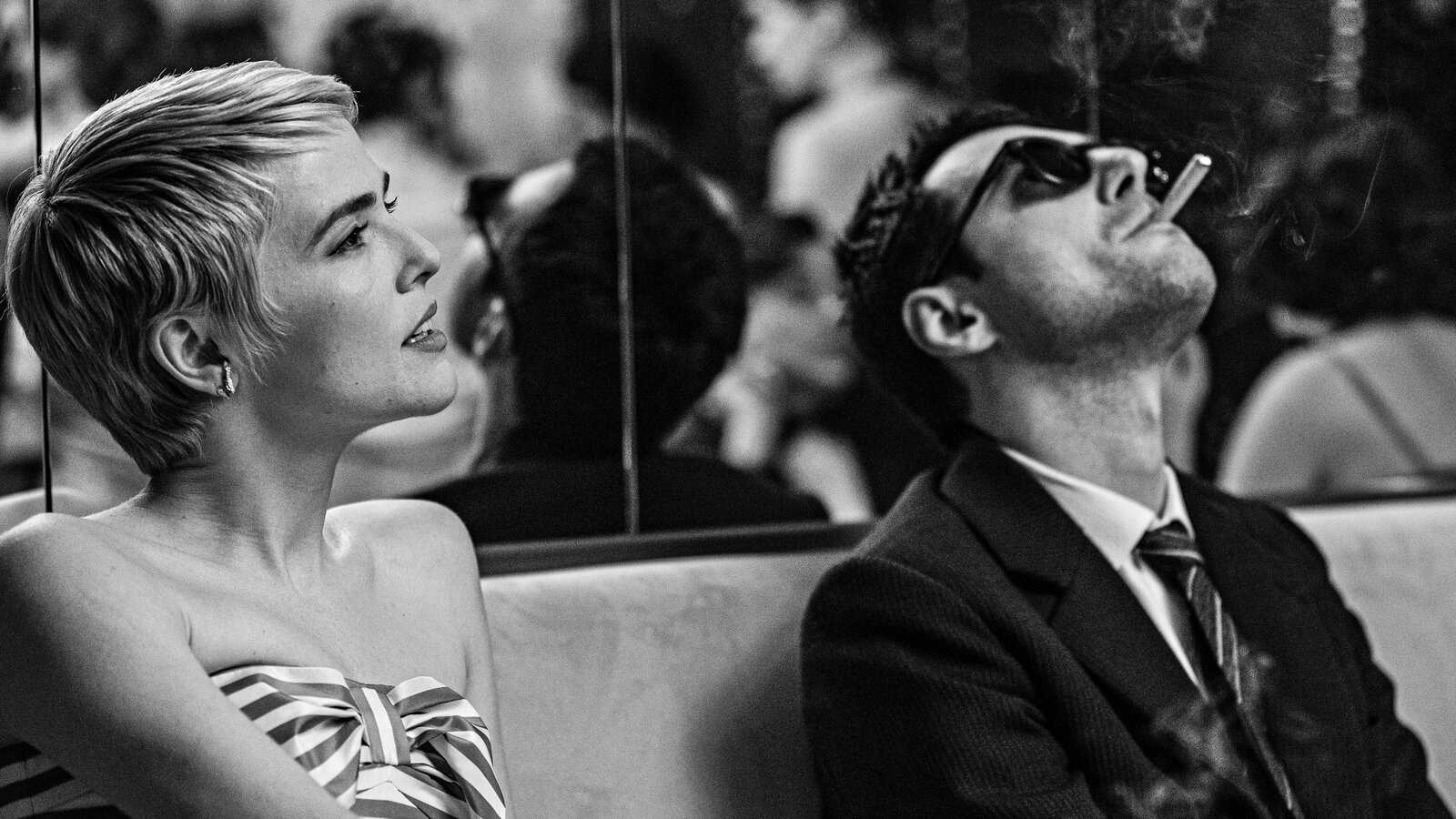
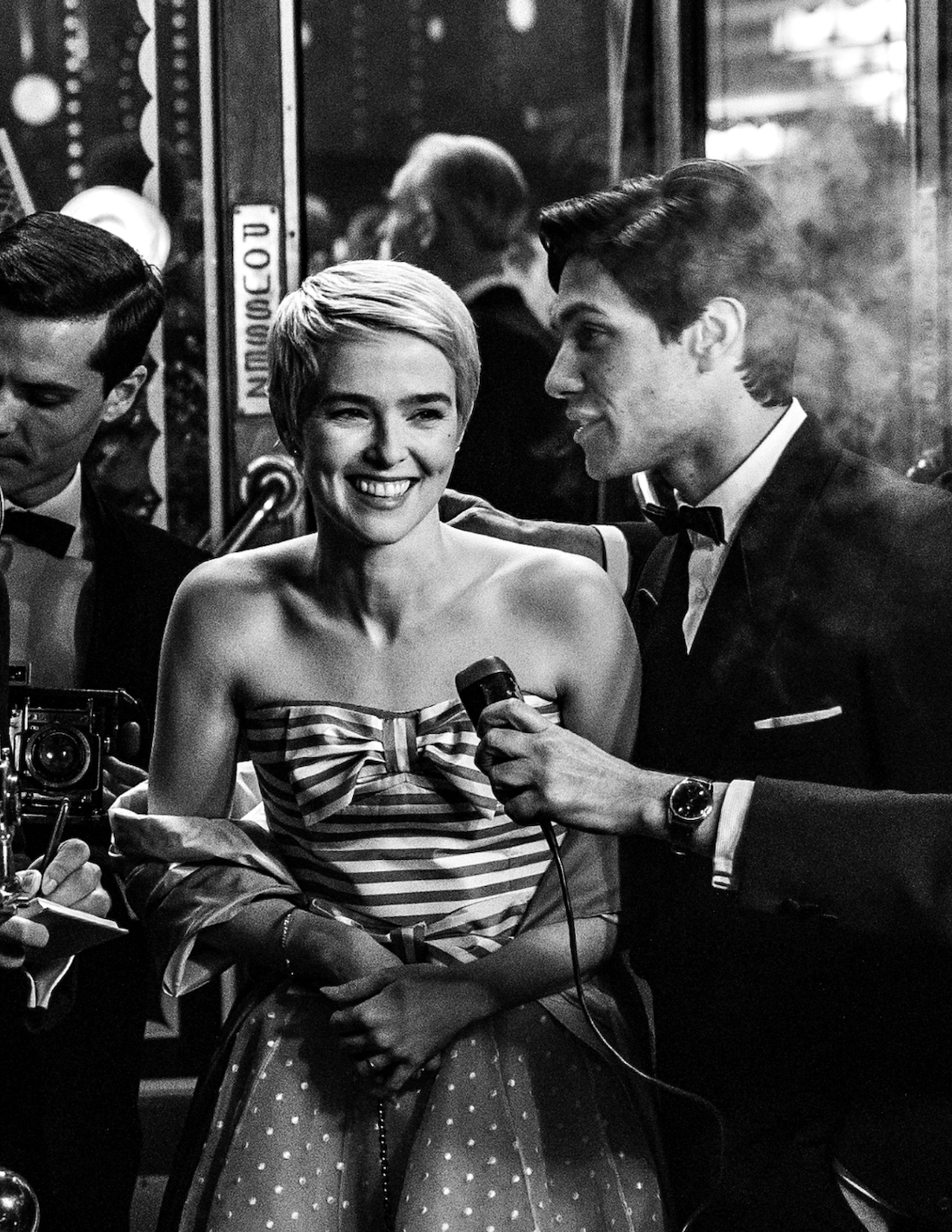
Marbec is brilliant as the chain-smoking, brooding Luc Godard, totally convinced of his own genius and, frankly, a bit of a knob, disregarding every bit of advice he’s given by more experienced friends. His casual approach causes Beauregard enough stress to drive him to the edge of a nervous breakdown. The novice director pretty much always uses the first take (though he rarely bothers to watch it back) and has a habit of calling a halt to the day’s shoot after a couple of hours’ work, simply because he’s ‘feeling peckish.’ Both Deutch and Dullin are eerie lookalikes for their real life counterparts, and the film effortlessly captures the frantic day-to-day shooting process that against all the odds, would result in one of the most groundbreaking films in movie history.

But lest I’ve made this sound like a worthy slog aimed at cinephiles, don’t be misled. Nouvelle Vague is an absolute breeze, fast, funny and utterly charming. Just like the film it’s homaging, it was shot on location in Paris with a tiny budget and no special effects, yet it somehow manages to capture the look and feel of a lost era with absolute conviction.

4.6 stars

Philip Caveney

Seberg

13/01/20

In the year 2020, who even remembers the name of Jean Seberg? Not many people judging by the meagre crowd gathered at tonight’s screening. 

But hers is a fascinating story of toxic stardom, of a young performer whose life was systematically destroyed by the FBI; of a reckless but well-intentioned young woman, who got embroiled in events she couldn’t hope to control – events that would eventually destroy her. 

Catapulted to stardom at the age of seventeen, Seberg starred in Otto Preminger’s Saint Joan and suffered serious burns when her character’s onscreen immolation went horribly wrong. A few years later, she became the darling of the French New Wave when she starred in Jean Luc Godard’s Breathless. But Seberg, directed by Benedict Andrews, examines her ill-fated trip to Hollywood in the late 60s, where she’d gone to film the Western musical Paint Your Wagon. (Or ‘Clint Eastwood Sings!’ as it’sfondly remembered my many.)

Seberg (Kristen Stewart) reluctantly leaves her husband Roman (Yvan Attal) at home with their young son. On the plane to America, she meets up with Hakim Jamal (Anthony Mackie), an influential player in the burgeoning Black Power movement. She shows solidarity with his cause, contributing funds for the school he runs and, shortly afterwards, embarks on an affair with him. This brings her to the attention of the FBI, where operative Jack Solomon (Jack O’Connell) is directed to put her under intense surveillance. When Seberg starts to engage with more powerful members of the Black Panthers, the agency sets put to discredit her by making the details of her affair with Jamal public – and, in the increasingly poisonous atmosphere that ensues, Seberg’s sanity is pushed to the edge of the abyss…

Seberg is an interesting if somewhat flawed film. Stewart is an assured actor (and, given the invasive media coverage she herself has endured, it’s easy to see what attracted her to this role), but the fictional elements of this retelling of Seberg’s story are rather less successful. O’Connell’s tightly buttoned FBI man doesn’t really have enough to do, hanging around the edges of events, listening in on her via bugging devices and serving as the audience’s collective conscience. His exchanges with his hard nosed colleague Carl Kowalski (Vince Vaughan) are nicely drawn but don’t add much to the telling.

The era is nicely evoked but I would have liked to have seen some recreations of the filming of Paint Your Wagon thrown into the mix. (This is, after all, a biopic.) Perhaps there simply wasn’t the budget for that approach or more likely the filmmakers couldn’t obtain the rights. There are a couple of tantalising glimpses from St Joan and Breathless, but its not enough.

In some ways, this could be seen as the tale of a luckless individual crushed by the corrupt might of American law enforcement. But really, as Seberg herself says, ‘I am not the victim here.’ There is a much bigger  story – a shocking demonstration of the depths that the American justice system will sink to in order to prevent black people from ever achieving any sort of equality.

There seem to be quite a few such stories around right now. Add Just Mercy and Richard Jewell to the mix and we’re beginning to see a familiar trope. All of these films offer the same narrative: America is a corrupt and unforgiving place and things aren’t getting any better for the poor and the dispossessed.

This is worth seeing for Stewart’s powerful performance in the title role, but I can’t help feeling it could have been more effective than it ultimately is.

3.8 stars

Philip Caveney