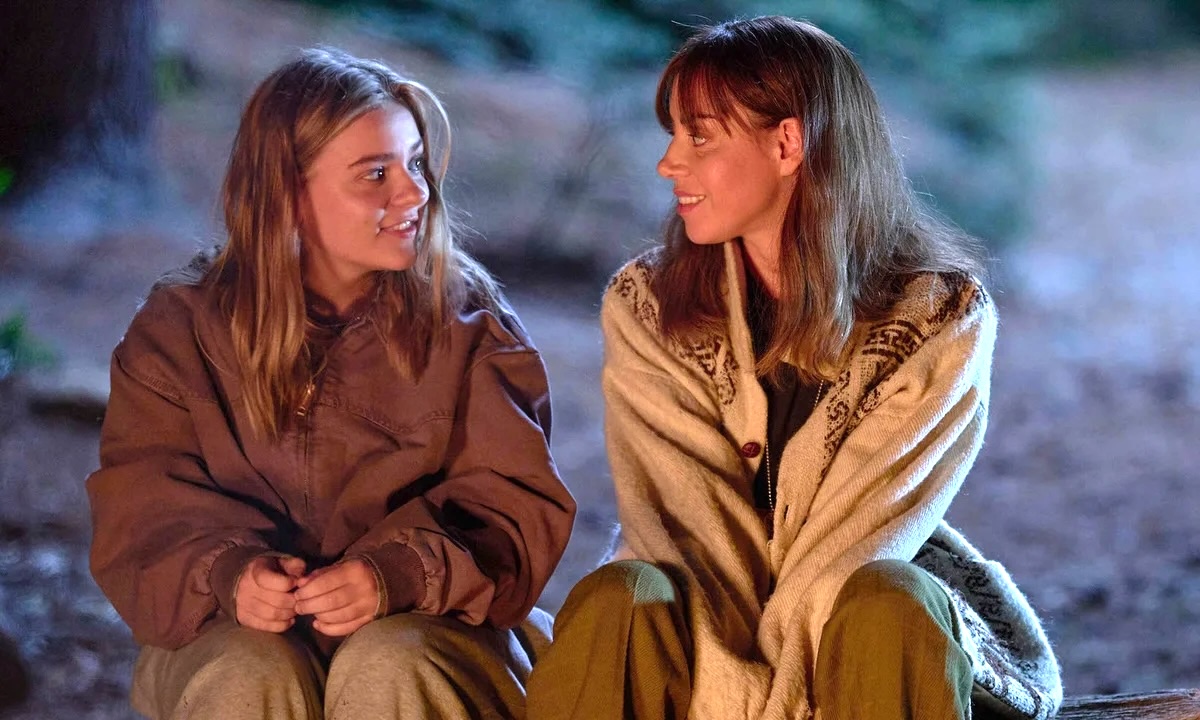


Aubrey Plaza

My Old Ass

26/11/24

Amazon Prime

Maybe because it’s lumbered with what must rank as one of the most unprepossessing titles in cinematic history, this charming film failed to make it into UK multiplexes and can only be found lurking amidst the ‘recently added’ section on Amazon Prime. Written and directed by Megan Park, it’s an engaging story, anchored by a tremendously appealing central performance by Maisy Stella.

She plays Elliott, a teenage girl living in the wilds of Canada. She’s recently finished school and is preparing to head off to university in Toronto. Meanwhile, she’s intent on enjoying her remaining days at home: making out with an attractive female assistant at her local coffee shop (an ambition that’s quickly ticked off the ‘to do’ list), and then heading off with her two pals, Ruthie (Maggie Ziegler) and Ro (Kerrice Brooks), for an unconventional birthday celebration. The trio have laid their hands on some hallucinogenic mushrooms and plan to spend the night in the local woods, getting utterly wasted. (With typical teenage insensitivity, Elliott is blissfully unaware that her family are waiting at home for her with a birthday cake).

The resulting trip has some unexpected consequences. Elliott encounters a version of herself from the future. Older Elliott (Aubrey Plaza) is thirty-nine, still in college and, judging by the scant information she gives away, living in a dark and unpredictable world. She has only one bit of advice for her younger self. Stay away from somebody called ‘Chad.’ (She refuses to say any more on the subject.)

The following morning, older Elliott has disappeared but she has left her phone number and, it turns out, the two of them can talk to each other across the decades, even exchange text messages. And then young Elliott bumps into a handsome and charming stranger (played by Percy Hynes White) and, despite her previous aversion to boys, she begins to feel powerfully attracted to him.

His name? You guessed it. Chad.

My Old Ass is a charming, bitter-sweet story that celebrates the freedom of youth and, at the same time, points out the futility of trying to deny your inner longings and the inevitability of change. As I said, Stella is tremendous in this and I expect to see her in more movies in the not too distant future. Elliot’s relationship with her mother, Kathy (Maria Dizzla), and her two brothers, Max (Seth Isaac Johnson) and Spencer (Carter Trozzolo), are effectively drawn – I particularly enjoy Spencer’s obsessive preoccupation with the actor, Saoirse Ronan – and the picturesque Canadian settings are beautifully utilised.

Aubrey Plaza makes a welcome addition to any film (she was the best thing about Francis Ford Coppola’s Megalopolis) and my only complaint is that here she’s somewhat underused, popping up only twice in person. But it doesn’t prevent the story from keeping me intrigued and hooked to its charming – and sometimes quirky – worldview.

So, the next time you’re stuck for something new to watch, head to Amazon Prime and give this a whirl. It’s a delight.

4 stars

Philip Caveney

Megalopolis

03/10/24

Cineworld, Edinburgh

Well, I can’t say I wasn’t warned. Francis Ford Coppola’s long-nurtured passion project, Megalopolis, arrives garlanded with the kind of vitriolic advance reviews that instantly sank its chances of making any money at the box office. But why all the furore? What has the man done that’s so unspeakable? You’d think he’d murdered somebody. Instead, at the age of eighty-six, he’s made a vanity project, self-financing the hundred million dollar film by selling one of his vineyards. (We’ve all been there.) He hasn’t bankrupted a movie studio, which makes a refreshing change.

Lest we forget, Coppola has made some underwhelming films before. Yes, he gave us The Conversation, The Godfathers (One and Two) and of course, Apocalypse Now, but there was also One From the Heart and er… Jack, both of which were less than perfect.

It’s important to note that right from the opening credits, Megalopolis is described as ‘A Fable,’ so those who describe it as ‘unrealistic’ may be missing the point.

Somewhere in an imagined future, New York has become New Rome, and those that run the city have taken on the aspects of senators and emperors, strutting around in toga-like garments and looking very pleased with themselves. Cesar Catalina (Adam Driver) is a sort of genius / town-planner, who has discovered a mysterious and indestructible building substance called Megalon. He has also found a way to stop time by clicking his fingers (as you do) and has a penchant for lapsing into Shakespeare soliloquies for no apparent reason.

Cesar is currently intent on building the titular inner city area, which he believes will be the first step in creating a bright new future, but his main adversary in this project is Mayor Cicero (Giancarlo Esposito), who seems to be opposed to any kind of progress. Cicero’s daughter, Julia (Nathalie Emmanuel), on the other hand, finds herself increasingly drawn to Catalina and it’s not long before sparks begin to fly between them. It’s clearly going to cause trouble.

There are other powers at work in the city. TV presenter, Wow Platinum (Aubrey Plaza), is suffering from failing audience figures and is keen to take a step up in the world by marrying Cesar’s rich uncle, Hamilton Crassus III (Jon Voight). She uses her nephew, Clodio (Shia LaBeouf), to help her to get there, by any foul means he can devise. (The odious Clodio is clearly inspired by Donald Trump, right down to the bloody insurrection he foments and is perhaps the one place in the ‘fable’ that does relate to real life.)

Overall, Megalopolis doesn’t work and it’s not that it’s short of ideas. On the contrary, it is virtually struggling to contain them all and it doesn’t help that there are too many big names in cameo roles here, most of them improvising their lines. The likes of Dustin Hoffman and Talia Shire flit briefly across the screen and it feels as though Coppola, having secured their services, is unsure of exactly what to do with them. Sometimes, when you work too hard on a project, you stop seeing it objectively.

On the plus side, the film looks magnificent in IMAX, a succulent, shimmering wonder to behold (Coppola did his own cinematography) and, in the film’s latter stages, there are sequences that might best be described as psychedelic, the massive screen appearing to erupt at regular intervals in a blaze of light and colour. If you’re going to see this, do try to catch it in the cinema, because its going to lose all of its majesty on streaming. The running time of two hours and eighteen minutes soon elapses and, after everything that Coppola has given us over the years, surely it’s not too much to ask that movie buffs make the effort to actually go out to see it.

3 stars

Philip Caveney

Black Bear

30/04/21

Curzon Home Cinema

Of course, my primary purpose here is to review Black Bear. But, before I do, let’s take a little look at Curzon Home Cinema. Why, I’d like to know, are there still no subtitles available for English language films on this platform? I try my best, where possible, to support indie endeavours over the major franchises, but this lack of accessibility is becoming something of a deal breaker. I can watch a film without subtitles; I just prefer not to. There are many, many people who simply can’t. Come on, Curzon. This needs to be resolved.

And so to Black Bear, sadly one of the most disappointing films I’ve seen in a while. It’s not half as clever as it keeps telling us it is; even the fabulous Aubrey Plaza can’t save this one for me.

Be warned: there are spoilers ahead.

There’s a remote house by a lake. It’s owned by a couple, Gabe (Christopher Abbott) and Blair (Sarah Gadon), who market it as a retreat for creative people. Blair is pregnant. Gabe is a failed musician. Along comes Allison (Plaza), a film-maker. She’s here to write, but spends most of her time sitting staring at the lake dressed in a red swimming costume. They’re all horrible. Blair and Allison become jealous rivals on sight. Gabe is a Lawrence Fox type, who thinks he’s being edgy by saying that feminism is the cause of society’s collapse. Blair says she’s a feminist, shrieks for a while and then cries. Allison sits dead-eyed, agrees with Gabe, then says she’s only joking. And fucks him.

I don’t know what writer/director Lawrence Michael Levine is trying to say here. It’s very muddled. Of course, characters don’t speak their author’s thoughts, but Gabe is given a suspiciously long time to expound his anti-feminist views in excruciating detail.

And then we have a switcheroo, sort of, except nothing really changes. Now we see that they are all making a film: Gabe is the director, Allison and Blair are actors. But instead of Blair and Gabe being a pair, it’s Allison and Gabe. But Allison and Blair are still jealous of each other, because… why? Because of Gabe? Because they’re two women in the same house and that’s just what happens? It’s a curiously old-fashioned view of female relationships.

The bear rustles in the undergrowth, a big unsubtle metaphor. When we see him, just twice, he looks passive, almost cuddly.

There are moments here that glimmer with promise. The deliciously uncomfortable conversation in the first act, where Gabe and Blair undermine everything each other says. The frantic chaos of the film set: the prompt (Jennifer Kim) who can’t find her page; the runner (Paola Làzaro) who’s got the runs.

But there’s a cruelty at the heart of this story that just doesn’t sit well, a mean-spiritedness that seems to pervade everything. The performances are flawless. But the story is a mixed-up mess.

2.5 stars

Susan Singfield

Ingrid Goes West

19/11/17

Ingrid Thorburn (Aubrey Plaza) is a young woman with serious issues. Desperately lonely and hopelessly addicted to social media, she feels decidedly miffed when one of her ‘online friends’ has the temerity to get married without bothering to invite her. Most of us would shrug this off, but not Ingrid – she turns up at the wedding reception and treats the bride to a faceful of Mace. Needless to say, it doesn’t go down at all well.

After paying the price for her transgressions, Ingrid heads home to an empty house. We learn that her sick mother has recently passed away after a long illness, that Ingrid has spent the last few years caring for her, and that Mom has left her only daughter a considerable sum of money in her will. Leafing through a magazine one day, Ingrid chances upon an article about  the woman who will become her latest obsession. Taylor Sloane (Elizabeth Olsen) is an Instagram ‘influencer’ who appears to be living the perfect boho lifestyle in sunny Los Angeles, with her artist boyfriend, Ezra (Wyatt Russell), and who can’t seem to smash an avocado without photographing it and adding a hashtag. For Ingrid, it’s love at first click – so she makes a cash withdrawal from the bank, buys a plane ticket and heads out to LA, where she rents an apartment from Batman-obsessed wannabe screenwriter, Dan (O’Shea Jackson Jnr). Once settled in she sets about inveigling her way into Taylor’s world, frequenting all the places that feature in her online posts. Pretty soon, she is moving in Taylor’s exalted circles and ingratiating herself with her new ‘friends’ at every opportunity… but will this be enough to satisfy her longing for acceptance?

Ingrid Goes West is a prescient tale, skillfully told, and Plaza offers a powerful performance in the lead role, making us care about Ingrid at every step, no matter how heinous her actions. Olsen is good too, as the vain and exceedingly shallow Taylor – but then, nearly everyone here (apart from the exceedingly sweet-natured Dan) is as shallow as a kiddies’ paddling pool. I particularly like the examples we are shown of Ezra’s ‘art’, which consists of a single word printed onto a ‘found’ image (i.e. nicked from other photographers). Everything in this world, it transpires, is fake.

The script, co-written by director Matt Spicer, gleefully eviscerates the world of the online glitterati, people so obsessed with their own style that they seem to have lost their humanity. In less assured hands, this could so easily have been a dark and miserable descent into despair, but that sparkling script – and an unexpectedly upbeat conclusion – actually makes this a must-watch.

#DontMissIt!

4.4 stars

Philip Caveney