Apocalypse Now

28 Years Later

22/06/25

Cineworld, Edinburgh

The release of 28 Days Later in 2002 was something of a game-changer. A ‘sort of’ zombie movie, it made the idea of a powerful, rage-inducing virus – accidentally released from a secret laboratory – seem queasily credible, and was a monstrous hit at the box office. Director Danny Boyle and star Cillian Murphy were too embroiled in their sci-fi epic, Sunshine, to take on the 2007 sequel, 28 Weeks Later – so they handed the directorial reins to Juan Carlos Fresnadillo. I missed that film on first release, but caught up with it earlier this week and thought it was actually pretty decent. It introduced the idea of a quarantined UK, taken over by American military forces, who act with brutal force when everything goes tits-up – which, given recent world events at the time of viewing, has a chilling new sense of prescience.

So, what’s left for part three? Plenty, as it turns out, with Boyle and original screenwriter Alex Garland stepping back into the proceedings with fearless assurance. The time-honoured tradition with long-running franchises is to retread familiar territory, thus ensuring that original fans will stay on board. But Boyle and Garland have clearly had plenty of time to develop a new story arc, and – provided this opening instalment puts the requisite number of bums on seats – have two sequels waiting in the wings.

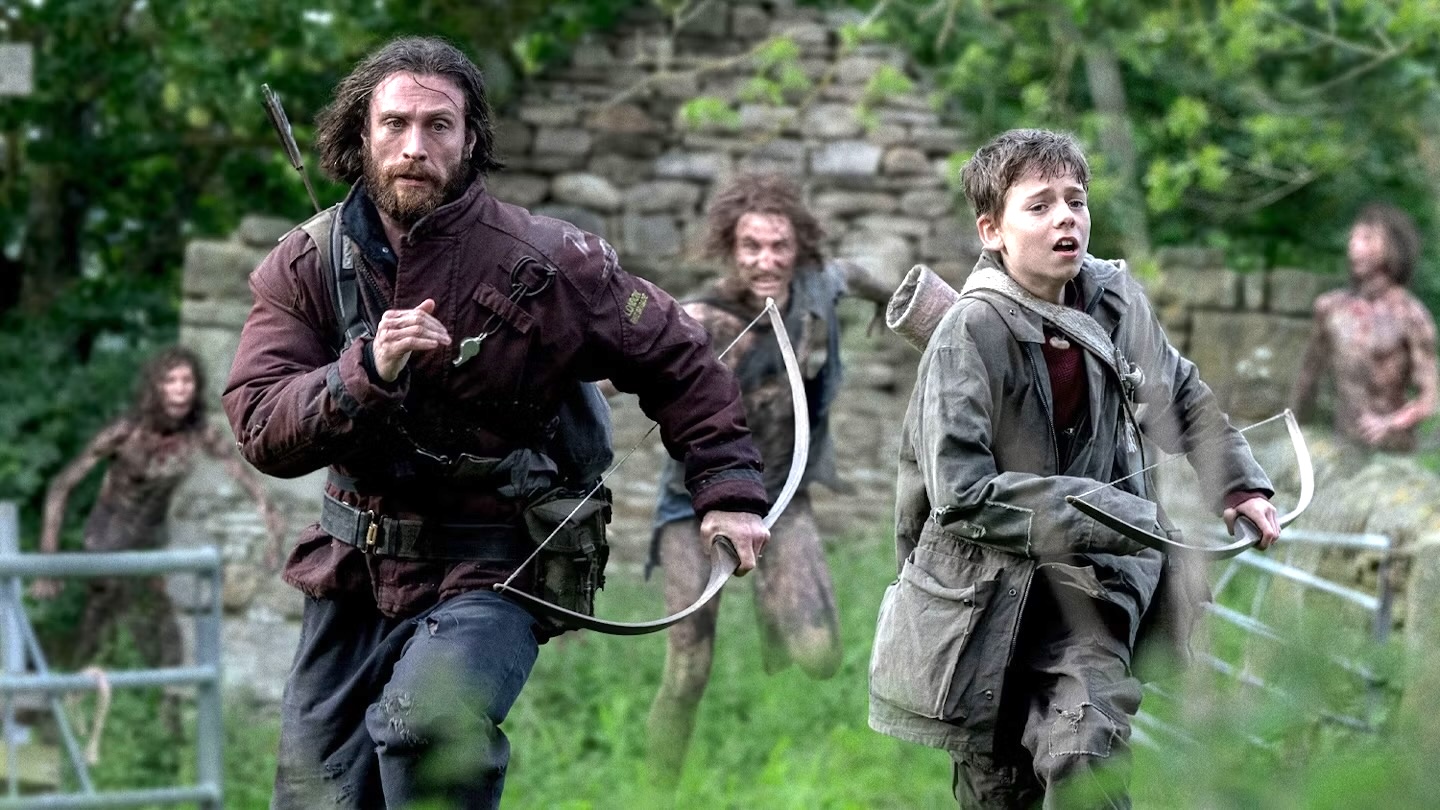
Time has moved on – by 28 years to be exact – and a community of survivors has been established on a remote island in the North East, connected to the mainland by a narrow causeway. This can only be crossed for a few hours each day at low tide, and the entrance gates are guarded around the clock. Spike (a strong performance from newcomer Alfie Williams) is thirteen years old and his father, Jamie (Aaron Taylor-Johnson), is preparing to take him to the mainland, where, in a long-established custom, he will kill his first ‘Infected’ with a bow and arrow. Spike goes along with the plan, even though he’s desperately worried about his mum, Isla (Jodie Comer), who is afflicted by a strange illness that makes her prone to forgetting who (and where) she is.

When Alfie hears talk of a mysterious doctor living somewhere out on the mainland, he decides to take his mum off the island in search of a cure…

This is a fabulous piece of cinema, shot almost entirely on iPhones, and crammed with so many references and allegories that it’s hard to take them all in with just one viewing. The community of uncompromising Geordies, proudly waving their St George flags and getting on with the basics of everyday life have completely shut themselves off from everything that’s happening over the water – and the filmmakers have taken considerable pains to establish the world building, making it all seem entirely credible. It’s very hard not to read this as a searing condemnation of Brexit and, in my opinion, that’s the filmmakers’ intention.

There are elements of folk horror woven into the script and the eerie atmosphere is beautifully accentuated by the music of the Young Fathers and the use of an old recording of Rudyard Kipling’s militaristic poem, Boots.

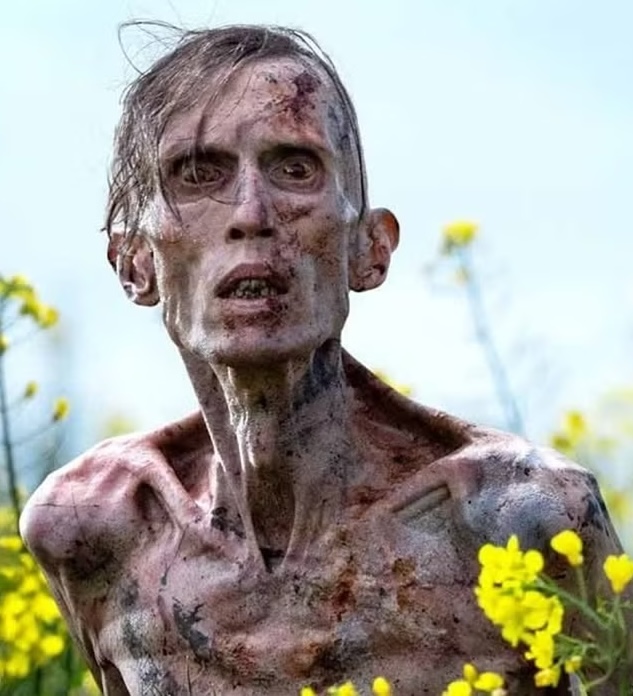
The first part of the story feels the most familiar. That hunting trip on the mainland gets out of hand and plunges Spike and Jamie headlong into the terrifying world of the Infected, where a new, faster, more powerful breed – The Alphas- are ruling the roost. These scenes are brilliantly handled with the suspense ramped up to almost unbearable levels. However, the second section heads off in an entirely different direction, introducing a detachment of Swedish Navy troops, who have been patrolling the UK coastline, and whose boat has run aground nearby. When Spike and Isla bump into young soldier, Erik (Edvin Ryding), the only survivor of his group, he provides some much-needed weaponry to help them to their destination.

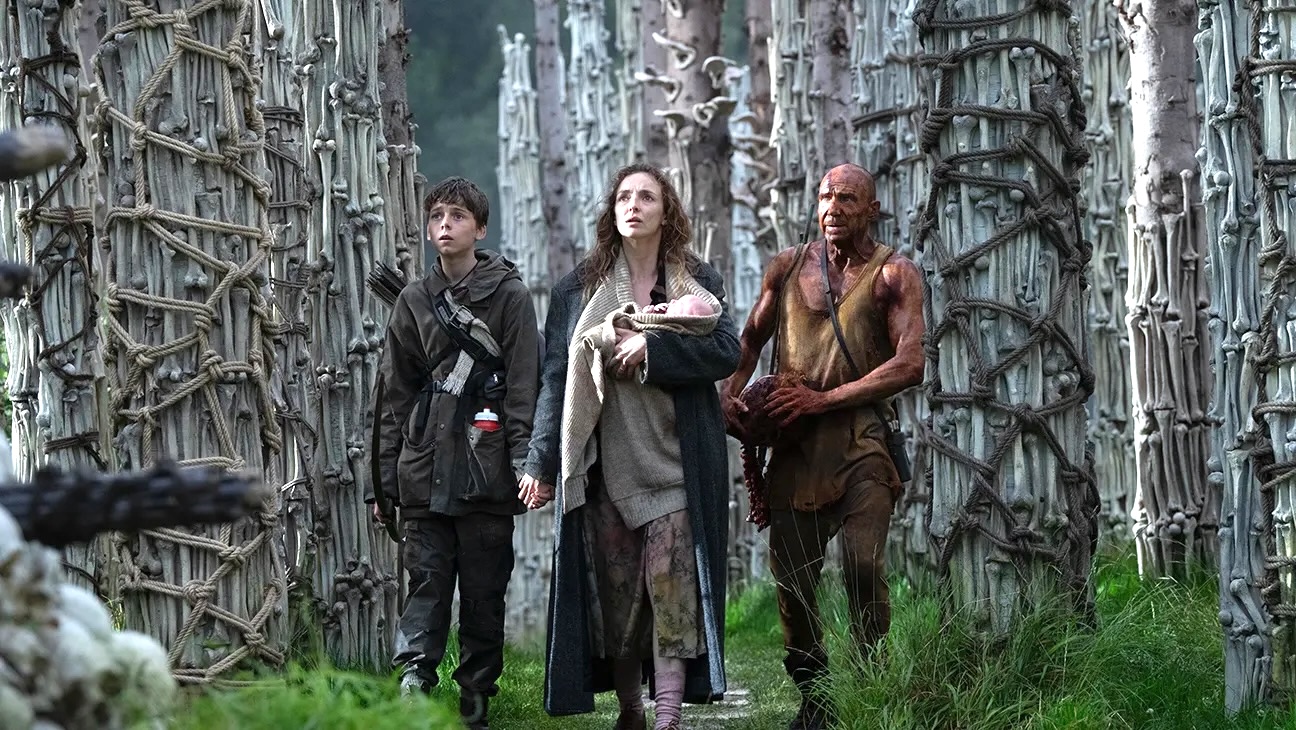
The film’s third section adds a plaintive and poignant note to proceedings as Isla’s plight becomes ever-more heartbreaking. When she and Spike finally encounter Dr Kelson (Ralph Fiennes), he’s living a monastic existence in the midst of a self-constructed homage to death, which he calls his memento mori. The character’s powerful resemblance to Captain Kurtz (from Apocalypse Now) is too marked to be accidental and Fiennes gives the character a calm, solemn dignity amidst all the madness.

And then we’re handed a conclusion so off the charts that it is sure to be divisive. It immediately solves a puzzle, established in the film’s opening scenes, while also offering disturbing questions about a character who has (quite literally) somersaulted into the storyline.

28 Years Later is a dazzling, uncompromising slice of horror cinema, that does the seemingly impossible: both continuing an established franchise and simultaneously reinventing it. I can only say that I can’t wait to see where this goes next.

5 stars

Philip Caveney

Megalopolis

03/10/24

Cineworld, Edinburgh

Well, I can’t say I wasn’t warned. Francis Ford Coppola’s long-nurtured passion project, Megalopolis, arrives garlanded with the kind of vitriolic advance reviews that instantly sank its chances of making any money at the box office. But why all the furore? What has the man done that’s so unspeakable? You’d think he’d murdered somebody. Instead, at the age of eighty-six, he’s made a vanity project, self-financing the hundred million dollar film by selling one of his vineyards. (We’ve all been there.) He hasn’t bankrupted a movie studio, which makes a refreshing change.

Lest we forget, Coppola has made some underwhelming films before. Yes, he gave us The Conversation, The Godfathers (One and Two) and of course, Apocalypse Now, but there was also One From the Heart and er… Jack, both of which were less than perfect.

It’s important to note that right from the opening credits, Megalopolis is described as ‘A Fable,’ so those who describe it as ‘unrealistic’ may be missing the point.

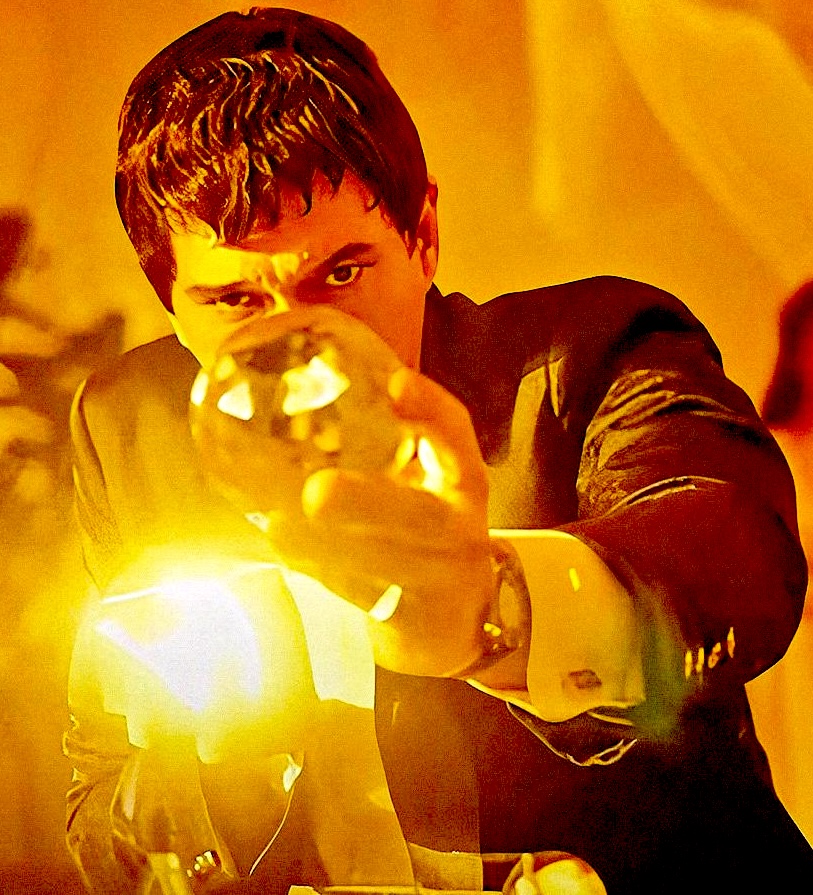
Somewhere in an imagined future, New York has become New Rome, and those that run the city have taken on the aspects of senators and emperors, strutting around in toga-like garments and looking very pleased with themselves. Cesar Catalina (Adam Driver) is a sort of genius / town-planner, who has discovered a mysterious and indestructible building substance called Megalon. He has also found a way to stop time by clicking his fingers (as you do) and has a penchant for lapsing into Shakespeare soliloquies for no apparent reason.

Cesar is currently intent on building the titular inner city area, which he believes will be the first step in creating a bright new future, but his main adversary in this project is Mayor Cicero (Giancarlo Esposito), who seems to be opposed to any kind of progress. Cicero’s daughter, Julia (Nathalie Emmanuel), on the other hand, finds herself increasingly drawn to Catalina and it’s not long before sparks begin to fly between them. It’s clearly going to cause trouble.

There are other powers at work in the city. TV presenter, Wow Platinum (Aubrey Plaza), is suffering from failing audience figures and is keen to take a step up in the world by marrying Cesar’s rich uncle, Hamilton Crassus III (Jon Voight). She uses her nephew, Clodio (Shia LaBeouf), to help her to get there, by any foul means he can devise. (The odious Clodio is clearly inspired by Donald Trump, right down to the bloody insurrection he foments and is perhaps the one place in the ‘fable’ that does relate to real life.)

Overall, Megalopolis doesn’t work and it’s not that it’s short of ideas. On the contrary, it is virtually struggling to contain them all and it doesn’t help that there are too many big names in cameo roles here, most of them improvising their lines. The likes of Dustin Hoffman and Talia Shire flit briefly across the screen and it feels as though Coppola, having secured their services, is unsure of exactly what to do with them. Sometimes, when you work too hard on a project, you stop seeing it objectively.

On the plus side, the film looks magnificent in IMAX, a succulent, shimmering wonder to behold (Coppola did his own cinematography) and, in the film’s latter stages, there are sequences that might best be described as psychedelic, the massive screen appearing to erupt at regular intervals in a blaze of light and colour. If you’re going to see this, do try to catch it in the cinema, because its going to lose all of its majesty on streaming. The running time of two hours and eighteen minutes soon elapses and, after everything that Coppola has given us over the years, surely it’s not too much to ask that movie buffs make the effort to actually go out to see it.

3 stars

Philip Caveney

Da 5 Bloods

12/06/20

A new Spike Lee film is generally a cause for considerable excitement. From She’s Gotta Have It, way back in 1986, to Do the Right Thing and his recent renaissance with BlackKkKLansman, Lee has always been the master of righteous indignation, a director whose beliefs are right at the forefront of his work and who never backs down from uncomfortable truths. And of course, in the time of Black Lives Matter, his voice carries extra authority.

And now here’s Da 5 Bloods, released without much trumpeting onto Netflix. It opens like a documentary, complete with vintage footage of Muhammed Ali and Malcolm X and shocking images from the war in Vietnam – indeed, the references come so thick and fast over the opening credits, it’s hard to keep up with them.

Yet, this is no documentary. The meat of the film is a story about four Vietnam veterans, who reunite to go back to their old battleground on a seemingly altruistic mission to recover the remains of their late comrade, ‘Stormin” Norman (Chadwick Boseman), buried somewhere deep in the jungle. But there’s another, less laudable reason for their return.  Concealed near his grave is a cache of American gold bullion, originally intended to pay South Vietnamese allies. The four amigos, Paul (Delroy Lindo), Otis (Clarke Peters), Eddie (Norm Lewis) and Melvin (Isiah Whitlock Jnr), see no reason why they shouldn’t collect that at the same time. After all, haven’t they paid for it in blood, sweat and tears?

At the last instant, they are joined by Paul’s son, David (Jonathan Majors), who is cut in for a share. And off they go into deep jungle, assisted by a Vietnamese guide, Vinh (Johnny Nguyen), and financed by shady French entrepreneur, Leroche (Jean Reno), in a story that openly references the likes of Apocalypse Now and, more specifically, John Huston’s classic adventure,  The Treasure of the Sierra Madre.

As ever with Lee, there’s no doubting the sincerity of his vision, and it’s clear that his anger about the way black troops were used as cannon fodder during the war is the heat that fuels this adventure – but it also has to be said that much of what goes on in deep jungle feels decidedly far-fetched and at times (dare I say it?) a crushingly predictable take on The Pardoner’s Tale. We also witness flashbacks to the foursome’s time as soldiers, where the eponymous bloods look exactly the same as they do now and Norman, young enough to be their son. Of course, this is intentional (it’s them looking back on the events) but it’s a bold move that takes a little getting used to.

Ultimately, Da 5 Bloods is neither fish nor fowl. It could either have been a powerful documentary about the exploitation of black lives at a time of war, or a gung-ho rumble- in-the-jungle adventure, mixing laughter and violence in equal measure. With typical ambition, Lee tries for both with the result that neither strand feels entirely convincing. It’s also puzzling when a director with such a breadth of experience allows an absolutely risible plot point to make it on to the screen. (You’ll know it when you see it.)

Da 5 Bloods has already been garlanded with high praise from several quarters, but for me, at least, it’s not up there with Lee’s finest work. What’s more, with a running time of two hours and thirty four minutes, there are sections here that feel more gruelling than they needed to.

3.6 stars

Philip Caveney


Monos

30/10/19

In a remote mountain hideout, somewhere in Colombia, eight teenage guerrillas are killing time. They belong to some unspecified rebel organisation, and their main purpose is to watch over an American captive, referred to simply as Doctora (Julianne Nicholson). The youths all have the anonmity of nicknames and they pass the long hours playing bizarre sports, exercising, arguing, having sex and recklessly discharging semi-automatic weapons, in some cases with catastrophic results.

From time to time, The Messenger (Wilson Salazar) rides over the hill and puts these feral youngsters through the wringer, instructing them to work their bodies to the limits of their endurance, encouraging them to inform on each other in order to further exert his malign influence over them. We learn nothing about the organisation they work for – or even why Doctora is being held hostage in the first place – but strangely, this all serves to make writer/director Alejandro Landes’ story ever more mesmerising as it unfolds.

There’s so much to relish here: the stunning location cinematography, the raw performances from the young actors (particularly from Sofia Buenaventura as the conflicted ‘Rambo’) and the oppressive feel of the isolation the eight-strong team are forced to endure. Watching this is an ordeal, but in the best sense of the word.

In the second half, after a violent skirmish with Doctora’s would-be rescuers, the team take their captive into deep jungle, where she attempts to engineer an escape – and the film veers into action/adventure territory. There are breathless chases and dangerous plunges down wild river rapids, all of which keep me perched on the edge of my seat right up to the final shattering frame.

There are evident references to other stories here, most noteably to William Golding’s Lord of the Flies – indeed, one scene is a direct homage to it. There are other images that wouldn’t look out of place in Apocalypse Now or Aguirre: Wrath of God. But such comparisons can sometimes serve to diminish a film’s worth, and Monos is very much its own creature, a brilliant and intelligent meditation on the nature of indoctrination.

If you can see this on the big screen, so much the better. It’s a stunner.

5 stars

Philip Caveney

Apocalypse Now: The Final Cut

04/09/19

Some film directors have an unfortunate habit of revisiting their earlier successes and producing new versions of them. But is it always the wisest move?

Apocalypse Now is a good case in point. It’s rightfully acclaimed as one of the greatest war (and anti-war) movies ever made, but Francis Ford Coppola will keep returning to the well and tinkering with his masterpiece. Now here we are on the 40th anniversary of its release and he’s gone and done it again, assembling a version that weighs in at a hefty three hours and two minutes.

I first saw the original in 1979, when it was a mere at two hours and twenty-seven minutes. It had been a weird kind of day. Cycling through Manchester, I was kicked off my bike by a football supporter through the open window of a passing car. Understandably shaken, I found a young policeman, helpfully hiding in a shop doorway, who told me that a visiting football team was running riot in the city centre. He advised me to ‘lie low’ for a while.

A bit further along Deansgate, the ABC Cinema was showing Apocalypse Now, and a war movie felt somehow appropriate. So in I duly trooped and was promptly blown away by what I saw. Coppola’s transposition of Joseph Conrad’s Heart of Darkness to the jungles of war-torn Vietnam felt masterful. Indeed, I watched it again only a few weeks later at the infamous Aaben cinema, where it was given added mystique by the fact that pretty much everybody at the screening was smoking dope. Er… far out.

But then in 2001 along came Redux and, with it, an extra forty-nine minutes of footage that had been excised from the theatrical release, including the French Plantation Sequence – three words that still strike horror into my heart. This seemingly interminable section where Captain Willard (Martin Sheen) eats a meal and is given a long lecture on Vietnam’s troubled history by the plantation owner has the unfortunate effect of stopping the film dead in its tracks. Was I the only movie fan who, on seeing the words ‘The Final Cut,’ fervently hoped that Coppola had actually shortened the running time by taking a large pair of scissors to this bit?

No such luck. There’s even more of it now. And it fatally wounds the film.

The problem is, it’s followed by the (already glacially slow) final set piece and any goodwill that the previous two thirds has earned itself evaporates all too quickly, as we watch Marlon Brando sitting in the darkness and mumbling incoherently.  Also, it must be said, that the ending – based on Conrad’s colonial-era novel with its white saviour storyline – looks a little dodgy when examined in the cold light of the present day.

A pity then, because – as ever – the film looks absolutely gorgeous, especially on the huge Imax screen. Many of the scenes have passed into movie legend, together with quotes from John Milius’s script (‘I love the smell of napalm in the morning’ – ‘Charlie don’t surf!’ – ‘Terminate with extreme prejudice,’ to name but three). The helicopter battle scenes are unparalleled and the film expertly portrays the complete insanity of war, depicting Willard’s upriver journey as a dark descent into his own battle-damaged psyche. Oh, and there’s also fun to be had watching out for early performances by Harrison Ford and Laurence Fishburne in supporting roles.

The original Apocalypse Now is undoubtedly a brilliant and unforgettable piece of cinema. This version (and it almost hurts me to say it) squanders its own strengths by giving its director free reign to put back things that were, for very sound reasons, removed in the first place. Those with weak bladders take note: time your toilet break to coincide with Willard’s arrival at the French plantation.

And take your time. Trust me, you won’t miss anything.

4 stars

Philip Caveney

Kong: Skull Island

11/03/17

I’ve long had a soft spot for King Kong. I saw the original movie – on TV – when I was very young and instantly fell for Willis O Brian’s famous stop-motion creation; and I’m one of those people who adored Peter Jackson’s affectionate and brilliantly crafted reboot of the story. So the news that Kong: Skull Island was on the cinematic horizon, as a taster to his grudge match with Godzilla, some time next year,  was greeted with a certain amount of cautious anticipation.

This standalone creature feature is a bit of an oddity, a curious mash-up of classic Kong and, of all things, Apocalypse Now. Set in 1973, just after America’s hasty departure from the Vietnam War, we learn of a proposed expedition to an uncharted island in the South Pacific, led by Bill Randa (John Goodman). Randa claims he’s looking for rare minerals but it’s clear from the outset that he has a hidden agenda. He enlists the help of Vietnam veteran Preston Packard (Samuel L Jackson) and his helicopter platoon to ferry the necessary equipment through the perpetual electrical storm that cloaks the island and, he also ropes in survival expert, James Conrad (Tom Hiddleston as the poshest mercenary in history) plus photo journalist Mason Weaver (Brie Larson) to record everything that happens on the trip. The helicopters go in, not to the strains of Wagner, but to the 70s rock soundtrack of Creedence Clearwater Revival and they drop a series of explosive charges on the island in order to scare up anything that might be hiding in the undergrowth. Whereupon, the titular 100 ft tall ape appears out of the smoke and gives the platoon a right royal kicking.

Kong, as imagined by Industrial Light & magic, is a truly magnificent specimen; and as the survivors of the initial assault soon discover, he’s only one of the gigantic creatures that inhabit Skull Island. Worst of all are the Skull Crawlers, hideous two legged lizards that occasionally emerge from underground intent on eating anything they can find. (They ate Kong’s parents so naturally, he bears the a lot of ill will).

OK, so this isn’t exactly a perfect film. The large human cast are inevitably dwarfed by the gigantic creatures pursuing them and any attempts at characterisation can only be sketched in with the broadest of brush strokes. (It’s interesting to note that Jackson’s film spent the best part of an hour with the human characters before they even reached Skull Island, but then he had three hours to play with). And really there are a lot of humans to consider here , though best of the bunch is undoubtedly John C Riley as Hank Marlow, a World War 2 pilot who has been marooned on the island for twenty eight years and who has gone slightly loopy waiting for rescue. (Marlow bears more than a passing resemblance to Dennis Hopper’s character in Apocalypse Now, and this cannot be a coincidence – nor the fact that Hiddleston’s character is called Conrad, author of Heart of Darkness on which Apocalypse Now is based).

At any rate, director Jordan Vogt-Roberts does a decent job of stitching it all together. There’s enough references to the original to keep fan boys like me happy and enough major characters being offed to keep me on the edge of my seat. I also loved the audacious twist on the ‘soldier sacrificing himself in a blaze of glory’ trope towards the film’s conclusion, which seemed to spell out how futile such gestures are.

This won’t please everyone, but I have to say I was entertained enough and occasionally thrilled by a concept which dared to throw so many new ideas at a classic storyline, that some of them had to stick. Skull Island is a fun place to visit and Kong is still my favourite movie monster.

4 stars

Philip Caveney