Aneurin Barnard

Mr Burton

11/05/25

Cameo Cinema, Edinburgh

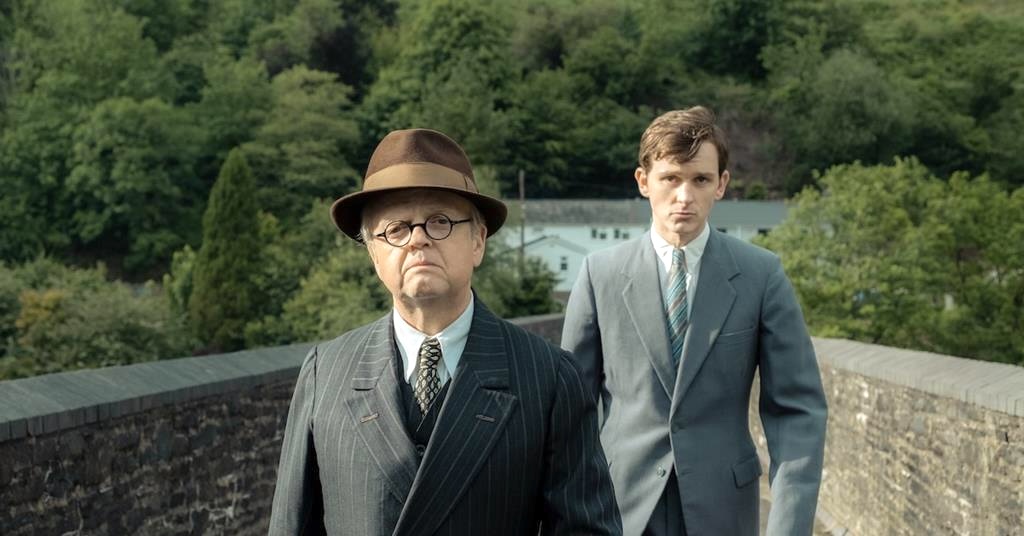
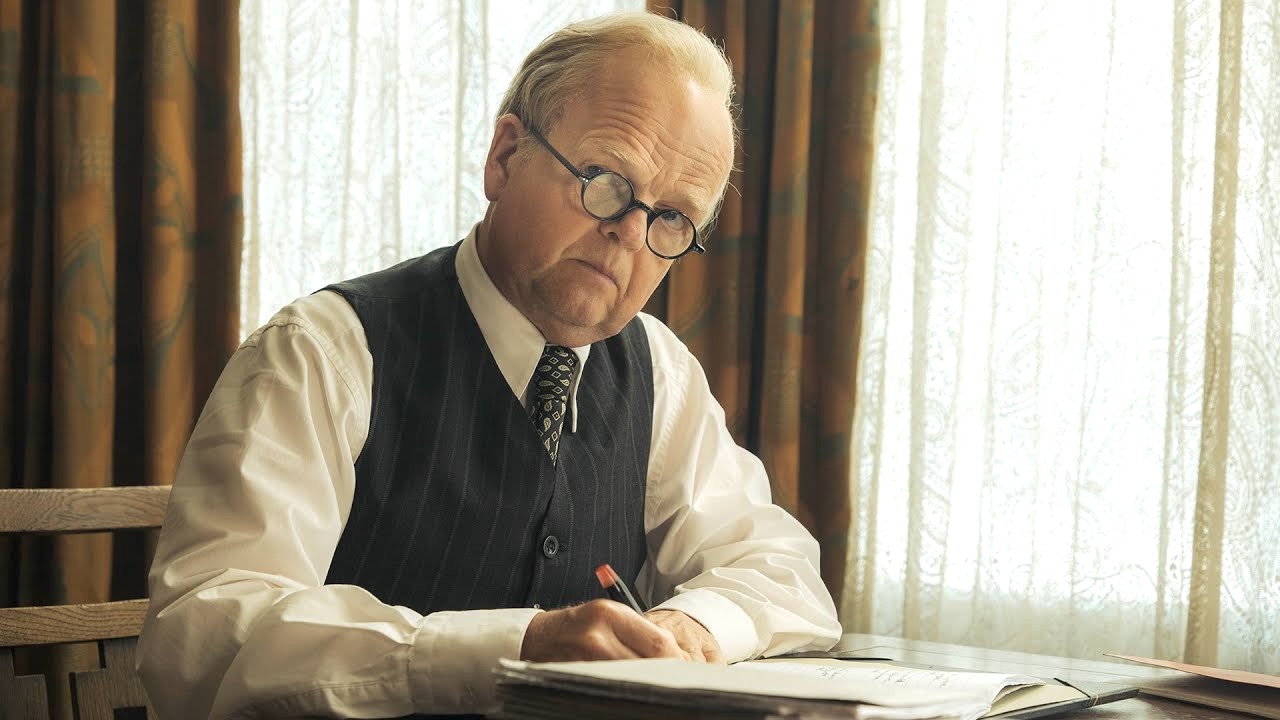
The theme of the ‘inspirational teacher’ is a well-worn cinematic device but, in the case of Mr Burton, it does have the advantage of being true. The titular Mr B (impeccably played by Toby Jones) is a quiet, but authoritarian teacher in a little school in Port Talbot, a man nursing his own thwarted ambitions as a playwright.

We join the story in 1942, when Mr Burton is doing his level best to instil a love of Shakespeare into his students, despite the glowering presence of the coal mines that threaten to claim those young men who are not thrown into the maelstrom of the Second World War. Burton is somewhat bemused to discover that the pupil who has the strongest response to his English literature lessons is Richard Jenkins (Harry Lawtey), a boy all-but abandoned by his coal miner father, Dic (Steffan Rhodri). Richard is obliged to live in the overcrowded home of his sister (Aimee Ffion-Edwards) and her resentful husband, Elfed (Anuerin Barnard).

When Richard shows considerable promise in a amateur production set up by Burton, the teacher is prompted to take the boy under his wing, giving him lessons in elocution in an attempt to erase his local accent, even finding him (and paying for) accommodation with his landlady, Ma Smith (Lesley Manville). Inevitably, tongues begin to wag as suspicious observers cast doubt on Mr Burton’s intentions.

When he takes the step of adopting the boy and lending him his surname, in the hope of getting him a scholarship at Oxford, the gossip intensifies…

Written by Tom Bullough and Josh Hyams and directed by Marc Evans, Mr Burton is an atmospheric period piece that captures the hardscrabble era in which it’s set. Jones is as assured as ever in a role that allows him to give little away, while Leslie Manville is a perfect foil for him – and makes a very decent fist of the Welsh accent. But it’s Lawtey’s star-making turn as Richard Jenkins/Burton that provides the heart and soul of this film. He’s utterly convincing as a shy, vulnerable teenager in the first half and then, when the action skips onward several years, convincingly nails Richard Burton’s sonorous tones and lithe sexuality, as he struggles to come to grips with his breakthrough role as Prince Hal in Stratford.

Lawtey’s astonishing transformation – and the astute comparison with the way that Hal shrugs off his former mentor, Falstaff in Henry IV – ensures that Mr Burton is a riveting piece about the importance of nurture and the many ways in which teaching can provide that all-important first step on the path to greatness.

4.4 stars

Philip Caveney
Timestalker

13/10/24

The Cameo, Edinburgh

The release of a new Alice Lowe film is a cause for celebration. Actor/writer/director – and as far as I know, she might do the catering as well – Lowe is adept at ensuring that a modest budget goes a long, long way. Her debut feature, Prevenge, was released way back in 2017, shot while she was pregnant (of course it was), so Timestalker has been many years in ahem… gestation. It’s probably best described as a fantasy set across hundreds of years, and the central theme is the general futility of pursuing the heart’s desire.

We first meet Agnes (Lowe) in the 1600s in Scotland, where she’s a lonely spinster, much gossiped about by her neighbours, who pays the occasional visit to a masked preacher, a man given to talking about the dawning of a new religion. When said preacher is arrested and brought to a public place for torture and execution (they made their own entertainment those days), his mask is removed, revealing the handsome face of actor Aneurin Barnard. Agnes is instantly and irrevocably smitten. Attempting to approach him, she trips and falls face first onto the executioner’s axe, which is the bloody end of her.

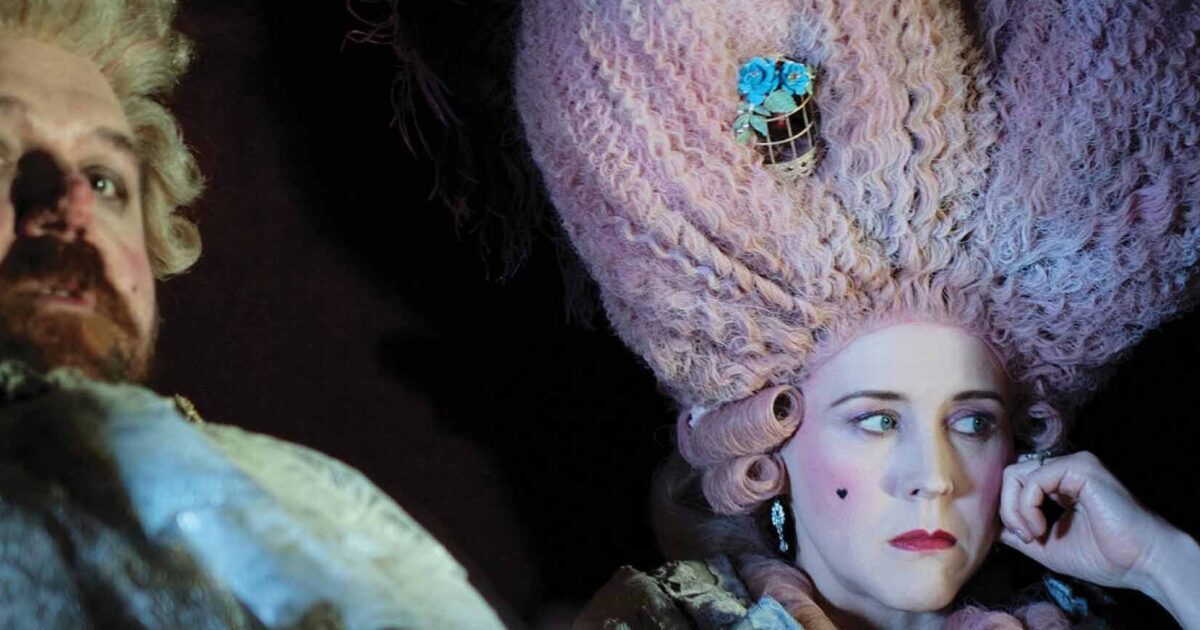
Except that it’s not. She’s promptly reborn in the 1790s, rich but bored, with a toxic husband played by Nick Frost. This Agnes has a penchant for wearing some truly monumental wigs but she’s missing something in her life. When she spies the visage of a handsome highwayman – Barnard again – her passion is reignited and she is, once more, in pursuit of love. But of course it’s doomed to end badly. With each transformation, her luck fails to improve and an added problem is that every new persona harbours memories of the one before… and where exactly does Cleopatra fit into all this?

Lowe’s sparky script is laced with deadpan humour, and cinematographer Ryan Eddleston has a lot of fun aping the look of celebrated films. If the opening sequence is Witchfinder General, then the 80s New Romantic section has the muted, pastel tones of Adrian Lyne’s Flashdance – and Lowe has the perm to back it up. Sadly, the budget doesn’t quite stretch to making the Manhattan locations look entirely convincing.

Tanya Reynolds does a good job of embodying the various iterations of Agnes’s perennial sidekick, Meg, and Jacob Anderson is quietly impressive as different versions of a character simply known as Scipio. Frost continues to be suitably malevolent in every loathsome bloke he portrays.

While it might sound faintly bewildering on the page, the myriad twists and turns of the plot are confidently handled and there are some cleverly placed visual clues – a huge heart hidden in a forest, a brightly plumaged songbird in a cage – to keep reminding us of what’s gone before.

As ever with Lowe’s work, the spirit of pure invention is kept proudly to the fore and I find myself wondering what this formidable film maker could achieve given a hundred-million-dollar budget. Until that unlikely event actually happens, why not seek out your nearest independent cinema and sample the delights of her latest gem? It’s well worth your time and money.

4 stars

Philip Caveney

The Goldfinch

28/09/19

I somehow never got around to reading Donna Tartt’s The Goldfinch. I loved her debut, The Secret History, but was not so enamoured of The Little Friend. Eleven years after reading a book I admired but did not enjoy, of course I wasn’t going to be first in the bookshop queue when The Goldfinch was released. Still, I have retained enough interest in Tartt’s work to pop along to Cineworld and give director John Crowley’s movie version a few hours of my time.

I’m glad I do, because it’s an interesting tale. I’ve read a few quite harsh reviews, but I don’t agree with those. It’s not perfect: the pace is glacial at times, and adherence to point-of-view means that some of the most exciting sequences happen off-screen. Theo’s sense of detachment permeates the movie and sometimes leaves us feeling rather detached too. And the one-hundred-and-forty-nine minute running time tests my patience somewhat: half an hour could be cut from this without sacrificing much.

But still. The plot is all convolution, contrivance and coincidence, but I don’t mind a jot. It works. Theo Decker (Oakes Fegley/Ansel Elgort) is at an art gallery with his mum one morning, passing the time before a meeting with Theo’s middle-school principal: he’s been caught with cigarettes. They never make it to the meeting, because a bomb explodes, killing Theo’s mum (Hailey Wist). As the dust clears, Theo sees Welty (Robert Joy), an old man at the gallery with his young niece, Pippa (Aimee Laurence/Ashleigh Cummings). With his dying breath, Welty gives Theo a ring, tells him where to take it, and urges him to rescue a priceless painting lying in the rubble. Theo puts the picture in his bag and stumbles home.

He’s taken in by the Barbours; he’s friends with their son, Andy (Ryan Foust). They’re a wealthy family, kindly but cold. Mrs Barbour (Nicole Kidman) in particular is stiff and uptight, doing her duty but with little compassion. As time passes, however, she becomes fond of Theo, and he starts to feel like he belongs.

Until his wastrel father (Luke Wilson) shows up with his latest girlfriend, Xandra (Sarah Paulson), and Theo is hauled off to the Nevada desert, where he befriends a Russian goth called Boris (Finn Wolfhard/Aneurin Barnard). He’s still got the titular painting though: his talisman, his link to his mother.

And when the wheels come off again, he makes yet another new start…

Nicole Kidman is the best thing about this film: she’s luminous and utterly convincing at all times. But the acting is uniformly good, the young cast particularly impressive in these demanding roles.

The film looks ravishing. The desolation of the abandoned housing estate in Nevada is beautifully rendered, the antique repair shop appears marvellous and magical.

The ending, however, feels a little deflating, the action occurring out of Theo’s (and therefore our) sight. Despite this, I think The Goldfinch is a decent film, and I might just purchase the novel now.

3.5 stars

Susan Singfield