Ali Craig

Sunset Song

30/05/24

Lyceum Theatre, Edinburgh

Lewis Grassic Gibbon’s Sunset Song is widely regarded as one of the most important Scottish novels of the 20th century. There are many who first encountered it as a set text in school and have carried it in their hearts ever since. Playwright Morna Young was evidently one such teenager and this is her adaptation of the tale in collaboration with Dundee Rep. I’ll confess that I’ve never got around to reading the book myself. Set in the 1900s, it’s a dour and sometimes bleak story based around the misadventures of the Guthrie family, farmers who live and work in (the fictional) Kinraddie in the wilds of Aberdeenshire.

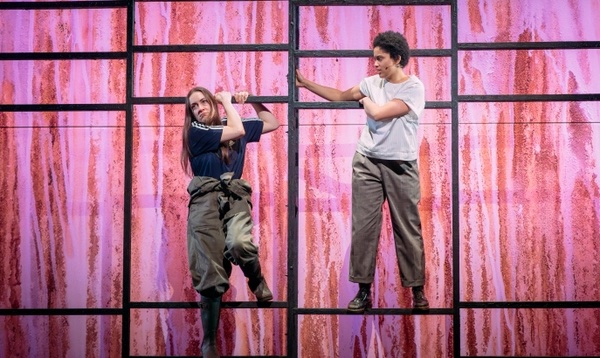
When we first meet Chris Guthrie (Danielle Jam), she’s young and ambitious, a keen reader and already planning to seek a career as a teacher. In this, she has the grudging support of her father, John (Ali Craig), though he’s a hard taskmaster, never slow to hand out physical punishment to Chris and her siblings whenever they step over what he perceives as ‘the line.’ 

Chris’s much-loved mother, Jean (Rori Hawthorn), mentally broken by the recent birth of twins, takes matters into her own hands, killing herself and her new babies. Two younger children decide to flee  the family home to start a new life in Aberdeen and it isn’t long before Chris’s older brother, Will (Naomi Stirrat) follows their example and heads off to seek his own fortune in Argentina. This leaves Chris to run the farm with her father and, after he suffers a debilitating stroke, to fend off his sexual advances. When tragedy strikes yet again, Chris finally has an opportunity to start over but (maddeningly) she decides to stay where she is and marry local boy Ewan (Murray Fraser). But by now, the world is heading into a massive global conflict and it’s hardly a spoiler to say that more heartbreak is looming on the horizon…

While it does of course feature more than its fair share of harrowing occurrences, it’s to this production’s credit that it manages to convey difficult themes without ever feeling too prurient. Young’s adaptation remains true to the novel’s Doric dialogue, though occasionally I feel I’m told things that I would rather see – and the decision to have no costume changes when actors embody several different characters does mean that I’m occasionally confused as to who is who.

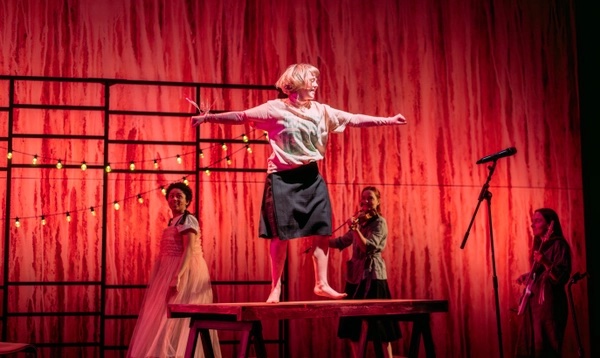
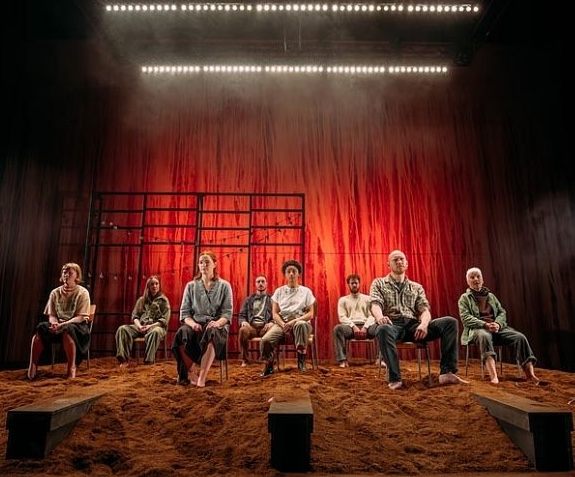
Emma Bailey’s simple but effective set design is based around a large rectangular section of soil, across which the characters walk barefoot, fight, make love and celebrate. The story’s central theme couldn’t be more evident. To the Guthries, the earth is all-important. It provides sustenance, a wage and a reason to go on living. And of course, it is also the place to which they will eventually return. As if to accentuate this, the backdrop is a closeup of a field of wheat.

On either side of the soil, musical instruments are arranged and the cast occasionally break off to deliver Finn Anderson’s evocative songs, singing in plaintive harmonies, pounding propulsive drums, strumming electric guitars and at one point even launching headlong into a spirited wedding ceilidh. These elements offer a welcome respite from the unrelenting bleakness of the story.

Finn de Hertog’s direction is assured and I particularly enjoy Emma Jones’ lighting design, which manages to convey that simple slab of soil in so many different ways. I like too that many of the props the actors require are clawed up out of the ground like a strange crop.

But much as I’d like to, I can’t really warm to the story, which at times feels uncomfortably like a series of disasters unleashed upon one luckless family.

3.6 stars

Philip Caveney

Fibres

29/10/19

Traverse Theatre, Edinburgh

Fibres is Frances Poet’s ‘heath and safety’ play, an emotive response to her discovery that an acquaintance had lost both parents, six months apart, due to asbestos poisoning. Poet’s perception of asbestos as ‘something dangerous from the past’ was exposed as a fallacy; subsequently, she learned that more people die of asbestos-related illnesses each year than die in traffic accidents, that the NHS will be footing the bill for corporate greed/negligence until 2040. Mesothelioma takes between twenty and fifty years to develop, and even brief exposure is enough to kill.

Indeed, the brevity of exposure is a key feature of this play. Jack (Jonathan Watson) only works as a shipbuilder for a few days; he’s nervous about the asbestos dust he’s been warned about, so takes a pay cut and becomes an electrician. He thinks he’s dodged a bullet. His wife, Beanie (Maureen Carr), washes his overalls, a simple domestic act fraught with symbolism, as the fibres enter her lungs too.

As you might expect from Poet, there are many layers to be unravelled here; it’s not a simple polemic. There are parallels drawn between the asbestos fibres and the impact of traditional gender roles on a relationship: a slow, invisible poisoning.

Despite the subject matter, it’s not all doom and gloom. Jack and Beanie are a believable couple, muddling through as best they can. They’re facing the horror with fortitude and humour: Jack loves a bit of comedy, and has a catalogue of cringey jokes. Their daughter, Lucy (Suzanne Magowan), is struggling, but her breakdown is shown through a series of bleakly humorous, hide-your-eyes-behind-your-hands-while-your-toes-curl moments.

Breaches in health and safety protocol are given a human face, in the form of Lucy’s boss, Pete (Ali Craig). They work for a fibre optics company, and he’s up against it, trying to meet the demands of a contract while allowing his workers their requisite study days and sick leave. He’s fed up with the union rep’s ‘unreasonable’ demands, preventing him from getting the job done. We’re shown how it happens, how decent people can be pressured into repeating old mistakes. But Pete is given a chance to learn: his fondness for Lucy redeems him.

If this all sounds a bit po-faced, don’t be misled. This plays as a cleverly written domestic tragedy, with a window onto larger political issues. The actors switch between narration and performance; the set (by Jen McGinley) is a fluid, symbolic space, where the characters flit between life and death, the past and the present, dark humour and even darker anger. Jemima Levick’s assured direction ensures that there is no confusion: we always know where and when events are taking place, the pace allowing us time to digest what’s happening.

Fibres is a vital, heartbreaking play with an important message at its core.

4.1 stars

Susan Singfield


Lost At Sea

20/05/19

King’s Theatre, Edinburgh

Morna Young’s seafaring play is a searing, tempestuous examination of fishing communities in the Northeast of Scotland. From the heydays of the 1980s, when the money was rolling in, to the more elitist issues of the early 2000s, when only a select few were still living it large, we are shown the strengths and divisions within these close-knit neighbourhoods and the cruel toll the sea exacts on them.

Journalist Shona (Sophia McLean) returns to the fishing village she left when she was just a child. She is looking for answers: her father, Jock (Ali Craig), died, lost at sea, and she needs to find out more, to know what happened on that fateful day. But the locals close ranks on her: they’ve lost too many; suffered too much; accepted the Faustian exchange that keeps them all in work.

Young’s own father was lost at sea, and this piece blends fiction with that reality. There are verbatim voices – telling of the fishermen’s arduous days at sea and their families’ agonising waits on land – interwoven with constructed dialogue; the authentic details of a fishing life and a fictional account of one woman’s family. It’s a powerful mixture.

There are politics here too: the cameradie and team spirit of the 1980s gives way to a far more cynical individualism and – by 2012 – the community is bitterly divided. Shona’s Uncle Kevin (Andy Clark) has taken advantage of the UK’s strange decision to enable its fishermen to sell their EU quotas to the highest bidder, often to foreign investors. (No other EU country allowed this – for obvious reasons.) In Kevin’s case, it means he’s safe, no longer endangering his life at sea, just staying home and waiting for the money to pour in. But, as Skipper (Tam Dean Burn) reminds him, this means that those around him are risking their lives for an ever diminishing slice of the pie. What price community?

This could be a heavy, sombre tale, but Ian Brown’s nimble direction ensures that it is fleet of foot, as restless as the sea itself. The ensemble work is precise and light, the movement (by Jim Manganello) evoking rolling waves, and turbulent emotions. The spare set (designed by Karen Tennent) lends the piece a stark brutality, with restless projections of a dark and ominous sea.

If we don’t quite get the cathartic thrill of a dramatic climax, we do at least get a thought-provoking piece of theatre, straddling introspection and social commentary. It’s not exactly an easy watch, but it’s certainly most worthwhile.

4 stars

Susan Singfield