Dark Noon

21/08/23

Pleasance EICC (Lennox Theatre), Edinburgh

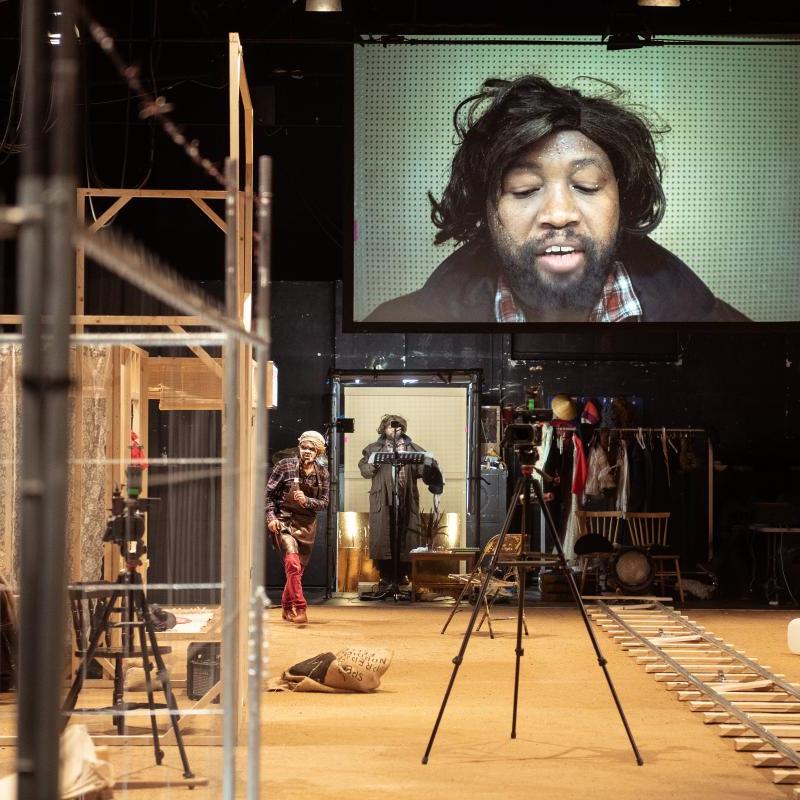
Once in a while, you chance upon a show at the Fringe that almost defies description. Dark Noon is one such show, but I’m a reviewer so I’m going to give it my best shot. This extraordinary co-production between Danish director Tue Biering and South African director and choreographer Nhianhia Mahlangu, is an epic recreation of the American West, seen through the eyes of not the victors but the vanquished – the people from whom the country was stolen.

It’s a shattering, exhilarating experience.

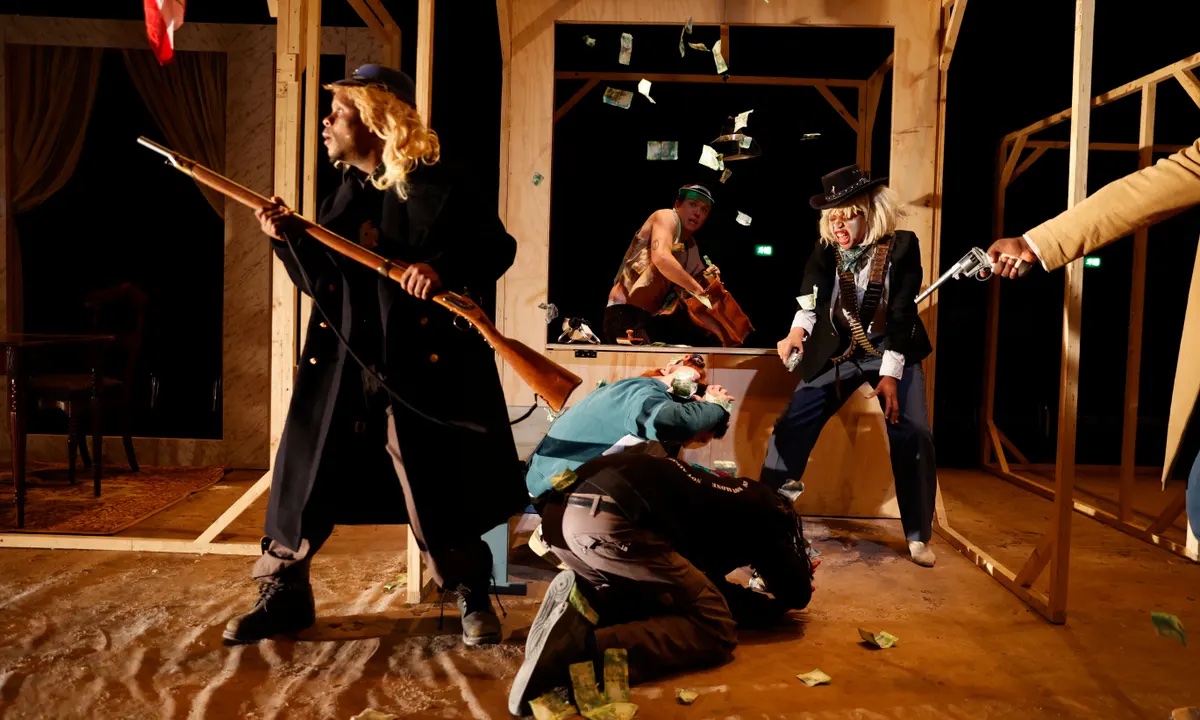
On a dusty expanse of ground, two gunfighters face each other in a scene that could have been plucked from a Sergio Leone movie. They shoot each other and fall in slow-mo – and then, the big screen that hangs over the massive horseshoe stage flickers into life and and actor Lilian Tshabalala talks directly to camera, telling us that we are about to see the story of one place, told in chapters.

We watch the seven-strong company as they race back and forth in a variety of guises, talking, singing, dancing – sometimes dragging members of the audience onto the stage to help create crowd scenes. At first, the actors are figures in an empty landscape but, as the story unfolds, they somehow manage to create a railroad, and then an entire Frontier town, which grows up one structure at a time, as necessity dictates: a homestead, a jail, a store, a brothel, a church and, perhaps inevitably, a bank. The sheer ambition of the undertaking is jaw-dropping.

Along the way, we witness the awful fate of the Native Americans, shot, exploited and eventually locked safely away behind wire fences; we see the mainly Black cast don ‘whiteface’ in order to assert authority over others. We see scenes of casual racism and are witness to fights and rapes and robberies. One by one, all the cosy myths of Western movies are blown to smithereens, right in front of our eyes. Occasionally, even the cavernous reaches of the Lennox Theatre struggle to contain so much action.

This is a unique piece of devised theatre, sprawling and multi-faceted. It’s sometimes funny, but more often it’s shocking and humbling. At the conclusion, the sell-out crowd rises to its collective feet and the applause reverberates around the room like thunder.

Watching this in the final week of Fringe makes me wish I’d seen it earlier, so I could have urged even more people to go and immerse themselves in it. It’s a wonder to behold.

5 stars

Philip Caveney
Where is Love

21/08/23

theSpace @ Surgeon’s Hall (Theatre 3), Edinburgh

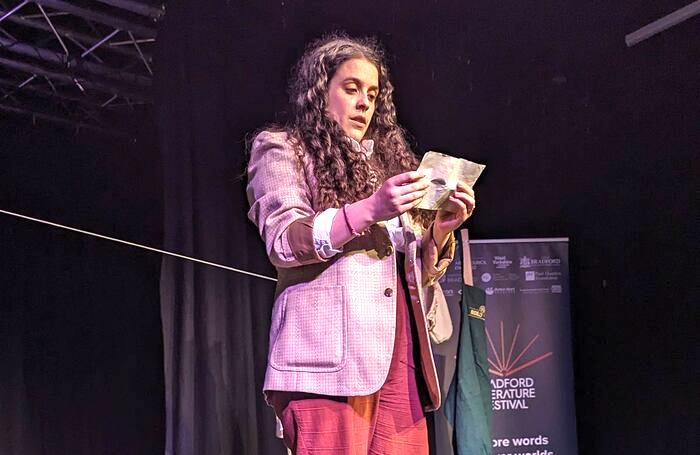
Bloomin’ Buds is a Bradford-based theatre company, founded by Katie Mahon (who also produces this play), with the aim of offering “drama-based support for working class communities who are struggling to access opportunities and the arts due to facing class inequalities.”

This seems especially important at the moment, as the cost-of-living crisis means that people have even less money than usual to spend on ‘non-essentials’, and arts subjects continue to be squeezed in state schools (though still highly valued in private ones… go figure). But, as Dana Gioia says, “The purpose of arts education is not to produce more artists… It is to create complete human beings capable of leading successful and productive lives in a free society.”

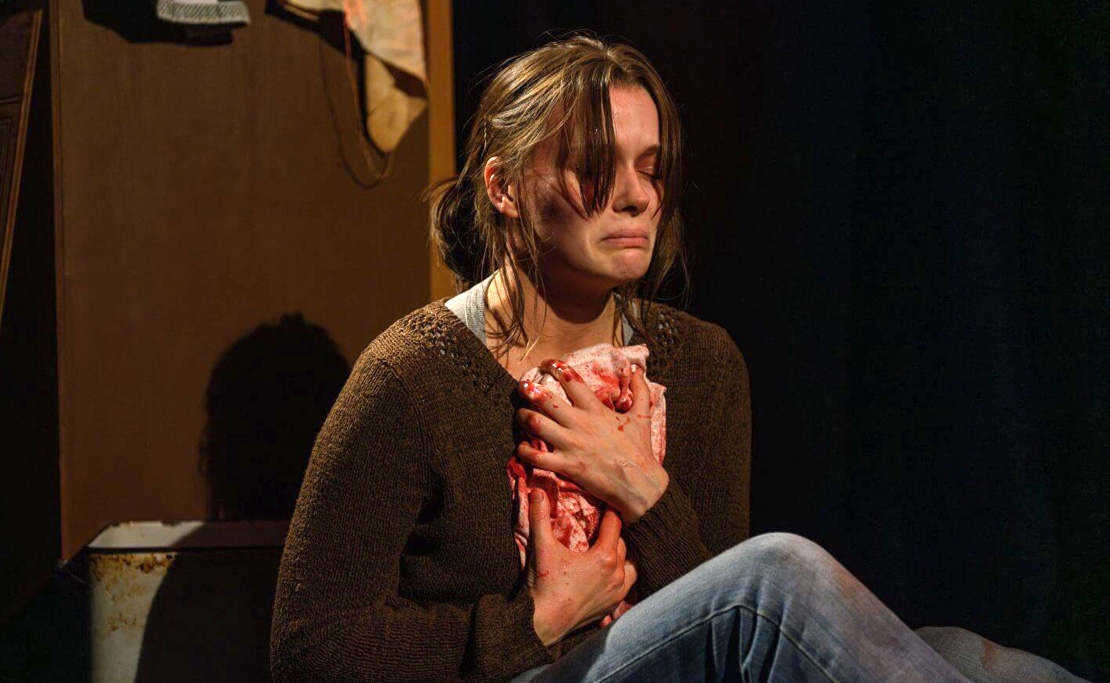
Where is Love‘s protagonist, Shelly (Maeve Brannen), is certainly a complete human being, although she’s not convinced she’ll have a successful and productive life. She’s a fighter; she’s had to be. Abused by her dad and taken into care, Shelly has learned to look after herself. She’s sixteen when she first meets Will and he seems exciting. But several kids and a lot of bruises down the line, Shelly is at breaking point…

This play, written by Jennifer Johnson, is based on a real life story and, if you think you’ve heard it all before, therein lies the tragedy. Shelly’s experiences are anything but unusual: one in three women in the UK experiences domestic violence. Perhaps some elements of the piece could be expanded on – it’s not quite clear, for example, how long a time period is covered, nor how many children Shelly has – but it all adds up to a compelling and surprisingly uplifting tale. The cycle can be broken: Shelly can give her kids the stability she never had and, through her work, help others who’ve been let down by the system.

Brannen performs the monologue with absolute conviction, imbuing Shelly with an impish appeal, and I like the addition of the real Shelly’s recorded voice, her words used to provide extra background information or to move the story along.

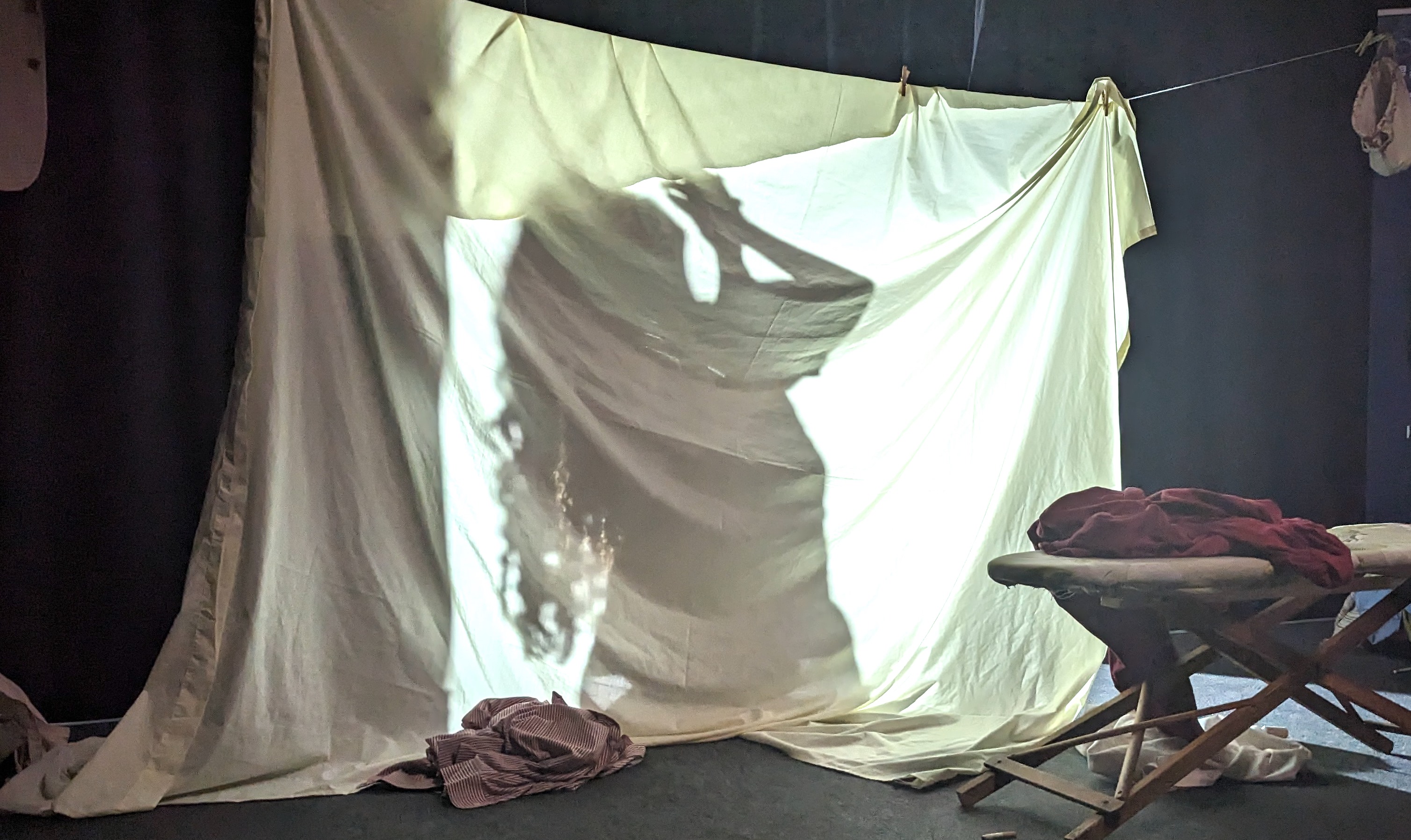
Grace Wilkinson’s direction is assured and imaginative: rarely has a washing line been put to such a variety of uses. This one serves not only as a symbol of Shelly’s domestic load, but also as the hanging strap on a bus, a shower screen and lots more. The music (by Claire O’Connor) is noteworthy too, particularly Shelly’s plaintive refrain, “I’ll be your landmark…”

Bloomin’ Buds are doing an important job in opening up access to the arts and ensuring that working class voices are not excluded from the mix. In fact, the theatre company’s own backstory would make an interesting play in itself. Next time, maybe?

3.5 stars

Susan Singfield

After This Plane Has Landed

20/08/23

theSpace @ Surgeon’s Hall (Theatre 1), Edinburgh

If I were ever asked to compile a list of subjects unsuitable for musical adaptation – it’s an unlikely occurrence, but bear with me – the story of John McCarthy and Jill Morrell would probably figure fairly prominently.

McCarthy is the British journalist, who in 1986 was kidnapped in Lebanon and spent over five years in captivity, being systematically beaten and interrogated – hardly the stuff of song and dance. Meanwhile, back in England, his fiancée and fellow-journalist, Morrell, tirelessly campaigned to keep his name and his predicament in the public eye. And although (spoiler alert!) McCarthy was eventually released and returned safely to his homeland, the couple didn’t have anything resembling the traditional happy ending.

When we first meet John (Benedict Powell) and Jill (Claire Russell) they are on the London Underground. As the music swells and Russell readies herself to launch into the opening song, Powell actually expresses incredulity. “This is going to be a musical?” he cries. And if I’m honest, I’m of the same mind.

But my reservations are quickly swept aside as soon as they’re a few bars into one of Adrian Kimberlin’s lovely, melodic ballads. Both Powell and Russell are gifted vocalists, especially when their plaintive voices are joined together in harmony. The script (also by Kimberlin) is clever enough to occasionally remind us of the artificiality of the piece, and this meta-theatricality provides a useful touchstone.

Most interestingly, the section that deals with the aftermath of the kidnapping – John’s ongoing struggle to reclaim some kind of normal existence after the living hell he’s been through – yields some of the most poignant moments. And Jill gets her chance to shine too. I particularly love the ballad where she insists that she will not be dismissed as ‘the woman who waits’, that she has a life and an identity of her own. I have to confess to tearing up a little during that song.

After This Plane Has Landed is a sweet and engaging musical, based around a turbulent few years in the relationship of two real people. Against all my expectations, it makes for a very entertaining hour – and I’ve just had to cross two names off that imaginary list.

4.2 stars

Philip Caveney
Artist/Muse

20/08/23

Assembly George Square (Studio Five), Edinburgh

The Wednesday Women’s Writing Collective (WWWC) is “a group of women and femmes dedicated to fostering creativity and uplifting marginalised voices”. In this piece, written by Diana Feng, Tegan Verheul, and Clarisse Zamba, their focus is on the anonymous artist’s muse, who – they posit – is a co-creator, and so merits some credit.

The Assembly’s Studio Five has a day job, spending eleven months of the year as a lecture theatre. On entering the small space today, I note that there are sheets of paper and pencils on the long bench tables. “Please feel free to do some life drawing,” the usher says.

On the stage, standing inside a large gilt frame, there is a woman. We pick up our pencils and begin to draw.

It’s a neat conceit, positioning the woman as an object, a thing for us to look at and attempt to recreate. It positions us as the artist too: we’re in charge of our creations, aren’t we? Except… without her, we have nothing to draw. Her style, the expression on her face, her demeanour; we have had no say in those. She is the image and we mere interpreters. (In my case, a pretty poor one at that…)

We never finish the drawings. Once the lights go down, the story begins. The woman steps out of the frame and bursts into life. She is Olivia Fernandez (Caterina Grosoli), a life model in the middle of a screaming row. Her sculptor boyfriend, Laurent (Luke Oliver), has found a new, much younger subject – and Olivia isn’t going to go quietly. As their argument grows more violent and heated, she seeks refuge in a stranger’s house. He – “Of course!” says Olivia, despairingly – turns out to be another artist, albeit a much quieter one. He’s Paul Patel (Sushant Shekhar) and he recognises Olivia: he’s seen her image captured many times. Before long, the two have fallen in love – but Paul is jealous and begs Olivia not to pose for anyone else. But how can their relationship survive if her wings are clipped? And, if his body of work depends on her body, how can he claim full ownership?

It’s an interesting premise and we find ourselves grappling with the thorny questions it raises for a long time afterwards. (What if the subject is a mountain or a piece of fruit? What if it’s a building – should the architect be acknowledged? Can we compare life models to musicians, in that a session player/occasional model doesn’t need to be named, but a band member/muse does?)

If the script itself isn’t as weighty as its themes, losing gravitas by centring on an improbable love story, it’s engaging nonetheless. Grosoli gives a sprightly performance as Olivia. Based on Fernande Olivier, Pablo Picasso’s muse, she is a bold, sassy young woman, and Grosoli imbues her with verve and spirit. I especially like the way that dance is used to symbolise her restless nature.

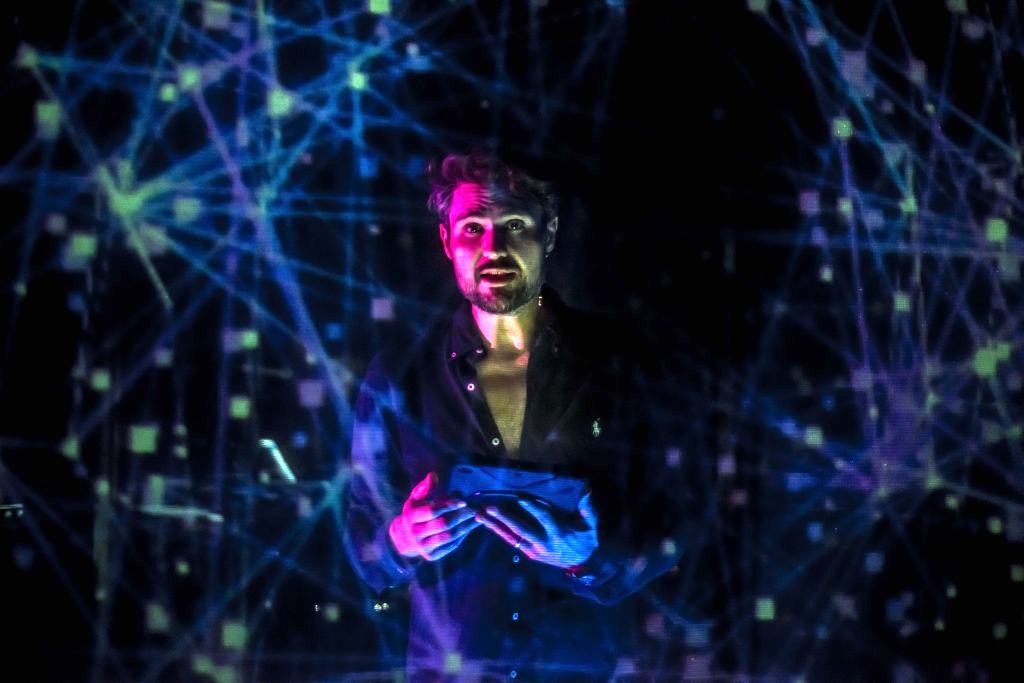
The play’s design is clever too, and I’m impressed by the judicious use of projection on the enticingly blank canvases.

The first thing I do when I get home is put a face to Fernande Olivier’s name, seeking her likeness in photographic as well as painted form.

3.4 stars

Susan Singfield

Lear Alone

19/08/23

The Space Triplex (Studio), Edinburgh

“Poor naked wretches… How shall your houseless heads and unfed sides […] defend you from seasons such as these?”

King Lear is probably my favourite Shakespeare play; Lear Alone is a distillation of the titular character’s descent into madness and destitution. This Lear isn’t just isolated from his friends and family, he’s isolated from the rest of the story too, and – with the spotlight turned on him – we see with brutal clarity exactly what is happening. Old age is upon him. The signs of dementia are stark: his judgement is poor; he is capricious and sometimes violent; he’s confused; he struggles to remember things – and he goes off, wandering. 

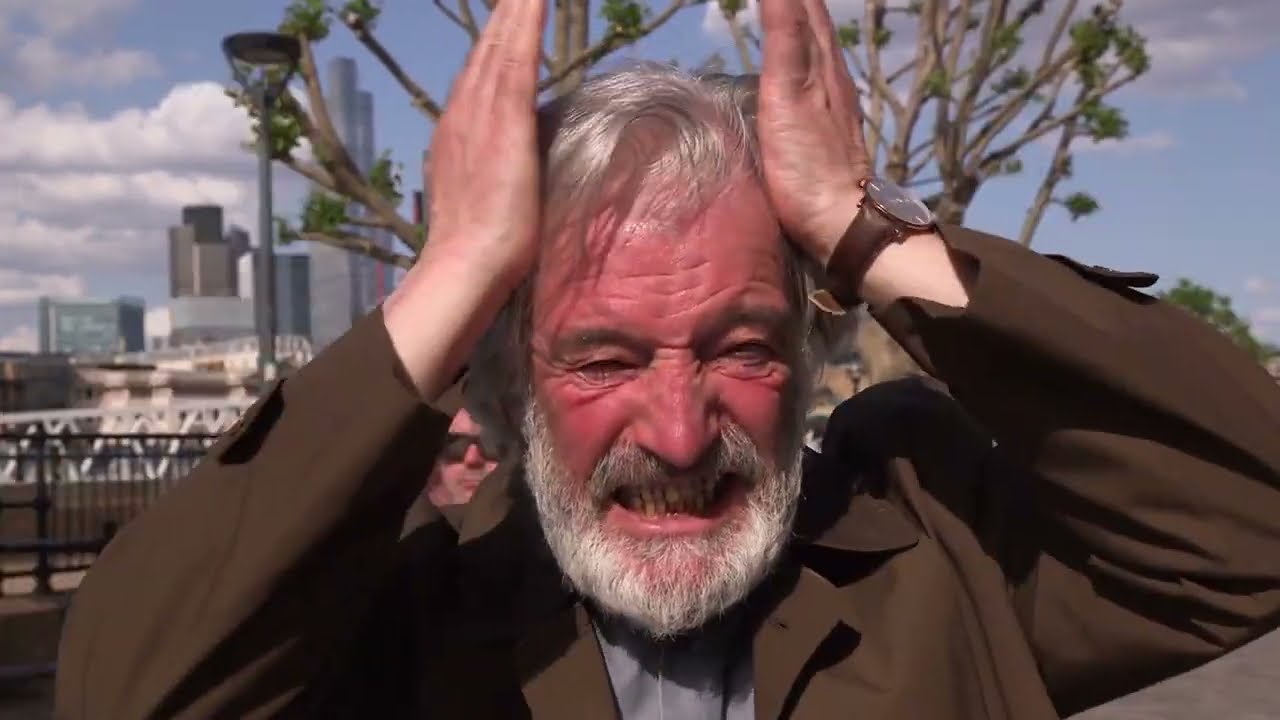
Created in partnership with Crisis UK, this project began life as a web series, focusing on older people’s homelessness. It’s an inspired notion. Using just Lear’s words from the first Folio, Edmund Dehn plays Lear as a shambling elderly man, ignoring his frantic daughter’s answerphone messages, traipsing the streets and talking to the air. He is Shakespeare’s king from 800 BC, but he is also an ordinary man of the 21st century. The words he speaks belong to his character, but they could just as well be memories, lines from his schooldays, recalled because of their present aptness.

He both is and is not Lear.

Dehn cuts a tragic figure, and it’s easy to empathise with him – as well as with his offstage daughter, who keeps trying to contact him. As he rails against the world, the sadness of his situation becomes ever more apparent. The symbolism is bold and simple and very effective: from the Lidl bag he carries everywhere to the blanket he clutches to him, Lear is desperately clinging to what little he has left, holding on to the familiar in the hope of warding off his demons.

Directed by Anthony Shrubsall, Lear Alone is a thought-provoking piece of theatre – a big performance on a tiny stage.

4.1 stars

Susan Singfield

The Hunger

19/08/23

Assembly George Square (Studio 3), Edinburgh

Somewhere in the wilds of the Yorkshire Dales, there’s something seriously wrong down on’t farm.

Deborah (Helen Fullerton) is desperately trying to protect herself and her teenage daughter, Megan (Madeleine Farnhill), as a terrifying epidemic holds the country in its sway. Something is turning ordinary people into creatures to be feared. Oh, they look normal but they have developed unnatural appetites.

The situation has been ongoing for a couple of years now, and is completely out of control, but Deborah is determined to soldier on, putting her trust in her free-range pigs, the way she always has. And thankfully, the prize sow is about to farrow, which will mean a fresh supply of good, wholesome food.

As for those occasional strangers who stumble upon the farm, they are dealt with in no uncertain terms because Deborah is very handy with a rifle and she’s not afraid to use it. She’s also determined to ensure that Megan will eat her three square meals a day…

The Hunger opens with a high-octane scene and keeps the same histrionic tone throughout. Both actors deliver intense, convincing performances, but I’m less happy with the storyline, which isn’t always entirely credible. If the two women have been cooped up together for so long, why does Megan have no idea what’s happening? There’s a revelation waiting down the line but this aspect of the script conspires to defuse it somewhat and, when it finally comes, it isn’t exactly a surprise.

A tense, horror-tinged production from Black Bright Theatre, this is the kind of dystopian end-of-the-world scenario that’s currently enjoying much popularity (and there are definitely echoes of The Last of Us here), but it needs a little more light to go with all that unremitting shade. Still, it keeps me hooked throughout, and I particularly enjoy the tense, open-ended conclusion, which steadfastly refuses to allow the audience to relax as we leave the theatre.

Maybe skip the visit to the kebab house on the way home.

3.8 stars

Philip Caveney
Martin Urbano: Apology Comeback Tour

18/08/23

Pleasance Courtyard (Bunker Three), Edinburgh

You can’t say anything theeeese days.

Martin Urbano has been cancelled, but – despite the title of his show – he’s not sorry in the least. He’s a good guy, unfairly victimised just for articulating what everyone’s thinking. And, you know, assault. “Have you tried tickling a woman you don’t know on public transport recently? Apparently, it’s not allowed any more.”

Just to be clear: this is satire, punching up at the likes of Louis CK and Bill Cosby rather than down at their victims. It’s not an hour of whinging from an entitled twat complaining loudly via a Netflix special that they’ve been de-platformed – it’s a very obvious parody of that. Indeed, at times I think the parody is too signposted: the show might be more hard-hitting if Urbano were to commit more fully to the loathsome character he has created (although I can see that further blurring those delicate lines might actually be dangerous for him. After all, he does spend fifteen minutes telling us that he’s a paedophile).

Urbano is saved from this potential danger by a self-deprecating demeanour and by regularly corpsing at the very awfulness of what he’s saying. These qualities combine to reinforce the fact that he does not stand by the ideas he’s espousing, that they are just jokes, intended to make us roar in horror and disbelief. It works. The dingy underground space of Bunker Three is alive with laughter.

The Mexican-American comedian makes his audience complicit too, handing out bits of script for several of them to read. They acquiesce, and so become a part of the phenomenon, happily making statements that conflict with their ethics. Why do I feel qualified to make this assumption about how they feel about their participation? Because I am one of them: I actually stand on the stage and read some very dodgy things into a microphone. It’s a neat reminder that, just like me, Urbano is playing a role.

For a show dominated by misogyny and paedophilia to land as well as it does proves that we’re in the hands of a professional. The hour flies by and the audacious ending really takes me by surprise.

4 stars

Susan Singfield

Things Hidden Since the Foundation of the World

17/08/23

Traverse Theatre, Edinburgh

Every Fringe offers at least one production that takes hold of your perception and gives it a thorough kicking. Things Hidden Since the Foundation of the World fits happily – if not exactly comfortably – into that category. Going in, I’m not quite sure what to expect and, coming out, not entirely sure what I’ve just witnessed… but I’m definitely thinking about it. A lot.

We begin with writer/director Javaad Alipoor walking out to deliver what I assume is a pre-show chat, but which actually turns out to be the beginning of the story. He tells us about the unreliability of Wikipedia searches, the way that everything in the world is subjective, open to different interpretations. He then mentions the unsolved murder of Iranian pop star, Fereydoun Farrokhzad at a flat in Berlin in 1992. Farrokhzad, we are told, was Iran’s answer to Tom Jones – but even that description is open to interpretation. As Alipoor talks, a dark grey wall behind him suddenly lights up with an image, a moustachioed man in a glittery jacket singing a pop song. Then, the walls slide aside and, projected onto a transparent screen, we see the image of another Iranian musician, King Raad (huge in Iran, unknown outside of it and now exiled to Canada). He talks about his own harrowing experiences, including the tragic death of his father.

Later, a compartment opens to reveal a room deeper within the set and we see that Raad is actually here in person, creating music with musician Mee-Lee Hay. The moment when he points out that now would be a propitious time to assassinate him is chilling.

The final piece falls into place as, up on a high platform, Asha Read hosts a podcast, asking questions about Farrokhzad’s murder, suggesting that perhaps the whole thing is a conspiracy, that the reasons for his death might be more complicated than we could possibly imagine. And as all these elements play out, the high-tech screens and various layers of the set begin to blossom into mind-blowing patterns, bursting with vivid colours, everything intermingling as Read’s questions become ever more complicated, ever more unfathomable.

The final sections are probably the closest I’ve ever come to experiencing an acid trip in the theatre. My head seems to be bursting with possibilities, my brain virtually turning itself inside out as it struggles to comprehend what’s happening. Actually, that makes the experience sound unpleasant, but I promise you it’s not. And I find myself falling back on that familiar cliché, that this production is like nothing I’ve ever seen before – but clichés exist for a reason. While I refuse to pretend that I know exactly what’s going on here, I’m happy to admit that I enjoy the cerebral workout it gives me.

If the Edinburgh Fringe is all about experimentation (and it really should be), then this intriguing and strangely compelling production has found its ideal home.

4.2 stars

Philip Caveney
Tony! (The Tony Blair Rock Opera)

17/08/23

Pleasance at EICC, Edinburgh

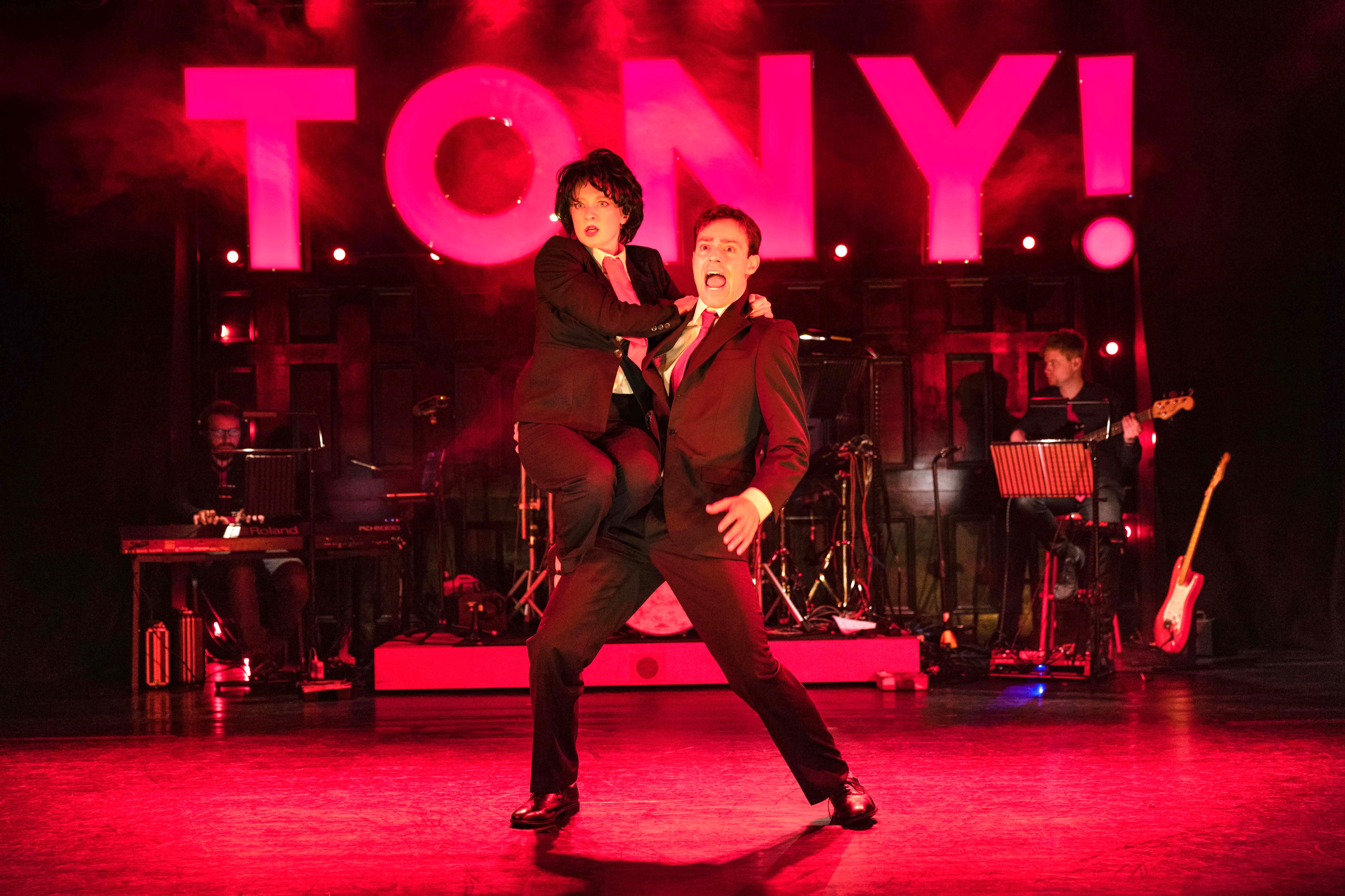
Having hot-footed it here from one political satire that doesn’t work, it’s gratifying to find one that actually does. The fact that the venue offers the most comfortable seating on the fringe is a wonderful bonus. Tony! (The Tony Blair Rock Opera) is bold and propulsive and packed with clever observations. As well as making me laugh out loud, it also makes me think

As one of the people who voted Tony Blair into power – and voted for him twice again – even after the debacle of the ‘weapons of mass destruction’ – it feels like the right time to reappraise the story of the man who changed the Labour Party, who made them electable for the first time in just about forever.

With lyrics by Harry Hill and music by Steve Brown, Tony! begins at the very beginning as our hero (Jack Whittle) emerges fully formed from his mother’s womb, complete with that winning smile and the belief that the world is his oyster. Within minutes, he’s grown up, been given his first electric guitar, grown his hair long and gone to University. Pretty soon, he’s fronting rock band Ugly Rumours and knocking out some funky riffs with moderate success. His greatest ambition at this time? To meet Mick Jaggers (sic). But instead he meets Cherie Booth (Tori Burgess), who introduces him to the world of politics and… well, you know the rest.

Or do you? With three musicians blasting out a series of catchy rock songs, the production hammers merrily along, introducing major political figures as it goes, with the ensemble cast given plenty of individual opportunities to shine. Howard Samuels impresses as a wonderfully creepy Peter Mandelson (with a sideline in making balloon animals); Phil Sealy is a (perhaps unfairly) buffoonish Gordon Brown; and Martin Johnston’s Neil Kinnock feels perfectly pitched.

Watch out too for Emma Jay Thomas as Princess Diana, who nails ‘the people’s Princess’ with aplomb. Through it all, Whittle is the consummate front man, singing, dancing and grinning like he’s breakfasted on amphetamines.

This is an object lesson in how to satirise a political figure, playing for laughs but hinting at so much more. At the fringe, you go past the sixty-minute mark at your peril and Tony! goes to ninety without ever losing its impetus. I exit the theatre with an ear worm, happily singing the chorus to the climactic number, even though it prominently features the word ‘assholes.’ 

Apologies to the people at the bus stop. I wasn’t referring to you, honest.

4.6 stars

Philip Caveney
Dom: the Play

17/08/23

Assembly Rooms (Ballroom), Edinburgh

The first thing to say about Dom: The Play is that it’s not what I’m expecting. Unsurprisingly, at the world’s largest arts festival, the vibe is mostly liberal and self-aware. Like its namesake, Dom: The Play is neither of these things.

This isn’t necessarily a problem – I’m all for challenging my own preconceptions – but the play just doesn’t really work for me. It’s not incisive or satirical; instead, it’s a seventy-five minute defence of Cummings, devoid of any critical analysis of his time in government. It’s easy to understand how people believed the rumours, cunningly circulated by playwright Lloyd Evans, that Cummings actually wrote the script. The closest the play comes to any kind of criticism is the acknowledgement that he didn’t actually manage to achieve what he set out to do.

Although the publicity material promises to reveal the truth about what really happened at Barnard Castle, it doesn’t: he’s never brought to task. In reality, Dom simply dismisses it in one line: “I didn’t break the law.” Surely, even if Cummings the character can’t see his own flaws, the play ought to expose them? Here he’s presented exactly as he seems to see himself: as a visionary hampered only by other people’s mediocrity.

Dom: The Play is an oddity in other ways too. It’s tonally uneven: the bad-wig pantomime buffoonery of Tim Hudson’s Boris sits uneasily alongside the long TED talk-style sections, where Cummings (a very convincing Chris Porter) is given space to expound on his ideas, while the sketches depicting Nicola Sturgeon, Michael Gove, civil servants and Guardian readers are very broad and rarely succeed in skewering their targets.

It’s all a bit icky. There’s something very misogynistic in the way an offstage Carrie Johnson is portrayed, as if she’s Eve or Lady Macbeth, responsible for her husband’s downfall, and there are some revoltingly classist jibes too, e.g. a line about Angela Rayner, which might well be a verbatim quote, but is presented here not as something awful that should never have been said, but as a funny joke, and one we’re invited to laugh at.

I leave disappointed. It feels as though this play is meant to rehabilitate Dom in the eyes of the public, but in truth it feels as smug and tone-deaf as the man himself. I’m angry all over again – about his boorishness and self-importance, and about the damage he wrought.

2.6 stars

Susan Singfield