Theatre

The Toxic Avenger: The Musical

03/08/17

Pleasance One, Edinburgh

Lloyd Kaufman’s 1984 movie, The Toxic Avenger has long been held in high esteem by cult movie fans – one of those ‘so bad it’s good’ guilty pleasures, it spawned several sequels and made the transition to musical in 2008. Prior to a new London run, it’s arrived at the Edinburgh Festival, where its riotous blend of rock music, camp silliness and hilarious bad taste make it a perfect fit for fun-seeking audiences.

The town of Tromaville is being overrun by pollution and its citizens are crying out for a hero to come and save them. The nerdy Melvin Ferd (Mark Anderson), longs to be that hero, if only to impress the love of his life, Sarah (Emma Salvo), a blind librarian. But when he gets tossed into a vat of nuclear waste by a couple of thugs, he emerges transformed into the world’s first toxic superhero, taking on the town’s corrupt mayor (Natalie Hope) and her two  evil henchmen, Oscar Conlon-Morrey and Che Francis. OK, so he’s prone to tearing the odd innocent person apart limb-from-limb, but hey, nobody’s perfect, right?

A musical in the same vein that made Little Shop of Horrors such a pleasure, The Toxic Avenger is an unqualified delight, romping happily along powered by its own exuberance and the efforts of a stellar cast, who give this everything they’ve got and then some. Salvo is possessed of a voice so powerful that it occasionally threatens to blow the roof off the Pleasance, while Hope performs an exhausting sequence where two characters do battle with other (she’s playing both roles), that must set some kind of record for lightning-fast costume changes.

You don’t need to be familiar with the original film to enjoy what’s on offer here. Indeed, if you’re looking for a night of galumphing, undemanding entertainment this is definitely worth seeking out.

4.6 stars

Philip Caveney

Cathy

02/08/17

Pleasance Dome, Venue 23

Ken Loach’s influential Wednesday Play, Cathy Come Home, first saw the light of day in November 1966 and made a powerful impact on the public consciousness. In 2016, his searing film, I, Daniel Blake demonstrated that over the intervening fifty years, very little has changed when it comes to society’s callous treatment of the dispossessed. This production by Cardboard Citizen is very much a homage to Loach and his worldview (at one point it even features a recording of the director speaking about his concerns). It’s a  new play by Ali Taylor, based upon real-life testimonies, showing all too clearly how people’s lives can so easily be affected by the spectre of homelessness – how they can slip through the cracks in the care system to find themselves abandoned and in desperate straits.

Cathy (Cathy Owen) is one such person, a single parent struggling to care for her fifteen-year-old daughter, Danielle (Hayley Wareham). Cathy holds down several zero-hours-contract cleaning jobs and tries her best to look after her dementia-afflicted father, who now lives in a care home. When she falls behind on her rent payments, she finds herself unceremoniously shunted into ‘temporary’ accommodation in Luton, far from the area where she’s lived all her life. Danielle, currently studying for her impending exams, finds it hard to deal with the ensuing rootlessness and, when the possibility of a permanent home appears tantalisingly on the horizon, mother and daughter are momentarily cheered – until they find it will involve a move to Gateshead.

This is a bleak and affecting drama, featuring superb performances from a four-strong cast. While Owen and Wareham stay within their roles throughout, all others parts are taken on by Amy Loughton and Alex Jones, who slip so effortlessly from character to character, I sometimes have the impression that there are actually more than four actors involved in this. The set is minimal, built mostly around a stack of wooden blocks onto which images are projected during the scene changes. If I have a minor criticism, it’s that there may be a little too much time spent dragging the blocks around to create beds, tables and the like – better, I think to trust the audience to know where events are taking place – though the scene where a frustrated Danielle sends the blocks tumbling is undoubtedly a powerful moment. While it may not be the show you’ll seek out to lift your spirits, it’s nonetheless a powerful polemic that tells a really important story – one that occasionally has me on the verge of tears. We don’t usually review previews but this has already been touring solidly for three months before Edinburgh and, after checking with director, Adrian Jackson, I’m happy to make an exception for this.

After the performance, Jackson leads a brief discussion about the problems of homelessness in our society. The overall feeling from the audience is one of helplessness. What can we do to improve this terrible situation? Well, a good way to start would be to go and see this heartrending production. Though it may not claim to have any answers, it certainly asks all the right questions.

4.6 stars

Philip Caveney

Whist

22/07/17

Festival Theatre, Edinburgh

It’s a rainy morning in Edinburgh, the perfect time to seek escape from reality. Upstairs in the bar at the Festival theatre may seem an unlikely location for such an escape, but it’s soon to be transformed into a landscape of the imagination, courtesy of dance company AOE and some nifty virtual reality headsets. Helpers are on hand to show us initially around what looks like a random selection of rather unprepossessing objects; we are told that, when these shapes are looked at through our headsets, they will unlock a series of sequences inspired by the work of psychoanalyst Sigmund Freud.

So, we allow ourselves to be fitted out with said headsets and we regard the first object we come to and… wow, this actually works! All of a sudden, I am standing mid-air in the centre of a dilapidated room, a room I can see in perfect detail, whichever way I choose to look. I can’t help but notice a rather ominous wooden chest in the corner and, as I watch (rather nervously, it has to be said), a woman emerges from the box and starts to chalk obscure symbols all over the wooden floor…

It’s hard to fully describe the impact of these ‘visions’. There’s a kind of voyeuristic pleasure in observing the various characters that wander in and out of the (seemingly unconnected) sequences and, often, a startling moment when they look directly at me and I become convinced that they know I am here, that they can see me watching them. The scenes range from the creepy to the baffling to the vaguely erotic. In my favourite sequence, I’m standing on a dinner table, my feet resting on a plate of bloody hearts. Around me, three diners are tucking in to the raw meat, drinking wine and shooting me challenging looks. I feel obliged to keep spinning around to make sure I take in all of their reactions. One of them looks a bit handy with a steak knife and I get the distinct impression they don’t much like me standing in the middle of their dinner…

There’s no through-storyline here. Each individual scenario is something that could have evolved from a dream or, more accurately, a nightmare. Birth seems to be a recurring theme and also, the subjugation of women. There’s a moment when I really want to step in to help somebody who is being manhandled, but I can’t, because I’m not actually there even though it feels like I am – and then there’s a moment when I suddenly find myself drifting alone through the cosmos and I nearly cry out with the wonder of it. I look down and it feels like I could fall forever…

The experience lasts an hour (which is probably just about the right duration) and I have to say, it’s pretty intense. For a while after it’s over, I have the conviction that the real word I’ve returned to is pretty damned strange (particularly when I spot Jarvis Cocker standing on the other side of the road) but that feeling soon passes. After all this is Edinburgh and the festival is fast approaching. Why shouldn’t Jarvis Cocker be around? Whist feels decidedly like it should be part of the festival, but it’s here right now and it’s one of the strangest, most immersive experiences I’ve ever had.

I urge everyone who can to pop along to the Festival Theatre and give it a try. It’s there until early August. There’s a limit of twenty participants per show, so get those tickets booked and dive right in. You’ll be intrigued, delighted, maybe even a little bit freaked… but I’m pretty sure you won’t be bored, not for a moment.

5 stars

Philip Caveney

Fame: The Musical

Unknown

21/07/17

Alan Parker’s 1980 movie, Fame, is the film that launched a million star jumps – and, throughout the 1980s, the television series captured the imaginations of countless more viewers. This musical by The Beyond Broadway Experience manages to take the essence of the concept and uncork it spectacularly in the splendid surroundings of the King’s Theatre. I should point out that this is an amateur production but, like many of the community shows here, it makes you want to find a better word than ‘amateur’ to describe what’s happening, because it’s genuinely dazzling.

The musical follows a cohort of successful applicants through their time at the New York High School of Performing Arts (a genuine establishment with incredibly exacting standards). There’s Tyrone (Rory McLeod), strutting and dancing up a storm, but hiding the fact that he’s dyslexic. There’s Carmen (Caitlin Tipping), bold, brassy and struggling to control a fatal fascination with the street drugs that keep her dancer-thin. There’s Nick (Reuben Woolard), already the star of a peanut butter TV commercial, but desperate to prove himself as a genuine actor, and there’s Serena (Melissa McNaught), a shy girl with a huge voice who finds herself a little bit fixated on Nick.

But perhaps it’s unfair to single out individuals – although Mabel (Sarah Kerr)’s singing is so impressive it gives me chills – because the whole company performs with such aplomb. Choreographer Murray Grant has somehow schooled one hundred and sixty (count them!) young actors into giving the performances of their lives – they jump, twirl and pirouette around the crowded stage with perfect precision and during the song  Dancing On The Sidewalk actually burst off the stage and through the audience in a display of infectious enthusiasm that nearly lifts the roof off the theatre. This is a thrilling production and director Gerard Bentall should really take a well-deserved bow for helming this complex piece so expertly.

The show’s only on for one more night at the King’s but, if you can get seats for it, I’d advise you to grab them. If the pizzazz and energy from tonight’s performance could be bottled we’d all live an extra ten years – and with great big smiles on our faces too.

4.8 stars

Philip Caveney

Death of a Salesman

20/06/17

King’s Theatre, Edinburgh

There’s no doubting the power and tragic beauty of this Arthur Miller play: I remember its strength from sixth-form English lessons; even reading around the classroom, it seemed to come alive. On stage and film, I have always found it utterly compelling, a desperately sad – and sadly desperate – illumination of our times.

Okay, so the specifics are late-forties New York, but Willy Loman is an everyman, and his predicament still common to those of us who live in capitalist societies around the world.  We are sold a dream: we are in charge of our own destinies. Work hard, and you will get somewhere. Compete, and you can be the best. Buy these products; owning them will show others what you’re worth. But for Willy, the dream he’s bought in to is crumbling: he isn’t great; he’s ordinary. And he’s lost his edge. He’s a salesman who no longer sells, and corporate America spits him out. Willy is outraged to discover he’s been had, and rails against the boss that now deems him obsolete: “You can’t eat the orange, and throw the peel away – a man is not a piece of fruit.” But his rage is impotent: the odds are stacked against him. Howard does indeed discard him, and Willy is left bereft, forced to confront the reality that his life has been a sham. His house is small and crumbling; his children haven’t changed the world. He can’t even grow beets in his yard, for pity’s sake. And now, when he’s old and tired, he’s left frantic and worried: how can he make ends meet?

This touring production (by Royal & Derngate, Northampton, in association with Cambridge Arts Theatre) has a thoroughly modern feel. It’s not that the period has changed, exactly, it’s just been made less prominent. The minimalist stage, with its fizzing neon illumination – THE LAND OF THE FREE – gives an eerie sense of transience and flimsiness. Costumes are subtly contemporary in style; Howard’s voice-recorder is tiny and looks like today’s technology, but there’s no suggestion it has more than one function. Howard’s reaction to this piece of kit is illustrative too: Thom Tuck (last seen by Bouquets & Brickbats as the excellent Scaramouche Jones) is delightfully brash and insensitive, showing off about how much money he’s spent on this vanity item, even as he refuses to grant Willy a living wage. “Ask your sons,” he tells Willy, blissfully unaware of his own hypocrisy. “Now’s no time for pride.”

Nicholas Woodeson is perfect for the lead role, conveying Willy’s struggle with warmth and vitality. We are frustrated by his refusal to accept a job offer from Charley (Geff Francis), but we understand it too: Howard is wrong; Willy’s pride is all he has left. The anger that spills out of him in response to Linda’s concern is utterly convincing too: he doesn’t want her to worry about him, to prop him up because he’s down. He wants her to be impressed by him, and he’s self-aware enough to know she pities him these days. Tricia Kelly plays Linda with real heart; her anguish, although quieter, is every bit as real as her husband’s, and her epilogue speech is delivered with unbearable dignity. It makes me weep.

I think it’s the direction that makes this production so good: Abigail Graham has done a wonderful job of clarifying everybody’s pain. We know what they’re all feeling, and can’t help but empathise, even when they’re behaving as badly as they can. Indeed, George Taylor’s dysfunctional Biff is the most fully realised I have ever seen. Infidelities, theft, cruelty: none of these are hidden from our view. Because flawed people are people too, and we’re all deserving of respect.

This is a superb production of a truly great play. It’s on at the King’s until 24th June, and the tour continues elsewhere until 15th July. I urge you to try to catch it if you can.

4.8 stars

Susan Singfield


The Wedding Singer

06/06/17

King’s Theatre, Edinburgh

I’ll be honest, I’m not expecting much of The Wedding Singer. Its tagline (“The Hilarious Musical Based on the Hit Film”) seems designed to put me off: I didn’t much care for the film and am suspicious of anything that calls itself funny. Still, if I’ve learned anything over the years, it’s to give stuff a chance; joy is often found in the most unlikely places.

And The Wedding Singer is really very good. It’s an energetic, riotous show, with some great set pieces and strong performances throughout. The tone is set before the lights go down, with a skewed cinema screen projecting trailers from 1980s classics: there’s The Goonies! Oh, and Desperately Seeking Susan! It’s a real nostalgia-fest, and makes one thing absolutely clear: this is a period piece.

And it needs to be, because the unquestioning conformity to gender roles would surely raise an eyebrow nowadays. Girls just want to get married, you see; they like dresses and rings and crockery. As for homosexuality, it’s the punchline to a lot of jokes in this play – and I don’t think that would fly in a contemporary piece, however affectionate the quips. (Maybe it shouldn’t work here either, but the crowd seems to lap it up; surely some of them are feeling as uncomfortable as I am though?)

Despite these issues, this is undoubtedly a feel-good musical with a lot of heart. It’s easy to engage with the two main characters, Robbie and Julia, who are played with warmth and good humour by Jon Robyns and Cassie Compton respectively. Both have lovely voices, ideally suited to the songs they sing. They make a delightful pair.

Ray Quinn, as Julia’s love-rat fiancé, Glen Gulia, is a standout: his dancing in particular is really impressive. And Ruth Madoc’s turn as Robbie’s young-at-heart grandma, Rosie, is the stuff that comic dreams are made of: sure, it’s a pantomime-ish caricature of a role, but her evident enthusiasm for the sheer silliness of it all is absolutely catching.

So yeah, if you’re after something to make you ponder, to broaden your understanding of the world, then this probably isn’t the play for you. But if you’re up for an evening of unabashed fun, then make your way to the King’s Theatre, and prepare to feel the buzz.

4 stars

Susan Singfield

Lyceum Variety Night 3

2d551df8c6

04/06/17

Lyceum, Edinburgh

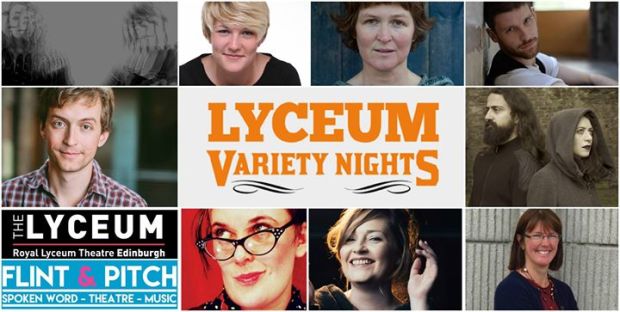
Flint and Pitch’s Variety Nights are fast becoming a thing of legend. Hosts Jenny Lindsay and Sian Bevan are as engaging and irreverent as ever, setting the tone for another fun-filled evening in their company.

Tonight’s proceedings kick off with a song from Maud the Moth, an interesting jazz-classical-fusion band built around the distinctive vocal stylings of Amaya Lopez-Carromero, featuring keyboards, drums, violins and, on the opening number, Queen Maud, electric guitar. It makes for a haunting start and I’m already looking forward to hearing more from them later.

Up next is Kieran Hurley, a storyteller whose schtick, he tells us, doesn’t really lend itself to ten-minute pieces, shorn of context. Still, he manages to contextualise tonight’s reading with wit and brevity, and it’s a real treat: an excerpt from his 2013 play, Beats. Two intertwining monologues tell us the story of an illegal rave – and we’re hanging on to his every word.

Audrey Tait and Michelle Lowe are The Miss’s, a Scottish singing/songwriting duo with a compelling set tonight. Tait’s plaintive voice is the perfect foil for Lowe’s more gutsy vocals, and they absolutely take my breath away. I love these two and could listen all night.

But it’s a variety night, so of course we are moved swiftly on. And it’s fine, because Caroline Bird’s performance poetry is a delight; in fact, she’s our favourite act of the evening. Her diffident, unshowy persona allows her poems to shine – and shine they do. They’re as charming as she is, illuminating dark truths about love, life and mental illness with cheerfulness and compassion. We’ll certainly be seeking out more of her work.

Jack Webb is the first dancer/choreographer to grace the Lyceum Variety Night’s stage, and this is certainly a very striking piece. Let’s be honest, interpretive dance isn’t an area we know much about, and we’re not sure we fully understand all this performance wants to say, but it is nevertheless clearly a corporal feat, all precision and control, conveying pain and a heightened sense of physicality.

It’s safe to say that Mairi Campbell is unique – she plays the viola and sings which is a pretty unusual combination, but she makes it work really effectively. She gives us a brace of memorable folk-tinged songs, the last one involving us all singing along on the chorus, and it’s evident why she won the Instrumentalist of the Year award in 2016.

Kathleen Jamie is a poet in the most traditional sense. She offers us a collection of lyrical pieces based around the beauty of the Scottish landscape and her childhood memories. The one that covers stamp collecting is a particular delight (and that’s not a line you get to say very often). Weirdly, despite winning a whole plethora of awards since her first in 1981, she doesn’t come across as the most confident of performers – but there’s no doubting the quality of her work.

It’s left to Maud the Moth to come on and finish off the night with three more of their excellent songs and highly original songs, before we head back to (as Jenny and Sian point out) the harsh reality of the world. An excellent night then and we only have one minor quibble – why have we still not managed to win the raffle?

4.5 stars

Susan Singfield and Philip Caveney


Shirley Valentine

30/05/17

King’s Theatre, Edinburgh

Willy Russell’s 1998 play has endured largely because of the strength of the writing and the fact that so many women identify with the character of Shirley Valentine. Essentially a comic monologue, the play was opened out for film in 1989 and this is how most people remember it – but the play has more power, simply because we view everything through the eyes of jaded working-class mother, Shirley, a woman so marginalised by her husband, Joe, that she has resorted to having conversations with her kitchen wall.

Jodie Prenger – who first came to the public’s attention when she won the BBC’s I’ll Do Anything, and went on to land the coveted role of Nancy in a revival of Oliver! at the Year Royal, Drury Lane – has a field day with the role of Shirley. She’s funny, assured and has an evident gift for physical theatre: many of the evening’s biggest laughs come from the way she deports herself as she talks. We spend the first two acts in Shirley’s kitchen as she initially cooks her husband’s dinner (an unscheduled plate of chips and egg) and then prepares to go on holiday to Greece with her friend. The final act takes place on the beach itself, where we learn that Shirley has had a brief fling wth a local barman and that she has now graduated to having conversations with a rock. What’s more, having reinvented herself in the sunshine, she has no intention of returning to her former life…

This is a charming slice of theatre, hugely appreciated by an enthusiastic audience and, while it must now be considered a period piece, it nonetheless offers a highly entertaining night at the theatre.

4.4 stars

Philip Caveney

Glory On Earth

23/05/17

Glory on Earth, written by Linda McLean and directed by David Greig, is a refreshingly unusual piece of historical theatre. It’s the story of Mary Queen of Scots (Rona Morison) and the four meetings she held with protestant reformer, John Knox (Jamie Sives), whilst she was in virtual captivity in Holyrood Palace. To Knox, Mary was an abomination – a staunch Catholic with a genuine claim to the throne of Scotland, a country that had so recently been swept ‘pure’ by the Calvinist reformation.

Karen Tenant’s stage design eschews any conventional attempt at historical accuracy. Mary and her six female attendants (who, frustratingly for any would-be reviewer, are all called ‘Mary’ and each take on several other roles throughout the play) are dressed stylistically, in a mixture of old and new – lace ruffs and painted boots. The sets feature key elements that simply hint at architectural detail – stone arches drift silently down from above; a wooden pulpit resembling a scaffold trundles in from the wings. Moreover, the sound design utilises a mash-up of contemporary music from The Jesus & Mary Chain to the torch songs of Edith Piaf (the latter alluding to Mary’s previous role as Queen Consort of France). To add to the mix, the actors also sing some enchanting reformation psalms and occasionally even play musical instruments.

If I’m making this sound like a bit of a hodge-podge, I certainly don’t mean to. The central tenet of the tale – the clash between two styles of religion – is eloquently told. Jamie Sives’s Knox is a dour and intimidating presence, his grim expression guaranteed to take the fizz off anybody’s pint in an instant, while Morison’s Mary displays all the impatience and affectation of an eighteen year old woman caught in an impossible situation, desperately seeking a husband and trying in vain to kindle some kind of a friendship with her father’s cousin, Elizabeth. Of course, we all know where Mary’s journey ends and, as she progresses steadily towards her inevitable doom, it’s impossible not to feel sympathy for her plight.

A deceptively powerful piece, this, and one that delights in pointing out that, centuries after these events, there still exists the same constant wrangling between Catholic Europe and Protestant Britain. Those with an interest in the history of Scotland will definitely want to catch this, but there’s something here that will resonate with a wider audience than that. This is a tale about humanity, about belief, and about the impact we have on others. And it doesn’t get much more universal than that.

4 stars

Philip Caveney

Who’s Afraid of Virginia Woolf?

18/05/17

Edward Albee’s 1962 play was famously adapted as a movie in 1966, starring Richard Burton and Elizabeth Taylor. The role of Martha is widely considered Taylor’s best onscreen performance, so it’s a tough act to follow – and perhaps, on paper, Imelda Staunton is an unlikely candidate for the role. But never underestimate her. She is an absolute revelation in this National Theatre production, beamed out live to cinemas across the UK. These screenings are a wonderful (and more affordable) way for people outside London to gain access to the very best of theatre.

George (Conleth Hill, best known for Game of Thrones) is an associate Professor of History at an American University, a man who feels that he hasn’t really achieved his life’s ambitions. This belief is constantly reinforced by his hard-drinking wife, Martha (Staunton), who seems to delight in reminding him of his failures at every given opportunity. The events of this three hour play unfold over one night, after a party at the faculty. George and Martha are already well-oiled when they arrive home and George is dismayed to discover that Martha has invited a young couple back ‘for drinks.’ They are a young biology professor, Nick (a barely recognisable Luke Treadaway) and his ditzy wife, Honey (Imogen Poots). Given the gladiatorial nature of the host couple’s conversation before the guests arrive, it’s clear that we are in for a bumpy ride… and as the drinks flow and inhibitions are increasingly broken down, the deepest secrets of everyone present are pulled out and ripped to shreds.

This is an incendiary, vitriolic drama, often wickedly funny but ultimately heart-breaking. Staunton’s extraordinary performance is perfectly matched by Hill’s dry, acerbic turn as George; indeed many of the play’s funniest moments are his, most tellingly the scene where he immerses himself in a favourite history book, while Martha and Nick cavort unabashedly just behind him. The other two actors may have somewhat less to do, but they make the most of what they’ve been given.

It’s a while since I’ve seen this performed and I was astonished at the similarities between this and Mike Leigh’s Abigail’s Party, which came along more than a decade later. In both plays, an ambitious male character is pushed to the very age by an unforgiving wife. In both plays, we laugh at the resulting humiliation, only to have that laughter snatched away by the misery of the conclusion.

This was a one night only screening, so if you really want to see this show, you’ll need to head down to ‘that London’ where it’s currently showing  at the Harold Pinter theatre.

4.5 stars

Philip Caveney