Film

The Bombardment

12/03/22

Netflix

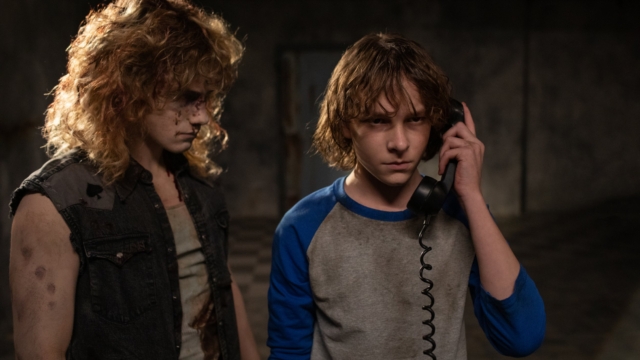
The Bombardment (original title The Shadow in My Eye, or Skyggen i mit øje) would be a harrowing movie at any time. Right now, as the war in Ukraine escalates and dominates the newsreels, it’s an especially difficult watch. And, of course, all the more vital. Writer/director Ole Bornedal’s unflinching portrayal of this true-life tragedy doesn’t allow us to avert our gaze from the human cost of war.

Copenhagen, 1945. The city is in Nazi hands. Members of the Danish resistance have been strategically positioned under the roof of the Gestapo headquarters, forming a human shield the Germans hope will make the Allies think twice before bombing. The RAF devise a dangerous plan, to attack the building from the side. But it’s risky, not least because of how low the jets must fly, and hitting the right target is far from assured…

Bornedal’s deceptively scattershot approach to the story works well: the details accumulate to form a devastating account of what occupation and bombing really mean to the people on the ground – and in the air. There’s a whole host of characters – all vulnerable, all flawed, all damaged by the war. Frederik (Alex Høgh Andersen) is a traitor, despised by his family, working alongside the Nazis; Teresa (Fanny Bornedal) is a novice nun, her faith sorely tested by the horrors her God has failed to stop. Perhaps the most tragic figure of all is Henry (Bertram Bisgaard Enevoldsen), a young boy so traumatised by what he’s witnessed that he’s lost the power of speech. He’s especially afraid of the open sky, so – in desperation – his mother sends him to the city, where he’s taken under the wings of his vivacious younger cousin, Rigmor (Ester Birch), and her friend, Eva (Ella Josephine Lund Nilsson). The children’s performances are heartbreaking: between them, they exude a horribly credible mix of youthful exuberance and awful anxiety, and it’s hard to deal with just how defenceless they are.

Lasse Frank Johannessen’s cinematography is as unrelenting as Bornedal’s script: although the landscapes and architecture are undoubtedly beautiful, nothing is sugar-coated here. The grimy underbelly is as visible as the polished exteriors; there is no attempt to hide the harsh realities.

Despite the violence and frantic manoeuvring, the film moves at a slow pace, giving us time to understand the characters, to care about them and their fates. Of course, this only serves to make the final climactic scenes all the more devastating. This is a powerful piece of cinema, but it’s not for the faint-hearted.

4 stars

Susan Singfield
Red Rocket

12/03/22

Cineworld, Edinburgh

The Florida Project was one of the undoubted cinematic highlights of 2017. Director Sean Baker’s ability to depict working-class American life is his real strength. No matter how wretched his characters, no matter how squalid their existences, he somehow manages to invest them with an innate nobility, finding the true characters hiding beneath the masks they show to the world.

Red Rocket continues in that vein, following the misadventures of one Mikey Saber (Simon Rex), former porn star, now down on his luck. Carrying the cuts and bruises of a recent business ‘disagreement,’ he arrives in his former hometown of Texas City with no car, no luggage and only twenty-two dollars to his name. He wastes no time but walks directly to the home of his estranged wife, Lexi (Bree Elrod), who now lives with her mother, Lil (Brenda Deiss). Neither of them is pleased to have him turn up unannounced on their doorstep, but Mikey pleads with them and eventually gets permission to sleep on their sofa ‘just for a few nights.’

Once in, he starts to wear them down, his first objective to get off that sofa and into his wife’s double bed. At first, he goes everywhere on Lexi’s borrowed bike, but soon begins to exploit his local ‘celeb’ status, starting with impressionable next-door neighbour, Lonnie (Ethan Darbonne), who quickly accepts the role of Mikey’s unpaid chauffeur. After some doomed attempts to find honest work, Mikey enlists with local drug queenpin, Leondria (Judy Hill), selling dope and steadily accruing the funds he needs to relaunch his stalled career.

And then, he visits local coffee shop, The Donut Hole, where he meets seventeen year old ‘Strawberry’ (Suzanna Son), a sparky young waitress who’s drawn to Mikey’s glamorous swagger and outsider status. He is instantly smitten too, not by love, but by the idea of a hot business opportunity. Surely he can act as Strawberry’s manager and launch her as the porn industry’s hottest new star? Would that be a way back in?

As you will have gathered, Mikey is an utterly detestable creep and I really ought to be hissing him off the screen, but, as played by Rex (himself a former porn star), he radiates so much charm and charisma that I absolutely understand how so many people are taken in by him. Here is a man always on the lookout for an opportunity to help himself to whatever’s available, who thinks nothing of dumping on those who have put their trust in him. It’s surely no accident that the television screens repeatedly reference a certain Donald Trump – proof positive that, in America, a shameless liar really can can make it to the top of the tree.

Red Rocket is built around an extraordinary performance from Rex – he is simply outstanding in the central role. Son too is fabulous as the naive teenager he’s so callously grooming. But there are some people who can see through Mikey’s charms. Leondria’s hard-bitten daughter, June (Brittany Rodriguez), recognises him instantly for what he is – and makes no secret of the fact that she distrusts him.

Baker’s film, despite a running time of over two hours, never puts a foot wrong. His cast of characters are brilliantly explored and (as in The Florida Project) he even makes the grotty urban landscapes of Texas City look vibrant and – especially at night – shimmering with possibility.

Catch this on the big screen if you can. It’s a must-see.

5 stars

Philip Caveney

The Duke

09/03/22

Cineworld, Edinburgh

The latest entry in the ‘truth is stranger than fiction’ genre is The Duke – the final feature from versatile director, the late Roger Michell. This is the story of the improbably named Kempton Bunton (Jim Broadbent), an irascible campaigner for pensioners’ rights, women’s suffrage and, in his spare time, a would-be playwright. Quite why his script The Adventures of Susan Christ never found an audience is anybody’s guess.

It’s the early 1960s and ,while England’s capital is celebrating a new-found sense of freedom, life on the gloomy streets of Newcastle is a somewhat bleaker prospect, as Bunton stumbles from job-to-job, constantly losing them because of his propensity to stand up against any signs of injustice he encounters. His long-suffering wife, Dorothy (Helen Mirren), slogs her guts out as a home help to her more affluent neighbour, Mrs Gowling (Anna Maxwell Martin), in order to make ends meet. She is mortified when her husband is obliged to spend a short spell in prison for non-payment of his TV licence (free TV for OAPs being his current pet project).

Meanwhile the couple’s younger son, Jackie (Fionn Whitehead), dreams of building and selling luxury boats, while his brother, Kenny (Jack Bundeira), has his own run-ins with the police to contend with.

And then a valuable painting of The Duke of Wellington by Goya is ‘borrowed’ from the National Gallery – and when it winds up hidden in the back of the Bunton’s wardrobe, it’s only a matter of time before the merde hits the fan.

The Duke is an irresistibly enjoyable piece that manages to evade the cosy complacency of so many films aimed at more mature audiences. Michell’s direction cleverly juxtaposes glossy widescreen shots of London with the grubby, timeworn realities of 60s Newcastle and the humdrum rigours of everyday working-class life are convincingly captured. The Buntons feel like real characters rather than archetypes. A past sadness that Kempton and Dorothy share is skilfully revealed in Richard Bean and Clive Coleman’s canny script – and there’s also a twist to the tale that genuinely takes me by surprise.

But this is surely Broadbent’s film. He’s terrific in the central role, making us genuinely care about a character who was, by all accounts, a bit of a wastrel. The penultimate scene where Bunton stands up in court to discuss the art theft with his barrister, Jeremy Hutchinson (Matthew Goode), had me laughing out loud and is probably worth the price of admission all by itself. Meanwhile, Mirren handles her role as the family matriarch with her usual aplomb and even manages to knit aggressively.

I’m hoping that some enterprising theatre will finally decide to stage one of Bunton’s lost plays – I’d love to see whether Susan Christ achieves her ambitions – but until that happens, The Duke is sure to send you on your way with a smile on your face.

4 stars

Philip Caveney

The Batman

04/03/22

Cineworld, Edinburgh

Director Matt Reeves’ modest ambition for The Batman was to make ‘the best Batman movie yet.’

Well, he hasn’t done that – but he’s certainly made the longest. Weighing in at a bum-numbing two hours and fifty minutes, it brings to mind the conviction that while ‘less’ is often ‘more’, ‘more’ usually equals ‘less’ when it comes to movies. And, while this just about scrapes four stars in its present bloated form, it would have scored much higher with some judicious editing. I mean, like, excising fifty minutes.

What is it about Batman that makes directors keep returning to that oft-plundered well? The fact that this is a comic-book hero who doesn’t have any super powers is always appealing, and there’s that delicious interplay between the vigilante who takes the law into his own hands and those misguided fools who see him as a hero. In this regard, The Batman feels a lot more nuanced than many of its predecessors, but it’s also sobering to think that the best film of the franchise is the one that he doesn’t even feature in.

Joker, thanks for asking.

Mind you if you thought Christopher Nolan’s depiction of Gotham City was dark, prepare to turn the palette down several notches. Reeves’ Gotham (shot in studios all over the UK) is filmed in tones of obsidian and anthracite. In this Gotham, it never seems to stop raining and the city is ruled by corrupt public officials, who gleefully take bribes and exploit the working classes for their own enrichment. (Remind you of anywhere?)

It’s Hallowe’en and a masked villain called The Riddler (brilliantly played by Paul Dano, though we don’t actually see his face until late on in the proceedings) is gleefully murdering those in power, who have allowed their standards to slip. Batman/Bruce Wayne (Robert Pattinson), though hated by most of the police force, is invited to investigate the crimes by Commissioner Gordon (Jeffrey Wright), the only cop who trusts him.

The Riddler is leaving cryptic clues at the scenes of the crime and Batman is good at deciphering them. In the course of his investigations, he comes into contact with Selina Kyle (Zoe Kravitz), crime kingpin, Carmine Falcone (John Turturro), and The Penguin (an unrecognisable Colin Farrell, hidden beneath layers of latex and sounding for all the world like Robert De Niro).

As the proceedings unfold, it becomes clear to Bruce that his own father, whose murder initiated Bruce’s transition into the Caped Crusader, might not have been as innocent as his son has always supposed. Batman also comes to realise that there are many people out there who follow his vigilante tactics with relish – and who would really like to be him.

And, as loyal butler, Alfred (Andy Serkis) is quick to point out, Bruce’s father might have done the wrong thing – but for very sound reasons.

There’s a lot here that I really like. It offers a much more interesting vision of DC’s premier hero than we’re used to seeing – but too much time is spent wandering along dark alleyways that don’t advance the plot enough. It’s only as I’m starting to grow impatient with the film that it finally coalesces and ramps up the suspense, as it heads into a vaguely apocalyptic climax that is weirdly prescient and also, in a strange way, uplifting. Reeves has already proven his worth with the likes of Cloverfield and his astute retooling of the Planet of the Apes trilogy – but, inevitably, The Batman just feels too long for its own good.

This is a shame because Pattinson really works in the lead role (for once, I actually believe that nobody would suspect his Bruce Wayne of being Batman, since the two personas are so different). Kravitz is also compelling in the Catwoman role, and I fully expect to see her return to it. A nifty coda shows us exactly where Reeves plans to go next and, given the projected casting for the next lead villain, I have to confess I’m suitably intrigued.

But please, Matt, next time around… can we just have a bit less?

4 stars

Philip Caveney

Cyrano

25/02/22

Cineworld, Edinburgh

The story of Cyrano de Bergerac is a rather unlikely one; nonetheless, over the years it has fired the imaginations of film and theatre directors alike, sometimes with spectacular results. In 1990, it brought director Jean-Paul Rappeneau and his lead actor, Gerard Depardieu, much acclaim in a movie adaptation of Edmond Rostand’s source play. And, a few years earlier than that, Steve Martin had already turned it into the much-admired contemporary comedy, Roxanne.

In both films, of course, Cyrano was a character with a comically oversized nose – something that his adversaries mentioned at their peril.

In Cyrano, director Joe Wright adopts a different approach. The hero of his story, though a brave and valiant soldier, is small of stature; and, as portrayed by Peter Dinklage, this simple premise turns out to be a masterstroke, the character’s inner turmoil told mainly through the cleverly nuanced expressions on his face. Everything else about the story stays pretty much the same – though I should probably add that this is a musical version, with songs by Aaron and Bryce Dessner.

Cyrano is desperately in love with Roxanne (Hayley Bennett), a poor and (it must be said) somewhat shallow young woman, who is considered a great beauty in her home town. She is pursued by many men, among them the rich but odious De Guiche (Ben Mendelsohn). When Roxanne summons Cyrano to meet her in private, he dares to hope that she might have reciprocal feelings for him; instead she confesses that she has fallen in love with Christian de Neuvillette (Kelvin Harrison Jr), a handsome new recruit to Cyrano’s regiment. Could Cyrano keep an eye on Christian and protect him from any harm?

Cyrano is so enamoured of Roxanne that he reluctantly agrees to help – and, when it turns out that Christian isn’t very good with words, Cyrano becomes the man who writes the many love letters that ‘Christian’ regularly sends to Roxanne. As Cyrano unfurls the deluge of longing he has nurtured for so long, the task nearly unhinges him.

Filmed on location in Southern Italy, Cyrano makes few concessions to realism. Instead, Wright’s film plays out through a series of highly stylised backgrounds with garish costumes, masks and makeup used to create a vibrant world that seems to virtually pulse with colour. Soldiers practising with swords move gracefully into dance routines, while large stretches of the dialogue are spoken in rhyme. It’s only when the film reaches its later stretches (and the location switches to the snow-covered heights of Mount Etna) that the brutal reality of war seems to bleach all colour from the screen and the story descends headlong into tragedy.

The songs are distinctive, plaintive and affecting, particularly in the scene where three soldiers, about to go out to their deaths in battle, leave letters to their loved ones, singing the words as they hand the pages to a messenger. It would already have been the film’s most moving sequence, but thoughts of the current conflict in Ukraine seem to lend it extra poignancy, and my eyes fill as it unfolds. If you’re already familiar with the story of Cyrano de Bergerac, you’ll know that there’s also a coda to this tale that isn’t exactly the happy ending you might have wished for.

This is undoubtedly Dinklage’s film, revealing impressive new depths to his acting, but Bennett is good too and her final scenes with Dinklage will probably send you out into the night with tears running down your face. If I’m making it sound like something of an ordeal, it really isn’t. Wright is adept at making every scene look ravishing, as he did in his under-appreciated adaptation of Anna Karenina. It’s the very theatricality of the telling that makes this film so powerful – and, in its own way, unique

4 stars

Philip Caveney

Uncharted

20/02/22

Cineworld, Edinburgh

Has there ever been a truly satisfying movie adapted from a video game? Not that I’ve seen.

It’s a conundrum when you consider that most games are cinematic in their scope and yet, time and again, they somehow fail to make the transition. Uncharted has been wallowing in production-hell for a very long time. Indeed, the original plan was to have Mark Wahlberg play young adventurer Nathan Drake, but time has moved on, and he has to be content with playing the father-figure, Sully, to Tom Holland’s Nathan.

Holland, fresh from box-office-conquering success in Spider-Man: No Way Home, could probably have chosen pretty much anything for his next project, so it’s interesting that he’s gone for this. He’s a self-professed gaming fan, so perhaps that’s what lured him. I should perhaps state at this point that I have never played the Uncharted game – in fact, apart from a few goes at Tomb Raider way back in the day, I have never felt the need to scratch the gaming itch.

Uncharted is a fun project, which makes no secret of the fact that it’s highly derivative, borrowing heavily from films that have gone before it: a splash of Oceans 11, a measure of National Treasure and a great big dollop of Indiana Jones. Indeed, the script, put together by no less than five screenwriters, openly references the latter movie several times, just in case we’ve missed the allusion.

When we first meet Nathan, he’s hanging grimly onto a shipping container trailing out of the back of a transport plane (as you do), a sequence lifted directly from the Playstation game that inspired the film. It’s pretty full on for an introduction, but happily the story then skips back to young Nathan’s life in an orphanage and his hero worship of his younger brother, Sam (Rudy Pankow). Sam is obsessed with the idea of finding treasure – specifically the lost gold of Spanish explorer, Ferdinand Magellan. But after breaking too many rules, he’s obliged to skip town and, after that, Nathan only hears from him occasionally, via a series of mysterious postcards from all around the world.

Back in the present day, Nathan is approached by Sully, who’s looking for somebody to help him find a lost treasure and, of course, it turns out to be the same one that Sam was looking for all those years ago. Sully also mentions that he knows Sam, so Nathan dutifully enlists with him. What follows is an elaborately plotted heist-treasure-hunt-action-spectacular. Thrown into the mix are Antonio Banderas as the ruthless Santiago Moncada, a man whose family history makes him believe the treasure rightfully belongs to him, his vicious hench-woman, Braddock (Tati Gabrielle), who is very handy with a blade, and another treasure seeker, Chloe Frazer (Sophia Ali), who might be trustworthy, but probably isn’t.

The action set pieces are nicely done, though the film’s 12A certificate sometimes jars with the onscreen violence. Vicious punches leave not a hint of a bruise and there’s what must qualify as the least bloody throat cutting-scene I’ve ever witnessed on the big screen. It just feels odd. But I enjoy the banter between Nathan and Sully, and a climactic sequence featuring helicopters and Spanish galleons is definitely a highlight.

All in all, this is a pleasant way to spend a couple of hours, but there’s nothing in Uncharted that will linger long in the memory. Fans of the game will doubtless complain that this doesn’t stick closely enough to the source material, while for me, the inevitable post-credit sequence which teases a second instalment, doesn’t feel in the least bit tempting.

3.4 stars

Philip Caveney

Freaky

18/02/22

NOW Cinema

Our on-going efforts to catch up with some of the movies that were lost in lockdown continues. Freaky was released at the worst possible time for a film of this kind. Here is something that really needs to be seen with a bunch of friends, in an actual cinema, to be fully appreciated. But, needs must and all that.

To be honest, Christopher Landon and Michael Kennedy’s spoof slasher movie starts unpromisingly as we see four teenagers gorily despatched by the Blissfield Butcher, a masked killer in the (jugular) vein of Michael Myers. Indeed, there are clear nods to Halloween and other classics of the genre, but the problem is that there’s no real suspense generated here, the killings suspended in that lonely wasteland somewhere between horror and comedy.

Just as I’m thinking of reaching for the ‘off’ switch, however, the film plays its trump card, as The Butcher (Vince Vaughan) attacks troubled teen Millie (Kathryn Newton) with an ancient Aztec dagger and things change significantly. For this, it turns out, is a body-swap story (working title Freaky Friday the 13th). Now Millie is running around in the body of a six-foot-plus male serial killer and she’s having the devil of a job convincing her best friends, Nyla (Celeste O’ Connor) and Josh (Misha Osherovich), that she’s worthy of their trust.

Meanwhile, The Butcher is wandering gleefully around the high school in Millie’s petite frame, exacting bloody revenge on everyone who is mean to him – and that vengeance is not exclusively directed at his fellow students, either. Teacher Mr Bernardi (Alan Ruck) is also due a healthy dose of comeuppance.

And suddenly it’s working! This edgy mix of killer-thriller and high school romcom feels fresh and inventive, while Vaughan gives a nicely nuanced performance that’s much more adept than the high-camp caricature familiar from this genre. Newton handles her inner malevolence with skill and Osherovich, as Millie’s snarky gay friend, is given some genuinely funny lines to deliver. As he observes to Nyla: ‘You’re black, I’m gay. We are SO dead!’

The subsequent killings have much more impact now that we actually have characters that we can care about – and the pace is too frantic to allow time to consider the improbabilities of the plot.

But, you can’t help but wonder, how on earth are they ever going to tie these various strands into a satisfying conclusion? Suffice to say they do, and, most refreshing of all, there’s no attempt to dangle the possibility of a sequel.

4 stars

Philip Caveney

Death on the Nile

12/02/22

Cineworld, Edinburgh

Kenneth Branagh earned himself a lot of brownie points for the sublime Belfast, but quickly squanders most of them in this, his second Agatha Christie adaptation. While it’s a definite improvement on his previous attempt, Murder on the Orient Express (which suffered from a bad case of too many actors in cameo roles), it still struggles to escape from the suffocating confines of the genre.

Mind you, it opens with a totally unexpected sequence set in the First World War, where we meet a digitally de-aged Poirot as a solider in the trenches, already flexing his powers of deduction. And then we are offered an origin story for that famous moustache. Interesting…

But all too soon, the action has moved on to 1937 and more familiar territory. Poirot is in a nightclub, fussing over some desserts, listening to blues singer Salome Otterburn (Sophie Okonedo) and watching as a certain Simon Doyle indulges in some rather dirty dancing with his fiancée, Jacqueline de Belfort (Emma McKey). The fact that Doyle is played by the recently disgraced Armie Hammer is, um, awkward, to say the least (and when I reflect that the previous film had a pivotal role for Johnny Depp, it makes me wonder is there isn’t some kind of ‘Curse of the Christies’ going on here).

Anyway, six weeks later, Doyle is climbing aboard a cruise ship in Egypt with his new bride… Linnet Ridgeway (Gal Gadot). Things get even more uncomfortable when Jacqueline arrives and spends her time glaring balefully at the newly weds over the lobster and fizzy wine. Honestly, if looks could kill!

Okay, this is Christie territory, so it’s a hardly a spoiler to say that somebody winds up murdered, which puts a proper crimp on the festivities. The perpetrator could be any of the passengers, all of them played by well know faces: Annette Bening, Dawn French, Jennifer Saunders, Russell Brand, Letitia Wright. Place your bets, folks – unless, like me, you saw the 1978 version or have read the book, and already know whodunnit.

Which, I must confess, spoils it somewhat.

It’s all handsomely done and this time around there’s enough focus on the various players to make it feel that they’re more than just cardboard cutouts. Egypt is lovingly recreated in CGI and the shameful opulence of the era is shown in unflinching detail. Here is an age where somebody can throw the contents of a champagne glass into the Nile and declare ‘there’s plenty more where that came from’ while starving people watch in silence from the river bank.

Okay, it was a different time, but at the end of the day, this feels hopelessly antiquated and badly in need of updating. Diehard Christie fans will doubtless tell themselves that Branagh has done his subject proud, and yes, perhaps he has – but I for one will be in no great hurry to see another Poirot movie. Unless, that is, it can offer something more unexpected than an origin story for some facial hair.

3.4 stars

Philip Caveney

Belle

10/02/22

Cineworld, Edinburgh

Writer/director Mamoru Hosoda’s Belle, is a modern re-working of Beauty and the Beast (renamed here in the subtitle as The Dragon and the Freckled Princess). This animation is a delight: a fresh, thought-provoking take on the fairytale. Is it sentimental? Yes. Does that bother me? Not one jot.

Suzu (voiced by Kaho Nakamura) is a troubled seventeen-year-old. Her mother died when Suzu was a little girl, and she’s never really come to terms with the loss. She is moody and taciturn with her father (Kôji Yakusho), and struggles to express herself. Suzu and her mother always used to sing together, but now – even under the patient guidance of her mother’s choir friends – Suzu can’t find her voice; she’s desperately shy and self-conscious.

But in the virtual world of ‘U,’ Suzu can use an avatar and, at this remove, her emotions all come tumbling out – in song. Her haunting voice and plaintive lyrics attract a lot of attention, and, as Suzu’s best friend, Hiroka (Lilas Ikuta), is a tech-savvy genius, her alter-ego, ‘Belle’ soon becomes a star. In U, at least, everything is going well… until a mysterious beast disrupts one of Belle’s performances, and she embarks on a quest to discover his identity.

This Studio Chizu production is gloriously animated. The real world backdrops are rendered in intricate detail, in stark contrast with the dizzying, eye-popping invention of the virtual world. And the story works well: the characters are fully-rounded – complex and flawed; their relationships are credible. The not-so-subtle allusions to Twitter pile-ons and trolls – represented here by Justin (Toshiyuki Morikawa) and his vigilante group – depict the problematic aspects of social media, but the main impression is one of positivity. U is a place of opportunity, an egalitarian space, where preconceptions don’t count.

Perhaps the film’s greatest strength is in its message that our virtual selves can work in harmony with our real selves, serving to bolster our confidence. Belle allows Suzu to sing again and, having practised in the safe space of U, she feels able to open up at school and home. We hear negative stories all the time, about how fake images and pretence are damaging our lives. But Hosoda asks us to see things differently, to consider how we might harness this technology to become the best versions of ourselves. It’s a fascinating take.

My only quibble is with the cinema rather than the movie. This is a children’s film, squarely aimed at a middle-grade to teen audience. So why is it only showing once a day, at 8pm, when most youngsters are at home, getting ready for bed? Of course, it works for adults too, and I enjoy it immensely, but it seems a shame to limit its potential in this way.

4.1 stars

Susan Singfield
Pig

06/02/22

Now TV

I’m late to this, mostly because of my inability to find the film showing at a cinema anywhere near me. But I’ve heard good things about it and eventually, I chase it down on the small screen. My expectations are that it will turn out to be a kind of ‘John Wick with a pig’ scenario, which isn’t a prospect I relish, but happily it is gentler and a bit more nuanced than that.

Disturbingly, though, days after the viewing, I’m still not entirely sure what it is.

Nicholas Cage plays ‘Rob,’ who ekes out a precarious existence in a tumbledown cabin in the middle of a forest in Oregon. He makes his living from harvesting truffles, along with his beloved er… pig (Brandy), who has a snout for that kind of thing. Rob is visited from time to time by young entrepreneur, Amir (Alex Wolff), who sells those foraged truffles in Portland, where they are prized by chefs at the fancier dining establishments. It’s an odd arrangement but it seems to work.

But things take a nasty turn when Rob is attacked one night and his pig stolen. So, with Amir as his driver, Rob sets out for the big city with only one thing on his mind: to get his pig back. It’s nothing to do with the truffle situation, though. Rob loves her and cannot envisage life without her.

As he and Amir travel through the city, it soon becomes clear that Rob has been here before. Once upon a time, it transpires, a near legendary chef and the very mention of his full name – Robin Feld – is enough to invoke awe in everyone who hears it. (It’s hard to imagine that the names of Jamie Oliver or Gordon Ramsay could inspire such respect.) Along the way, Rob has some strange encounters. He volunteers to be beaten up in a private fight club (as you do), he cooks food for Amir and his ruthless father, and he makes it clear that he has nothing but contempt for his former career and for the customers who used to flock to him for his gastronomic delights.

Pig is an odd film, to say the very least. While it’s refreshing to see a Nicholas Cage project that doesn’t require him to chew the scenery, it’s also probably true to say that most of what’s going on here is in the subtext. Rob is a shambling, monosyllabic central character, covered with bruises and blood throughout the film – a scene where he books a table at a swanky restaurant and none of his fellow-diners raise so much as an eyebrow actually beggars belief – and he is single minded in his determination to get that pig back, come hell or high water.

Debut director/co-writer Michael Sarnoski’s fairy tale seems to be suggesting that greeting violence with love (and food) is the way to solve problems, and perhaps he’s right on that score, but ‘turning the other cheek’ is hardly a revelation, and it doesn’t seem enough to hang an entire movie on. While it’s also true to say that Pig never goes anywhere you expect it to, it feels somehow as though the stakes need upping a little.

Bacon sandwich, anyone?

3.4 stars

Philip Caveney