Film

Drive-Away Dolls

16/03/24

Cineworld, Edinburgh

Since their auspicious debut with Blood Simple way back in 1984 (when I had the honour of interviewing them for Manchester’s City Life magazine), Joel and Ethan Coen have unleashed a whole barrage of brilliant films. OK, so there have been one or two misfires in there, but few filmmakers have been so consistently prolific and on the button.

A few years ago they decided to take a sabbatical and work on their own individual projects. Older brother Joel landed first with The Tragedy of Macbeth, which – despite having possibly the most self-aggrandising screen credit in history – turned out to be one of the finest Shakespeare movie adaptations ever. Now it’s Ethan’s turn and Drive-Away Dolls, co-written with his wife, Tricia Cooke, is the result. The central story is so sniggeringly phallus-obsessed it might just as easily have been written by Beavis and Butthead.

The ‘dolls’ in question are Marian (Geraldine Viswanathan) and Jamie (Margaret Qualley), two lesbian besties. Marian is reserved and socially awkward. She spends most of her spare time reading highbrow literature. Jamie is her polar opposite, with a propensity for raucous and ill-fated relationships. She’s in the process of messily breaking up with policewoman, Sukie (Beanie Feldstein), and urgently needs a change of scenery, so she talks Marian into taking her on a road trip to Tallahassee.

The women hire a drive-away vehicle from Curlie (Bill Camp) and set off on the long drive, blissfully unaware that they have got their wires badly crossed and that the boot of their car contains a metal attaché case containing something of great value. (This device feels so like the MacGuffin in Pulp Fiction, it surely has to be intentional.)

At any rate, Marion and Jamie are being pursued by a trio of bad guys, led by ‘The Chief’ (a criminally underused Colman Domingo), who want what’s in that briefcase. Rough stuff inevitably ensues…

While Drive-Away Dolls feels closer to familiar Coen territory than Shakespeare ever could, it’s exasperating to witness how consistently this fails to hit any of its chosen targets. Viswanathan and Qually are both engaging performers, but Qually in particular is stuck with the unenviable task of delivering slabs of frankly unbelievable dialogue, the kind of lines that no human character would ever utter. Furthermore, the women’s lesbianism is viewed purely through the male gaze: they are incongruously penis-fixated and the camera lingers on their bodies in a salacious fashion, which makes the whole thing feel dated as well as puerile. The villains are so inept that they fail to generate any sense of menace and, meanwhile, a string of A listers, including Matt Damon and Pedro Pascal (who presumably signed up for this on the understanding that it had the name ‘Coen’ attached), are reduced to cameo roles that give them little to do except die.

There are a few funny lines. A couple of weird psychedelic sequences, which seem to have drifted in from an entirely different movie, occasionally attempt to shift this ailing vehicle into a higher gear, but Drive-Away Dolls is a resounding failure that feels hopelessly stuck in first.

The news that the Coens are back together and already working on their next project can only come as a welcome relief.

2.5 stars

Philip Caveney

Lisa Frankenstein

07/03/23

Cineworld, Edinburgh

Diablo Cody first came to my attention with Juno (2007), a whip-smart, whimsical piece of work that deservedly won her the Oscar for Best Original Screenplay. Two years later, her script for Jennifer’s Body, though divisive, was still an impressive piece of work. Since then, her career has been somewhat hit and miss, but her name is still the main reason I choose to see Lisa Frankenstein

So I’m somewhat nonplussed to discover that the film is a dud. Seriously, the word ‘disappointing’ does not cover how bad this is – a slice of horror comedy that isn’t particularly gruesome (given the PG13 certificate) and manages to be about as funny as a car crash. The kindest thing I can think to say about it is that it has stylish opening titles that promise something much more sophisticated than what follows.

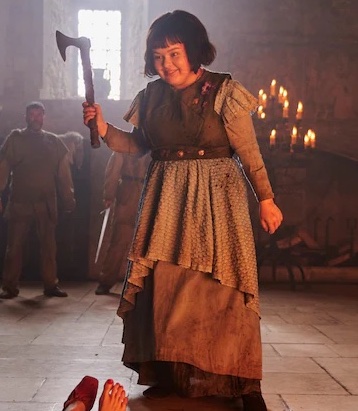
Lisa Swallows (Kathryn Newton) has never quite got over the night when her mother was murdered by a random axe murderer. (Laughing yet?) She now lives with her Dad, Dale (Joe Chrest), who is now married to Janet (Carla Gugino, chewing the scenery as the traditional evil stepmother, yet arguably the most watchable element in the film).  Lisa has also acquired a step-sister, Taffy (Liza Soberano), who – against all the odds – is friendly and supportive, which may be the only touch of originality here.

Lisa has taken to spending her spare time in the local cemetery, where she has been brooding beside the grave of a young Victorian male, who died back in 1837. Cue a thunderstorm, a convenient flash of lighting and said creature (played by Cole Sprouse) reanimates and lumbers his way to Lisa’s house, where she – quite by chance – is all alone in her bedroom. The creature is missing a hand and it’s not long before he and Lisa are on the lookout for a replacement…

I honestly want to like this, but almost everything about it misfires. The ‘jokes’ fall flat from the word go; the direction (by Zelda Williams) is perfunctory at best and occasionally rather confusing. While the 1989 setting is decently evoked, the dialogue that emerges from the mouths of the mostly young cast sounds like nothing anyone of that age would ever say. Newton does her best with what she’s been given, but deserves better lines to deliver. It doesn’t help that for nearly all of the film, her co-star Sprouse is only able to make various grunts, growls and shouts. 

The film lurches clumsily onwards, powered only by its own internal logic, but when that logic is so fatally flawed, it takes every ounce of my will to stay in my seat until the end. Sorry to all involved, but this feels like a waste of a sizeable budget that could have been spent on something better than this muddled mess.

1.5 stars

Philip Caveney 

Spaceman

06/03/24

Netflix

Adam Sandler. There, I said it.

Sandler is, of course, best known for his comedies, though these can most politely be described as ‘variable’. More often than not, they seem like an elaborate excuse for Sandler to team up with a bunch of mates and improvise something that feels like it has been literally thrown together. And then, every now and again, out of the blue, he decides to star in something more substantial for a quality director. I’m thinking of the likes of Punch Drunk Love, which he made with Paul Thomas Anderson, and the stone cold masterpiece Uncut Gems, written and directed by the Safdie Brothers, which possibly qualifies as the most stressful couple of hours I’ve spent in the cinema.

Spaceman, directed by Johan Renck and adapted by Colby Day (from a novel by Jaroslav Kalfar), is not in the same league as those two films and yet it’s a sizeable step up from Sandler’s usual offerings, a slow-moving, thoughtful allegory about the distance that can exist between a man and his wife, even when they are physically together.

The Spaceman of the title is Jakub, a Czech cosmonaut, currently on a six-month mission to visit (and take samples from) the mysterious Cloud of Chopra, somewhere beyond Neptune. At home, his pregnant wife, Lenka (Carey Mulligan), is falling out of love with him, because he’s been distant in so many ways -even before he set off on his current voyage.

Jakub is nonplussed to discover that his regular calls to Lenka are going unanswered. He’s even more bewildered to learn that he has a stowaway aboard his spaceship – a huge alien spider, who can talk and is memorably voiced by Paul Dano. (Arachnophobes, take note: this film may not be for you!)

Most movies of this kind would pitch the alien as a voracious predator, with no higher motive than to chow down on the spaceship’s other occupant, but this creature (whom Jakub names Hanûs) turns out to be a gentle and communicative beast, who soon takes on the role of a kind of life coach, offering Jakub advice about all manner of things, including his failing marriage. It’s the sheer unexpectedness of this approach that grabs me most. As the mission steadily unfolds, we begin to learn more about the event that caused the rift between Jakub and Lenka. Can it ever be repaired?

Spaceman won’t be for everyone. For one thing, it moves at a glacial pace, Jakub’s journey interspersed with flashbacks to his courtship of Lenka and occasional cutaways to her present day conversations with her mother, Zdena (Lena Olin). There’s a lot of footage of the mysterious Cloud of Chopra, which – though pleasant enough to look at – soon starts to feel suspiciously like filler.

I will also confess to being initially confused by the ending, but with a little thought it soon makes perfect sense. Overall, Spaceman is an interesting little film with a fascinating premise. Though flawed, it’s light years ahead of Sandler’s customary output.

3.6 stars

Philip Caveney

Dune: Part Two

03/03/24

Cineworld, Edinburgh

It only needs a glance around the IMAX auditorium at Edinburgh’s Cineworld on this Sunday afternoon to confirm that Denis Villeneuve’s big gamble has paid off. There’s barely an empty seat in the building. 

Dune: Part One came along at a propitious time. It was October 2021 and we were barely out of lockdown, sitting uncertainly in our seats, wearing paper masks and slapping gel on our hands at five-minute intervals. What we needed now was something epic to take our minds off the pandemic and we certainly got that – but what we were also handed was an unfinished story and a three-year wait for its conclusion. 

Would it be worth it?

The answer to that is a resounding yes! If the first film occasionally felt a little too languid for comfort, Part Two ramps the action up to eleven, and Villeneuve has the good sense to keep everything rattling along at full speed ahead. The result is a film that, despite  a running time of just under three hours, never feels overlong. 

And in this case the word ‘epic’ barely does the material justice: this is an immense, eye-popping spectacle, an insanely inspired slice of cinematic world-building that at times leaves me almost breathless at what I’m witnessing up on the giant screen. This, my friends, is why they invented IMAX. If you haven’t seen Part One since its release (or at all for that matter), I’d advise you to catch up with it via streaming before sitting down to the second installment. I did and it helps no end to reacquaint myself with the characters.

We pick up exactly where we left off. Paul Atreides (Timothée Chalamet) and his mother, Jessica (Rebecca Ferguson), have survived the murder of most of their family and have sought refuge with the Fremen people in the remotest part of the desert planet, Arrakis. Paul has finally met his (quite literal) dream girl, Chani (Zendaya), and, under the protection of Stilgar (Javier Bardem), he’s learning the ways of the Fremen. 

At the same time, he’s all too aware that some of the more devout members of the tribe are giving him meaningful looks and referring back to an ancient prophecy that a messiah will one day arrive and lead the Fremen to triumph over their oppressors.

Could this be a potential way for Paul to take revenge for the killing of his father by the evil Baron Harkonen (Stellan Skarsgard), who is still skulking in a bathtub doing unspeakably horrible things to everyone who comes near him? And if you think he’s bad, wait till you meet his nephew, the psychopathic Feyd-Rautha (Austin ‘Elvis’ Butler), who redefines the word ‘villain’ in one of the most remarkable screen transformations ever.

Villeneuve has excelled himself here and Dune: Part Two is an extraordinary achievement, one that cements his reputation as one of the great visionaries of the cinema, up there with the likes of David Lean and Stanley Kubrick. His interpretation of Frank Herbert’s source novel spins allegories about the links between religion and drugs, the evils of colonialism, the ruthlessness of royalty, the inevitability of war between the poor and the privileged. That’s all there lurking behind the dazzling action set pieces and massive explosions.

My only niggle (as with the first film) is that the 12A rating sometimes works against the film, when all that violent mayhem must remain essentially bloodless in order to tick the boxes – but it’s not a big enough quibble to dampen my enthusiasm for this giant-sized helping of space fantasy, that quite frankly makes the Star Wars franchise look positively amateurish by comparison. 

And if the story’s conclusion doesn’t feel quite as er… conclusive as I might have expected, the possibility of Dune Messiah looming on a distant horizon may account for it. A trilogy, perhaps? 

Well, it would be rude not to, right?

5 stars

Philip Caveney
Perfect Days

25/02/24

Cameo Cinema, Edinburgh

‘It’s about this guy who cleans toilets for a living.’

Yes, I know. On paper, Perfect Days doesn’t sound like the most promising scenario I’ve ever heard but, in the hands of veteran director, Wim Wenders, it’s so much more than I might have expected. Wenders is somebody who I used to love back in the day. Paris Texas (1984), is the movie I remember him best for, but, since Wings of Desire in 1987, I have lost track of his output. This latest offering is a charming, affectionate study of a man’s everyday working life and the various people he encounters along the way. 

Perfect Days picked up a couple of prestigious prizes at Cannes in 2023 and more recently was nominated for Best International Feature Film at the 96th Academy Awards. It’s easy to see the qualities that enchanted the judges.

The aforementioned toilet cleaner is Hirayama (Koji Yakusho), a quiet and reserved character who has very little to say for himself but who appears to have an almost zen-like appreciation of the world about him. He’s a man who is absolutely committed to his routine and, from the opening scene onward, we share it with him. He wakes in the early hours of the morning in his small but immaculately neat apartment and we travel with him in his van as he listens to a series of vintage songs on his cassette player – The Animals, Van Morrison and (perhaps not surprisingly given the title of the film) Lou Reed.

We work alongside him as he journeys from public toilet to public toilet, ranging from simple-but-functional cubicles to state-of-the-art superloos, sharing his brief interactions with the people he encounters along the way. Not all of them are strangers to him. There’s his feckless young colleague Takashi (Tokio Emoto), endlessly chasing after a woman called Aya (Aoi Yamada) and trying to find ways to earn enough money to go out with her. There’s Hirayama’s teenage niece, Niko (Arisa Nakano), who turns up unannounced at his door one evening after running away from home. And there’s Hirayama’s estranged sister, Keiko (Yumi Aso), who comes to collect her daughter and who cannot understand why her brother is ‘wasting his life’ in such a thankless occupation.

But as the story progresses, we begin to understand that Hirayama isn’t wasting his life. Far from it, he is carrying out important work to the best of his ability, with quiet dignity and determination. Of course, a life so based on routine only needs the slightest glitch to throw everything into turmoil, which happens when Takashi fails to show up one day, leaving Hirayama to do the work of two people…

As Perfect Days unfolds in its calm, understated way, it exerts an increasingly powerful grip on the viewer, gradually revealing more about its central character but always leaving us wanting to know a little more. It’s also true to say that the city of Tokyo is one of the most important characters in the film. Wenders unveils its various charms in so many different lights, from dawn to dusk, from sundown to sunrise. Franz Lustig’s cinematography depicts its back alleys and sidestreets, stares up at its neon lit skylines in a sort of swooning wonder. 

Yakusho’s performance is also a delight, his character saying little but revealing every emotion through his range of expressions, dour and perplexed one moment, on the verge of helpless laughter the next. It all culminates in an extended shot of him driving his van home as Nina Simone’s Feeling Good blasts from the tape deck, Hirayama’s face registering the sheer unadulterated joy of every line.

Some will claim that there’s not enough content here to sustain a two-hour running time, but I would respectfully disagree. This is a little gem of a film and a reminder if ever it were needed that, at the age of 78, Wenders is still a creative force to be reckoned with.

4.4 stars

Philip Caveney
Vanya: National Theatre Live

23/02/24

Cameo Cinema, Edinburgh

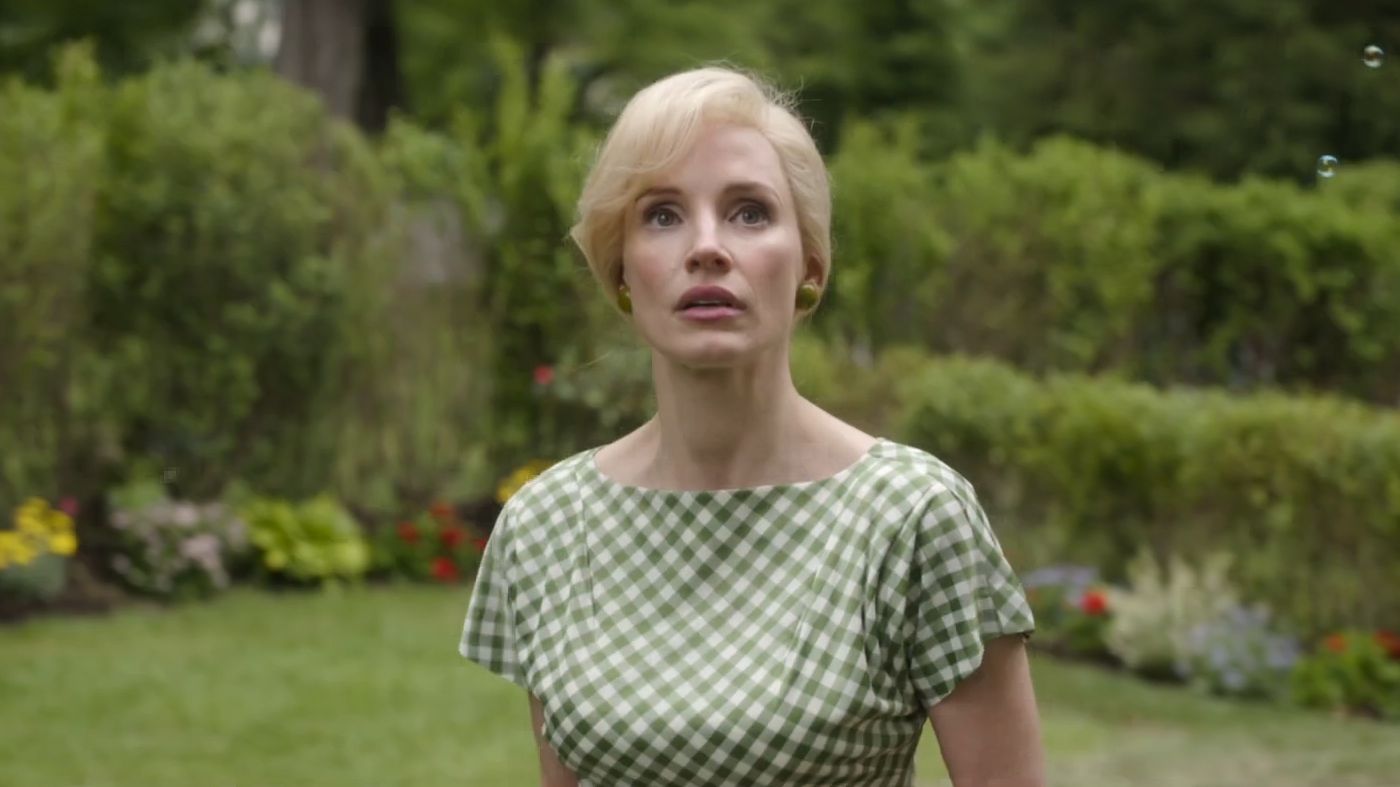
I have previously been somewhat baffled by the general adulation heaped upon Andrew Scott. Don’t get me wrong, I’ve always thought him a perfectly decent actor, but have somehow failed to appreciate the full depths of his talent.

Until now.

Simon Stephens’ brilliant adaptation of Anton Chekov’s Uncle Vanya features seven characters in a complex tale of a family’s interactions on a remote country estate. All of them are played – perhaps inhabited would be a more accurate word – by Scott. There’s no recourse to any costume changes and the set design amounts to little more than a series of chairs, a piano and a doorway. Scott slips effortlessly from one character to the next, using only slight modulations of voice and tiny mannerisms to tell me instantly who he is at any given moment. The effect is uncanny. The term tour de force is often used but I’ve rarely seen it so consummately earned.

Credit should also go to Stephens, whose script strips the story back to its basics (and slightly updates it) so that all the characters’ motivations are clear from the outset – and to director Sam Yates who keeps the whole enterprise beautifully understated, so that it flows from scene to scene like honey in a heatwave. But the lion’s share of the accolades must go to Scott, who is mesmerising in every role: pompous and self-aggrandising at Aleksandr Sebryakov, the retired professor still obsessed with working on his latest project; smooth and sensual as Aleksandr’s young wife Helena; and painfully self-conscious as his daughter Sofia, who has always been told that she’s ‘plain’.

He’s delightfully gossipy as Maria – the mother of the titular Ivan (Vanya), a hard working man who has selflessly devoted himself to supporting Aleksandr, whom he has idolised since childhood – and wonderfully tragic as Mikhail, the middle-aged country doctor who is desperately in love with Helena.

And finally, he is comically ingratiating as Ilya, an impoverished landowner, now dependent on the goodwill of the Sebryakov family. A delightful running joke has us (and the rest of the cast) forgetting that he’s there, observing everything that happens.

If this sounds hopelessly complicated on paper, fear not. The wonder of this National Theatre Live production is the way in which it glides like gossamer through the cuts and thrusts of a family drama, where even a scene where Scott is obliged to make love to himself unfolds like a dream. Throw in a rendition of Jacques Brel’s heartbreaking ballad If You Go Away and I’m completely sold, a convert to Scott’s evident talent.

Vanya – and Scott – are both extraordinary. If you get the opportunity to see this, I urge you to take it.

5 stars

Philip Caveney
Passages

21/02/24

MUBI

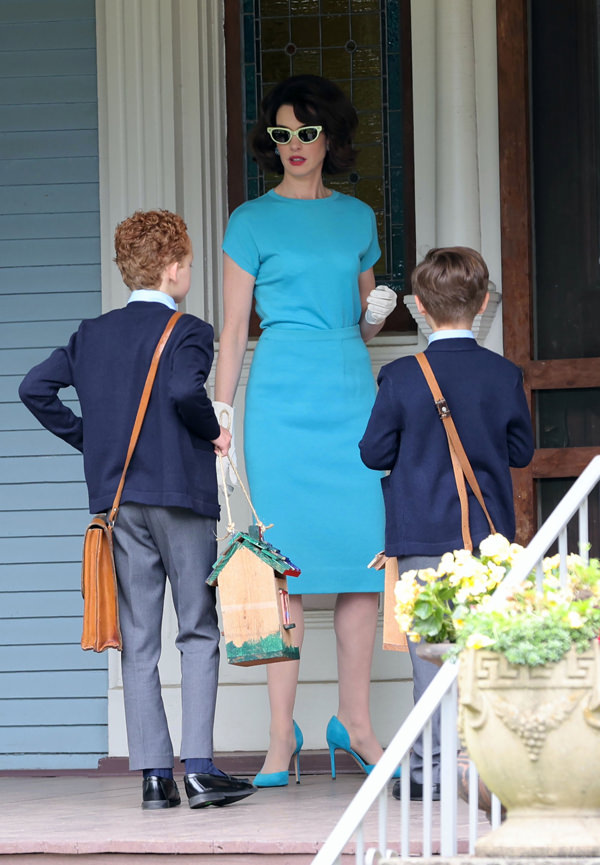
Film director Tomas (Franz Rogowski) is a bit of a shit. His tyranny is evident as soon as we encounter him on set in Paris, berating an actor for failing to display exactly the right amount of nonchalance when walking downstairs. At the wrap party, we learn that the actor is also his husband, Martin (Ben Whishaw), which sets the alarm bells ringing. Just how toxic is their relationship?

Very, it turns out. Martin isn’t really in the mood to party, so Tomas hooks up with Agathe (Adèle Exarchopoulos), a school teacher/film extra. Suddenly, he’s in love with her – and moving out of the marital flat. But when Martin tries to move on too, Tomas proves reluctant to let him go. Before long, he’s got both Martin and Agathe miserably dancing to his tune. Like I said – he’s a shit.

Directed by Ira Sachs, Passages is a fascinating study of unapologetic selfishness. The performances from all three leads are intense and engaging, and Whishaw and Exarchopoulos elicit great sympathy for their characters. However, although Rogowski inhabits the role convincingly, Tomas is so utterly awful from the outset that there’s very little progression. We just see a man behaving badly, over and over – demanding too much from the people he claims to love, while never giving anything in return. I find myself frustrated by both Martin and Agathe’s willingness to indulge him. I’m literally shouting at the screen: “Just tell him no!” (I’m watching this at home, not at the cinema, so the shouting is okay – although I’m not sure that the neighbours agree…)

The world-building is exquisite: there’s no obvious exposition; we’re simply dropped into the characters’ lives, mid-story – but we’re never in any doubt as to what is going on. It’s adroitly done.

There’s no denying the fact that Passages is well directed and beautifully acted – but it’s a film to admire rather than enjoy.

3.4 stars

Susan Singfield

Dream Scenario

20/02/24

Amazon Prime

Over a long and varied career, Nicolas Cage has developed a reputation for embracing weird movie projects, and writer/director Kristoffer Borgli’s Dream Scenario certainly fits that description – even if Paul Matthews, a rumpled professor of Zoology at an obscure university, appears to be the most normal guy in the world. Released in 2023, the film barely got a look in at the multiplexes and, having missed it there, I’ve been eager for it to start streaming. It’s finally available to rent on Amazon Prime, and I have to say, it is worth the wait. This bizarre, complex and occasionally shocking film has more twists and turns than the proverbial python on itching powder.

It begins (hardly surprisingly, given the title) when Paul listens to an account of a dream that his daughter, Sophie (Lily Bird), has experienced the night before – a dream in which she is floating helplessly skyward while her father sweeps up leaves in the garden and pays absolutely no attention to her plight. Paul feels weirdly guilty about his inability to do anything to help her, but older daughter Hannah (Jessica Clement) and Paul’s wife, Janet (Juliet Nicholson), assure him he’s just being paranoid.

But then other people start having dreams about Paul and in all of them, he’s just standing there, watching. As these dream scenarios become more common, a bewildered Paul finds himself featuring in the dreams of most of the students in his classes, a situation that seems to make them more receptive to his usually rather dry lectures. It’s not long before he’s a social media sensation. He can’t help but enjoy this new-found celebrity, telling himself that his stalled academic career might receive an invigorating bump from this strange phenomenon. He even engages the services of a team of marketing people, led by the vacuous Trent (Michael Cera), who keeps trying to persuade him to forge a partnership with Sprite.

But then the dreams that feature him take a much darker turn and Paul finds, to his dismay, that his students – and most of his friends and colleagues – are no longer quite so keen on him…

Dream Scenario is a fascinating film, one that works on many levels. It’s tempting to see it as an allegory about the nature of fame in the 21st century, the ways in which the most innocuous events can go viral and affect people’s lives – and also, how easily circumstances can change, resulting in those same people being cruelly cancelled by their former admirers. I like the way in which I find myself increasingly unsure, as the narrative unfolds, as to what’s a dream and what’s reality, the lines between the two realms blurring. Always a gifted performer, Cage is particularly compelling here, capturing Paul’s bumbling persona, as well as his rising doubts and paranoia as he sees his hopes for a more fulfilling career dashed and compromised at every turn.

There’s an interesting coda that takes the whole idea in a slightly different direction, while at the same time remaining true to its central premise. I’m left with the distinct conviction that, had I managed to catch this on first release, it would have numbered among my favourite films of 2023. But, better late than never, I guess.

4.5 stars

Philip Caveney
Wicked Little Letters

19/02/24

Cineworld, Edinburgh

I’m primed to like Wicked Little Letters. With Olivia Colman, Jessie Buckley and Anjana Vasan as the triumvirate of talent at its helm, what could possibly go wrong?

And yet I find myself struggling to warm to this film. Despite fine performances from the three leads, as well as a stellar supporting cast (including Timothy Spall, Joanna Scanlan and Alisha Weir), it feels somehow both heavy-handed and insubstantial.

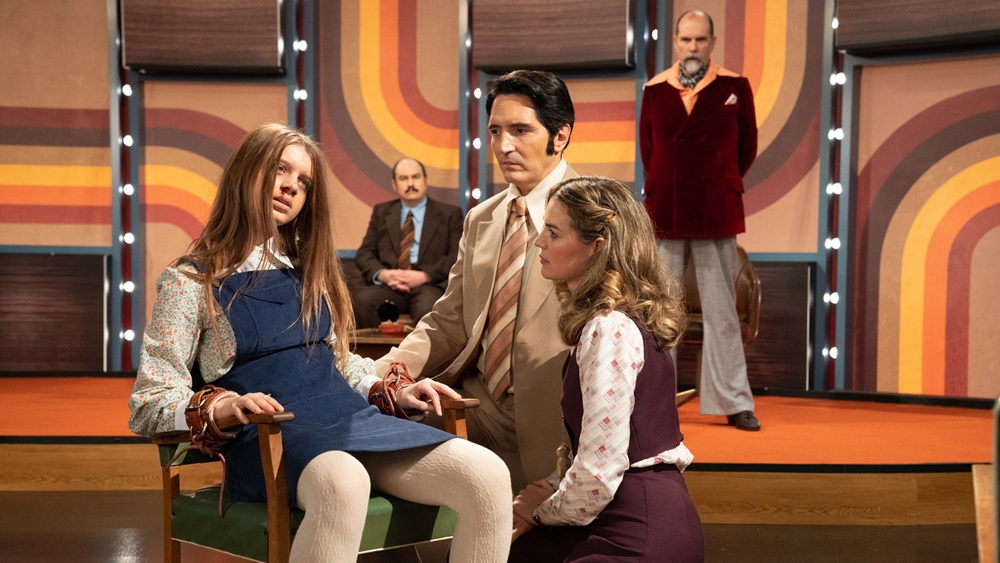
Set in 1920s Littlehampton, Wicked Little Letters is loosely based on a true story. Colman plays Edie Swan, a repressed spinster, unable to escape from her overbearing father (Spall). When a spirited Irish widow (Buckley) moves into the house next door – complete with daughter Nancy (Weir) and new partner Bill (Malachi Kirby) – Edie is delighted, but her friendship with Rose soon turns sour. Then Edie begins to receive poison pen letters, and the local bobbies know exactly where to lay the blame. But Woman Police Officer Gladys Moss (Vasan) thinks they may have jumped the gun…

To quote the very excellent Deborah Frances-White, “I’m a feminist, but…” the misogyny in this movie is cartoon-like, laid on with a proverbial trowel. At the same time, racial politics are completely ignored. I find it hard to believe that the same white male colleagues who openly sneer at Gladys because of her gender wouldn’t also have something to say about the fact that she’s Asian. Likewise, it’s incredible that Rose doesn’t face much anti-Irish prejudice, and no one ever mentions the fact that Bill is Black. I like the fact that the fictional characters are more diverse than their real-life counterparts, but intersectionality matters, and it doesn’t make sense to ignore it here.

At first, I enjoy the humour in Jonny Sweet’s script, but I get bored of the whole “sad stinky fucking foxy arsehole” sweariness; it’s repetitive and the shock value soon wears thin. Director Thea Sharrock does a good job of evoking a sense of time and place, and of allowing her cast to shine, but there’s no getting away from the thin material. It doesn’t help that there are no red herrings, or that what little suspense there is is squandered by revealing the culprit at the halfway point.

Colman, of course, is brilliant, managing to convey a perfect mixture of horror and triumph every time she utters a profanity – and this, along with Buckley’s brittle vivacity and Vasan’s wide-eyed determination, elevates the film. Wicked Little Letters works well as a character study, less so as a compelling narrative.

3.6 stars

Susan Singfield

Bob Marley: One Love

18/02/24

Cineworld, Edinburgh

It’s been a long time coming, but finally Bob Marley has his biopic. While it does a pretty decent job of capturing the era in which he rose to prominence and makes you appreciate how many insanely ear-wormy hits he created, there is a slight tendency here to sanitise his offstage antics. But perhaps, with no less than four of his immediate family onboard as executive producers, that’s no great surprise.

We first meet Marley (Kingsley Ben-Adir) when he’s already successful, married to Rita (Lashana Lynch) and watching bewildered as his home town teeters on the edge of a brutal civil war. When a house invasion results in Bob being shot and Rita rushed to hospital, Bob takes the advice of his record producer, Chris Blackwell (James Norton) and heads off to London, where he develops plans for Exodus – the record that will propel him to superstardom. Along the way, he experiences recurring visions of his childhood years under colonial rule, and of the white father he never really knew.

The film is at its best when it’s showing us recreations of the stage shows that would cement Marley’s reputation as an electrifying live presence – and I particularly enjoy the scene where the title track of Exodus is taken from a single idea, through a series of rough improvisations with the band, until it finally comes close to the finished article. I’ve rarely seen a better recreation of the way a band works together to develop a song.

If Ben-Adir is a little too handsome for the role (something that’s accentuated by the post-credit sequences featuring the real Marley), he nevertheless nails the man’s dance moves, gestures and affectations with aplomb. Ironically, it’s Lynch who has more opportunity to generate genuine emotion. In a scene where she berates her husband about the various sexual indiscretions she’s had to tolerate over the years and the way her own singing career has been sublimated in order to help him achieve his goals, she really shines.

In the end, One Love is an enjoyable movie, that could perhaps have benefitted from a grittier approach. Lovers of Marley’s music will have a field day, as one belter after another blasts from the speakers. Like me, fans will doubtless find themselves foot-tapping and twitching in their seats. More than anything else, this is a celebration of the man’s musical accomplishments and his unwavering quest for peace, rather than a warts-and-all investigation of his private life.

4 stars

Philip Caveney