Month: March 2022

The Scent of Roses

10/03/22

Lyceum Theatre, Edinburgh

After an unfortunate delay, due to the continuing saga of the dreaded COVID 19, The Scent of Roses is finally with us and it’s been well worth the wait. A timely meditation on the nature of everyday lies and the importance of finally speaking the truth, Zinnie Harris’s spiky, ambitious play is beautifully realised within Tom Piper’s austere set design. Initially claustrophobic, a suburban bedroom is gradually opened out like an ingenious puzzle box to reveal unexpected depths and wider horizons.

We’re somewhere in Scotland in the near future, where the summer temperatures are soaring and where birds are liable to fall from the skies for no explicable reason – and everywhere there’s the unpleasant odour of dying flowers.

Chris (Peter Forbes) and his wife, Luci (Neve Mcintosh), are having a heart-to-heart in their bedroom. Chris has little choice in the matter, because Luci has locked them both inside and hidden the key. It seems to be the only way she can get him to open up to her. Chris, it seems, has not been entirely truthful about his fidelity over the years and, it turns out, Luci has a terrible secret of her own to share with him.

Meanwhile, their daughter, Caitlin (Leah Byrne), arrives at the house of her former teacher (and lover), Sally (Saskia Ashdown), carrying a dead crow in her bloodstained hands. Caitlin claims to have run over the unfortunate bird on her bike – but then she also adds that she’s just murdered her father. It quickly becomes clear that Caitlin is a serial liar and we shouldn’t take anything she says for granted.

It’s only when Sally heads over to meet up with her estranged mother (Maureen Beattie) that the various strands of this Gordian knot of a storyline are finally unravelled before being skilfully retied. The cast all handle their roles admirably (particularly Beattie as the long-suffering mother who must put her own triumphs on hold in order to see to her daughter’s issues) and Harris handles the directorial reins with assurance. Ben Ormerod’s lighting design floods the stage with a palpable swathe of brilliant ‘heat.’

After a recent diet of tried-and-tested crowdpleasers, this is exactly the kind of theatre I’ve been longing for – mature, challenging and above all else, thought-provoking; so much so that my companion and I immediately head off to a local drinking den to discuss it at great length.

Which accounts for the fact that I’m writing this with a wee bit of a hangover.

At least, that’s my story. And I’m sticking to it.

4.2 stars

Philip Caveney

A Midsummer Night’s Dream

09/03/22

Assembly Roxy, Edinburgh

EUSC’s A Midsummer Night’s Dream is a real treat. I’m feeling a bit tired and grumpy before we set off for the theatre – a culmination of late nights and hayfever – but this sprightly production soon puts a spring in my step and, by the time I leave, I’m all smiles.

There’s something endearing about the audiences for these student productions: they’re always so vocal in their enthusiasm. It really helps to cement the whole ‘shared experience’ feeling of live performance, and debunks the idea that theatre only appeals to the middle-class and middle-aged. Their liveliness feeds the atmosphere, which is almost as charged off-stage as on. I love it.

Director Sara Cemin deftly braids the disparate strands of Shakespeare’s play. This is a vivacious, playful production, subtly updated with occasional asides (I mean, I don’t think “Fuck’s sake!” appears in the First Folio), which illuminate the jokes, sending laughter rippling through the auditorium.

The fever dream chaos is nicely realised: the four passionate youths, lost in the woods; the bumbling Mechanicals, desperately sincere in their desire to create something worthwhile; the mischievous faeries, unable to resist the impulse to play tricks. It’s a perfect storm.

The Mechanicals are the standouts. Some of this is down to Billy Bard himself, of course: there’s such a clever balance of scorn and tenderness in his rendering of them. But Cemin deserves credit for drawing this out, for resisting the urge to make them pantomime-ish figures, affording them instead the dignity of working people, striving to make something good (while still gently poking fun). Max Prentice (last seen by B&B in EUTC’s Education, Education, Education in 2018) is perfectly cast as Bottom: he’s clearly a natural comedian, and is instantly engaging. He’s definitely one to watch. But don’t underestimate those in the smaller roles either; this strand highlights the power of ensemble performance.

I do have a couple of minor gripes. First: the dry ice machine. “Fuck’s sake,” as Helena would say. It works well to set the scene when the faeries first appear, but – where cough-inducing smoke is concerned – less is more. Second (and this might just be me): the long interval. I know people need time to go to the loo and buy a drink, but anything longer than fifteen minutes disrupts the momentum, and all the tension that’s been so carefully built in the first act just starts to dissipate. Neither of these is a deal-breaker though.

I love Amelia Chinnock Schuman’s choreography, particularly in the fight scene, which is impressively visceral. The four lovers (Lucy Melrose, Archie Barrington, Isabelle Hodgson and Will Nye) approach this tussle with evident gusto, and the fear of injury seems very real (not least because of the rucked-up rug I keep thinking someone’s going to trip over. Yes, I am a laugh). The music is a satisfying addition too. It’s all original (by Joe Pratt and Mark Sandford), and I applaud the decision to have live musicians on stage. The songs are well-integrated into the production: enhancing rather than intrusive.

No review of AMND is complete without reference to Puck, and Priya Basra seems made for the role. She imbues the goblin with the necessary likability, so that we can witness his careless cruelty without abhorring him. She has eye-rolling down to a fine art.

All in all, then, this is an absolute delight. There’s only one night left. Buy a ticket – quickly!

4.3 stars

Susan Singfield

The Duke

09/03/22

Cineworld, Edinburgh

The latest entry in the ‘truth is stranger than fiction’ genre is The Duke – the final feature from versatile director, the late Roger Michell. This is the story of the improbably named Kempton Bunton (Jim Broadbent), an irascible campaigner for pensioners’ rights, women’s suffrage and, in his spare time, a would-be playwright. Quite why his script The Adventures of Susan Christ never found an audience is anybody’s guess.

It’s the early 1960s and ,while England’s capital is celebrating a new-found sense of freedom, life on the gloomy streets of Newcastle is a somewhat bleaker prospect, as Bunton stumbles from job-to-job, constantly losing them because of his propensity to stand up against any signs of injustice he encounters. His long-suffering wife, Dorothy (Helen Mirren), slogs her guts out as a home help to her more affluent neighbour, Mrs Gowling (Anna Maxwell Martin), in order to make ends meet. She is mortified when her husband is obliged to spend a short spell in prison for non-payment of his TV licence (free TV for OAPs being his current pet project).

Meanwhile the couple’s younger son, Jackie (Fionn Whitehead), dreams of building and selling luxury boats, while his brother, Kenny (Jack Bundeira), has his own run-ins with the police to contend with.

And then a valuable painting of The Duke of Wellington by Goya is ‘borrowed’ from the National Gallery – and when it winds up hidden in the back of the Bunton’s wardrobe, it’s only a matter of time before the merde hits the fan.

The Duke is an irresistibly enjoyable piece that manages to evade the cosy complacency of so many films aimed at more mature audiences. Michell’s direction cleverly juxtaposes glossy widescreen shots of London with the grubby, timeworn realities of 60s Newcastle and the humdrum rigours of everyday working-class life are convincingly captured. The Buntons feel like real characters rather than archetypes. A past sadness that Kempton and Dorothy share is skilfully revealed in Richard Bean and Clive Coleman’s canny script – and there’s also a twist to the tale that genuinely takes me by surprise.

But this is surely Broadbent’s film. He’s terrific in the central role, making us genuinely care about a character who was, by all accounts, a bit of a wastrel. The penultimate scene where Bunton stands up in court to discuss the art theft with his barrister, Jeremy Hutchinson (Matthew Goode), had me laughing out loud and is probably worth the price of admission all by itself. Meanwhile, Mirren handles her role as the family matriarch with her usual aplomb and even manages to knit aggressively.

I’m hoping that some enterprising theatre will finally decide to stage one of Bunton’s lost plays – I’d love to see whether Susan Christ achieves her ambitions – but until that happens, The Duke is sure to send you on your way with a smile on your face.

4 stars

Philip Caveney

The Batman

04/03/22

Cineworld, Edinburgh

Director Matt Reeves’ modest ambition for The Batman was to make ‘the best Batman movie yet.’

Well, he hasn’t done that – but he’s certainly made the longest. Weighing in at a bum-numbing two hours and fifty minutes, it brings to mind the conviction that while ‘less’ is often ‘more’, ‘more’ usually equals ‘less’ when it comes to movies. And, while this just about scrapes four stars in its present bloated form, it would have scored much higher with some judicious editing. I mean, like, excising fifty minutes.

What is it about Batman that makes directors keep returning to that oft-plundered well? The fact that this is a comic-book hero who doesn’t have any super powers is always appealing, and there’s that delicious interplay between the vigilante who takes the law into his own hands and those misguided fools who see him as a hero. In this regard, The Batman feels a lot more nuanced than many of its predecessors, but it’s also sobering to think that the best film of the franchise is the one that he doesn’t even feature in.

Joker, thanks for asking.

Mind you if you thought Christopher Nolan’s depiction of Gotham City was dark, prepare to turn the palette down several notches. Reeves’ Gotham (shot in studios all over the UK) is filmed in tones of obsidian and anthracite. In this Gotham, it never seems to stop raining and the city is ruled by corrupt public officials, who gleefully take bribes and exploit the working classes for their own enrichment. (Remind you of anywhere?)

It’s Hallowe’en and a masked villain called The Riddler (brilliantly played by Paul Dano, though we don’t actually see his face until late on in the proceedings) is gleefully murdering those in power, who have allowed their standards to slip. Batman/Bruce Wayne (Robert Pattinson), though hated by most of the police force, is invited to investigate the crimes by Commissioner Gordon (Jeffrey Wright), the only cop who trusts him.

The Riddler is leaving cryptic clues at the scenes of the crime and Batman is good at deciphering them. In the course of his investigations, he comes into contact with Selina Kyle (Zoe Kravitz), crime kingpin, Carmine Falcone (John Turturro), and The Penguin (an unrecognisable Colin Farrell, hidden beneath layers of latex and sounding for all the world like Robert De Niro).

As the proceedings unfold, it becomes clear to Bruce that his own father, whose murder initiated Bruce’s transition into the Caped Crusader, might not have been as innocent as his son has always supposed. Batman also comes to realise that there are many people out there who follow his vigilante tactics with relish – and who would really like to be him.

And, as loyal butler, Alfred (Andy Serkis) is quick to point out, Bruce’s father might have done the wrong thing – but for very sound reasons.

There’s a lot here that I really like. It offers a much more interesting vision of DC’s premier hero than we’re used to seeing – but too much time is spent wandering along dark alleyways that don’t advance the plot enough. It’s only as I’m starting to grow impatient with the film that it finally coalesces and ramps up the suspense, as it heads into a vaguely apocalyptic climax that is weirdly prescient and also, in a strange way, uplifting. Reeves has already proven his worth with the likes of Cloverfield and his astute retooling of the Planet of the Apes trilogy – but, inevitably, The Batman just feels too long for its own good.

This is a shame because Pattinson really works in the lead role (for once, I actually believe that nobody would suspect his Bruce Wayne of being Batman, since the two personas are so different). Kravitz is also compelling in the Catwoman role, and I fully expect to see her return to it. A nifty coda shows us exactly where Reeves plans to go next and, given the projected casting for the next lead villain, I have to confess I’m suitably intrigued.

But please, Matt, next time around… can we just have a bit less?

4 stars

Philip Caveney

Sheila’s Island

01/03/22

King’s Theatre, Edinburgh

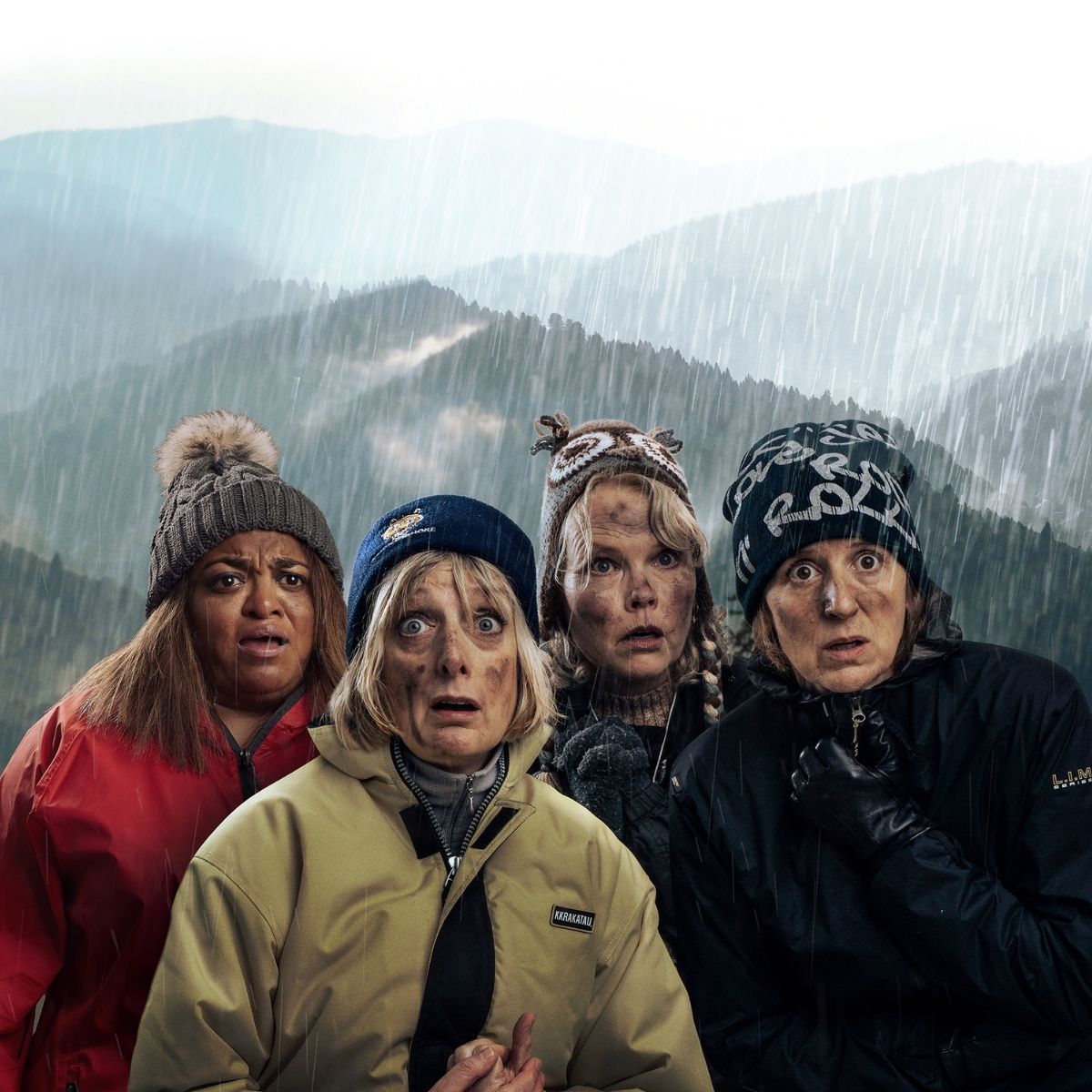
Sheila’s Island, directed by Joanna Read, is a reworking of Tim Firth’s 1992 play, Neville’s Island, about a group of middle-managers on an outward bound ‘team-building’ trip. Only two notable things have changed: the protagonists’ gender, and the need to explain why no one has a working phone. The former is dealt with more convincingly than the latter: the women are as rounded and credible as their male counterparts. As for the perennial mobile problem, I’m quite happy to buy the idea that ‘water damage’ has rendered Julie’s unworkable; I’m less convinced that the other women would have acquiesced to a request to hand theirs over to the course organisers. It just seems unnecessarily convoluted. ‘No signal’ would suffice…

The island in question is in the Lake District – Derwentwater – only a mile from the mainland. It’s November 5th, and the women are there because Sheila (Judy Flynn), their team leader, has led them astray, after misreading the first clue on a treasure hunt. They’re stranded because their canoe has sunk. Denise (Abigail Thaw) is particularly miffed, because her rucksack is still in the canoe, but Julie (played tonight by understudy, Tracy Collier) has packed enough for ten, so they’ll probably be okay. Except that Fay (Sara Crowe) is with them… and Fay has a lot of personal issues to work through.

Firth is good at humour, and there are jokes a-plenty in the script, delivered with gusto (and great timing) by the performers. The low-stakes situation is played for laughs: this is a long way from Robinson Crusoe or Lord of the Flies; the women can expect to be rescued within a day or so. Nevertheless, they rapidly descend into disharmony, with petty rivalries sparking heated exchanges, and their ridiculous attempts at bushcraft are genuinely funny.

Where the play fails, for me, is in its attempt to deliver something deeper than the shallow waters at the island’s edge. I don’t believe any subject should be off-limits when it comes to jokes, but neither do I think that issues as serious as nervous breakdowns, suicide attempts and being a long-term carer should be appropriated as asides. The subjects are too weighty for this flimsy tale to bear, and they make the tone uneven. It seems a little tin-eared, if I’m honest.

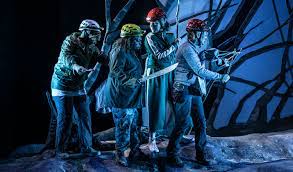
The set (by Liz Cooke) is a thing of loveliness, with simple, stark lines depicting bare trees, and an inlet of water reflecting Paul Anderson’s gorgeously lit winter sky with all its Bonfire Night fireworks. In the end, though, Sheila’s Island doesn’t quite deliver the “oohs” and “aahs”.

3 stars

Susan Singfield