Month: December 2020

Click To Connect

09/12/20

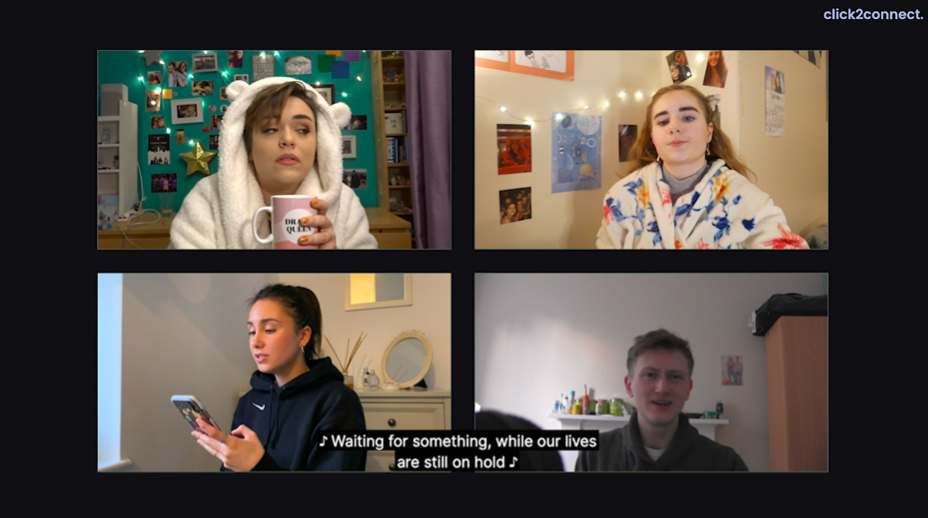
We’ve seen many enjoyable musicals from this talented student company over the years, but in 2020 – for pretty obvious reasons – they’ve had to make some radical adjustments to their usual approach. With all the cast members stuck in their own spaces, they’ve decided to embrace those limitations and the result is Click To Connect, an original play/movie musical filmed as a series of Zoom meetings. If this sounds underwhelming, don’t be misled. Others have tried this approach and foundered, but I’ve rarely seen the format appropriated with such brio.

The script, co-written by no less than five authors, concentrates on four relationships. Amy (Lucy Whelan) has recently broken up with her long time boyfriend and is now living with her parents. She contacts her friend, Sam (Nicola Alexander) and confesses the real reason why she is now single. Lex (Annie Docherty) and Kelsea (Leonie Findlay) are ex-partners, who’ve set up a double-date with their respective new interests, Mia (Kristen Wong) and Tom (Attir Basri) but, once the chat is underway, things don’t quite go to plan. Finally, Sadie (Rachel Cozens) is living away from her husband, George (Sebastian Schneeberger), and things have gone somewhat awry. Can their once-strong relationship be salvaged?

There are some breezy, melodic pop songs to kick things into action and nicely judged performances from Whelan and Alexander provide the piece’s strongest moments. I also love the way that Zoom’s limitations are cannily incorporated into the storyline – a warning that we are going to be kicked off after a set time (because we haven’t paid to use the service for longer than 40 minutes) is deftly employed and there’s even an attempt to simulate the inevitable dodgy wi-fi signal for one character.

Click to Connect is a timely example of how artistic ingenuity can overcome severe limitations and EUSOG have certainly risen to the challenge with aplomb. Of course we all look forward to the times when we can head back to the Pleasance to watch their next venture, but until then, this will do nicely.

4 stars

Philip Caveney

Small Axe: Red, White and Blue

07/12/20

BBC iPlayer

After the experimental Lovers Rock – which I have to confess, really didn’t work for me – Red, White and Blue, sees director Steve McQueen moving back to the kind of material he explored in Mangrove: the rampant racial discrimination experienced by black people in 1980s London. The difference this time around is that the major player here is a black police officer. Once again, it’s based on a true story, that of Leroy Logan (John Boyega), a former research scientist, who, after witnessing the savage beating of his father, Ken (Steve Toussaint), at the hands of two police officers, decides to join the Metropolitan police in the fervent hope that he will be able to improve things from the inside.

Of course, he quickly learns that making such changes is no easy matter and that, once on active duty, he will be unable to count on his white colleagues to back him up in any dangerous situation. But he’s clearly a tenacious individual. Logan stayed in the force until his retirement in 2013 and remains a member of the National Black Police Association.

If this were a Hollywood movie, of course, we’d see Leroy battle his way through appalling odds to emerge at the end, bruised, bloody and victorious. But this is crushingly realistic stuff – the inevitable realisation being that, though things may have improved a little since the 80s, they haven’t improved anything like enough. This story ends pretty much as it starts – with Logan stubbornly refusing to compromise his position.

Boyega is particularly impressive in the lead role – indeed, he dominates this episode and makes it very much his own. A scene where he finally explodes into anger at the callous conduct of his fellow officers is riveting stuff. There’s also a gruffly likeable performance from Toussaint as his father, a man who carries his bottled-up rage around with him like a cross he has to bear.

Next stop, the Brixton Riots. Can’t wait.

4 stars

Philip Caveney

Mank

04/12/20

Netflix

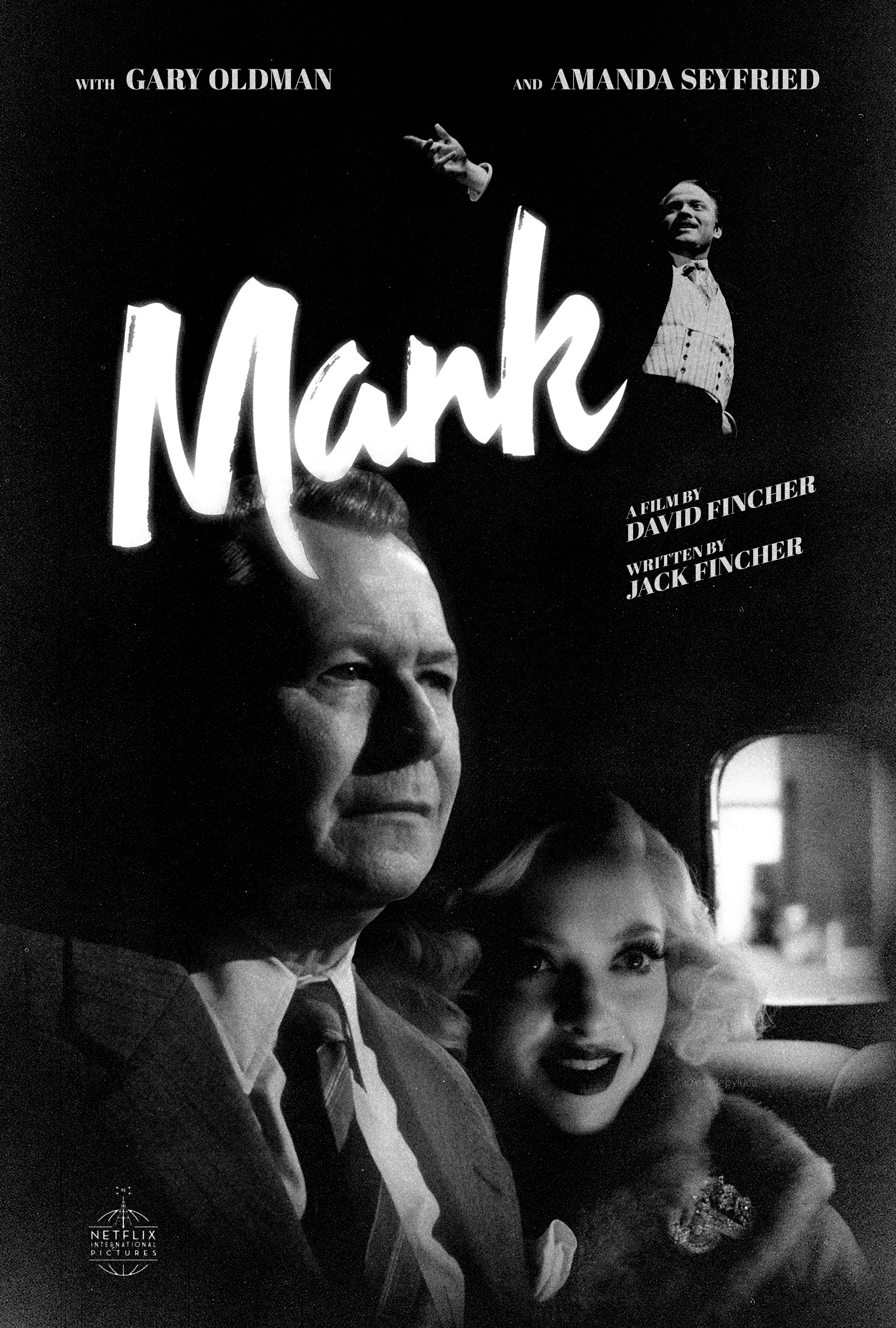
It seems I’ve been waiting for this film for just about forever. Director David Fincher first mentioned it as a possible follow up to Alien3 way back in 1992. With a screenplay by his father, Jack, it would focus on the creation of Citizen Kane. It would provide an answer to how much involvement Orson Welles actually had in the writing of that Oscar-winning screenplay and it would, of course, look into the allegations that the film was besmirched by the machinations of powerful newspaper tycoon, William Randolph Hearst.

Was I up for this? Yes, big time, because this is a story that has fascinated me since my youth. But, as it turned out, I was going to have to be patient…

And now, in one of the bleakest years in human history, it finally turns up, virtually unannounced on Netflix. Needless to say, I don’t allow a great deal of time to elapse before I tune in.

And it’s worth the wait. This is absolutely sumptuous, oozing class from every beautiful monochromatic frame, courtesy of cinematographer Erik Messerschmidt. Here is a faultless recreation of an era, right down to the visible scene descriptions, written clickety-clackety on a manual typewriter. From the opening credits onwards, Mank puts the viewer slap-bang in the early 1940s and keeps them immersed in that turbulent era right up until the final credits.

Washed-up screenwriter Herman J Mankiewicz (Gary Oldman) finds himself installed in a remote desert location, shortly after suffering serious injuries in a car crash. Sternly monitored by John Houseman (Sam Troughton) and ably assisted by English secretary, Rita Alexander (Lily Collins), he has been given the daunting task of writing the debut motion picture for Mercury Theatre’s Wunderkind, Orson Welles (Tom Burke). And he has just sixty days in which to do it.

It doesn’t help that Mank (as he is known to his friends) is an alcoholic. But he sets about the task with as much vigour as he can muster and, as he writes, his mind skips back and forth (rather like the screenplay he’s working on) over his changing fortunes in the Hollywood film industry.

We encounter Mank’s hostile relationship with muck-raking press baron, Hearst (Charles Dance), his platonic friendship with Hearst’s wife, Marion Davies (an almost luminous Amanda Seyfried), and his pugilistic dealings with the extremely unlikable Louis B. Mayer (Arliss Howard). There’s more – much more – in a packed two hours and eleven minutes; indeed, it’s probably fair to say that this is a story as rich and multi-layered as Kane itself. It’s also surprisingly prescient. The realisation that a super-rich newspaper proprietor can exert a powerful influence over the politics of a country, even going so far as to film fake news items to help steal an election, seems like a decidedly contemporary notion… but clearly that kind of thing has been going on for decades.

The film isn’t quite perfect. A scene where Mank goes on a (very long) drunken diatribe at one of Hearst’s lavish parties stretches credulity, and there are a few leaden missteps around the middle section, but these are minor blips in something that’s a giant step up from much of the so-so fodder that gets made. Fincher has created a warm, and moving testimonial to his late father’s memory, one that deserves to stand alongside the infamous movie it commemorates. Of course, it helps if you’re a fan of Kane in the first place, but it’s by no means essential.

If you’ve a couple of hours to spare, why not spoil yourselves? This is a superb piece of cinema.

4.8 stars

Philip Caveney

The Laundromat

03/12/20

Netflix

The Panama Papers – the massive exposé of hundreds of shady shell companies, dating back to the 1970s – was revealed in 2016 by a mysterious whistle-blower known only as ‘John Doe.’ It’s a fascinating tale of greed and deceit and one that was inevitably going to find its way onto cinema screens sooner or later. Furthermore, Steven Soderbergh is exactly the kind of director I would have picked to helm such a project. And yet, The Laundromat doesn’t quite work – mostly, I think, because of its scatter-shot approach.

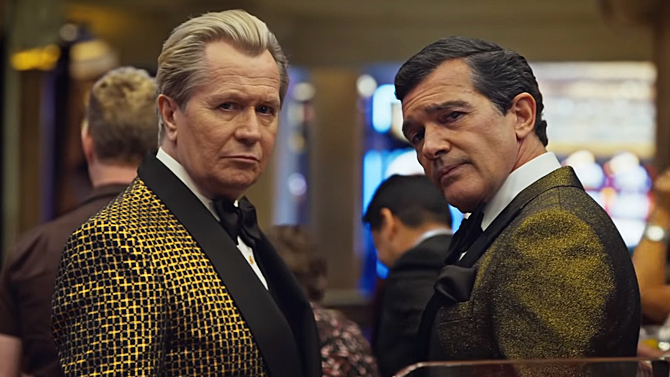
It starts well. We are introduced to Jurgen Mossack (Gary Oldman) and Ramon Fonseca (Antonio Banderas) wandering through a variety of exotic locations as they chat direct to camera, sip cocktails and explain that shell companies aren’t exactly illegal, they are simply ways of ensuring that billionaires won’t have the tiresome burden of paying all those pesky taxes they owe.

No big deal. The way they tell it, it sounds almost reasonable. But it can more succinctly be described in two words. Money laundering.

And then we meet Ellen Martin (Meryl Streep), recently widowed when she and her husband were on a cruise on Lake George and their hire boat capsized. First Ellen learns that the insurance policy she and her hubby took out for the trip won’t pay up because the firm they bought it from has itself been purchased by a shell company known only as ‘Nevis.’ And then her plans to retire to a condo that overlooks the place where she and her husband first met are brutally scuppered when the apartment is purchased – for cash – by a couple of Russian oligarchs.

Understandably miffed, she decides to devote some time to investigating the dealings of Nevis…

So far, so good, but it is at this point that screenwriter Scott Z. Burns takes us on a whistle-stop tour around the globe, to meet other people who, because of the wheelings and dealing of Messrs Mossack and Fonseca, are the nominal owners of shell companies, purportedly worth millions of dollars, but in reality not worth the paper they are printed on. African billionaire Charles (Nonso Anonzie) is attempting to pay off his wife and daughter over an affair he’s been having with a teenage girl, by making them the ‘owners’ of two such companies – and, in China, Madame Gu (Rosalind Chao) will seemingly go to any lengths to protect the reputation of her husband, whose main method of generating income seems to be trading in human organs.

These side-stories whizz past and aren’t investigated deeply enough to make them feel like part of the overall narrative arc. The unfortunate effect is that, by the time we get back to Ellen Martin’s quest, much of the story’s momentum has been lost. The film is by no means terrible, but it is unfocused – and even a late reveal (which I have to admit I didn’t see coming) fails to salvage it.

There’s certainly food for thought here. It’s interesting to note that the victims focused on in these stories are not the poor and impoverished, but middle-class people who’ve failed to realise that they are toiling at the behest of the greedy rich, whose paramount intention is to hang on to every penny they have generated, with no concern for the human wreckage left in their wake. It’s also sobering to learn that Mr Mossack and Mr Fonseca were able to walk away from this debacle with what amounts to little more than slapped wrists. Because, you know, it’s not really illegal…

For a winter evening stuck at home, this provides a decent night’s entertainment, but it certainly won’t figure among Steven Soderbergh’s best films – and there’s surely a more definitive adaptation of the Panama Papers story waiting somewhere in the wings.

3.6 stars

Philip Caveney

They’ll Love Me When I’m Dead

02/12/20

Netflix

With David Fincher’s Mank due to appear on Netflix any day now, this seems like the perfect moment to have a closer look at the maverick genius, Orson Welles. Mank is all about screenwriter Herman J. Mankiewicz, and the making of Citizen Kane. For many decades consistently referred to as ‘the best movie ever made,’ it certainly was an absolute game changer when it appeared in 1941. Welles was only 24 years old at that point – but, mostly due to the awful treatment he subsequently received from his peers in Hollywood, he would never achieve such dizzy heights again.

Also on Netflix is this gem – a documentary about the great director’s long (and ultimately doomed) attempts to create one final movie, The Other Side of the Wind. The film, as meticulously reconstructed from a series of outtakes by Welles’ old buddy, Peter Bogdanovich, can also be found on Netflix if you look hard enough, but it’s this vivid documentary that makes for the better watch. Narrated by Alan Cummings, directed by Morgan Neville and starring a whole cavalcade of Welles’ former friends and acquaintances, it gives an all-too-clear indication of the kind of mayhem that ebbed and flowed around the great man during the film’s troubled shoot. (You can almost smell the hashish blasting around the likes of Dennis Hopper, John Huston and Rich Little as they stumble around the set, vainly trying to work out exactly what Welles is attempting to do.) But TOSOTW had other problems to contend with, not least having the movie’s master print seized and locked up by the Shah of Iran – one of Welles’ shady backers.

Did Welles deserve to be regarded as a cinematic genius? Oh, yes, definitely. Was he treated abominably by the country that spawned him? Most assuredly. Hollywood may belatedly have offered him a trumped-up award for cinematic achievement, but nobody was ready to back up any of his enterprises with hard currency. In retrospect, it seems that they were simply trying to absolve their own collective guilt.

But it’s important to point out that, through a career plagued by adversity, Welles did somehow manage to create some astonishing films. Kane, The Magnificent Ambersons, The Trial, A Touch of Evil… and also, some of the best Shakespeare adaptations ever committed to celluloid – Chimes at Midnight is frankly extraordinary. This is a decent legacy for any director to leave behind, let alone one who started so promisingly and thereafter had every kind of shit heaped on his shoulders. He developed a reputation for being hard to get on with, but is it any wonder?

If you haven’t seen this, do take the opportunity to catch up with it and, if you’re feeling brave, move on to The Other Side of the Wind. Sure, it’s a tad incoherent and I’m really not sure about the film within a film – the one that clearly sets out to rubbish the likes of Michelangelo Antonioni and Federico Fellini, but… imagine how good it might have been if only Welles’ had the budget he needed to do it properly.

4.2 stars

Philip Caveney