Month: April 2016

I Am Thomas

I_Am_Thomas_415x800_jpg_300x200_crop_q8512615524_962903753801176_8608464594952847469_o

Lyceum Theatre, Edinburgh

06/04/16

I Am Thomas is a true ensemble piece, in production as well as performance. The list of those involved in its creation is very long (Told By An Idiot, Simon Armitage, Iain Johnstone, National Theatre Scotland, the Royal Lyceum Edinburgh, Liverpool’s Playhouse and Everyman) and it shows: this is an eclectic and dynamic mix of music and drama, a triumph of collaboration, devised theatre at its best.

It tells the tale of Thomas Aikenhead, a young Edinburgh student who, in 1696, was the last person in Scotland, to be hanged for the crime of blasphemy. Lurching appealingly between the past and the present, Aikenhead’s story is told though a series of vignettes, presenting him as a pub singer and – at one point – as Jesus Christ himself. Each member of the cast takes on the central role, the changes signified by a simple ‘I am Thomas’ slogan emblazoned on jackets and T-shirts, so that we are never in any doubt as to who is playing him. This helps, of course, to underline the ‘I am Spartacus/Je suis Charlie’ message already highlighted by the play’s title, and brings the focus – the importance of the right to free speech – into sharp relief.

The performances are uniformly strong: the cast are all musically adept, playing a range of instruments, and singing beautifully. The lyrics are witty, the music sprightly and engaging. It’s funny and warm – and tragic too. The props are deliciously silly and inventive, and the costuming a marvel of 1970s theme party kitsch. All in all, it’s really rather good.

Just one thing: what’s a prehistoric heron got to do with anything?

4.6 stars

Susan Singfield

The Easy Fish Co.

IMG_1866IMG_1897

Heaton Moor, Stockport

31/03/16

We were in the mood to celebrate, and the release of my latest novel seemed to offer a spurious excuse, so we resolved to eat at the Easy Fish Co. We dined here soon after the place opened, before we’d even started writing this blog and remembered the experience fondly, so back we came to investigate further.

Like most restaurants on ‘the Moor,’ the EFC is situated close to Damson, that fabulous venue against which all other Moor eateries must, inevitably, be measured. Rather like the FishWorks in London, the EFC is a fishmonger by day and a restaurant by night, so there’s clearly no problem in obtaining fresh ingredients for the meals. The staff are relaxed and friendly and the service is on the leisurely side – we sat down at 6.45 and didn’t leave the place until 8.45, but the bustling, congenial atmosphere was nice enough and we had a decent bottle of Pino Grigio to drink, so there was no great hurry.

We chose two starters, which we shared. The ‘Taster Board’ comprised a selection of fishy things – charred baby squid with sweet and sour peppers, whitebait, poached king prawns and pea aranchi (a kind of croquette) with mint crème fraiche. We also sampled a jar of smoked fish pate with a golden raisin chutney, served with toasted bread. The pate was the star of the show, light, citrusy and deliciously smoky, and the aranchi and poached prawns were also perfectly done. The squid though, was a tad rubbery and without those zesty peppers in support, wouldn’t have tasted of all that much. The whitebait was disappointing, the flavour a little muddy and the coating not as crisp as I would have liked. A few of them were left, which isn’t like me at all.

On to the main courses. I’ve always loved swordfish, and have often eaten it in little beach bars in Spain where the steak you’re given is so generous it could almost double as an eiderdown. This was a more realistic portion, two triangular steaks served on a bed of sweet potato, with scorched pak choi, a green Thai creme fraiche, beansprouts and sweet chilli. It was, in short, sublime and whoever thought of pairing it with sweet potato should really take a bow, because it worked brilliantly. Susan had opted for bouillabaisse and when it came to the table, we couldn’t help staring at it, because though it looked nicely cooked and presented, this wasn’t really a bouillabaisse at all, which really should be a hearty fish stew, swimming in a spicy, full-flavoured stock that has been simmering away for several days. OK, the medley of perfectly cooked fish on the plate came with a little pot of thick, creamy sauce to pour over, but this was not bouillabaisse as we know it. (A member of staff later explained that this was the chef’s own take on the classic dish, which is fair enough, but the name brings certain expectations and no matter how nicely the meal is done, there’s a sense of disappointment when you realise it’s not going to be what you actually wanted.)

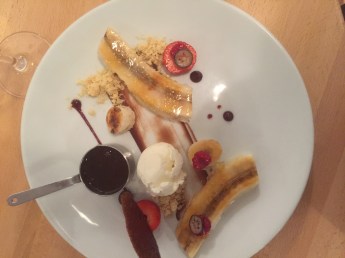
As it was a special occasion, we thought we’d sample some desserts and these proved to be so delicious they were well worth the wait. I had caramelised bananas with peanut crumb, served with a salted caramel rum sauce and ice cream, which tasted every bit as delicious as it sounds. The rum sauce was a particular delight, delicately flavoured and ‘lick the plate clean’ satisfying. Susan had the special, an Affogato – two scoops of ice cream with an espresso coffee and a hearty shot of amaretto to pour over. It was, she proclaimed, a coffee-lover’s dream. Both desserts had an expertly made tuile to go with it and there were fresh strawberries and little blobs of intensely flavoured fruit compote to further enhance your eating pleasure.

So, all in all, a very good meal in agreeable surroundings, with just a couple of details that might have been improved on. And while I can hardly detract points for calling a dish something that it isn’t (particularly when the dish in question is cooked with such skill) I would humbly suggest that they find a new name for that chef’s take on a classic dish.

4 stars

Philip Caveney

The Herbal Bed

English Touring Theatre

The Lowry, Salford

30/03/16

The Herbal Bed: The Secret Life of Shakespeare’s Daughter takes the sparse historical details of a suit for slander and weaves them into an engaging tale. The facts are few: Susanna Hall (Shakespeare’s oldest daughter) was accused, in 1613, of having an affair with a local man, Rafe Smith. The accuser, Jack Lane, was convicted of slander, and excommunicated for his crime.

Playwright Peter Whelan extrapolates a convincing narrative from these scant details; indeed, in this version of events, Lane is telling the truth: Susanna and Rafe have indeed been intimate. But, with help from her reluctant maid, Susanna takes the moral high ground, and Lane is exposed as a spiteful liar.

It’s an interesting play, with strong performances. Michael Mears, as Vicar-General Goche, is a real delight: a perfect incarnation of lugubrious self-righteousness, revelling in the sordid details of the sin he so abhors. Matt Whitchurch, as the hapless Lane, is also very good: a brash, emphatic performance, yes, but also a convincing one, and a welcome relief in what is overall a very measured piece.

If there’s a problem with this production, it’s in the measured tone. There’s no peril here, no real tension. We know the outcome of the case; we know Susanna’s reputation – and her marriage – survive the accusations sent her way. And nobody gets carried away by emotion: apart from one brief moment of passion, Rafe and Susanna behave with sober propriety; Susanna’s husband, John Hall (Jonathan Guy Lewis) remains calm throughout. The affair, such as it is, doesn’t really seem to matter; no one’s heart is broken; no one really cares.

In the programme, director James Dacre says that Whelan “never imposes an unrealistic crisis for the sake of good drama.” And, of course, no one wants to see an unrealistic crisis in a serious play like this. But what would be wrong with a realistic crisis? It’s a fictionalised account; the possibilities are limitless. And a little excitement would go a long way.

Despite this niggle, I enjoyed The Herbal Bed. It’s intelligently conceived, and well delivered – certainly one to watch.

4 stars

Susan Singfield


The Railway Children


York Theatre Royal and the National Railway Museum

Encore Cinema Screening

28/03/16

I saw this play when it opened in 2008, and was blown away by the site-specific production: the idea of staging it inside the National Railway Museum, once realised, seemed at once audacious and really bloody obvious. The tracks made a natural traverse, and the audience, seated on the platforms either side, were closely involved with the action. It was an ingenious and engaging piece, and one I’ve talked about ever since. It was no surprise to see its run extended, year on year, nor to see it relocate to King’s Cross for London’s theatre crowd.

So today’s cinema screening was a welcome opportunity to see this production again. And it didn’t disappoint. Of course, a film can never quite evoke the immersive atmosphere of live theatre, but this was beautifully done, capturing the essence of this charming adaptation of E. Nesbit’s famous book.

The story is well known: Bobbie, Phyllis, Peter and their mother are obliged to relocate to the countryside after their father is called away; they don’t know where he has gone, but they do know that they are suddenly – and frighteningly – poor. The servants and luxuries they have grown up with have all gone, and they have to learn to live a very different kind of life. They gravitate towards the railway station, where they make friends, and come to learn a lot about themselves and others too.

In its original form, The Railway Children is a sweet – if somewhat cloying – tale; here, it is given a dash of spice, as the adult Bobbie, Phyllis and Peter reminisce, telling their story with a knowing, grown-up edge. This conceit works well; it seems natural when they engage with the audience, or point out moments that are difficult to stage. It’s humorous and witty – but still tear-jerking: the essence of the story is not diluted by the fresh approach. Is there anyone alive who doesn’t cry when – in print, on screen or on stage – Bobbie cries, “Oh daddy, my daddy”? If there is, I’ve never met them.

The performances are very good throughout (although Andrina Carroll, as Mother, did have a tendency to shout), but it’s the staging and design that are the stars of this show. Bare wooden blocks are pushed along the tracks, with simple props placed on them to evoke a range of locations. The platform and bridge are incorporated well, and the appearance of the hulking, steaming locomotive is a real wow moment.

If you haven’t seen this already, it’s certainly one to look out for.

4.2 stars

Susan Singfield