The Royal Hotel

The Surfer

18/05/25

Cineworld, Edinburgh

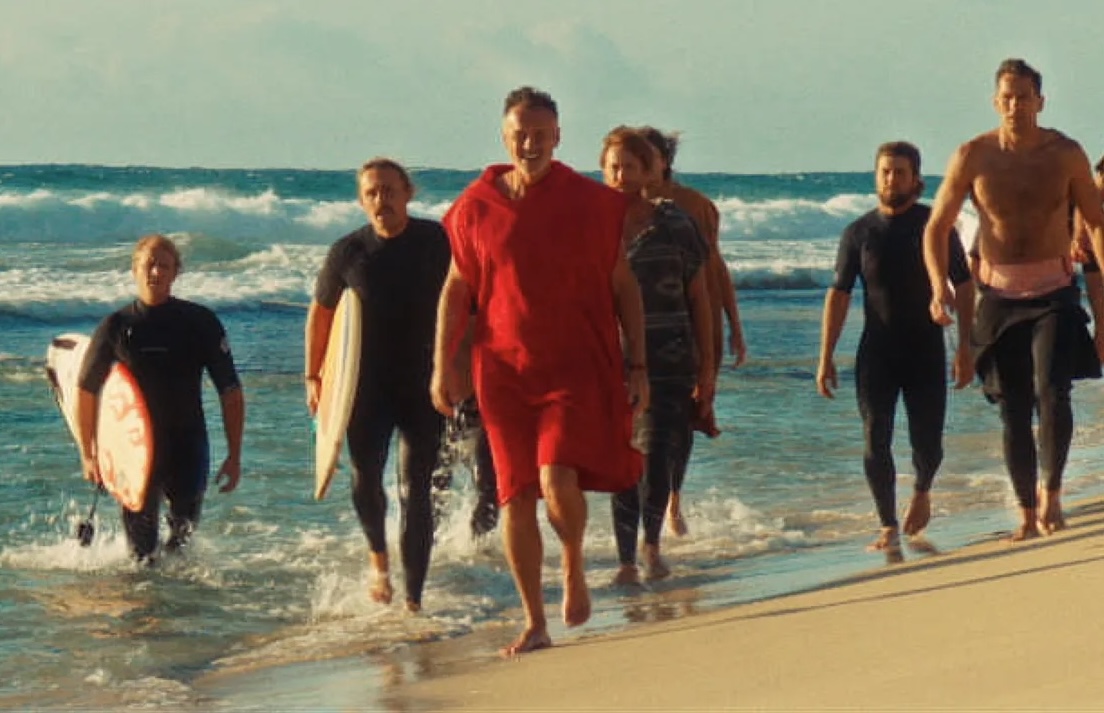
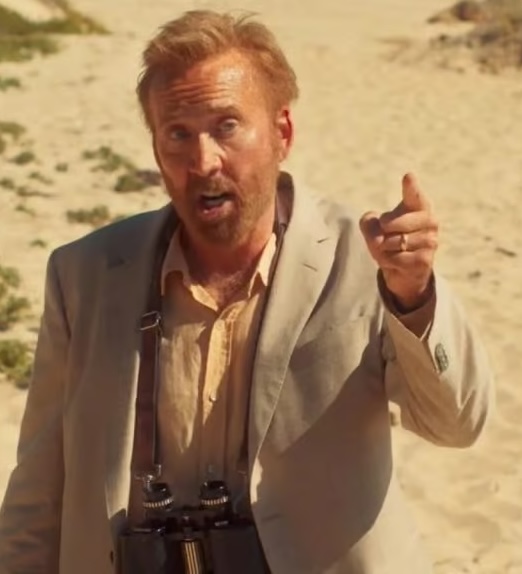
The Surfer, written by Thomas Martin and directed by Lorcan Finnegan, is an Irish-Australian collaboration, filmed on location in beautiful Yallingup. Cinematographer Radek Ladczuk perfectly captures the town’s glorious coastline, all bright blue waves and golden sands shimmering in a sultry heat. However, despite initial appearances, this isn’t a story destined to gladden the hearts of the tourist board Down Under. Instead, it falls firmly into that sub-genre of ‘Unsettling Aussie Small Town’ films – helmed by Wake in Fright and encompassing everything from Picnic at Hanging Rock to The Royal Hotel – and acts as a warning to stay away.

Indeed, the warning here is explicit. As The Surfer (Nicolas Cage) strides confidently towards the water with his son (Finn Little), keen to share his childhood experiences of this particular beach, he is told in no uncertain terms that they’re not welcome: “Don’t live here, don’t surf here.” The Surfer’s protestations that he grew up in the town are met with indifference. “Don’t live here, don’t surf here,” the hostile gang of men repeat. And, in case he’s not quite got the message, “Fuck off.”

But The Surfer has no intention of fucking off. He might have messed up his marriage, his relationship with his son might be rocky, but he’s been successful in his career and he’s here to buy back his grandfather’s old house and start to put things right. The problem is, the locals are a close-knit, powerful bunch, and they’re determined to make him leave…

If this all sounds pretty straightforward, don’t be fooled. The Surfer is a head-scramble of a film: as twisty and impenetrable as an overgrown maze; a hallucinatory experience where nothing is as it seems. Is The Bum (Nicholas Cassim) real? Is he The Surfer? Is he both – a literal and metaphorical double, like Bertha Rochester or Frankenstein’s monster? There are also some gruesome, gnarly moments, and viewers with an aversion to rats should be prepared to look away.

As The Surfer becomes increasingly untethered, spiralling into an chimerical world of sleep deprivation, dehydration and sun exposure, his point of view becomes ever less reliable, and we’re as lost as he is, unsure what’s true and what is not. But in amongst the madness, he clings to one thing: securing the deal on the house. If he can just get through to his broker, everything will be okay…

Under Finnegan’s direction, The Surfer is a taut, disturbing psychological horror, the tension never letting up. Scally(Julian McMahon) makes a compelling villain, his Andrew-Tate-ish brand of toxic masculinity both revolting and convincingly irresistible, and I’m on the edge of my seat throughout, hoping for his comeuppance. But this is Cage’s film and he really owns it, dragging us with him into The Surfer’s personal hell.

In short, The Surfer is an excellent film. Just not a great advert for Oz.

4.1 stars

Susan Singfield
The Royal Hotel / Hotel Coolgardie

04/11/23

Cineworld, Edinburgh / Amazon Prime

We watch The Royal Hotel in the cinema. It’s fascinating. We know it’s based on a documentary, but how much of it is true? We head straight home and seek out Hotel Coolgardie.

Wow.

Hotel Coolgardie centres on two Finnish backpackers, Lina and Steph. When their wallets are stolen in Perth, they need to work to earn some money. An agency finds them a job serving drinks in a remote mining town. “You have to be able to cope with male attention,” they are warned. They don’t seem to notice the flashing red light. (Or perhaps they just feel reassured by the mitigating presence of a filmmaker.)

The pub is run by an odious landlord, who proudly informs the agency that it’s okay if the girls are inexperienced so long as they’re good-looking, and then takes great delight in bellowing at them when they arrive, belittling them for not understanding the local dialect and for not instinctively grasping the idiosyncrasies of his business. His clientele are heavy drinkers, and lewd behaviour is encouraged. “My customers grow an extra leg when new girls come into town,” he leers, as he puts out a sign announcing their arrival. In the bar, the men discuss who’ll be the first to ‘bag’ one of them. They know they’re being filmed; clearly, they don’t think they’re doing anything wrong.

Pete Gleeson’s documentary serves as a salutary lesson: when sexism and xenophobia are normalised, they thrive, especially within an isolated community. Coolgardie is not a safe place for Lina and Steph and, because they’re not willing to play along with the roles they’ve been assigned, they’re mocked and resented by the locals.

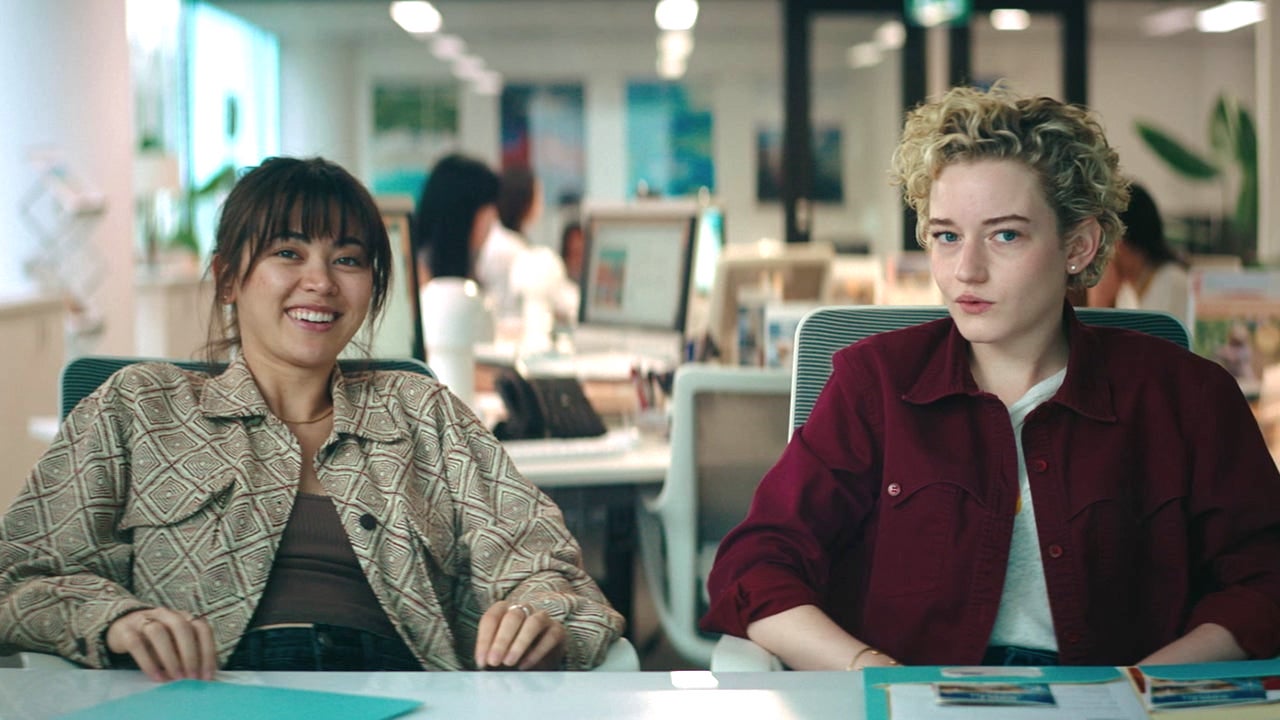
Writer-director Kitty Green seizes on the horror elements of this real-life set-up, highlighting the remoteness of the location as Canadian backpacking duo Hanna (Julia Garner) and Liv (Jessica Henwick) make their arduous bus journey through the empty desert. The Royal Hotel is dirtier and dingier than its counterpart; its customers nastier and more deliberate. The score, by Jed Palmer, ramps up the disquietude, and tension mounts as first Liv begins to assimilate, and then their only ally, Carol (Ursula Yovich), departs, leaving Hanna to face her adversaries alone.

Somehow, Green’s amplification makes the story less menacing. Gleeson’s documentary shows a more nuanced view of the community: we see the men’s vulnerability as well as their defensiveness, the insecurities that fuel their misogyny. This doesn’t excuse them or diminish their threat; in fact, it makes them more frightening because, unlike the cartoonish bad guys in Green’s film, they’re all-too recognisable. In the Royal Hotel, the men are uniformly terrifying; in the Hotel Coolgardie, there is a scale. “Canman” John Joseph Lowe, for example, has a genuinely sweet side. Sure, he’s a rambling drunk who demands too much of the girls’ attention and creeps them out by showering them with unwanted gifts, but he also looks out for them, drives them where they want to go and truly wants to help. On the other hand, “Pikey” – reincarnated in The Royal Hotel as Dolly (Daniel Henshall) – is a terrifying man, spewing hatred towards all women because no one wants to sleep with him. “It’s because I haven’t got a driving licence,” he says. “That’s not the reason,” Lina tells him. Henshall’s Dolly is horrible, but nothing he does is as scary as Pikey’s quiet, all-consuming rage.

What’s more, while Hotel Coolgardie‘s bogeyman is sexism, The Royal Hotel‘s seems to be Australia. The difference is subtly drawn, but it’s there. In the documentary, we see the magnification of a bigoted culture, flourishing in this particular spot thanks to an enabling landlord. In the movie, the implication is that Canada is somehow different, that the problem is specifically Australian working-class men.

Still, I wish that Gleeson had acknowledged his presence in Hotel Coolgardie; there’s something disingenuous in the way the film suggests the women are in real danger, when we know that he’s always there with them, filming everything, reducing their risk. But I still prefer it to Green’s film, which undermines the truth of Hanna and Liv’s situation by allowing them to ‘win’. The coda at the end of The Royal Hotel is far more chilling.

It makes sense to view these two films as a pair. My dearest hope is that the job agency stops sending young women out to places like Coolgardie. It’s not enough to warn them that they have to be okay with male attention. They need to warn the landlords instead: our clients have human and employment rights.

The Royal Hotel3.4 stars

Hotel Coolgardie – 4 stars

Susan Singfield