Steven Soderbergh

Black Bag

15/03/25

Cineworld, Edinburgh

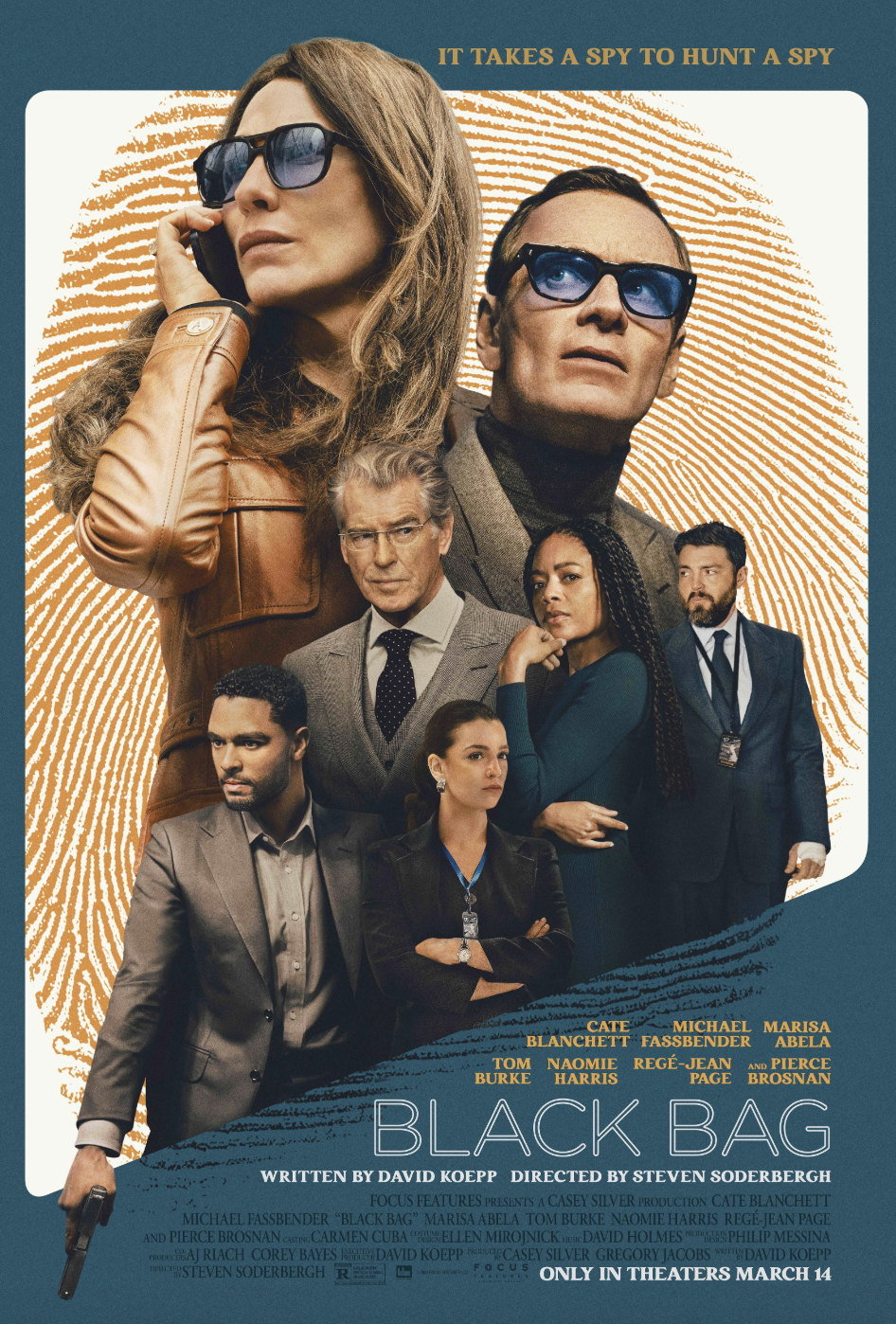
Meanwhile, back in the most unconvincing retirement since Frank Sinatra announced his ‘final’ tour, Steven Soderbergh has a new film. (We reviewed his previous effort, Presence, in January.) So he’s more productive than most of his peers and, if it sometimes feels as though he’s simply ticking some boxes here – “Ooh, I haven’t done a proper spy movie before!” – Black Bag is yet another notch on his belt, even if it seems like his latest opus is a little too understated for comfort.

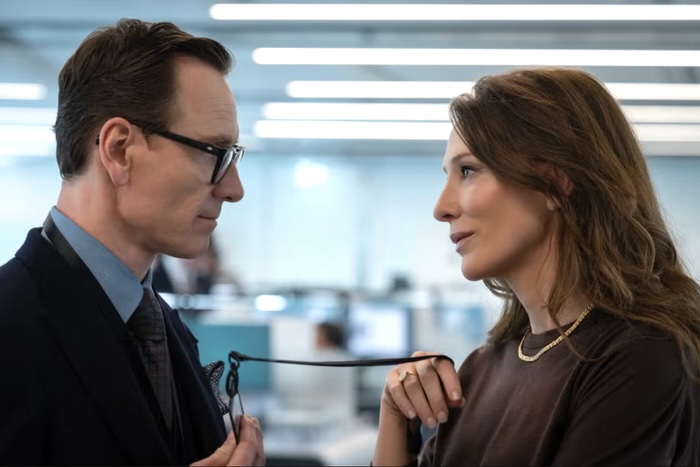
British intelligence officer George Woodhouse (Michael Fassbender) is contacted by his superior, ‘Meachum’ (Gustaf Skarsgaard), to investigate the leak of a top-secret software programme called ‘Severus.’ (It might just as readily have been named ‘McGuffin.) All we really know about Severus is that, if it falls into the wrong hands, thousands of people could die, though exactly how is a matter of conjecture. Meachum warns George that amongst the suspects is Woodhouse’s wife and fellow-operative, Kathryn (Cate Blanchett), who – George has to reluctantly admit to himself – has been behaving rather suspiciously of late. But he trusts her implicitly… doesn’t he? Meachum gives George a week to find out who is responsible but, shortly afterwards, Meachum succumbs to an unlikely heart attack and dies.

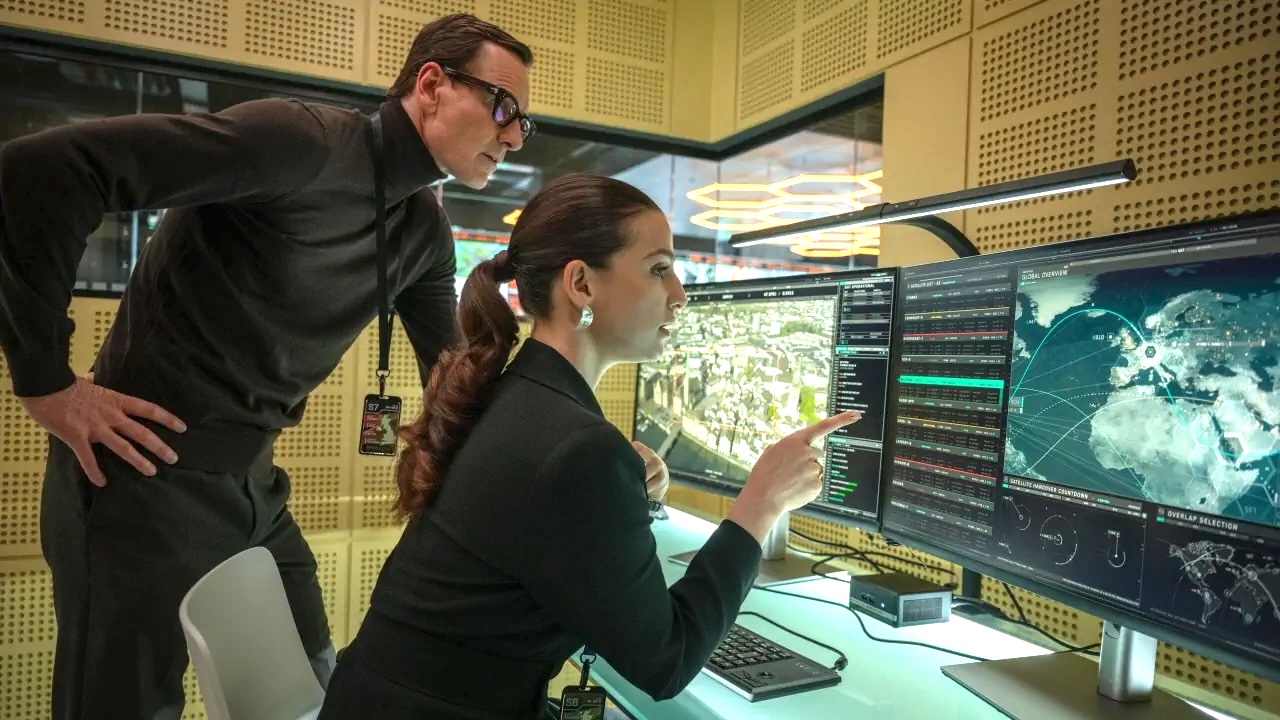
George is a meticulous operative and he promptly invites the four other suspects – all of them fellow spies – to a dinner party at his house, where he spikes a bowl of curry with a truth serum (after first warning Kathryn not to eat any). But who is the most likely candidate for this betrayal? Could it be satellite imagery expert, Clarissa (Marisa Abela)? Her current boyfriend, Freddie (Tom Burke), who is himself having an affair with… somebody? What about the agency psychiatrist, Zoe (Naomi Harris), who is privy to all their secrets? Or her current squeeze, James (Regé Jean Page), a man who is perhaps a little too cool and handsome to be entirely trustworthy?

To add a little extra spice, the agency’s overall boss, Arthur Steiglitz (Pierce Brosnan), would also appear to have some skin in the game…

Black Bag is, I suppose, a slice of cold-war claustrophobia. The title refers to the two-word excuse given by operatives when they don’t want their recent escapades to be investigated too closely. Soderburgh keeps everything bubbling along as David Koepp’s script switches slickly back and forth between the various machinations, and there are some cyber-tech scenes where suspects are investigated by hidden cameras… but there’s a problem here: it’s that I’m simply not invested enough in the characters to care what happens to them. The most interesting scene is the one where the four suspects undergo lie-detector tests and Soderbergh has fun cutting back and forth between their respective POVs, but that’s not really enough to keep me hooked through the entire hour-and-a-half run time.

And the closing scene’s final ‘twist’ doesn’t feel like enough justification for the whole enterprise. So, decent-ish, I guess, but certainly not up there with the director’s finest work.

So, let’s see what he has up his sleeve. It occurs to me that he’s never really done a cannibal holocaust movie. Who knows? It could just happen.

3.2 stars

Philip Caveney

Presence

26/01/25

Cineworld, Edinburgh

Steven Soderbergh’s latest film is Presence, a taut little ghost story told with absolute assurance. Striking a perfect balance between genre tropes and a fresh approach, this is an intelligent and entertaining piece of work, well worth eighty-five minutes of anybody’s time.

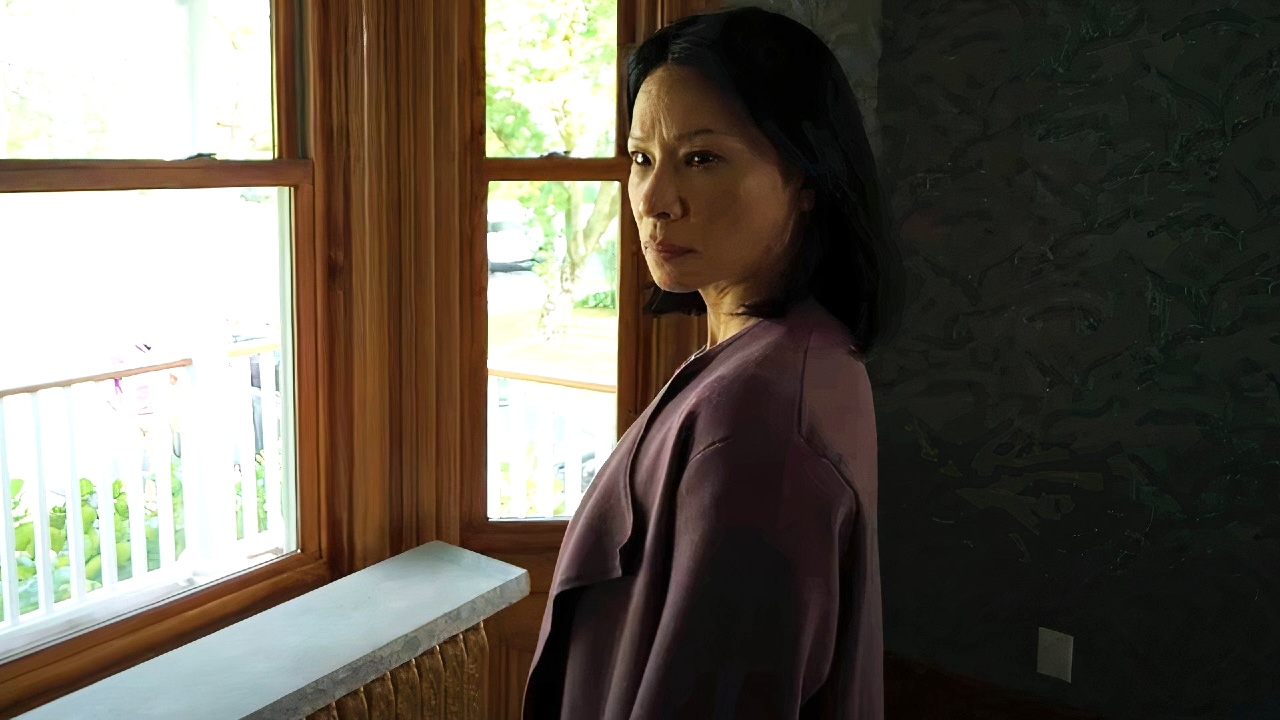
Rebekah (Lucy Liu) is immensely proud of her son, Tyler (Eddy Maday), and determined to maximise his chances of a swimming scholarship, even if it means relocating to a different school district. Her husband, Chris (Chris Sullivan), is unconvinced. After all, it’s only a couple of months since Tyler’s younger sister, Chloe (Callina Liang), lost her best friend to a drug overdose. How will she cope with the upheaval?

But Rebekah is an unstoppable force and so the family duly moves. But Chloe becomes aware that there’s a presence in the new house. Someone – or something – is watching her. Did something bad once happen here?

So far, so predictable – but don’t be fooled. Written by David Koepp, this is a highly original tale with twists and turns aplenty. Its simple surface belies its depths: I find myself thinking about it for hours afterwards, recalling hints and clues that were hiding in plain sight.

Soderbergh’s cinematography sets a claustrophobic tone, as we witness everything from the point of view of the titular presence, peering out from behind the shadows, apparently unable to leave the house. Time sputters forward jerkily: the rooms are empty, then filled with furniture; the walls change colour; trinkets appear; messes are made. The family dynamics are slowly revealed: the cracks in Chris and Rebekah’s marriage; Chloe’s longing for her mom’s attention; the chasm separating Chloe from her jockish brother. Whatever the presence is, it doesn’t seem to want to cause her harm…

Liang might be a relative newcomer, but she more than holds her own in the lead role, creating a compelling and engaging character for the audience to root for. Liu and Sullivan convince as a disaffected couple, while Maday and West Mulholland (as Tyler’s team-mate, Ryan), provide the boyish bantz.

It would be criminal to reveal more here, and so I won’t. Suffice to say that this is a welcome addition to the ghost story cannon. And I look forward to seeing what else the prolific Soderbergh has to offer, in next month’s highly anticipated Black Bag.

4 stars

Susan Singfield

The Laundromat

03/12/20

Netflix

The Panama Papers – the massive exposé of hundreds of shady shell companies, dating back to the 1970s – was revealed in 2016 by a mysterious whistle-blower known only as ‘John Doe.’ It’s a fascinating tale of greed and deceit and one that was inevitably going to find its way onto cinema screens sooner or later. Furthermore, Steven Soderbergh is exactly the kind of director I would have picked to helm such a project. And yet, The Laundromat doesn’t quite work – mostly, I think, because of its scatter-shot approach.

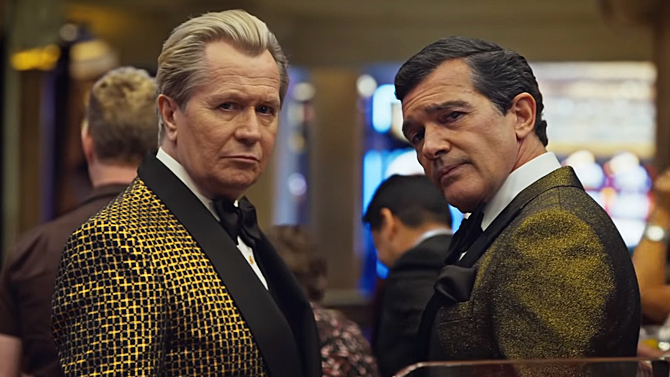
It starts well. We are introduced to Jurgen Mossack (Gary Oldman) and Ramon Fonseca (Antonio Banderas) wandering through a variety of exotic locations as they chat direct to camera, sip cocktails and explain that shell companies aren’t exactly illegal, they are simply ways of ensuring that billionaires won’t have the tiresome burden of paying all those pesky taxes they owe.

No big deal. The way they tell it, it sounds almost reasonable. But it can more succinctly be described in two words. Money laundering.

And then we meet Ellen Martin (Meryl Streep), recently widowed when she and her husband were on a cruise on Lake George and their hire boat capsized. First Ellen learns that the insurance policy she and her hubby took out for the trip won’t pay up because the firm they bought it from has itself been purchased by a shell company known only as ‘Nevis.’ And then her plans to retire to a condo that overlooks the place where she and her husband first met are brutally scuppered when the apartment is purchased – for cash – by a couple of Russian oligarchs.

Understandably miffed, she decides to devote some time to investigating the dealings of Nevis…

So far, so good, but it is at this point that screenwriter Scott Z. Burns takes us on a whistle-stop tour around the globe, to meet other people who, because of the wheelings and dealing of Messrs Mossack and Fonseca, are the nominal owners of shell companies, purportedly worth millions of dollars, but in reality not worth the paper they are printed on. African billionaire Charles (Nonso Anonzie) is attempting to pay off his wife and daughter over an affair he’s been having with a teenage girl, by making them the ‘owners’ of two such companies – and, in China, Madame Gu (Rosalind Chao) will seemingly go to any lengths to protect the reputation of her husband, whose main method of generating income seems to be trading in human organs.

These side-stories whizz past and aren’t investigated deeply enough to make them feel like part of the overall narrative arc. The unfortunate effect is that, by the time we get back to Ellen Martin’s quest, much of the story’s momentum has been lost. The film is by no means terrible, but it is unfocused – and even a late reveal (which I have to admit I didn’t see coming) fails to salvage it.

There’s certainly food for thought here. It’s interesting to note that the victims focused on in these stories are not the poor and impoverished, but middle-class people who’ve failed to realise that they are toiling at the behest of the greedy rich, whose paramount intention is to hang on to every penny they have generated, with no concern for the human wreckage left in their wake. It’s also sobering to learn that Mr Mossack and Mr Fonseca were able to walk away from this debacle with what amounts to little more than slapped wrists. Because, you know, it’s not really illegal…

For a winter evening stuck at home, this provides a decent night’s entertainment, but it certainly won’t figure among Steven Soderbergh’s best films – and there’s surely a more definitive adaptation of the Panama Papers story waiting somewhere in the wings.

3.6 stars

Philip Caveney

Solaris

14/09/19

Lyceum Theatre, Edinburgh

As soon as I see Solaris advertised, I find myself thinking, ‘How the hell are they going to make this work onstage?’ Most of us familiar with the title will know it from the infamous Andrei Tarkovsky film of 1972. Rather fewer of us will have seen Steven Soderbergh’s 2002 remake, in which a bemused-looking George Clooney wanders listlessly around a space station, haunted by ghosts from his past.

But this version, adapted by David Greig from Stanislaw Lem’s 1961 source novel, sticks closely to the original concept, though it does take the opportunity to gender-swap the lead protagonist.

Psychologist Kris Kelvin (Polly Frame) arrives at a space station orbiting the planet Solaris, which is composed entirely of water. The crew have lost contact with Earth and Kris has been sent to find out what’s going on. She discovers that Sartorius (Jade Ogugua) and Snow (Fode Simbo) seem extremely discombobulated by recent events, which include the death of Kris’s old mentor, Dr Gibarian (Hugo Weaving, appearing courtesy of a series of videos that Gibarian is meant to have recorded before his demise).

It turns out that both Sartorius and Snow are being haunted by key characters from their pasts: alien dopplegangers, created from water, that eerily mimic the originals. Kris too is soon back in contact with Ray (Keegan Joyce), an old flame, who – she knows only too well – drowned years ago… and as she starts to rediscover what she liked about him in the first place, she becomes understandably torn between the strictures of science and her human emotions.

Despite its B movie premise, this production benefits from Hyemi Shin’s extraordinarily accomplished set design. A screen portrays a restless ocean, rising periodically to reveal a stark, roofed set, ingeniously devised so that – in the blink of an eye – it can transform into a different location aboard the space station. The arrival of Ray is at first a source of dark humour but, as the story goes on, it moves into more emotive territory as he begins to question what he actually is and, consequently, his reason for existence.

At the heart of Solaris lurks the grim spectre of loneliness; the story asks how far indivuals are prepared to go in order to ensure that they are loved. Matthew Lutton’s pacy direction keeps everything bubbling along nicely, and I particulary relish the presence of Sartorius’s drowned daughter (Almila Kaplangi/Maya McKee), which gives the events the delicious frisson of a traditional ghost story.

Solaris grips right up to its revelatory conclusion: even habitual sci-fi haters will find plenty to enjoy here.

4.8 stars

Philip Caveney

Unsane

21/03/18

Continuing what must be the most unconvincing retirement in cinematic history, Steven Soderbergh is back once again with this energetic little exploitation movie. Allegedly shot on iPhones, it’s the story of a young woman’s struggle with an obsessive stalker. It’s fast-paced and occasionally gripping, even if the plot line sometimes causes the involuntary raising of eyebrows.

Sawyer Valentini (Claire Foy, a long way from Buckingham Palace), has relocated to Pennsylvania after suffering two years of being terrorised by David Strine (Joshua Leonard), a man who first became infatuated with her when she nursed his dying father. But when she starts spotting a familiar bearded face around the office in which she now works, she starts to wonder if her mind is playing tricks on her. She decides to visit a psychiatrist and, during an apparently informal one-to-one,  confesses that she  sometimes has thoughts of suicide. She is asked to sign some papers, which she does. Before she quite knows what’s happening, she realises she has just committed herself to be an inmate of the Highland Creek Behavioural Centre, a place that specialises in admitting ordinary people and exploiting them until their medical insurance runs out.  Foy handles the slow realisation of her predicament brilliantly and Soderbergh maintains a steadily mounting sense of paranoia throughout, even though the  concept does seem decidedly far-fetched. We are reminded several times that Highland Creek isn’t averse to bending the rules, but really? It’s that easy to find yourself locked up? Gosh, I hope not.

Things rapidly get worse for Sawyer, with the arrival of a hospital orderly who looks and acts exactly like her old adversary, Strines. But is he real… or just a product of Sawyer’s disturbed mind? As the tension racks up, she has only two people she can turn to for help – her estranged mother, Angela (Amy Irving), and fellow inmate, Nate (Jay Pharaoh), a man who may not be exactly what he seems. Everyone else she speaks to treats her like somebody who has, well, lost touch with reality.

To fully enjoy this, you’ll need to be able to suspend your disbelief – and it’s not always easy. It’s well acted and queasily credible at times, but scenes that show Foy running around an apparently deserted building do make me smile at inappropriate moments. What’s happened to all the staff? And how can a hospital orderly exercise such total control over the place in which he works?

Still, it’s nice to have Soderbergh back, even if this doesn’t quite measure up to his finest work. And if this is an example of what can be achieved using an iPhone, then surely we really have entered an age where becoming a film director is as easy as pulling out your mobile – although most of us won’t be able to call on old pal, Matt Damon, to put in a virtually uncredited cameo role as a security expert.

Still, no worries. Pass me that phone. Now… quiet on set, please! And, action!

3.8 stars

Philip Caveney

Logan Lucky

07/09/17

It’s four years since Steven Soderbergh made the shock announcement that he was retiring from filmmaking. Mind you, he hasn’t exactly been putting his feet up with a cup of cocoa. There’s the little matter of directing two seasons of medical TV show, The Knick (under an alias) and his involvement in the upcoming project Mosaic (of which I know very little, other than it’s a ‘branching narrative’) So there’s the distinct impression that he may have returned to the big screen with Logan Lucky for a quieter life.

In a way, he’s returning to familiar territory, as this is a heist movie, a path he’s already worn fairly smooth. But put aside all thoughts of the slick, ultra cool Oceans 11. As one character observes in Rebecca Blunt’s caustic script, this is more like Oceans 7/11 – a tattered, down-at-heel story set in West Virginia. (John Denver on the soundtrack? Naturally.)

Channing Tatum plays Jimmy Logan, a down-on-his luck former sports star, who loses his job as a bulldozer driver because of an old injury which has left him with a permanent limp. Divorced from his wife Bobbie Jo (Katie Holmes) and with a precocious young daughter to care for, he comes up with a desperate scheme to make money, one that he shares with his taciturn one-armed war veteran brother, Clyde (Adam Driver). The two of them will rob the Coca Cola 600 Race in Charlotte, Virginia, a massive sporting event that generates millions of dollars. Clyde decides that he’s ‘in’ but, to carry out the robbery, the brothers will need to enlist the services of infamous explosives expert, Joe Bang (Daniel Craig, as you have never seen him before). Only problem is, Joe is already doing time for other misdemeanours, so the brothers will need to break him out of jail, do the heist and get him back inside without his presence being missed. Complicated? You bet. Impossible? Well, it’s going to take some planning and, of course, this is exactly the kind of premise that Soderbergh loves to play with.

There’s plenty here to enjoy. Tatum and Driver work well together, even if they are the most unlikely film siblings since Arnold Schwarzenegger and Danny DeVito. Riley Keough puts in an appealing performance  as Jimmy’s resourceful sister, Mellie, and both Jack Quaid and Brian Gleeson are brilliant as Joe’s dumb-and-dumber brothers, Fish and Sam, who Joe insists must be brought on board to help expedite the robbery. And Craig really does have a whale of a time as the outlandish explosives expert, addicted to eating hard boiled eggs and able to create explosives from the most innocuous ingredients. Gummy Bears? Who knew?

But not everything in the mix is perfect. I could have done without Seth MacFarlane’s oafish Max Chilblane, sporting an English accent that’s almost as bad as the one employed by Don Cheadle in the Oceans movies. Hilary Swank is mostly wasted in the role of a ruthless investigator trying to nail the perpetrators of ‘the Hillbilly Heist’, given little to do but stand around and glower at people and, in my opinion – at just under two hours – the film is about thirty minutes too long. A leaner, meaner narrative would have helped no end here, but perhaps I’m quibbling. This is a very enjoyable way to spend a couple of hours in the cinema and there’s no doubt that Soderbergh has returned to the movie business with a palpable hit.

What next for him, I wonder? Another ‘retirement?’ More TV? And that branching narrative he keeps mentioning? We’ll just have to wait and see.

4 stars

Philip Caveney