Sofia Coppola

Priscilla

22/12/23

Cameo Cinema, Edinburgh

Priscilla

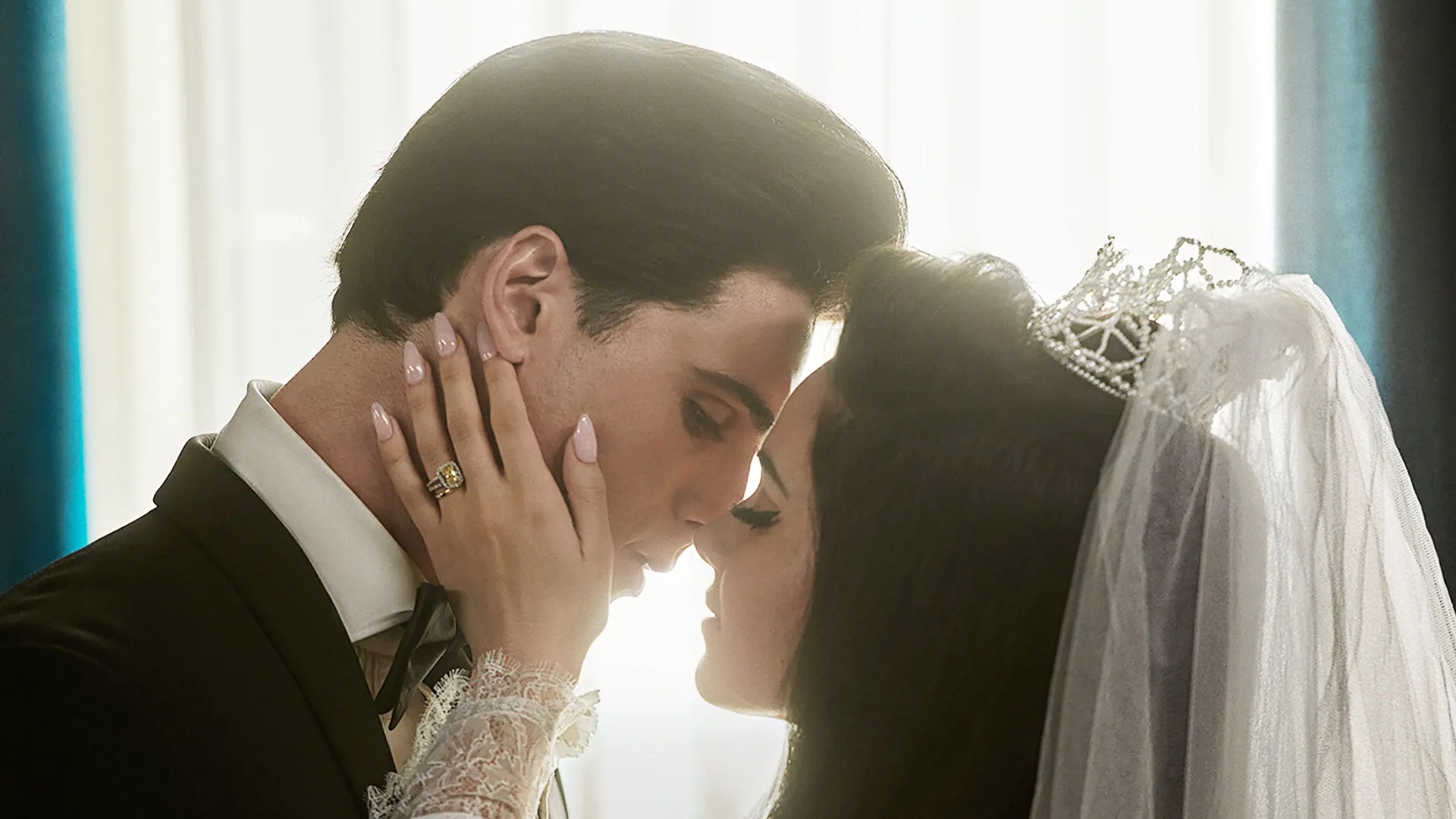
If Baz Luhrmann’s Elvis was a dazzling celebration of the singer’s career, Priscilla offers the polar opposite of that film – a true story with a dark underbelly that, viewed with the gift of hindsight, feels almost shockingly transparent. Presley emerges as a toxic human being, a man who manipulated and exploited a naive fourteen year old girl for his own purposes. 

And before you say, “Well that’s just director Sofia Coppola’s interpretation of what happened,” let me add that her screenplay is closely based on Priscilla Presley’s autobiography, Elvis and Me – and that she was one of the executive producers on the film.

We first meet her as a bored teenager on an Army base in Germany. Cailee Spaaeny submits an impressive performance in the title role, managing to convincingly portray her subject from her early teens to her late twenties. When a young officer approaches Priscilla and casually asks her if she’d like to meet Elvis Presley, of course she says yes! Like most other kids in the late 1950s, she is a big fan. And he is arguably the most famous person on the planet.

So, to the understandable consternation of her parents, Priscilla heads off to Elvis’s house and is soon chatting to the man himself, as played by Jacob Elordi, last seen being quintessentially English in Saltburn, but managing to inhabit Presley’s mumbling, brooding persona with considerable skill. The pair hit it off, big time.

When Elvis is posted back to America, a lengthy interval suggests that he may have forgotten about her but, out of the blue (and again, much to her parent’s understandable concern), she’s summoned to his new home, Graceland, where she’s invited to become a permanent fixture. No sex yet, not until she’s of age, but plenty of smooching and much manipulation from Presley, who coaxes her to change her hair, her makeup and her fashions – to become, in effect, his dream girl.

As Presley grooms Priscilla (and there really isn’t a more appropriate term for what he’s doing), so her own identity becomes increasingly erased – and who knows where it’s all going to end?

Coppola’s accomplished film is handsomely mounted, the period detail convincingly evoked over the changing decades and it’s interesting to note how cinematographer Phillippe Le Sourd keeps everything murky and claustrophobic in the film’s early stretches, mirroring young Priscilla’s view of the world she’s obliged to exist in. Le Sourd returns to the gloom in the film’s later scenes, as Presley slips inexorably into addiction to prescription drugs. In between, the screen sizzles and pops as the odd twosome actually begin to enjoy the advantages of being a couple.

Weirdly, I knew about their story from my own childhood. My sister was a member of Presley’s fan club and received a monthly magazine. In the early sixties, I read repeatedly about the man’s developing relationship with Priscilla. Of course, back then, I wasn’t mature enough to fully appreciate how profoundly creepy the whole arrangement was. Priscilla’s age was an open secret to the world but, blinded by Presley’s fame, we just kind of accepted it. Shame on us.

This is a fascinating film, one that digs a lot deeper than Lurhman’s (admittedly very enjoyable) biopic, exposing the ugly bumps and warts that lay beneath the shimmering surface of stardom. To say that it’s an eye-opener would be something of an understatement. 

4.3 stars

Philip Caveney

The Beguiled

15/07/17

In The Beguiled, Sofia Coppola’s remake of Don Siegel’s 1971 Clint Eastwood vehicle, received wisdoms are questioned at every turn. For a start, we’re clearly positioned on the women’s side, with their talk of ‘our boys’ at odds with the dastardly Union soldiers and the havoc they wreak (disrupting schooling, stealing chickens, killing brothers – the list is long). It’s easy to forget, while watching, that history is on the Unionists’ side: Colin Farrell’s Corporal McBurney is fighting to end slavery. Even if he is a mercenary, he’s doing the right thing.

But this is history Jane Austen-style: the politics and horrors of the outside world barely penetrate these school walls. Oh, their impact is felt and heard: there is shooting in the distance; the girls can’t go home; soldiers pass by the house or come in to search the place – but the focus is on the interior domestic world of women, ostracised by the fighting, trapped indoors, biding their time.

Miss Martha (Nicole Kidman) is the headmistress; the school is her family home. She clings to a sense of tradition in the face of uncertainty, citing the lineage of everything, even her father’s desk and gun. There might be shells exploding on the horizon, but the gates are locked and the girls must learn their French declensions. Everything is very ordered and proper, and decorum is everything.

Into this world comes the injured Corporal McBurney, as charming and handsome as, well… Colin Farrell. He’s discovered by Amy (Oona  Laurence), one of the younger pupils, on a rare and forbidden foray into the woods. She’s looking for mushrooms, but she finds the wounded and immobile soldier instead, and takes him to the school for her teachers to assess. “I couldn’t just leave him to die,” she says, seeking approval, clearly conflicted. Miss Martha agrees: “The enemy, viewed as an individual, is often not what we expect.” (The same can be said, of course, of these privileged women, whose ‘side’ is that of the oppressor, not the oppressed.) But the act of charity is doomed: the house is a hotbed of repressed sexuality, from Miss Martha’s uptight propriety to Alicia (Elle Fanning)’s burgeoning self-awareness, not to mention Edwina (Kirsten Dunst)’s blushing neediness and the little girls’ barely understood desire for male attention. These are women without men in a patriarchal world: Corporal McBurney offers them the chance to relieve their frustrations. They vie for his affections, and begin to fall apart.

It’s a tense, exciting kind of film, in the same way as The Falling or Picnic at Hanging Rock. It’s slow and sensual, forbidding and unsettling. The claustrophobia is palpable, and it’s clear that something must erupt from this seething undercurrent of repressed passion. The acting is superb, each character utterly and devastatingly believable. There’s a lovely ambiguity too: who’s really in the wrong? Does Miss Martha really have to take the drastic action she does (I can’t say more without revealing far too much), or is she acting to protect the girls and regain control? Is McBurney to blame for looking out for himself, for using what he’s got to keep himself safe? These are all flawed, credible people, acting and reacting to the cards they’ve been dealt, making mistakes and having to live with the results of them. It doesn’t pull many punches, and it’s really very good indeed. Sofia Coppola’s best director award at this year’s Cannes film festival is very well deserved – let’s just hope we don’t have to wait another fifty-six years before another woman gains this accolade.

4.2 stars

Susan Singfield