Scarlett Johansson

Jurassic World Rebirth

17/07/25

Cineworld, Edinburgh

Since its release in 1993, Steven Spielberg’s Jurassic Park has suffered from a bad case of recurring sequelitus – Jurassic Park Parts 2 and 3, Jurassic World and its three increasingly dodgily-titled offspring, not to mention knockoff fodder like Jurassic Shark and Jurassic Whoops I Can’t Think What to Call This. (Okay, so I made the last one up, but you get the idea.)

When this latest instalment was announced, I was initially reluctant to go and see it but, as soon as I heard that it was to be helmed by Gareth Edwards, my interest was piqued. Edwards’ 2023 sci-fi movie The Creator was one of our choices for the best films of that year – a completely original concept and, moreover, a film that looked like it cost millions of dollars more than it actually did. Perhaps inevitably, it fared badly at the box office. This may explain why Edwards decided to throw his hat into the ring for the latest Jurassic spin-off, authored by the franchise’s original writer, David Koepp. Well, it’s sure to have a good storyline, right?

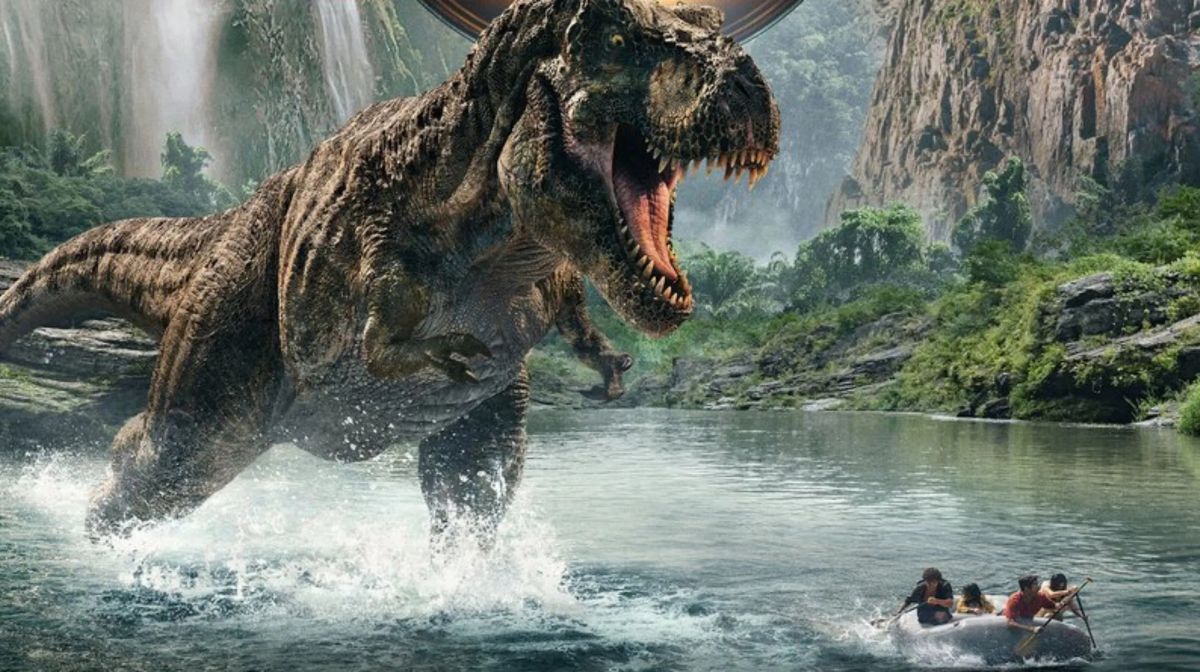
It’s thirty-odd years after the events of the first film and, it seems, dinosaurs have fallen out of favour with the general public. Stegosaurs? Been there, done that. Consequently, dinosaur theme parks are now closing around the world because everyone’s bored with watching tyrannosaurs and allosaurs. Now these mighty critters only exist in remote tropical jungles on the equator, where people are warned never to venture. But shady entrepreneur Martin Krebs (Rupert Friend) still thinks there’s potential gold in them there beasts. He has devised a plan to extract blood from three different types of dinosaur in order to produce a serum that will dramatically reduce the rates of heart disease around the world… yes, really. And the problem is the serum must be extracted while the creatures are still alive. Er… right. As you might guess from his malignant name, Krebs is not just doing this because he’s a nice guy, but because he’s expecting to make big bucks from the pharmaceutical industry.

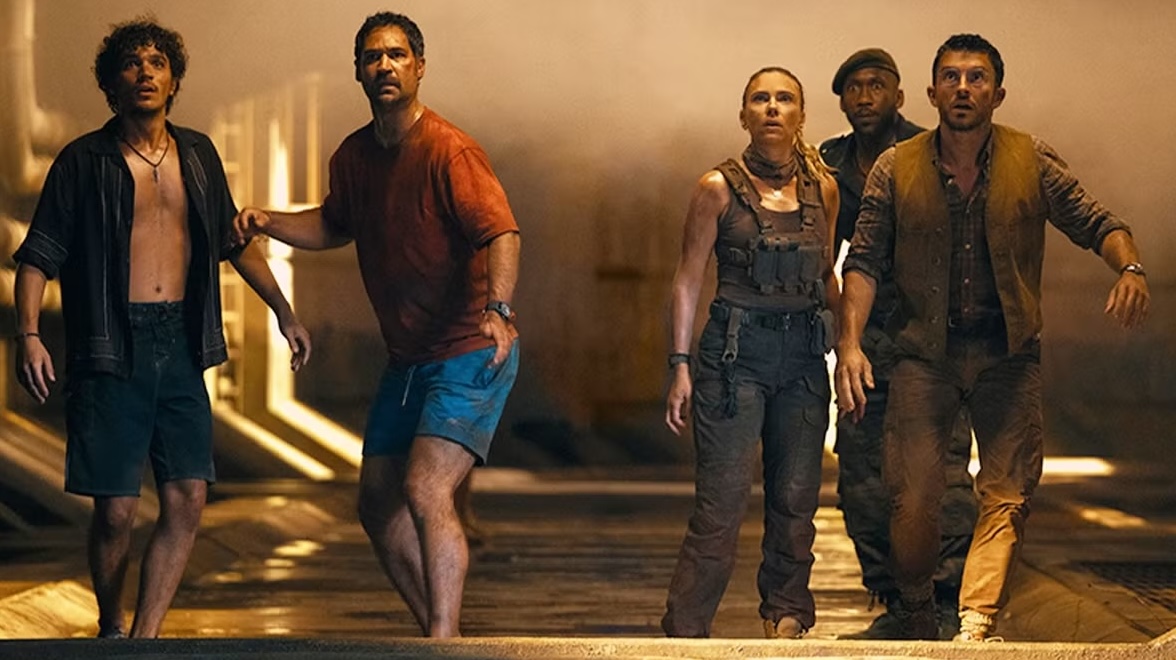
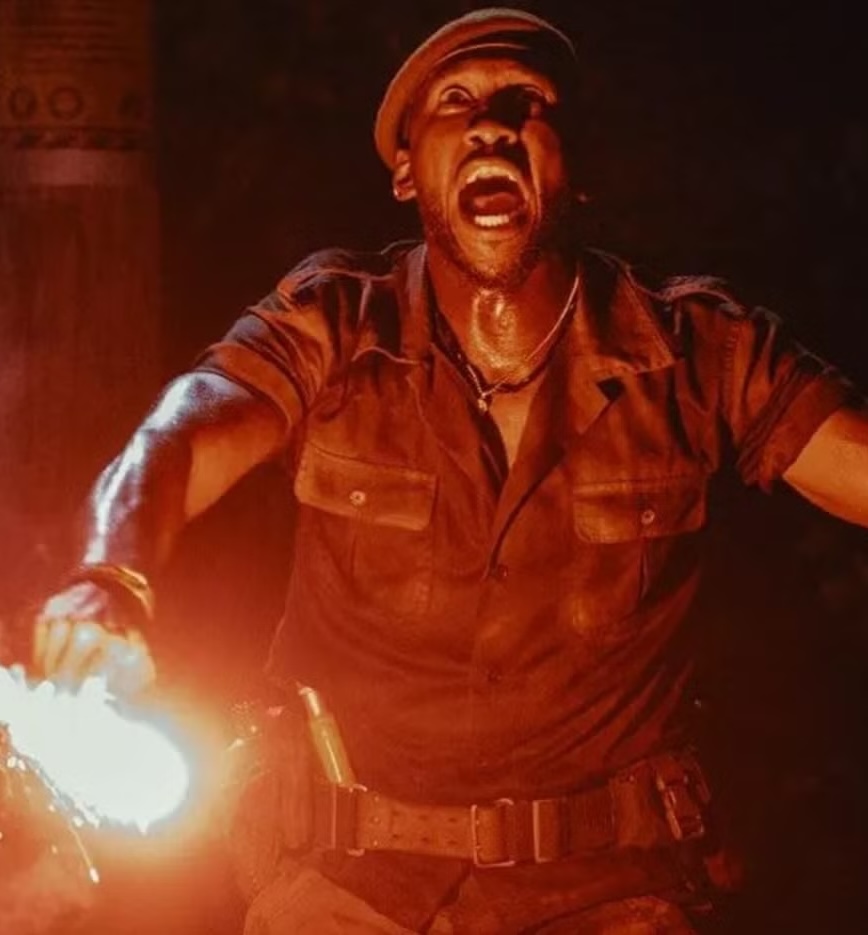
He recruits special operative Zora Bennett (Scarlett Johansson) to head up the operation, ably assisted by her former military chum, Duncan Kincaid (Mahershala Ali). Also in the team is dinosaur expert, Dr Henry Loomis (Jonathan Bailey) – well, you have to have somebody who knows a bit about dinosaurs, don’t you? And there’s a bunch of assistants, who may as well have numbers on their foreheads designating the order in which they will be turned into dino-dinner. The motley crew set sail for a remote island that’s home to the three species they’re looking for.

On the way there, they rescue a party of four Mexican holidaymakers, out for an ill-advised leisure cruise through reptile-infested waters, their reasoning being that, well, there’s hardly any amphibious dinos left, so what are the chances of being attacked? One of the crew is a cute little girl called Isabella (Audrina Miranda) because, of course, there has to be a wide-eyed youngster for the audience to care about.

To give Edwards his due, there are three genuinely exciting set pieces here that actually have me on the edge of my seat as they unfold – for some reason, the water-bound sections are particularly effective. Once again, Edwards manages to bring in the film on a much lower budget than its predecessors, though it’s still in the region of 180 million dollars, which is nobody’s idea of cheap and cheerful.

But the two main problems here are: A – that eyebrow-raising storyline, which seems to revel in making itself increasingly unbelievable as it goes along; and B – the fact that the human characters feel under-developed, somehow less convincing than the CGI beasts that surround them. It’s ironic to see high-calibre actors like Johansson and Ali desperately trying to emote in the midst of all the giant lizard action, but no doubt they were handsomely paid for their efforts, so good luck to them. There are several inevitable visual references to the original film (viewers may as well be issued with a list to tick off). I prefer the delightful little tribute to stop-motion wizard Ray Harryhausen, with a brief clip from The Valley of Gwangi showing on a random TV screen.

If everything were been up to the standard of those mighty set pieces, I’d be much happier with the film, but what do I know? Based upon it’s opening week, it looks as though this is going to make a handsome profit, so inevitably, there are sure to be more titles to follow.

Jurassic World Afterbirth? Hmm. Maybe not.

3. 4 stars

Philip Caveney

The Phoenician Scheme

26/05/25

Cineworld, Edinburgh

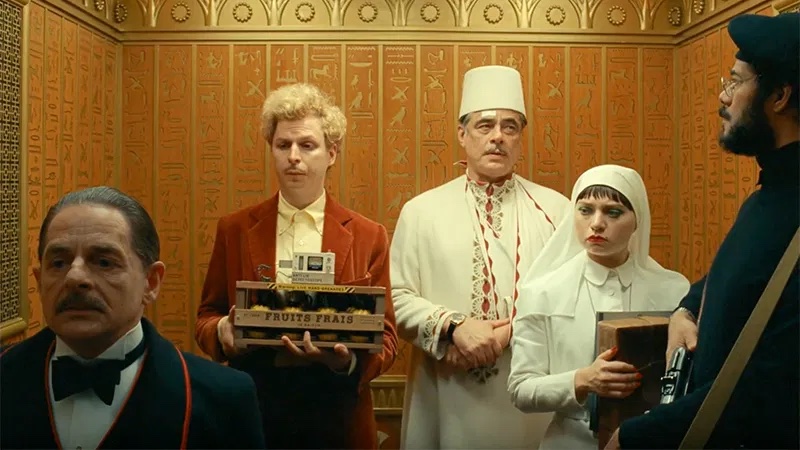
Cinema fans can hardly have failed to notice that a new Wes Anderson movie is on general release. As ever, it features his usual bag of tricks: impeccably-framed images arranged in perfect symmetry on the screen; an extended set of famous faces, all of whom show up for every successive project and seem happy to put in cameo performances for shirt buttons; and, as ever, a plot that appears to have been created simply to redefine the term ‘off-beat.’

Anderson has long been a disciple of Verfremdungseffekt – the distancing technique devised by playwright Bertolt Brecht, employed to prevent an audience from easy identification with his characters. It’s always been there in Anderson’s work to some degree but, this time around, I can’t help feeling that it might have been too enthusiastically applied.

Call me old-fashioned, but I do like a character I can root for. Here, there really isn’t one.

Wealthy and indomitable business magnate Zsa zsa Korda (Benicio del Toro) continues to thrive, despite the many assassination attempts that have been made on him by his rivals. After a near-fatal plane crash, he gets in touch with noviciate nun, Liesl (Mia Threapleton), who may just be his only daughter. (Korda has nine sons, several of them adopted, but he tends to spend as little time with them as possible.) Now, realising that he might be getting close to the end of his life, he has decided to offer Liesl a trial run as the sole heir to his considerable estate. He also takes on a new assistant, Bjørn Lund (Michael Cera), his last sidekick having been blown in half in the aforementioned plane crash.

The threesome must now travel around the fictional country of Phoenicia, where Korda has heavily invested in several major projects. A shadowy cabal of businessmen, led by Mr Excalibur (Rupert Friend), have raised the price of an all-important rivet used in the manufacturing process. This means that, unless Korda can persuade his business associates to take smaller profits, he is at risk of losing everything…

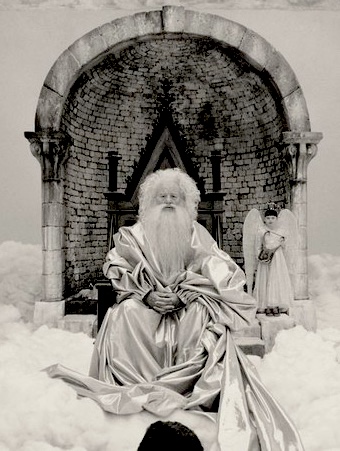
Even as I write this plot outline, I wonder why I’m bothering. Wes Anderson films are like art exhibitions. Some you love, though you cannot exactly pinpoint why. And others leave you flat for no easily-discernible reason. I’m not saying that The Phoenician Scheme is without merit. I sit watching it unfold, approving of its incomparable look and style, occasionally chuckling at some absurd lines of dialogue, even spotting the occasional movie reference. That Moroccan style club run by Marseille Bob (Mathieu Amalric), that’s a nod to Casablanca, right? And the black and white dream sequences, where Korda meets up with God (Bill Murray, naturally), are surely a reference to…

But this is pointless. I loved Anderson’s previous release, Asteroid City, which many viewers dismissed as another exercise in style over content. But this time, even I can’t seem to make myself care enough about the many characters I’m presented with. Korda’s growing relationship with Liesl could perhaps have been the hook that pulled me in, but that element feels somewhat under-developed.

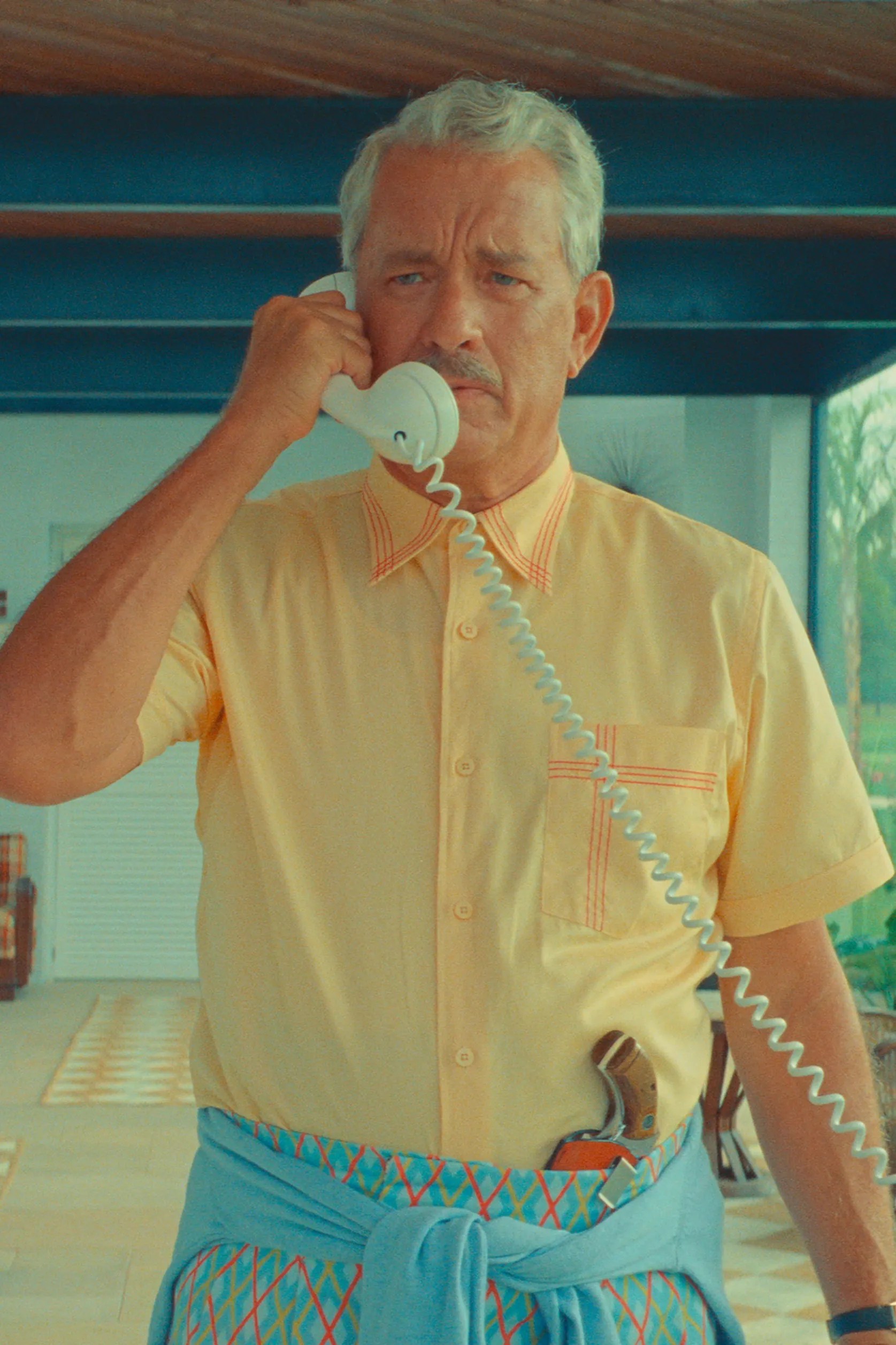
That said, Anderson is one of the few film makers who walks his own path and refuses to compromise his vision. With names like Tom Hanks, Scarlett Johannsson and Benedict Cumberbatch ready and willing to bury their egos in walk-on roles, he’s in the rare position of being free to do exactly as he wishes.

So, why not give this a go? Chances are, you’ll completely disagree with me.

3.6 stars

Philip Caveney

Asteroid City

25/06/23

Cineworld, Edinburgh

If you were ever looking for the film director equivalent of Marmite, Wes Anderson might just be your best bet. His detractors delight in pointing out that he always makes the same film, but that’s a ridiculous over-simplification. While I’d be the first to admit that his films do have an unmistakable look – that you can see one frame, taken at random from any one of his many features, and know instantly that it’s his work – we rarely make that complaint about artists who work with paint and canvas.

Asteroid City has all of the man’s familiar hallmarks: those sumptuous, vividly-coloured landscapes dotted with unlikely looking ramshackle buildings; a massive roster of A listers, all of them prepared to swallow their pride in return for delivering just a line or two of quirky dialogue; and that weird detachment from reality, those bizarre situations seemingly created to point up the artificiality of the whole undertaking. For me, these are the elements that confirm Anderson as a unique and brilliant filmmaker. But then, I’ve been a fan ever since Rushmore in 1998.

The film opens in stark black and white with an earnest narrator (played by Bryan Cranston) talking about the creation of a new play by hotshot writer, Conrad Earp (Edward Norton), and the play’s tortuous path to production – and then we cut to the full-colour, wide-screen film adaptation of the same story. War photographer Augie Steenbeck (Jason Schwartzman) arrives at the titular desert town with his son, Woodrow (Jake Ryan), who is one of five gifted children invited to attend a ceremony where one of them will be presented with a prize for their latest invention.

Woodrow and his three little sisters have some devastating news to deal with first, but their father seems far more interested in the presence of screen actor, Midge Campbell (Scarlett Johansson), who has her own gifted daughter, Dinah (Grace Edwards), in tow. It’s not long before Dinah and Woodrow begin to develop an interest in each other…

But this is about as far as any rational plot outline can take us. From this point, madness ensues in the form of a group of singing cowboys, the aforementioned weird childhood inventions and a WTF alien visitation. And, as the tale enfolds, we are treated to regular visits back to the monochrome world of the original theatrical version, where we see the actors in the film actually being the actors and learning to handle their roles, whilst commenting on the artificiality of the whole experience. Meta? Well yes, but clearly that’s the point.

If this sounds hard to get your head around, don’t despair, because the sparky script by Anderson and Roman Coppola keeps the pot bubbling happily away as the story unfolds. I find myself laughing at the wonderful absurdity of some of the situations – and is the director making a comment on cinema’s general inability to handle theatrical material with any sense of conviction?

It’s heartening to see that a sizeable audience has come out for this on a rainy Sunday afternoon and also to read that Asteroid City has enjoyed a bigger opening weekend than the latest Transformers movie. Perhaps a lot more people out there are acquiring a taste for Marmite.

4.6 stars

Philip Caveney

Black Widow

23/07/21

Cineworld

After the apocalyptic smorgasbord of the Avengers trilogy, Marvel Studios seem to be struggling to find their proper niche in the cinema.

Black Widow has been a conspicuous victim of the lockdown, its release delayed by almost two years. Finally, here it is, gamely attempting to make its presence felt under the restrictions of a 12A certificate, where the excessive violence feels somehow at odds with what the filmmakers are actually allowed to show. This seems an ill-advised move. Cartoon violence is one thing, but Black Widow appears to have all the smashing, bashing and limb-breaking of a more realistic depiction without any of the consequences. Director Cate Shortland has to employ a lot of shakey-cam, so we don’t linger on injury detail. Protagonists emerge from bruising combat with a discreet smear of blood at the corner of the mouth. It’s unconvincing to say the least.

Maybe a 15 certificate would have been a better option?

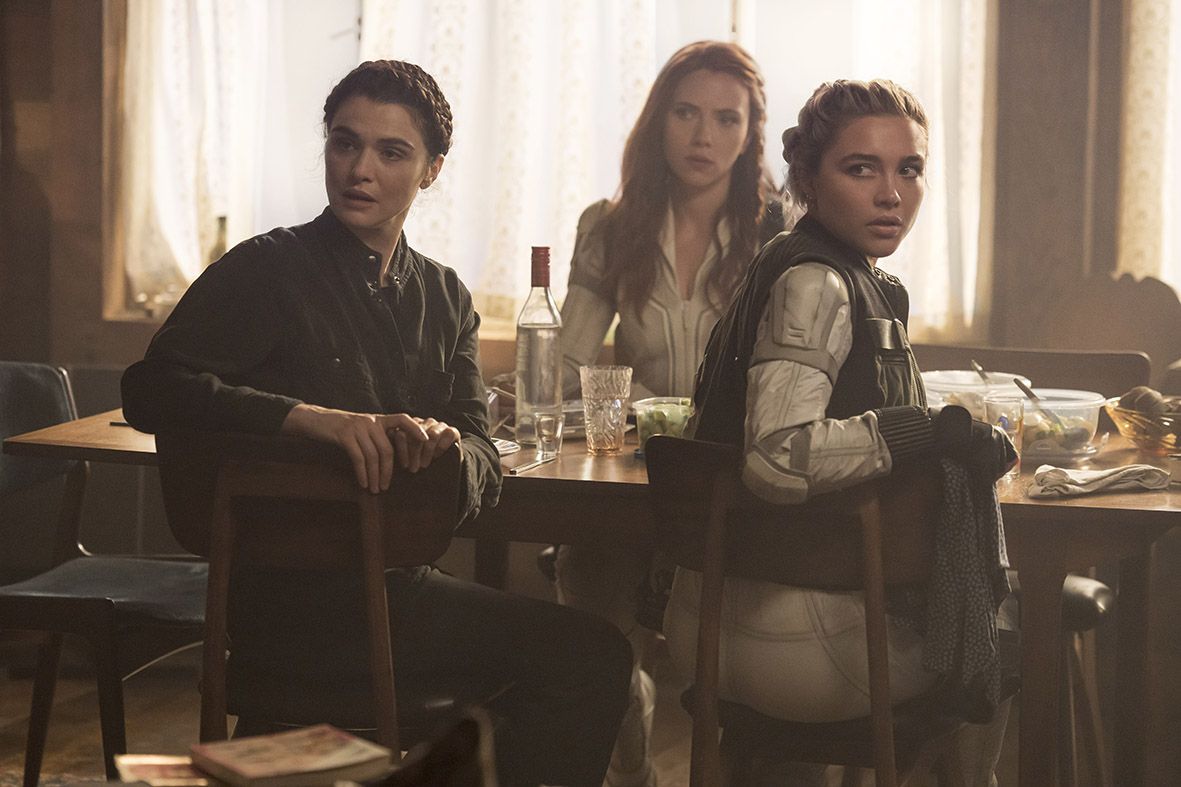
The film is, by necessity, a prequel. It begins in 1995 in Ohio, where Russian super-soldier Alexie Shostakov (David Harbour) and his ‘wife,’ Melina (Rachel Weisz), are posing as a happy family, with their two ‘daughters,’ Natasha and Yelena in tow. But when evil forces close in on them, they are forced into running for their lives. Yelena winds up being a ‘widow,’ a genetically engineered soldier, for the ruthless Dreykov (Ray Winstone), while Natasha defects to the West. She grows up to be an Avenger and, of course, in time, Scarlett Johansson.

In 2016, Natasha finds herself on the run once again, this time from her American employers, and it isn’t long before she reconnects with her sister, Yelena (Florence Pugh). After first attempting to beat the crap out of each other – as you do – they team up and go in search of their ‘parents.’ Alexie’s in a penitentiary and first needs to be sprung, while Melina is hard at work in a remote outpost teaching pigs to stop breathing (that’s not a misprint BTW). Subsequently, the family decide to team up in order to take down Dreykov and what has now become a massive army of widows, all of them turned into mindless servants by the liberal application of er… pheromones.

Much bloodless punching and kicking dutifully ensues – at times, this feels decidedly like Marvel’s take on the Jason Bourne movies, only with added Spandex – before everything culminates in one of those big action set-pieces which takes place aboard Draykov’s sky-station.

The screenwriters make a valiant effort to establish a feminist statement amongst all this Sturm und Drang, but the effect is horribly overdone, the proverbial sledgehammer/nut scenario played out at maximum volume with minimal coherence. While we should definitely be pleased that a mainstream superhero franchise is finally trying to get in step with female empowerment, it needs to be done in a less ham-fisted manner than this. Once again, here’s a clear case of what is essentially an animated comic strip getting ideas above its station.

Johansson and Pugh are both good in their roles – indeed the film’s best moments are rooted in their bickering, competitive sisterhood – while Harbour is assigned the role of comic relief, a blundering Russian oaf addicted to shots of vodka. Overweight and out of practice, he can still put up a decent fight when he needs to. Weisz seems criminally short-changed in her thankless role as mother/scientist/all-round ass-kicker.

Marvel aficionados will know to hang around for the inevitable post-credits sequence, but I feel so underwhelmed by Black Widow, I really can’t be bothered to wait. Another helping? No thanks, I’ll pass.

3 stars

Philip Caveney

Jojo Rabbit

16/12/19

After the massive success of Thor Ragnarok, Taika Waititi could probably have directed any film he fancied. But he decided to stick with Jojo Rabbit, a long-cherished project, based on a novel by Christine Leunens and written for the screen by Waititi himself. Before Thor, no studio wanted to touch ‘a coming of age comedy featuring the Hitler youth,’ and it’s really not difficult to understand why. On paper, it sounds batshit crazy and on the screen, it looks… well, pretty deranged. But mostly in a good way.

Ten-year-old Johannes (Roman Griffith Davis) is doing his best to fit in with the other kids in the local Hitler youth, and he’s helped along by his imaginary friend, Adolf (Taika Waititi), for whom Johannes has an unquestioning adoration. But a bullying incident soon earns Johannes the titular nickname of Jojo Rabbit. Meanwhile, he tries to figure out what’s going on with his secretive mother, Rosie (Scarlett Johansson), who clearly tolerates her son belonging to an organisation she detests, while taking every opportunity to instill in him the kind of worldview that the Nazis would certainly not approve of. And then, a chance discovery up in the attic leads Johannes to Elsa (Thomasin McKenzie), a Jewish girl, whom Rosie has given refuge to. Should he inform his sympathetic troop leader, Captain Klenzendorf (Sam Rockwell)? Or should he try to learn as much as he can about this mysterious creature whom he had been taught to believe is some kind of evil monster?

The film lurches audaciously between moments of slapstick humour and scenes of outright horror. Of course, this is all seen from a ten year old’s perspective, which accounts for the cartoonish feel of the film, but there’s sometimes the impression that characters are being brought on as added comic relief – Stephen Merchant’s chilling turn as a member of the Gestapo is a good case in point, great while he’s on, but then we barely see him again. Rebel Wilson, an actor whose popularity I struggle to understand, has a cameo role as Fräulein Rahm, occasionally dropping in to shout obscenities and burn books. Johanssen is delightful as Rosie, while Johannes’ interraction with his doleful best friend, Yorki (Archie Yates) is one of the film’s strongest suits. I love too that Elsa is depicted not as a victim, but as a strong, resourceful survivor.

It’s also true that, in a world that is increasingly drifting to the right, Jojo Rabbit has an added prescience. Here, the antics of fascists are held up for ridicule. If only what’s happening in the real world right now were anything like as funny.

4.4 stars

Philip Caveney

Marriage Story

09/12/19

Noah Baumbach’s Marriage Story is a tale of unravelling, of thwarted hope and bitter frustration. Here, divorce rewrites the past, reframing a loving relationship as a decade-long battle, impoverishing its players while enriching their lawyers. For the latter, the higher the stakes, the brighter the rewards; any sense of peace or perspective is lost to their big-dollar game.

Based on Baumbach’s own experiences during his 2013 split from actor Jennifer Jason Leigh, this semi-autobiographical movie is told mainly from theatre director Charlie (Adam Driver)’s point of view. His wife, Nicole (Scarlett Johansson), has had enough. He’s cheated on her, and it’s the final straw. She gave up a promising LA film career and relocated to New York to be with him; her fame ensured publicity for his then-fledgling theatre company. Now he’s successful, fêted as the toast of the avant-garde, and he’s stopped paying attention to what she wants.

And what she wants now is a divorce.

Not only that, she’s also moving back to LA, where she’s been offered a part in a TV pilot. Charlie doesn’t rate TV, and he doesn’t think the project will go anywhere, so he doesn’t object when she takes their eight-year old son, Henry (Azhy Robertson), with her. But Nicole has no intention of returning – why would she? – and, when the pilot is given the green light, she employs a lawyer to help her wrangle the details.

Laura Dern plays Nora Fanshaw, a fancy LA divorce lawyer with a tendency to kick off her heels and over-sympathise, a vulture feigning friendship. She’s terrific in the role, all hard-as-nails faux-comforter and, along with the other lawyers in the piece (Ray Liotta and Alan Alda), provides much light relief in what is, at times, a harrowing story. Young Azhy Robertson is a delight too: his Henry is wonderfully truculent, never saying quite what his parents want him to, refusing to perform for either one of them, turning his deadpan eyes away.

But this is Adam Driver’s movie, really. Johansson performs well too, but we see more of Charlie, understand his grief better, and his failings too. He despises LA, and we share his sense of helplessness as he’s forced to semi-relocate there in order to be a dad, while his New York directing career begins to suffer his absence. Despite their privilege, he and Nicole are nearly broken by the process, their plain apartments in clear contrast with their lawyers’ glitzy offices and designer clothes.

It’s genuinely heartbreaking, but rather funny and lovely too. Catch it on Netflix now.

4.2 stars

Susan Singfield