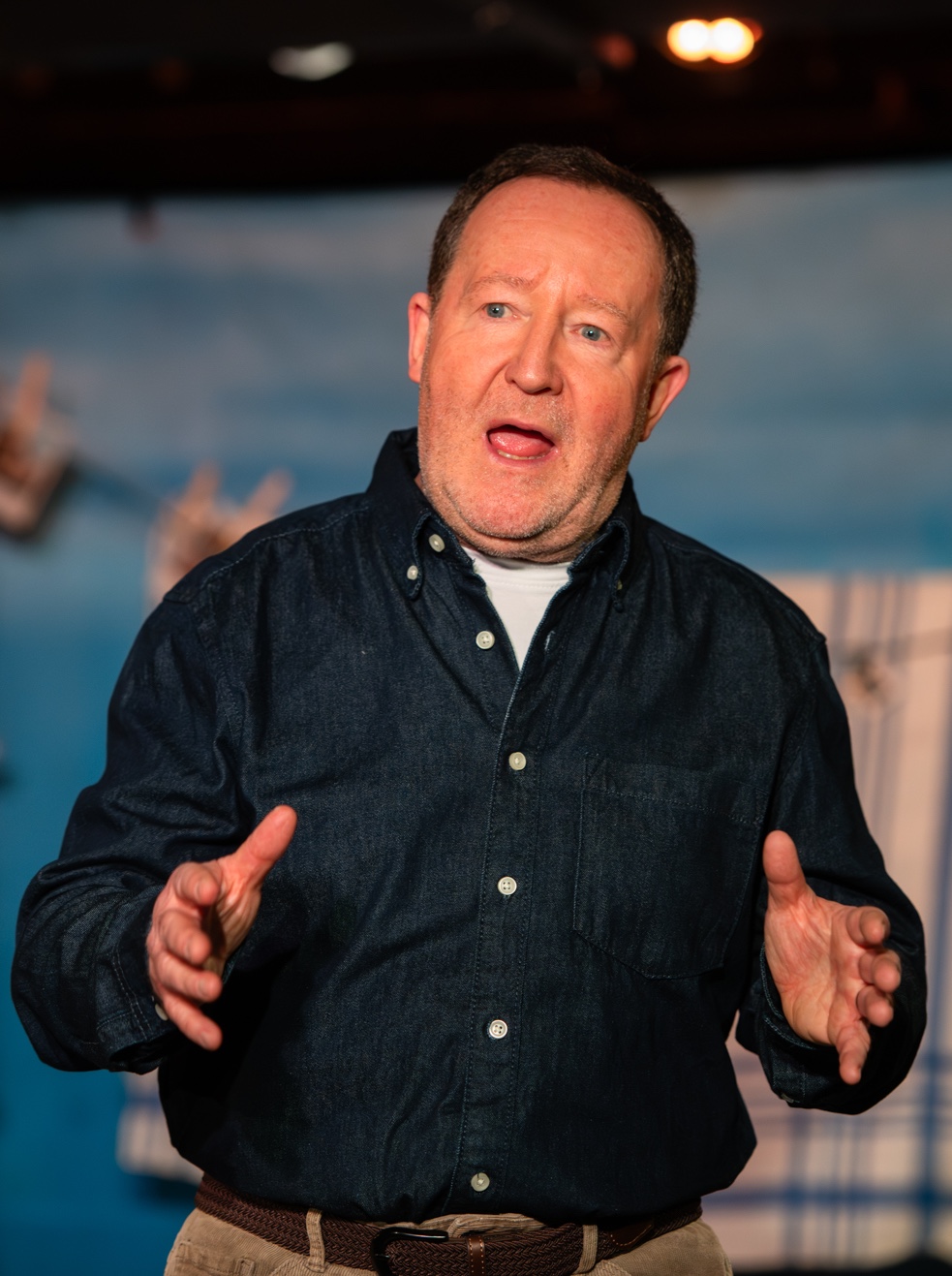
Sally Reid

Shirley Valentine

13/06/24

Lyceum Theatre, Edinburgh

In Edinburgh, the weather is dreich, the rain falling endlessly from grey skies – but in the welcoming environs of the Lyceum Theatre, the sun blazes down onto fine white sand and shimmering Mediterranean waters. It’s here that Shirley Valentine has just experienced a personal revelation. The clitoris really does exist! Who knew?

Willy Russell’s celebrated play gets a welcome revival in this delightful production from Pitlochry Festival Theatre. Many will be familiar with the 1989 film adaptation starring Pauline Collins, where the story is opened out to include the various other characters whom Shirley describes in such hilarious detail, but here it’s presented in its original form – a funny, acerbic monologue in three acts.

We first encounter Shirley (Sally Reid) as she prepares a dinner of “chips ‘n’ egg” for her husband, Joe, and considers the best way to inform him that she has fed the mince he’s expecting to a vegan dog. Meanwhile, she chats to her oldest friend, the wall. In the second act, she’s anxiously preparing to head off on the Greek holiday she has also neglected to tell Joe about.

And, in the final act, she’s there: on an idyllic island, getting to know boat owner, Costas, and coming to terms with a newly-discovered sense of personal freedom.

Of course, the play stands or falls on the strength of its performer and Sally Reid does a fabulous job here, encapsulating Shirley’s strengths and weaknesses, her ability to move from mocking good humour to tragedy in the blink of an eye, the beat of a heart. She also manages to nail a Scouse accent while convincingly frying eggs. No easy matter. And Russell manages that rare thing, a male playwright effortlessly capturing a female personality with what feels like absolute clarity, managing to find the humour in her weary worldview without ever making his subject feel like a caricature.

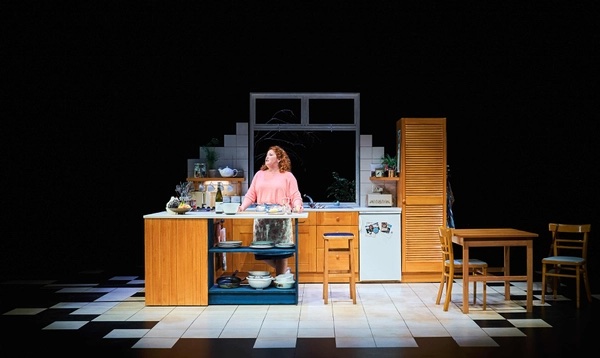
Emily James’ set design mirrors the play beautifully. Shirley’s Liverpool home is solid and brutally realistic, the walls constricting her. The Greek beach, however, comprises sequinned blocks, all shimmery and dreamlike – a mirrorball of possibilities. Director Elizabeth Newman keeps everything nicely nuanced throughout. I’ve seen other productions of the play that amp up the laughs until the bittersweet charm of it is all but swamped, but here is comes through loud and clear. Those looking for the perfect alternative to a disappointing summer need look no further than the stage of the Lyceum, where Shirley Valentine offers a warm and vibrant alternative.

4.6 stars

Philip Caveney

Group Portrait in a Summer Landscape

05/10/23

Lyceum Theatre, Edinburgh

Patriarch Rennie (John Michie) has invited a disparate group of people to his retirement party. He’s had to keep the guest list secret from his wife, Edie (Deirdre Davis), because – with the exception of her old pal, film star Jimmy Moon (Benny Young) – there’s no way she’d agree to hosting the people he has in mind. En route to the couple’s country house in the Scottish Highlands is their daughter Emma’s ex-husband, for example – even though their wedding ended acrimoniously and Charlie (Matthew Trevannion) is renowned for wreaking havoc wherever he goes. Of course, he maximises the antagonism by bringing along his latest girlfriend, Jitka (Nalini Chetty), and why wouldn’t Rennie ask the newly-betrothed Frank (Keith Macpherson) and Kath (Patricia Panther) to join the party? It’s not as if Frank’s always been in love with Emma (Sally Reid) or anything, is it? Oops. There’s an uninvited presence too: the ghost of Rennie and Edie’s son, Will (Robbie Scott), who watches over the day’s proceedings with increasing horror…

Playwright Peter Arnott says he set out to to write a ‘Scottish Chekhov’ and to some extent he has succeeded. At first it seems as though, unlike Chekhov, Arnott is looking back at the political moment that nominally serves as the play’s pivot; he has the advantage of hindsight to create dramatic irony. After all, we know the outcome of the 2014 Scottish independence referendum, the divisive topic inflaming the characters. But we soon learn that this is just a distraction: as Charlie says, it’s mere tinkering around the edges while ignoring the real revolution that is on its way, and which only the rich and ruthless will be able to survive.

If Arnott’s script is retro, then David Greig’s direction is decidedly contemporary, a deliberate jarring of styles that helps to illuminate the sense that something is changing, mirroring the mismatch between parochial politics and apocalyptic predictions, Chekhovian naturalism and magical realism. I like the dissonance.

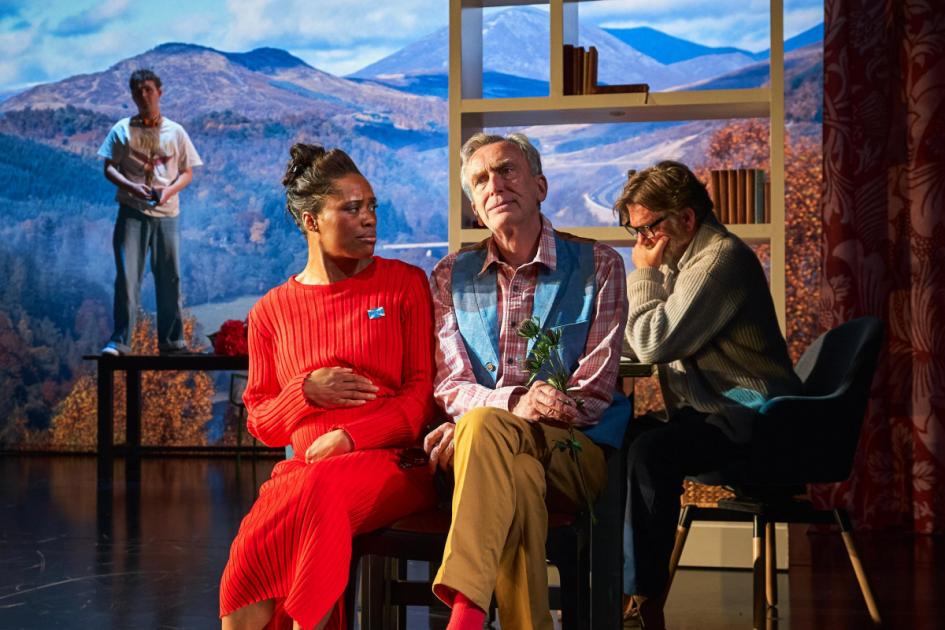
Jessica Worrall’s set also leans into the contrast, a hyper-realistic backdrop juxtaposed with a more figurative interior: a glorious photograph of a Highland glen and a sketched-in kitchen-diner, symbolised by oversized shelving units, enormous tables and vast floral curtains.

Both Simon Wilkinson’s lighting and Pippa Murphy’s sound are integral to the production: the former spotlighting the snippets of conversation that combine to drive the plot, the latter signalling the shifts to the ghost’s point of view, as the sound distorts and fragmented memories play through Will’s Walkman. This supernatural presence is one of my favourite things about the play: Scott physicalises the spirit’s pain and confusion with a beautiful awkwardness.

The first act is very strong, an interesting set-up that promises something the second doesn’t quite deliver. Although the characters are all cleverly depicted, the piece feels somehow unfinished, as if the story arc has been cut short. Rennie’s revelation, when it comes, is anticlimactic, and I don’t quite buy it as a reason for inviting these particular people to his home (why would anyone ever invite Charlie anywhere?). But, even if it’s a little opaque and doesn’t offer any real answers to the issues it grapples with, Group Portrait in a Summer Landscape is an intelligent and ambitious play, leaving us with a lot to think – and talk – about.

3.8 stars

Susan Singfield

Wendy & Peter Pan

30/11/18

Lyceum Theatre, Edinburgh

The story of Peter Pan is a perennial Christmas favourite for family audiences. This clever reworking by Ella Hickson, created for the Royal Shakespeare Company in 2013, is adapted not from JM Barrie’s original play, but from from the extended version he published as a novel in 1911.

As you might deduce from the rearranged title, this is an altogether more feminist version of the story. Instead of being a helpless victim throughout the action, Wendy (Isobel McArthur) is clearly one for taking the initiative and, as it turns out, she’s also a dab hand with a cutlass. She first meets Peter (Ziggy Heath) shortly after the death of her brother, Tom (Keiran Gallagher); a year later, her parents, still unable to regain their equilibrium, appear to be drifting apart. Then Tom reappears and takes Wendy and her two other brothers, John (George Naylor) and Michael (Christian Ortega), off to join the Lost Boys in Neverland…

This rumbustious, sprawling adventure seems to delight in subverting audience expectations. Hook (Gyruri Sarossy) is not the usual sneering fop, but an oafish yob who’s beginning to feel the inexorable advance of old age. His bosun, Smee (Dorian Simpson), is a pernickety, snarky sort of fellow, who also throws a few good dance moves when he’s in the mood. Tink (Sally Reid) is a punky Glaswegian in dark glasses and sparkly leggings who is well versed in caustic remarks. There are sword fights aplenty (one of which I fear goes on a tad too long), a spectacular pirate ship set and, of course, there’s quite a bit of flying, though sometimes this feels a little too careful to be truly magical. I expect that will develop as the performers become more confident with the ropes and harnesses.

Needless to say, the younger members of the audience (at whom this is mostly aimed) have a great time with this, although one little chap in front of us does seem a bit overwhelmed by an unexpected visit from a very large and hungry crocodile; and there’s enough depth here for the big kids in the audience not to feel left out. The most interesting idea is an allegory about bereavement and the need for people to move on with their lives. Perhaps, Hickson seems to be saying, Neverland is something more than just a place for aimless kids to hang out.

At any rate, those with restless youngsters seeking entertainment could do a lot worse than head down to the Lyceum for their yuletide fix. This is sprightly stuff that should keep the whole family thoroughly entertained.

4 stars

Philip Caveney